
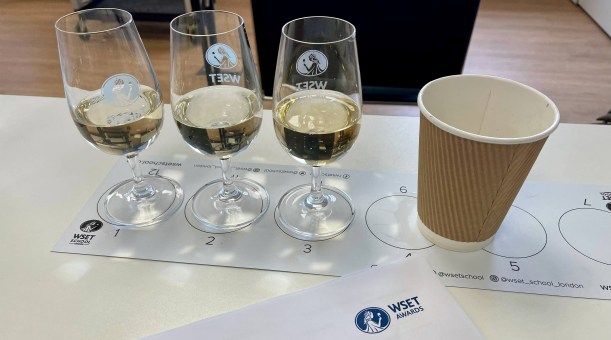
The team at WanderCurtis have studied wine in various different ways some informal and some formal. Self-directed learning is great. You follow your ‘nose’, attend wine dinners (a shameless plug for ours!), visit wineries, talk to wine makers or experts and even read blogs (another plug!). In this way you can get a deeper appreciation of wines and regions you already have an interest in.
However to broaden one’s knowledge and understanding and to embed it solidly, there is no better way than to embark on a formal study programme. The big advantages are having a structure to the learning and having a peer group to learn and practice with.
A good curriculum will fill gaps in your knowledge and give you an oversight of how everything fits together. In the journey of the wine towards your glass you’ll learn what happens, when and where it happens and why.
A course will also give you a framework for tasting. With discipline and practice and the support of a nice group of fellow students you will vastly improve your tasting skills.
The disadvantage of course is having to sit exams (although Adam claims that he has always loved doing them!?).
The WC team has all taken courses with the Wine and Spirit Education Trust (WSET). They offer four levels of course:
WSET Level 1 Award in Wines – This beginner-level course introduces the basics of wine, ideal for wine enthusiasts looking to build confidence in wine selection and hospitality professionals starting their careers. This can be done in a day or a couple of evening classes.
WSET Level 2 Award in Wines – Designed for those with basic wine knowledge, this is an intermediate course exploring major wine regions, grape characteristics, and factors influencing wine styles. If you already have some knowledge and experience you can probably start with this one.
You will begin to learn to taste, evaluate and communicate about a wine using the WSET Structured Approach to Tasting (SAT). Hospitality professionals, wine retailers, and wine enthusiasts take this fun course and it can be done over 9 weekly evening classes.
WSET Level 3 Award in Wines – An advanced qualification covering viticulture, winemaking, and wine evaluation. Students learn to assess wines with greater precision and understand global wine production. This course is taken by sommeliers, wine buyers, and wine professionals but also designed for engaged wine enthusiasts and there is always a good contingent of these in the class. You need to have done level 2 or pass an entrance exam. It can be done as an evening class over 16 weeks. You get to taste great wines whilst learning about their origin and I looked forward to every evening class.
WSET Level 4 Diploma in Wines – This is the flagship WSET course. It is described as an expert-level qualification providing an in-depth understanding of wine production, business, and tasting techniques.
This is where the depth and breadth of one’s wine knowledge is stretched and in my journey through it I have found every aspect fascinating. However the curriculum will take most students to areas of the world of wine that fall outside of the main interests so you have to approach it with the spirit of enquiry.
The course is split into modules; D1 – Wine Production, D2 – Wine Business, D4 – Sparkling Wines, D5 – Fortified Wines and making up 50% of the course D3 – Wines of the World, finally D6 – An independent research assignment.
The diploma examines you in different ways across quite a broad range of skills:
Theory exams require hand written essay answers to questions (yes back to secondary school exam conditions – not ideal when you have let your hand writing turn into an illegible scrawl like mine). These essays test factual recall but also deductive reasoning and critical thinking.
Tasting exams require writing accurate and evaluative tasting notes of wines tasted blind. You also answering questions on grape variety, region or country of origin and what key wine making techniques are evident in the glass.
Finaly the assignment requires research on a given subject. This takes the form of a literature review, then crafting 3000 words summarising and critically reviewing the subject from a production or commercial point of view and then drawing your own conclusions.
It is a serious commitment in terms of both time and course fees delivered in a range of formats over a minimum of a two year period with biannual exams.
Study Notes
The support of study groups has been really helpful in talking the diploma so as I progress through the Diploma I will be sharing some notes and summaries that I’ve made on these pages for anyone studying or just interested in learning.
These notes are absolutely not a substitute for the course books provided by WSET or indeed other excellent reference books such as the Oxford Companion to Wine by Julia Harding and Jancis Robinson.
However I have found it helpful to condense information and present it visually in a way that tries to draw out the what, how and why that links things together or the similarities and contrasts that can help to make sense of everything. These notes are very much prompts to the memory rather than full or detailed explanations.
I will revisit these over time to improve them and iron out the no doubt many inaccuracies and inconsistencies that they contain. However in the meantime please beware there may be errors and if you spot any do let me know.
The notes are free to download are intended for personal use only, all you need to do is sign up to our newsletter then follow the links below.
 WanderCurtis Wine