WanderCurtis Wine

Wine tastings, corporate events, reviews and recommendations


Leave a comment

Bodegas Valdespino’s cellar

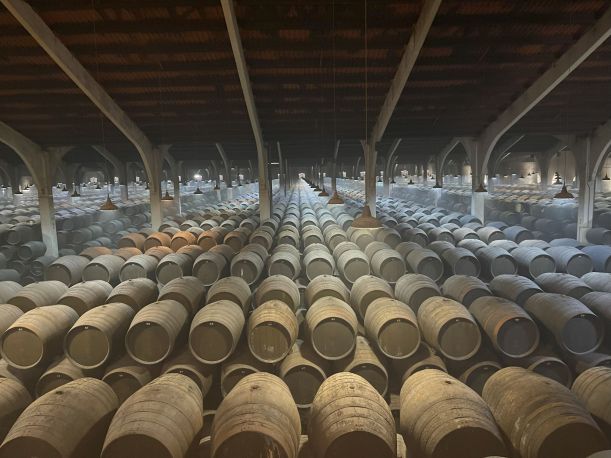
Jerez de la Frontera, so named as the boundary between warring Christians and Moors in the 13th Century is the home of bodegas Valdespino. And just look at this amazing cellar, in the dim light and controlled moisture haze it seems to go on as far as the eye can see!

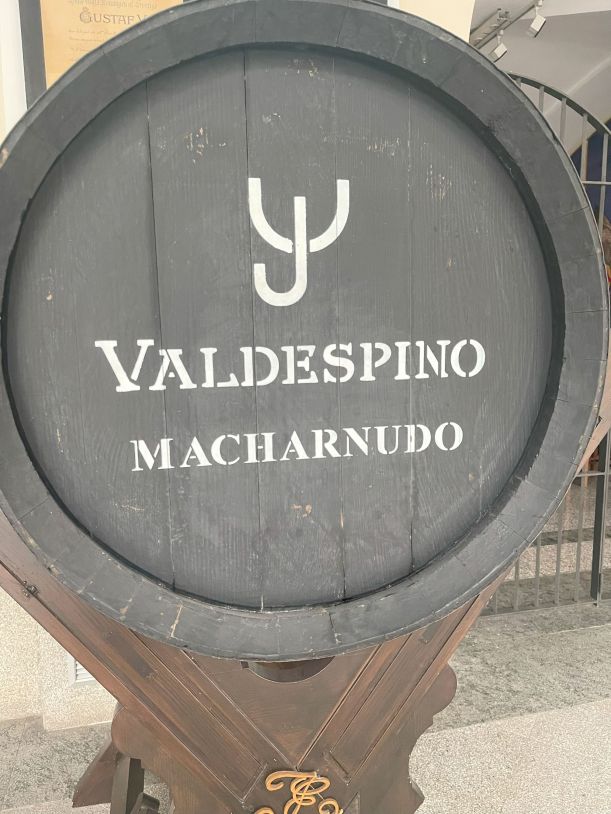
This is where the solera for the excellent Inocente Fino and the Tio Diego Amontillado live. Both contain wine made from the highest point of the Macharnudo Alto single vineyard.

Doors to the west open to allow the cool Poniente breeze in

The best vineyards in the sherry triangle have Albariza soils which are a mix of limestone, silica and clay. These soils absorb moisture in the winter and then form a crust during the dry growing season retaining moisture and slowly releasing it to the vines. The gently sloping vineyards have a series of troughs, called Asperpia, worked into them to catch water and let it soak into the soil.  

The Macharnudo Alto vineyard has a little more elevation than elsewhere and so catches the cooling Poniente breeze from the Atlantic and the albariza soils here contain a particularly high level of limestone both contributing to more concentrated grapes.

In the cellar the solera systems sit side by side each with 10 criadera and the final tier of solera.  The Inocente barrels all contain flor and as with all Finos the resulting wine has been fully matured under a layer of yeast. Wine is removed for bottling from the bottom solera layer, where the wines are oldest, each spring and autumn when the flor is thickest. The wines therefore have an average age of around 10 years. The barrels in the solera are then topped up successively each from the criadera above it until new wine is added to the first set of barrels. The nutrients within the fresh wine added helps to feed the flor yeast and keep it alive.
The first three criadera of the Tio Diego Amontillado solera system have flor and then more spirit is added fortifying the wines up to 17% ABV which kills it off.  The wine matures in the remaining layers of the solera oxidatively resulting in a wine with both yeasty flor character and nutty, caramel type notes and a of course a darker colour. There is more evaporation without the floor and so the abv rises by another few degrees. Wine is only drawn off the solera once a year meaning that the average age of the Tio Diego is more like 17-18 years.

There is one other wine connected with these soleras and that is the Palo Cortado. Every now and then the wine maker recognises that one or two of the barrels ‘want to be’ Palo Cortado. It may be that the flor has died or the barrel displays some extra concentration or individual character.  These barrels are moved over to join the Palo Cortado solera producing Viejo C.P. or even the PC  VOS (Very Old Sherry).

There are 11 layers within these solera systems and there are 70 barrels in each making 770 in total. This sounds like a lot but less than 40% is taken out each year and with an average age of 10 and 17 years respectively it takes a lot of time and space not mention care and attention to make these fantastic wines.  

For tasting notes of the Inocente Fino see wine of the month


Leave a comment

The Maritime Climate

I am sharing notes that I’ve made during my Diploma on these pages for anyone studying a formal WSET course or just interested in learning. 

These notes are absolutely not a substitute for the course books provided by WSET or indeed any other reference books. However I have found it helpful to condense information and present it visually in a way that tries to draw out the what, how and why that links things together or the similarities and contrasts that can help to make sense of everything.  These note are very much prompts to the memory rather than full or detailed explanations.

I am revisiting these notes over time to improve them and iron out the no doubt many inaccuracies and inconsistencies that they contain. However in the meantime please beware there may be errors and if you spot any do let me know.

The notes are free to down load are intended for personal use only all you need to do is sign up to our newsletter.


Leave a comment

The Continental Climate

I am sharing some notes that I’ve made during my Diploma on these pages for anyone studying a formal WSET course or just interested in learning. 

These notes are absolutely not a substitute for the course books provided by WSET or indeed any other reference books. However I have found it helpful to condense information and present it visually in a way that tries to draw out the what, how and why that links things together or the similarities and contrasts that can help to make sense of everything.  These note are very much prompts to the memory rather than full or detailed explanations.

I am revisiting these notes over time to improve them and iron out the no doubt many inaccuracies and inconsistencies that they contain. However in the meantime please beware there may be errors and if you spot any do let me know.

The notes are free to down load are intended for personal use only all you need to do is sign up to our newsletter.


Leave a comment

Flint Wines American Tasting

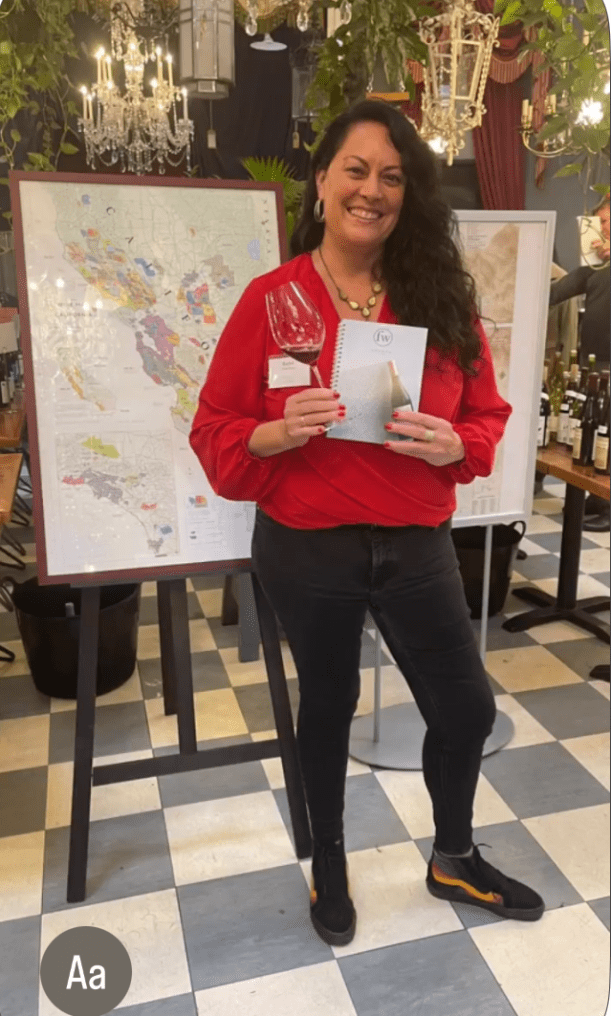
Flint Wines have a comprehensive portfolio of wines from the USA and to support a recent portfolio tasting they have put together an amazing American tasting booklet.  It is packed full of maps, descriptions of each AVA’s character, climate, aspect, soils and detailed winery profiles. 

Quality grapes in California are very much a product of one or more factors in the vineyard that moderate the otherwise warm climate. The cold Pacific sends cooling breezes and overnight fog far inland along the State’s various east west valleys that cut through the coast mountains and of course San Fransico Bay itself.  Also vineyards planted at altitude on these mountain slopes also enjoy cooler nights. 

Grapes as a result ripen more slowly, developing flavour and retaining more acid giving the wine maker lots of good material to work with.  Growers of Pinot Noir, Chardonnay and even Syrah are particularly on the lookout for cool climate pockets.  It was great to be able to visualise all this with aid of these maps.

The tasting was organised by region which allowed you to travel from one AVA to another comparing and contrasting and really see how wine makers are responding to the changing conditions.

Hats off to Rachel Dixon their USA Ambassador, who’s mission to educate about wines of American is certainly working! 

For me standout wineries included:

  • Chanin Wines –  Chardonnays & Pinots from Los Alamos, Santa Maria Valley 
  • Christom Vineyards-  Chardonnays & Pinots  from Willamette Valley, Oregan
  • Tyler Winery  – Chardonnays & Pinots from Santa Rita Hills, California.
  • Snowden Vineyards – Sauvignon Blanc & Cab Sauvignon from Napa Valley, California.


Leave a comment

Wines of Greece Annual Tasting

Greece’s wine story is ancient, its golden age between 500–300 BCE saw Hellenic culture and viticulture spread across the Mediterranean. Wines were often infused with pine resin, herbs or honey, more for preservation than flavour. But centuries of upheaval, from Roman rule to civil wars, meant Greek wine lost ground. Until fairly recently, it was largely defined by Retsina. However, since the 1980s, quality-driven estate bottlings have steadily redefined the landscape. Today, with rising exports and a growing reputation, Greece is quietly producing some seriously characterful and delicious wines.

The country’s geography plays a vital role. A warm Mediterranean climate dominates, though elevation and coastal influences bring vital moderation. Summers can be punishingly hot; Santorini, for example, sees as little as 200mm of annual rainfall. Inland regions swing to harsh winters, while strong island winds can challenge growers.

Greece’s mountainous terrain and low-fertility soils yield naturally limited, quality-focused harvests. Many international varieties are also grown which are still favoured by the domestic market. But around 90% of vineyards are planted with indigenous varieties, some 300 in total, many with real identity and resilience.

Assyrtiko, originally from Santorini, is a flagship white, prized for its tension between ripe fruit and taut acidity. Savatiano and Roditis are widely planted; when grown with care, they offer surprisingly refined expressions. Moschofilero and Malagousia add aromatic flair and freshness.

Among reds, Agiorgitiko is versatile and plush-fruited, while Xinomavro, from Macedonia’s Naoussa PDO, is more structured, with a profile not unlike Barolo.

Increasingly mainstream, Greece is now firmly on the map for thoughtful drinkers seeking something distinct, grounded in tradition, yet confidently modern.

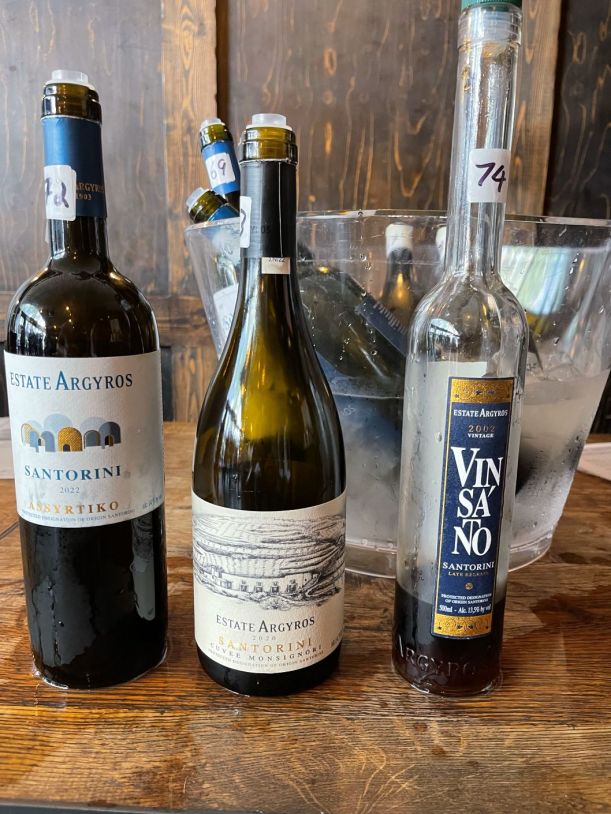
I was delighted to find an old favourite the Argyros Estate Assyrtiko 2020

Made from a blend of vineyards with 100 year old vines, the wine spends 3-4 months on lees. On the nose, stone fruit, sea air and an undertone of herb; tarragon or cut grass. The fruit is ripe, there is cooked lemon with a salty tingling long finish in the mouth. The body is full and acidity bracing. This wine is made for food especially Greek dips, fetta and grilled fish. Delicious.

For my full tasting notes of the Argyros range see Adam’s article on the winery.


Leave a comment

The Growing Environment

I am sharing notes that I’ve made during my Diploma on these pages for anyone studying a formal WSET course or just interested in learning. 

These notes are absolutely not a substitute for the course books provided by WSET or indeed any other reference books. However I have found it helpful to condense information and present it visually in a way that tries to draw out the what, how and why that links things together or the similarities and contrasts that can help to make sense of everything.  These note are very much prompts to the memory rather than full or detailed explanations.

I am revisiting these notes over time to improve them and iron out the no doubt many inaccuracies and inconsistencies that they contain. However in the meantime please beware there may be errors and if you spot any do let me know.

The notes are free to down load are intended for personal use only all you need to do is sign up to our newsletter.


Leave a comment

The vine growing cycle

I am sharing notes that I’ve made during my Diploma on these pages for anyone studying a formal WSET course or just interested in learning. 

These notes are absolutely not a substitute for the course books provided by WSET or indeed any other reference books. However I have found it helpful to condense information and present it visually in a way that tries to draw out the what, how and why that links things together or the similarities and contrasts that can help to make sense of everything.  These note are very much prompts to the memory rather than full or detailed explanations.

I am revisiting these notes over time to improve them and iron out the no doubt many inaccuracies and inconsistencies that they contain. However in the meantime please beware there may be errors and if you spot any do let me know.

The notes are free to down load are intended for personal use only all you need to do is sign up to our newsletter.


Leave a comment

Sparkling Wines Chile and Argentina

A condensed summary of sparkling wines from Chile and Argentina including history,  regions, growing environment, vineyard management, grape varieties, wine making, styles, wine law and business.

Sources include: WSET Diploma Wines of the World, Oxford Wine Companion by Julia Harding and Jancis Robinson, various producer websites.

Note this document is intended for personal use only not for commercial or promotional use. We accept no liability for any omissions or errors that may be contained in the document.

© Kiran Curtis 2023. Personal use only not to be used for commercial or promotional purposes.


Leave a comment

Sparkling Wines Germany

A condensed summary of sparkling wines from Germany including history,  regions, growing environment, vineyard management, grape varieties, wine making, styles, wine law and business.

Sources include: WSET Diploma Wines of the World, Oxford Wine Companion by Julia Harding and Jancis Robinson, various producer websites.

Note this document is intended for personal use only not for commercial or promotional use. We accept no liability for any omissions or errors that may be contained in the document.

© Kiran Curtis 2023. Personal use only not to be used for commercial or promotional purposes.


Leave a comment

Sparkling Wines Italy, Tank Method

A condensed summary of tank method wines from Italy including history,  regions, growing environment, vineyard management, grape varieties, wine making, styles, wine law and business.

Sources include: WSET Diploma Wines of the World, Oxford Wine Companion by Julia Harding and Jancis Robinson, various producer websites.

Note this document is intended for personal use only not for commercial or promotional use. We accept no liability for any omissions or errors that may be contained in the document.

© Kiran Curtis 2023. Personal use only not to be used for commercial or promotional purposes.