WanderCurtis Wine

Wine tastings, corporate events, reviews and recommendations


Leave a comment

Tasting Grenache/Garnacha

Continuing our blind tasting training we recently lined up a number of Grenache / Garnacha based wines from different regions to taste and discover what common characteristics they had and what regional variation there might be.

Grenache Noir:

This is a late-ripening grape variety that thrives in warm, dry climates. Its resilience to drought makes it well-suited to regions with low rainfall, and it is often cultivated as a bush vine on low-fertility, well-drained soils. Known for its high yields, Grenache accumulates sugar quickly, leading to wines with elevated potential alcohol levels, often exceeding 14–15% ABV.

In the glass, Grenache typically produces wines with a pale ruby hue, low acidity, and soft, supple tannins. On the palate, it offers ripe red fruit flavours such as strawberry, raspberry, and red cherry, accompanied by herbal notes of dried thyme and rosemary, along with subtle spicy nuances like white pepper and clove.

Grenache is frequently used in blends, particularly in the Southern Rhône, where it contributes fruitiness, alcohol, and body. It plays a key role in Châteauneuf-du-Pape, alongside Syrah and Mourvèdre. The grape also thrives in Spain (where it is known as Garnacha), especially in Priorat and Campo de Borja. Other prominent regions include Australia’s Barossa Valley and McLaren Vale, and Sardinia (as Cannonau).

Tasting advice:

Nick Jackson describes the tannin of Grenache as having ‘structureless structure’.  This means that you feel tannin all over the cheeks, gums and roof of the mouth.

Tim Gaiser suggests looking out for ripe and cooked fruit, savoury herbs and animal notes in a high alcohol full bodied wine. Thick slow legs in the glass.

So what did we find?

In planning a Grenache tasting we focused on the classic wine regions but favoured examples that are 100%. In some ways this is atypical as the grape is by and large used as a blending partner that traditionally reliably ripens and tolerates a warm mediterranean climate.  On the other hand the examples we chose probably are representative of the current trend to make Grenache in a perfumed, lighter, unoaked style, picked a little earlier for freshness.

What this highlighted was that the addition of the other grapes changes the character of the wine enormously.  The only blend was the Gigondas which was still 80% Grenache but even the small proportion of Syrah and Mourvèdre added significant black fruits, earthy and dried meat notes.

Key findings:

  • The light colour intensity of the pure wines was consistent and even the blend was still fairly light.
  • All the wines had mid-range acidity, pretty full body and alcohol on the way to high.
  • The mid-level tannins were consistently felt all over the inside of the mouth and were ripe.
  • The pure Grenache wines were really quite aromatic, with pretty soft fruit, and consistent a dried herb, sometimes animal note. Including the one new world example from Barossa.
  • In the mouth the fruit character of all the ‘old world’ wines was much less ripe and often quite tart. The finish was always savoury and very dry. Even the Barossa example finished dry and although fruity contained an herbal note.

So the good news is that there do seem to be quite a  few distinguishing features that spread across different regions of origin.

Tasting notes:

Finca L’Argata, Montsant 2016 14%

  • Light ruby towards garnet, slightly dull sheen. Slightly hazy, unfiltered? Medium legs.
  • Very aromatic nose, wild bright red strawberry, wild herbs, oregano, strawberry tart, spice, cherry cola. Very giving.  Floral notes, then dried rose and an orange peel note.
  • Much tarter fruit on the palate than the nose promises. Dry, medium acidity, medium plus body, medium slightly prickly grainy tannins all over the mouth: cheeks, gums, roof of mouth. A biting into a lemon sensation, very tart cherry, underripe strawberry, a cranberry flush of freshness. Savoury and drying finish. Complex  Finish medium.

Contino San Rafael Garnacha, Rioja 2021. 13.5%

  • Mid ruby through to the core. Medium thickness and speed legs.
  • Ripe red and black cherries, raspberry, strawberry chew, dried basil, roasted rosemary, slight animal fir. Toast, and vanilla. Pronounced nose. Much more fruit forward.
  • Dry, medium acid, full body, medium alcohol, medium grainy tannins again all over the mouth, again more savoury in the mouth than the nose, strawberry, orange, dried herbs and a wet stone and very dry finish. Good length.

Le Gril du Mas Cristine 2022, Cotes de Rousillon.13.5%

  • Old vines, no oak aging.
  • Pale ruby to a watery edge, medium thickness and speed of legs.
  • Red cherry, raspberry, ripe fruit, strawberry sweet wine gum, dried wild herbs, touch of rosemary, dried oregano. Interestingly much more perfumed and fruitier in a burgundy glass.
  • Dry, medium acid, med+ body, med alcohol, medium tannin finer grained all over the mouth again. Again more savoury the palate, herbs, wet stone, dry finish which is med +.

Vino de Altura Garnacha. WS Gen Series. El Escoces Volante. 2023. Calatayud. Spain. 13%

  • Old vines. Altitude 750-950 m
  • Darker colour, still medium depth. Red and black cherries, green stems, and herbs, very nicely perfumed and floral.
  • Dry, medium upper end acidity, medium body, medium – tannin all over, tart fruit, orange peel. Medium plus length dry and savoury finish.

Yalumba Bush Vine Grenache. 2019. Barossa Valley, Australia. 14%

  • 100% old vine 35%. Pale but a bit darker and goes closer to the rim. legs bit more viscous and slower.
  • Strawberry, wild strawberry, cranberry, banana fruit salad, dairy, yogurt vanilla, sandalwood, pot puri. Pronounced. More fruit driven than others. The herbal nature manifests as more of animal, and an amaro herb liquor. In the small glass some green pepper corns but in the big glass sweet red fruit.
  • Dry, medium acid, full body, high alcohol, really soft medium powdery tannin all over the mouth. Fruit is sweeter and rounder in the mouth, fruit is the main event, there is an underlying herbal note and the finish is fruity but with a bit of ash and cinders.

Moulin de la Gardette, Gigondas  2020. 14.5%

  • 80% grenache, Mourvèdre and Syrah
  • Much deeper colour. Legs are very slow to form and slow,
  • Cut grass, smoke, grilled meat, wild strawberry, balsamic vinegar, black cherries, ripe black berry, spice, dried herbs, pepper black. Carraway seeds. In the big glass much more fruit dominant and interestingly sweeter on the palate from the big glass.
  • Dry, medium / medium + acid, tart blackberry, ripe black cherry, fruit is a little tarter but not as much as earlier wines. There is an earthy note from the Mourvèdre probably. Tannin is medium grainy and all over, finishes long dry and savoury. Most powerful and concentrated of the wines.


Leave a comment

How easy is it to identify the common characteristics of Rhone wines? Part 1: Whites

Tasting wines with contrasting aromatic and structural qualities side-by-side is a great way of calibrating your palette and improving your tasting skills. But training yourself to recognise the characteristics of a particular grape variety or blend is another matter.  

The excellent Guild Som’ has a series of podcasts on blind tasting. In the episode called ‘Study methods for improving your blind tasting’ they suggest that to really get to know a particular grape variety or regional blend you should line up as many samples and taste them non blind side by side.

Sounds obvious right? But normally when tasting a wine one is focusing on what if anything makes it unique and interesting.  Here one is looking for common characteristics and similarities. By making detailed notes you can then look for any consistent ‘tells’ to help identify the variety. It is still worth looking at the differences to help understand what the range of tolerance for a grape variety is. I guess the process also helps embed a personal taste memory that can be triggered when you come across it again.

So at a recent Big Rhone Tasting by the excellent Yapp Brothers I decided to try this out and see what I could learn.  First the whites here and then the reds will follow.

Part 1: White Rhone

White Southern Rhone

Cotes du Rhone Chateauneuf du Papes. Well these are tricky! So many different grape varieties and combinations and not really enough of a sample on this occasion to make generalisations about. They all had similar structure: medium acidity, full body & highish alcohol and varying levels of viscous mouth feel.

White Northern Rhone – Croze Hermitage, Saint Joseph and Hermitage.

These but can be 100% either.  These wines were also full bodied but were fresher and more structured. The texture was viscous but somehow firmer. Whilst there were floral notes and ripe stone fruit they were in essence savoury and many had a saline note. Use of oak was evident to varying degrees. (Wow the Jean-Loius Chave wines were amazing!)

White Northern Rhone – Condrieu

Made from 100% Viognier these wines all had a lot in common. Although sometimes toasty oak masked the nose there were pretty consistent distinct floral notes of cut flowers and blossom. Interestingly although the level of acidity was only medium the wines managed to have a freshness about them that balanced the full body and oily, viscous texture. (George Vernay really does produce a great range of Viogniers.)

These wines were all fruitier on the nose than the palate where they tended to be more savoury certainly on the finish.

Detailed White Rhone Tasting Notes

Côtes du Rhône Villages Sablet: Domaine Saint Gayan ‘L’Oratory’ 2023 13%

A blend of Viognier, Bourboulenc, Clairette, Roussanne and Grenache Blanc. Very pale watery lemon in colour, ripe apple a floral note peach and some green herbs. Dry with medium acid a viscous elastic quality to the texture, less fruity on the pallet. There are more vegetal and rooty notes and spice on the palate. Medium plus in length.

Lirac: Domaine Maby ‘La Fermade’ Blanc 2023 14.5%

Grenache Blanc (55%) Clairette (25%), Piquepoul (15%) and Ugni Blanc (5%). Very pale watery lemon colour, reflective. White flower, orchard fruit, ripe pear, white peach on the nose. Dry with medium acidity and a full body more creamy texture more citrus and vegetable notes on the palate than the nose a little grip?  Medium plus length.

Châteauneuf du Pape: Le Vieux Donjon Blanc 2023. 14%

Clairette, Roussanne. Super pale lemon colour. Medium plus intensity nose quite tight and a bit closed. Some floral notes, ripe apple and pear and a mineral and saline quality. Dry with medium acid full body definitely high alcohol there’s a thick creamy firm texture and again a savoury dominance to the palate with wet stones and a salty note. There is some grip to the sides of the cheek.

Crozes-Hermitage: Alain Graillot Blanc 2023. 13%

Marsanne with some Roussanne. Pale but slightly more lemon colour. The legs are medium but quite quick. On the nose there is orchard fruit, herbs and spicy notes. It is dry with medium acid and has an elastic viscous mouth feel. Again orchard fruit, some peach, herbs and a touch of brine with a dry long finish.

Saint-Joseph: Jean-Louis Chave Sélection ‘Circa’ Blanc 2023. 13.5%

100% Roussanne. Pale and watery lemon colour with medium legs. Some florality, citrus, pear, peach all ripe in character and definite vanilla and toast notes. It’s dry, savoury with medium acid, full body and has an elastic viscous texture. The finish is spicy and a bit salty with a long toasty note.


Hermitage: Jean-Louis Chave Sélection ‘Blanche’ 2021

100% Marsanne. Again medium lemon colour with a watery rim and medium slow legs. The nose has some floral notes smoke, toast, ripe peach and verging on tropical notes. It is dry with medium plus acid, full body and high alcohol but beautifully balanced. It has a silky viscous mouth feel and a slight salty note.

Hermitage: Domaine Jean-Louis Chave Blanc 2019. 15%.

80% Marsanne and 20% Roussanne. Medium yellow colour with a watery rim, slow and thick legs. Immediately one notices the toast, smoke and oak notes, then ripe peach, some tropical pineapple notes and vanilla. The pallet is dry with medium acid. It’s rich and concentrated, full-bodied and has a thick viscous mouth feel. Super concentrated, obviously high alcohol but well integrated and it’s very long finishing with some nice salty notes.

Condrieu & Viognier


IGP Collines Rhodaniennes: Domaine Georges Vernay ‘Le Pied de Samson’ 2023. 14.5%

So floral: cut flowers in bloom, peach blossom. The wine has thick and slow legs. It’s dry with medium acidity, medium + body, an oily viscous texture, but balanced with enough freshness to carry it through.

Condrieu: Domaine Georges Vernay ‘Les Terrasses de l’Empire’ 2023. 14%.

Pale colour, slow thick legs. Blossom ripe pear and just ripe peach. On the pallet dry medium acidity, full body with an oily, viscous texture but again a balanced lifted quality.

Condrieu: Domaine Georges Vernay ‘Les Chaillées de l’Enfer’ 2023. 12.5%

Honeysuckle peach and some spice on the nose again, pale but with medium legs. It is dry with medium to medium plus acid medium + body with a silky texture. On the pallet one can still taste cut flowers, its fresher with peach and some spice, it has a long finish.

Condrieu: Domaine Georges Vernay ‘Coteau de Vernon’ 2022. 14%

Pale lemon in colour with thick legs. The florality here is more subtle but there are still cut flowers ripe pear, some peach and a little smoke. It is dry with medium to medium acid and an oily, viscous mouth feel. On the pallet one notices the ripe fruit, peach and pear, herbs and also a touch of toast and smoke. Long finish.

Condrieu: ‘La Carthery’ 2019 Chateau Grillet. 15%

Very pale and watery appearance with thick slow legs. Immediately one notices toast spice then some floral notes and peach but added in with green dried herbs and more smoke. On the pallet it is dry with medium to medium plus acid, full body an oily, viscous and elastic texture. This is an intense and concentrated wine with great balance. It finishes on a long smoky peachy note.


Leave a comment

Blind tasting Albariño, Grüner Veltliner and Pinot Grigio

Are there distinctive tells that can help differentiate phenolic whites like Albariño / Alvarinho, Grüner Veltliner and Pinot Grigio? We been tasting to find out, read on to see what we discovered.

In our continuing quest to improve as blind tasters we often listen to the great series of podcasts that the Guild of Sommeliers produce on the subject.

In a recent episode the talk touched on the confusion that Albariño, Grüner Veltliner and Pinot Grigio often cause. They are after all, all phenolic grape varieties and structurally similar in a number of ways. The tasters in the podcast each had a slightly different take on what markers they used to differentiate the varieties, so we thought we’d better line up some samples and see if we could root out some ‘tells’ of our own.

Guild Som’ advised assembling samples that show typicity, tasting them against each other no-blind and writing detailed notes to identify both similarities and differences.

In the Blind Tasting episode hosted by Chris Tange and featuring Chris Lara & Torrey Lewis they talked about noticing the textural differences of the wines and spotting the characteristic earthy – radish aromas in Grüner.  

They also talked about impact compounds which are the chemicals responsible for certain wines having distinct types of aromas.  These include Methoxypyrazine (grass and green pepper), Monoterpenes (floral and citric), Rose-cis oxide (rose) Rotundone (pepperiness), Polyfunctional thiols (tropical fruit and box tree).

Here the panel pointed out that Albariño sometimes has floral ‘monoterpenoid’ notes but never peppery ‘rotundone’ note and vice versa Grüner often has peppery rotundones but not obvious floral monoterpenes.

For completeness we also looked at what two of our other ‘go to’ authorities on blind tasting say about the varieties: 

Tim Gaiser is an MS and author of Message in the Bottle who I think it is fair to say takes an aroma led approach to identification but also emphasises what can be learnt from appearance. Nick Jackson MW, author of Beyond Flavour, in contrast emphasises the structure of the wine.

Pinot Grigio.

Tim Gaiser Pale – med straw, green, possibly rose/ copper colour.Tart apple, pear, floral, lemon , lees, mineral.Tells: Tart fruit, floral and mineral notes.

Nick Jackson Acidity shape is ‘linear and horizontal’ and ‘tingly’.
Albariño

Tim Gaiser Straw – green glintsWhite peach, mandarin orange, blossom, herbs, lees, wet stone. Tells: Viognier nose + Reisling structure.

Nick Jackson ‘Wall to wall acidity’ on entry, disappears then returns.High level of phenolic grip. Salty character.
Grüner  Veltliner

Tim Gaiser Pale to deep yellow with green.Tart green apple/pear, citrus, white pepper (rotundone) herbal veg notes, lentils, mineral. Warmer versions ripe stone fruit.Tells: Herbs, white pepper, lentil.

Nick Jackson ‘Roller coaster acidity’, up down then up again, ‘humming’.‘Savoury flavour profile’

What we tasted

We tasted in sequence six wines:  

  • Forte Alto Pinot Grigio 2023. IGT Dolomiti.
  • Pinot Grigio, Alto Adige DOC St Michael-Eppan
  • Pequenos Rebentos Alvarinho, Moncao e Melgaco. 2023
  • Bar Bun Tin, Albariño. Rias Baixas. 2023.
  • Ebner Ebenauer Grüner Veltliner Poysdorf 2021
  • Wachau Werk Grabenwerkstatt Grüner Veltliner 2021.

Full tasting notes are bellow beware they do include a few odd terms as we searched for ways to describe textural and phenolic characteristics.

We then chose one of each variety to taste directly side by side to compare and contrast:

Forte Alto Pinot Grigio 2023. IGT Dolomiti. 12% Lighter intensity, but a cheaper wine, clean floral, fruity, slightly confected in character. Rose water., A sweeter hit than others with a thin line of medium acid. The texture: fine grained and light. A slight ‘lemon pip’ bitterness on the finish.Pequenos Rebentos Alvarinho, Monção e Melgaço 2023. More colour intensity whilst still pale. More pronounced, salty sea air, cut flowers  (daffodils – monoterpenes?). This floral note is a big difference between it and the Grüner. Lime, apricot. Dry, the acid is still a mouth filling ball, the finish salty and dry. Ripe fruit contrasts with the salty finish. The texture and grip is like fine soft talcum coating the gums and cheeks. Long.Ebner Ebenauer, Poysdorf 2021 (12%) Pale, much less overtly fruity, the defining character is savoury.  Notes of white pepper, radish, spices and earthiness laying over orchard and stone fruit. It is dry. The acid has a big impact and is tart, it does drop away then rematerializes as a horizontal rod laying on your tongue. Again radish earthy spicy notes. The texture is a spicier grippy sensation across gums and cheeks. Not a hint of florallity.

So what did we discover?

There were distinguishing characteristics in the aromatics, the impact compounds, and the shape of the acidity. They all displayed some phenolic grip but wider tasting will be needed to see if there are consistent textural differences.

The Albariños were also floral, displaying monoterpenes but had a distinct salty quality contrasting with the fruit. The acidity was indeed mouth filling in a different way to the others.

The Grüner Veltliners were not at all floral and displayed classic white peppery ‘rotundone’ notes. The acidity was a different shape, like a horizontal rod lying on your tongue and the perception of it dropped away and reappeared. There were savoury notes fitting with the earthy, lentil and radish descriptions.

The Pinot Grigios were floral, displaying monoterpenes. We did feel the acid as a line from front to back of the palate in contrast with the others.

So each of the tasting approaches certainly had something to offer!

Full tasting notes

Forte Alto Pinot Grigio 2023 – IGT Dolomiti (12%)

  • Appearance: Very pale lemon with a green glint. Watery rim.
  • Nose: Medium intensity. Aromas of generic blossom ‘air freshener,’ grapefruit with pith, ripe pear, red apple, and melon. A subtle herbal note.
  • Palate: Dry, with medium+ acidity, medium body, and lower-end medium alcohol. Well-balanced with a medium finish. The texture offers a fine-grained grip on the cheeks and gums. Palate consistent with the nose, showcasing ripe fruit, but with a slightly stronger, bitter green herb note. The acidity is linear and horizontal, creating an electric, voltage-like sensation that reverberates briefly.

Pinot Grigio, Alto Adige DOC – St. Michael-Eppan (13%)

  • Appearance: Very pale lemon with a slight spritz and faint foam – Faulty!
  • Nose: Medium intensity but somewhat muted. Aromas of white flowers, grapefruit, ripe pear, and peach, with a hint of spice and white peppery funkiness. A dusty quality slightly masks the aromas.
  • Palate: Dry, with medium acidity, medium+ body, and medium alcohol. Slightly more grip on the cheeks. The fruit is more pronounced on the palate but still masked by what looks like some secondary fermentation in the bottle.

Pequenos Rebentos Alvarinho, Monção e Melgaço 2023 (13%)

  • Appearance: Slightly richer lemon colour than the Pinot Grigios, but still watery.
  • Nose: Medium+ intensity with ripe pear, lemon, lime, floral, white flowers, and just-ripe nectarine. Hints of baguette, wet stone, and briny rock pool.
  • Palate: Dry, with high acidity, medium+ body, and medium alcohol. Long finish. The acidity is mouth-filling, expanding across the palate with a noticeable salty tang. The texture is reminiscent of a cotton shirt—firm rather than silky—leaving a persistent soft grip on the cheeks and gums, with lingering fruit flavours.

Bar Bun Tin Albariño, Rías Baixas 2023 (12.5%)

  • Appearance: Richer in colour compared to the previous wines.
  • Nose: Intense and pronounced yet compact. Aromas of ripe orchard fruit, apricot, melon, banana, sultana, tinned pineapple, and sea spray. A touch of nutmeg adds complexity, with a focus on ripe, concentrated fruit.
  • Palate: Dry, with high acidity, full body, and medium alcohol. Again mouth-filling acidity which adds to the wine’s length. The palate reveals more ripe fruit, cake spice, and perhaps a hint of mushroom—suggesting possible botrytis influence. Complex and layered. The texture resembles thicker cloth, with a grippy, mouth-coating feel.

Ebner Ebenauer, Poysdorf 2021 (12%)

  • Appearance: Pale and watery, similar to the Pinot Grigios.
  • Nose: Not floral or overly fruity. Aromas of ripe yellow apple, pear, peach, and apricot, with earthy spice notes. Hints of radish, lentils, and a slightly heady distillate note.
  • Palate: Dry, with medium+ acidity that lies horizontally across the palate. Medium intensity, body, and alcohol, with medium+ length. The orchard fruit is tarter than on the nose, with dominant spice and earthy radish flavours. Definite white pepper and savoury notes. Light texture. The acidity initially hits sharply, gradually fades, then reappears more softly, lingering persistently.

Wachau Werk Grabenwerkstatt 2021 (12%)

  • Appearance: Pale, slightly cloudy.
  • Nose: Medium+ intensity. Aromas of grapefruit peel, ripe apple, peach, and melon, overlaid with white pepper, earthy spice, and radish. A crayon-like note adds a savoury character.
  • Palate: Dry, with high acidity that quickly drops off but resurfaces more softly, hovering in the central palate and resonating. Medium- body and medium alcohol. The fruit is tarter on the palate, with more citrus character than on the nose. Predominantly savoury, with a slightly bitter finish. Notes of wet stone and a powdery grip add texture.


Leave a comment

If you like Pinot Noir try Beaujolais Crus

This is a piece of advice that I’ve often been given over the years but have normally been disappointed when taken until recently.

In our last blinders Stuart and I were convinced that a wine Adam had brought was a pinot noir. Not only that but one with concentrated fruit, spice, savoury notes, lifted aromatics and aging potential.  Too savoury probably to be a new world example and perhaps not concentrates enough to be Central Otago so quite possibly a very good village Burgundy.

Well it turned out to the a Morgon Beaujolais Cru!

Situated just south of Burgundy, the Beaujolais wine region is renowned for its Gamay-based wines, offering a range of styles from light and fruity to complex and age-worthy. The region’s climate is semi-continental, with warm summers and cool winters, creating ideal conditions for grape cultivation.

Beaujolais’ landscape is defined by rolling hills and diverse soils, which significantly influence wine quality. The northern part is home to the Beaujolais Crus, where vineyards are planted on granite and schist slopes, producing more structured and complex wines. Notable Crus include Moulin-à-Vent and Morgon, known for their aging potential and Burgundian finesse. In contrast, the southern part of the region is flatter, with more fertile clay-limestone soils. This area produces Beaujolais AOC and Beaujolais-Villages wines, which are typically lighter and designed for early drinking.

Most Beaujolais and Beaujolais-Villages wines are made using semi-carbonic maceration, a technique that enhances the wine’s fruitiness and freshness. Whole grape clusters are placed in tanks, where fermentation begins inside the berries, resulting in wines with bright red fruit aromas, low tannins, and a lively, juicy character but often a slight bubble gum / banana taste.

In contrast, the winemaking approach in for the Crus employs more Burgundian techniques, including traditional fermentation, oak aging, and longer maceration periods. This produces wines with greater complexity, depth, and aging potential. Moulin-à-Vent offers firm tannins and spice, while Morgon is known for its fuller body and earthy character.

Climate change and investment are clearly having an impact on this regions ability to produce outstanding quality wines at compared to its northern neighbour very reasonable prices. For instance check out the Wine Society’s 150th Anniversary Moulin-à-Vent 2019.


Leave a comment

Blind tasting dinner featuring the wines of Marchesi di Grésy

A very nice habit has started to form since our trip to the Barbaresco tavola last year.  Whenever Geoff from Marchesi di Grésy is in town we get together for a dinner and blind tasting.  This weekend our good friend Mehul hosted and it was quite a night to remember.

Among the highlights were three bottles that Geoff brought all from the legendary Martinenga vineyard.

Few sites in Barbaresco carry the quiet weight of history and pedigree quite like Martinenga. A monopole vineyard which is rare in Piedmont and rarer still in Barbaresco, it has belonged to the Cisa Asinari di Grésy family since 1797. Hidden in a natural amphitheatre in the heart of the appellation, Martinenga is one of the key crus that has defined the reputation of the region, on par with the likes of Pajoré and Sorì San Lorenzo.

Marchesi di Grésy approach their craft with restraint and clarity of purpose. Farming across four estates in Langhe and Monferrato, their focus is always the vineyard first. At Martinenga, careful site

selection and a deep respect for Nebbiolo allow them to produce wines that express elegance over power. Vinification is deliberately hands-off, designed not to overshadow what the vines already say, but to draw out the identity of place with quiet precision.

The wines we tasted were:2020 Marchesi di Grésy Barbaresco Martinenga . The estate’s classic Barbaresco.

2017 Marchesi di Grésy Barbaresco Martinenga Gaiun Single-vineyard selection from within Martinenga and is produced only in the best vintages

2018 Marchesi di Grésy Camp Gros Martinenga Riserva. Is the top bottling from a specific east-facing parcel called Camp Gros within Martinenga.

These are stunning wines to rival the best in Barbaresco and will age beautifully over the next decade or two.  Seek them out.

For full tasting notes of  these wine see Stuarts notes from our visit.


Leave a comment

Blind Tasting, an exploration of Bordeaux Varietals. Can you tell Cabernet Sauvignon from Cabernet Franc or Merlot?

Stuart’s challenge this week was blind reds, Bordeaux varietals predominant, a blend but had to be >65% of one of the main current Bordeaux varietals – Cab Sauvignon, Merlot, Cab Franc, Petit Verdot, excluding Malbec, any age and from anywhere.

We would have to draw upon our favourite tome ‘Beyond Flavour’ by Nick Jackson MW and remind ourselves of some key distinguishing features of the varietals.

Cabernet Sauvignon has medium to high levels of fine grained tightly knit tannins, always felt on the gums not the tongue. (Hole in the middle of palate) The sleek tannin structure is linear with a strong sense of direction enhanced by good retention of acidity.

Merlot’s fine grained tannins are also felt on the gums but they are fruit wrapped and can sometimes feel a bit sticky/clayey.

They are so richly fruited that the tannins are often less obtrusive in Merlot than Cabernet Sauvignon. Furthermore the feel of the tannins can lead to a more square sensation rather than the linearity of Cabernet Sauvignon. Also there is no hole in the mid palate as Merlot has such rich ripe fruit concentration. As opposed to Cabernet Sauvignon it can quickly lose its acidity and require acidification.

Cabernet Francs grainy stalky moderate tannins are also felt on the gums. It preserves its acidity well and has savoury red fruits and obvious pyrazines with a strong herbaceous streak.

Carmenere is described as green on green

Malbec has intense colourmay display high ‘lockjaw tannins’ especially at the angle of the jaw, with sweet fruit ending dry.

Petit Verdot is  often perfumed with floral violet notes

The natural woody cedar flavours of the Bordeaux varietals enable them to blend so well with oak maturation also allowing gentle oxidation.

We had initially explored this theme a few months ago (including Malbec) tasting notes  below.

Blind tasting Bordeaux varietals January 2021

Kiran’s wine

Musty, leather, earthy, cedar, perfume, boot polish, menthol.

Complex nose, very fine resolved tannins, powdery, not at angle of jaw, sweetness, black fruit medium + acid Med + Savoury persistent drying tannins. Delicious complex savoury balanced wine

We thought 15 to 20 years old as mainly tertiary notes no particular pyrazines and suggested a Malbec.

2006 Jean-Luc Baldes Clos Triguedina ‘Probus’, Cahors, France 100% Malbec

Adam’s wine

Green pepper, herbs, black currant leaf.

Herbaceous green pointing to S America for Stu re green and herbaceous

Stu getting lockjaw tannins

Marked acidity with our mouth’s still watering.

The greenness and acidity pointed us to Cabernet Franc, though not particularly red fruited.

Cabernet  Franc Valdivieso 2015 chile

Stuart’s

Bell pepper, pyrazines, floral hint of volatile acidity, dried lilies, red fruits  some cassis, woody cedar and savoury.

Lovely balance and  length with complexity resolved tannins horseshoe profile

We felt this must be old world.

Grand Puy Lacoste 2000

75% Cabernet Sauvignon 20% Merlot 5% Petit Verdot

Blind tasting Bordeaux varietals April 19th 2021

Kiran’s wine

Medium to deep garnet clearly showing some age, on the nose  Kiran detected baked plums and milk chocolate , Stu – Spices plum compote possible strawberry.

Adam got more spiced wood  cedar also an oxidative nose, finishes a little Savoury/salty no pyrazine of note

On the palate soft resolved tannins very fine powdery dusty gum tannins mainly, medium plus acidity.

We were pretty certain this was a Merlot dominant right bank Bordeaux of probably premier cru level St Emillion of about 15 to 20 years old

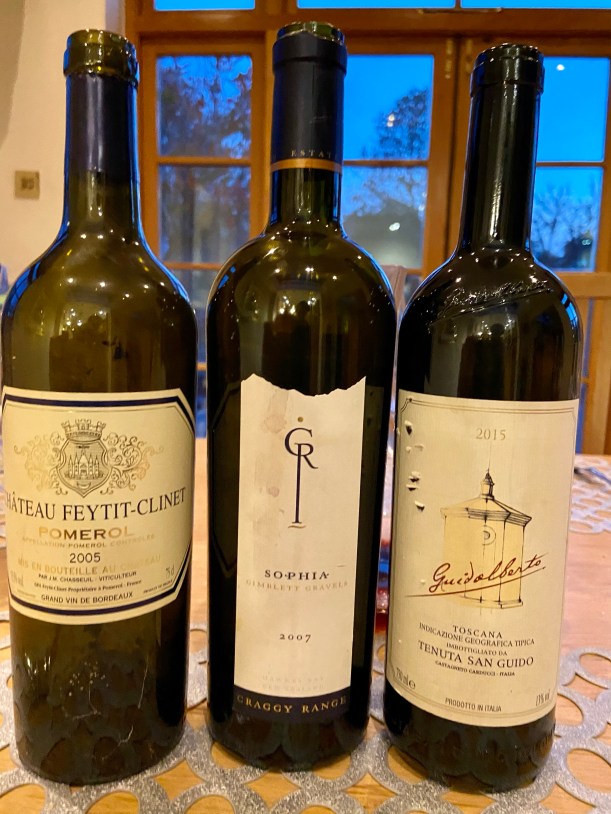
2007 Sophia Gimblett Gravels Hawkes Bay New Zealand

Merlot dominated Cabernet Franc Petit Verdot blend

This surprised us, though Hawkes Bay is pretty much as close as you can get for this style in the New world and I’m sure Steve Smith MW who we’ve done many tastings with will be delighted to know the outcome of our blind tasting thoughts.

I visited Craggy Range last year and saw the dedicated winery built just for Sophia.

Stu’s wine

Initially charred smoky charcoals cloves spices herbaceous

Smooth soft ripe tannins sweetness.

Full lush perfumed nose, black pepper, incense, sandalwood, young cedar sap from tree

Juicy fruity  slightly sticky feel in the mouth

Kiran gets green pepper pyrazine no one mentioned fruit.

Fresh pour some green pepper stalky

Lavished with oak

Delicious aromatic

Reminds me of Pomerol for no more a reason than I really loved it, an Emotional memory of previous Pomerols often shared with Stuart

Château Feytit clinet 2005 Pomerol

(95% Merlot and 5% Cabernet Franc)

Adams wine

Sweet fruit, strawberry plum fruit forward blackberry

Spiciness, Smoky cloves barrel

Stu got Jammy baked fruit

Stu sure dried fruit warm climate and found raisins

Tannin on the gums drying medium plus acidity

Guidealberto Tenuta San Guido IGT 2015

Cabernet Sauvignon dominated cab Merlot blend from the famous Sassicaia winery in Bolgheri.

Learning points

Focusing on tannins is invaluable. Merlots certainly felt sweeter fruit wrapped and sticker

New Zealand and other New world regions with age can very closely resemble the old world. If in doubt lack of any pyrazines(herbaceous bell pepper blackcurrant leaf cassis notes) unlikely to be Bordeaux

Pyrazines are more often found with Cabernet Sauvignon and Cabernet Franc less so with Merlot which has lusher fruitier spectrum with softer tannins and no hole in the palate


Leave a comment

Blind wine tasting April 6th 2021

The theme this week was back to the original that we started with at the beginning of lockdown. Blind anything.

Kiran’s wine

Smoke, Black pepper the most I have experienced.

(Black pepper is a note I have struggled with. Partly because I’ve been trying too hard to find it in Syrah/Shiraz when it’s never been there. The majority of Syrah probably doesn’t have this note. Also because I’ve been looking for spices, when in fact, after obsessionally smelling pepper grinders for the last few weeks I now realise it’s more of a floral woody note spice yes but much more complex than that.)

This wine had it in abundance- Floral violet blackberry, wood spice.

Soft tannins mainly on the tongue less so upper palate

Medium plus acid medium alcohol

A lovely Elegant balanced wine

Reminiscent of Pinot Noir but the clear black pepper nose countered that.

Stuart and I were pretty sure this a Northern Rhône Syrah, the elegant style. We had all visited Rene Rostaing a few years ago and this reminded us of that style. Delicious

Wine was

Francois Villard 2012 Cote Rôtie Le Gallet Blanc

The wine is produced from mostly Syrah with a hint of Viognier, 1% or 2% of the blend.

The berries are whole cluster fermented and up to 30% of the grapes are destemmed. The wine is then aged in an average of 50% new, French oak barrels for up to 18 months. A lovely wine highly recommended

Stuart’s wine

(Served in Bordeaux bottle)

Red strawberry chews, very clearly red fruit a little later some beeswax hint vegetal sweet spice.

Soft tannins all over mouth with high acid,fresh, puckering salivary glands

We thought Pinot, possible laterals Grenache but didn’t have the alcohol/body and had very fresh cool climate acidity.

Bonnes Marres 2011 Drouhin Larose

Bonnes-Mares is a grand cru in the Cote de nuits, mostly within Chambolle Musigny with a small 1.5 hectare (3.7ac) plot in neighboring Morey-Saint-Denis

The style of Drouhin-Laroze is between modern and traditional style with moderate use of oak. Based in Gevrey-Chambertin, Drouhin-Laroze owns range of Grand Cru across the Cote d’Or.

Adam’s wine

Rhubarb, red fruit, smoke, liquorice, hint leather complex

Soft tannins all over medium palate medium acid, length Delicious

Château de Beaucastel 2001, Château neuf du pape

Remarkably young for 20 years drinking beautifully.

A blend of 30% Grenache, 30% Mourvedre, 10% Syrah, 10% Counoise, and the balance split among the other permitted varietals. From the Perrin family’s largely organic and biodynamic vineyards

Dessert wine

Brown, thick, viscous, unctuous,Dates figs raisins molasses syrupyThick very very sweet mouth coating.Thoughts ? Pedro Ximenez you could stand a spoon in this!

Esszencia Tokaji Château Pazjos 1993

We didn’t know Kiran had this up his sleeve.Served in miniature bottles containing 100 ml only.From Sárospatak Alcoholic Content: 4.7 % volAcidity: 12.5 g/l A whopping 435g/l residual sugar


Leave a comment

Chianti and Confit

Kiran’s choice this week, and it was to be our first non blind tasting for over a year. Kiran was seeking an exploration of Chianti, one of his blind spots. After listening to the excellent Guild of Sommeliers podcast on Sangiovese it further inspired this weeks theme.

A trio of Chianti wines

It was a little disconcerting arriving with uncovered bottles but it had its own merits and still presented us with many learning points.

Of course we had pre read the indispensable ‘Beyond flavour’ by Nick Jackson MW which primed us into what structure to expect. However there were some revelations in store.


Kiran’s wine

Monte Bernardi Sa’etta Chianti Classico riserva 2016

100% Sangiovese single vineyard oak 24 months bottle 1 year

Appearance– Medium ruby

Nose– tart cherry thyme tobacco spice savoury profile

Taste-Very drying gum tannins fine sand or chalky. Clearly felt in the gums medium + and med + acidity

Med acid very dry dusty no real sweetness

Savoury salty flavour profile cherry strawberry

No tertiary aromas

This felt like a typical Chianti and was crying out for a tomato pasta dish

Adam’s wine

Brolio Barone Ricasoli 2013 Chianti Classico Riserva

Very different nose clearly pyrazine blackcurrant, blackcurrant leaf

Herbaceous, chocolate vanilla yoghurt smoother ? Oak influence

Smooth sweeter softer tannins mainly gums

If Tasted blind we all said we would have thought this was a Cabernet based wine. Tannic quality a little different but on the nose clear pyrazine.

Sangiovese 80% Merlot 15% Cabernet Sauvignon 5% aged in barrique and tonneaux for 16 months

Learning points

Small amounts of other varietals can make a profound difference

Chianti Classico wines can vary enormously

Stuart’s wine.

Il Carbonaione 2016 Podere Poggii Scalette

Sangiovese 100% IGT from older vines planted in 1928 from the rare Sangiovese di lamole clone

Red fruits dried and jammy some dark fruit cinnamon stick Vanilla tobacco Tinned cola

Mouth more powerful wine

Notable oak vanilla

Gummy distribution tannins finish savoury

This was a more robust expression of Sangiovese again showing the great diversity of Chianti. In some ways this provides greater interest in other you don’t know quite what to expect.

As with all Italian wines food is needed, fortunately, Kiran hade made a delectable Confit duck and red cabbage


Leave a comment

Improve your blind wine tasting skills.

WanderCurtis Wine, Tasting Tips: Improve your blind wine tasting skills.


Celebrating the first tasting in person after 3 months of Zoom tastings!


These last few months of forced isolation have provided the perfect opportunity to hone our blind wine tasting skills while enjoying a brief weekly escape from the tedium of lockdown..

Kiran, Stuart and I have taken turns to drop off decanted blind samples of wine to our doorsteps (carefully sanitising the bottles and minimising any contact, of course) then analysing them via Zoom with each other. More recently we have been doing this outdoors in each other’s gardens – all with minimal hints and desire to fool the others using various techniques such as decanting into the completely wrong bottle and glass shapes for the type of wines being tasted!

We want to share our notes with you as well as some of our learnings about how to find the ‘tells’ for some of the wines that gave us trouble.


After all, wines with friends is always better than wine alone!


The wine notes and learning points are detailed below:


Tasting 1 – April 26th 2020  – First Zoom tasting


Adam’s – deep ruby red, fruit forward, mainly black and blue fruits, compact a bit tight at this moment, nice touch of oak. Opinion was a new world wine probably Cabernet, still tight so age given as quite young 5-10 years.

Torres Mas La Plana 2015 Cabernet Sauvignon – an early killer blow dealt given that this was a wine at one of our tastings. Challenge set.


Stuart’s -Burnt smoke, spice, black fruits, complex, thoughts were Syrah given fruit profile and spice, we narrowed down to old world and Rhone Syrah. Age was thought to be very young, around 5 – 8 years.

Cote Rotie Guigal d’Ampuis 2010 Rhône – A good piece of deduction by the boys


Kiran’s – tertiary notes definitely old vegetal, compost, urine, pale colour. Could not distinguish varietal as too old all tertiary, but smelled of an aged Bordeaux. We were very close on age and left bank Bordeaux blend (Stuart said 1995)

Chateau Langoa Barton 1996 – pretty much nailed this one


Learning points


Don’t forget all the places around the world producing quality Cabernet Sauvignon. Italy, France (Bordeaux of course), Chile, California, South Africa not to mention Australia! Spain had us fooled despite having conducted one of our wine dinner tastings at Frederics with this wine!

See the excellent Wine Folly website for more details


Tasting 2 – May 3rd 2020 – Zoom


Adam’s – lemon citric petrolic nice mouthfeel length, but not oily! Kiran and Stuart believed this to be Semillon based, new world, and fairly old like 10 years.

 2012 ‘Margaret’ Peter  Lehman Sémillon Barossa – spot on with the detective work


Kiran’s – delicious, red fruits perfume, wild strawberry, earth, floral, violets, mixed spice

We thought classic NZ Pinot and likely Central Otago given perfumed red fruit in abundance and quality. Stuart and I both though of C Otago Pinot Noir, and thought Felton Road Bannockburn, about 6-8 years old.

2010 Mt Difficultly, Bannockburn Pinot Noir , central Otago. This was at a great drinking age and showed how well NZ Pinot’s can be a decade on, unfortunately Kiran’s last bottle!


Stuart’s – complex, herbal, cinnamon, spice, savoury, blood meat, good acidity and  tannins, thought Italy because of structure. Kiran and I had a lengthy discussion about whether it was Nebbiolo or Sangiovese, and then correctly landed on Sangiovese, a younger wine, like 5-8 years old.

Brunello di Montalcino 2010 Argiano – a tough one but we landed on our feet


Learning points


Ageing potential of New World wines is often underappreciated.

If stuck between Sangiovese and Nebbiolo, think about the tannins. The merciless tannins in Nebbiolo will be the tell.


Tasting 3 – Sunday May 10th 2020 –  Zoom


Stuart’s – White, lots of colour, golden, oxidative hazelnut texture ++ full body Med  acid more like a red re:body, lees, wood, drying tannin slight salty savoury after taste whisky. Stu says floral orange blossom. Guess was Rhone varietals and a blend.

St Joseph Blanc 2015 Vins de Vienne Roussane/ Marsanne – excellent work!


Kiran’s –  red. full of raspberry’s very ripe, blueberry with medium drying tannins and med + acid. Reminded of Italy savoury blood meat kept thinking of beef Florentine? Possibly Barolo or Brunello but not coal tar roses and not mixed spices of Brunello, not harsh enough tannins

Key was blood savoury after taste liquorice. Then we thought possibly Brunello.

It was actually a GSMC mix, which fits G red fruits ++ M savoury blood salty, liquorice spice great wine and in retrospect there wasn’t enough acid and tannins for Barolo/ Italy and red fruits much too overt, almost new world,

Coudolet de Beaucastel 2009 30% Grenache, 30% Mourvèdre, 20% Syrah, 20% Cinsault – what a delicious wine, we were all very animated about how enjoyable this was


Adam’s cocoa, coffee, chocolate, wood ++ , Kiran cola, black fruit, floral, Stuart Balsamic vanilla coconut wood, delicious drinking beautifully.

Stu got Rioja but I asked him what else it could be and diverted him to GSM mix. Correctly guess Rioja, and approximate age (10-15 years, possibly 09)

Contino réserva 2007  – missed out on which maker despite having tried it on numerous occasions so a little disappointed


Learning points


Italy and Spain laterals of Sangiovese v Nebbiolo

GSM blends can be like Chianti/Tuscan but Italians are more acidic and tannins a bit harsher.

Noted that Coudolet de Beaucastel is an EXCELLENT wine, and I (Adam) went on to buy a case of 2016 which is delicious, moreish and nearly gone already!


Tasting 4 – Sunday May 17th  – Zoom


Adam’s – Blackberry pepper Med + acid, drying tannins a little austere poor year tasted more old world thought GSM Rhone blend. The wine had that garrigue character, and a lightness with good acidity so thought potentially a higher altitude wine but Stu and Kiran dismissed Malbec

Zuccardi Mountain vineyards Uco valley, Argentina,2014 Malbec  – fooled by this one


Kiran’s – med acid ++ pickled lemon, floral, Stu apricots, flowers. long (no petrol). Very full body, a more heavyweight wine. Stu and I got aromatic varietal, were torn between Gruner, Riesling and possibly Albarino.

Riesling FX pichler 2013 smaragd Austria –  a beautiful fuller bodied style of Gruner


Stu’s –   Wow wish I hadn’t dropped my bottle on the pavement!

Big nose+++ polished wood, floral, pot pourri, tar, liquorice, in the finish sandalwood caramel acid ++ tannin++ drying

Awesome wine very complex nose and well-balanced palate – thought aged Barolo, around 15 years old.

Azelia 2001 Barolo Bricco Fiasco – this was in such a beauty


Learning points – Laterals to GSM think Malbec as red plum and black fruits similar structure, medium tannins and med low acidity. Malbec, weak spots need better strategies to identify it, and most definitely drink more high-altitude Malbec!


Showed just how great Barolo ages over many decades. Other great vintages include 1999 2001 2004 2006 2010


Tasting 5 – May 24th – Zoom


Adam’s – lots of fruit, leather. Medicinal, cough linctus, menthol eucalyptus liquorice. Kiran and Stu both got Shiraz, Stu thought it was Shiraz Cab blend, about 15-20 years old.

Henshke  Keyneton Euphonium 2001 Shiraz-based blend. Such a pleasure to drink!


Kiran’s – Honey poss. Botrytis, ginger. Old feel, me honey and hay, phenolic feel slight bitterness on the finish and some tannins – surprising.

Med + acid not high, Stu bruised apple thought possibly aged Chablis, too honeyed, about 10 yrs old.

Domain Huet Chenin Blanc 2012 – this one got us, although we both thought about Chenin at some point


Stu’s – pot pourri ++ light colour ? Pinot soft powdery tannins salty savoury aftertaste

Kiran wood ++, nutmeg clove spices, balsamic character. Final thoughts – Kiran – very clearly Rioja

Rioja Alta 890 Gran Reserva 2001 (95%Tempranillo) – experience counts!


Learning points – Remember laterals for very old wines, age brings soft elegance colour fades like old Rioja resembling a Pinot.

Australian wines 20+ years old can age beautifully

If find botrytis in white wine think Chenin, Gruner

Must drink more Chenin!


Tasting 6 – Adam’s Garden


Kiran’s – Initially Gewürztraminer nose terpenes floral ripe stone fruits

Glycerol thick oily lovely mouthfeel medium + acid

Not floral enough for Gewürztraminer no bitter finish acid a bit higher thought viognier poss Gruner did not get white pepper

Stu found mineral seashell herbaceous wood. Didn’t get this one.

Emmerich Knoll smaragd 2010 Reid Shutt Gruner Veltliner known as a floral site, fantastic wine ++


Adam’s – Tarry medicinal spirity initially closed. Later floral cherry in alcohol

Stu complex Coca Cola violets flowers

Kiran complexity spirity spices development ? Uccelleria Brunello 2010

Barbaresco Produttori di Barbaresco Riballa 2007  – absolutely lovely and changed a lot as evening went on tannin++


Stu’s – Adam initially Pinot old excellent quality turmeric nutmeg cinnamon spices tea dried flowers pot pourri not much fruit, compost+ manure earth tertiary

Tannin+ drying and acid high

Thought could not be Pinot re tannins ? Chianti? Age about 10-15 years.

1999 Comte Armand Pommard 1er Cru “Clos des Epeneaux” known for tannin profile. Missed this wine which was in a fantastic place


Learning points.

High quality Burgundy from certain sites can have firm very present tannins also wood age adding to tannins, so don’t rule out Pommard when you get these characteristics


Tasting 7 – Zoom


Stu’sClassic toast smoky buttery Malo nose, Chardonnay, honeysuckle, caramel, lemon tart, lovely good acidity but not cleansing or laser like sharp linear (Burgundy)

Both thought Chardonnay

Kiran – Kumeu River? me on reflection NZ too, slightly richer than Burgundy but very close. Landed quite firmly on NZ Chard

Vidal Legacy Hawkes Bay New Zealand 2014 – – great score for Kiran and me!


Kiran’sVery pale brick red, nose dried roses hint of tar liquorice some herbs tannins medium soft sl drying Med + acid

Thought Nebbiolo re nose and colour, quite perfumed.

 Sesti Rosso di Montalcino 2013  – In retrospect tannins too soft for Nebbiolo


Adam’s Very fruit forward blackberry possible cassis

Eucalyptus medicinal herbs Stu and Kiran thinking Aussie Cab/ Shiraz re fruit.

Stu didn’t like tannins slightly bitter and poss out of balance with alcohol

Revealed that it was French

Corbières Serres de Mazard 2017 50% Syrah, 25% Carignan, 20% Grenache, 5% Mourvèdre.


(After notes probably some carbonic maceration as fruit a little confected/esters) Decanter outstanding in April 2020 edition


Learning Points

Which region In France produces such fat ripe fruit forward wines akin to New world? Languedoc

New world vs. warm climate Languedoc wines – look for old world techniques like carbonic as a possible differentiator

Tasting 8 –  Stu’s garden


Kiran’sInitially smokey toast oak vanilla aftertaste caramel some lemon rind but predominant 2y Oak

Nice texture and balance Med +acid alcohol texture

Oak predominated

Stu and I both thought Bordeaux semillon sav blend, lacked florality and prettiness of Sauvignon mix. Fruit was missing on this wine.

Château Bouscaut Semillon Sav Graves Pessac Leognan 2012 – the oak and pyrazines were the giveaway on this one


Adam’sKiran and Stu instantly said Rioja

Balsamic coconut American oak chocolate bounty bar spice turmeric clove cinnamon nutmeg red fruits. Plush anything you want it to be open and giving

Thought réserva Rioja about 10 years old

Protos Gran Réserva Ribera Del Duero 2004


Stu’sAlcoholic. Double tiers of legs! Full body

Closed, struggled to get much

Smokiness perhaps red fruit

Acid medium

Tannins medium/ low

Hard to gauge soft tannins Med acid high alcohol bit of spice red fruits ? Hint carbonic/ esterification. Thought southern Rhône blend Grenache predominant

2013 Chapoutier Bila-Haut Occultum Lapidem Grenache Syrah Carignan


Tasting 9 – Adams garden


Kiran’sTerpenes variety, white flowers peach aromatic nose

Same palate, acid medium to med + not searing acidity

Something petrolic on nose implies age thought poss Riesling but detected some texture from lees or oak not done in Riesling

Difficult one to nail aromatic variety warmer climate possibly Riesling,Gruner, Albariño ,Viognier, Stu thought maybe pepper

Blank Canvas Gruner Veltliner 2013 New Zealand  – this one fooled us and had some new French oak to make it even harder. The next day Kiran’s NZ Gruner even better, really textured with botrytis honey petrol smoke mandarin smaragd like but I still don’t find white pepper!


Stu’s – initially nose of glue dope ? VA heady potent

Once that blew off violets blackberry black plum cocoa chocolate baking spices 5 spice wood tannins Med + soft acid medium, high alcohol body high

Thought 14.5% Adam getting a bit drunk

Probably Rioja possibilities Brunello but not acidic or red fruit enough new world Syrah too much oak not obvious black pepper or burnt rubber smoke

 Alion 2003 Ribera del Duero  – A big glamourpuss of a wine, drinking beautifully. Shame that was the last bottle…


Adam’s – All tertiary old, mushrooms earth leather

Stu clearly bell pepper and cedar

Thought 20 yr old + left bank initially then to Right bank

Fruit dropped away

1998 Pomerol Chateau Taffellier  –  a wine Stu gave me a few years ago


Bonus wine – Kiran

Prunes raisins alcohol full sweet residual sugar almost a port

Adam reminder of trip to Puglia, thought Primitivo

Other possibilities Amarone or Ripasso bit too raisinated and sweetness

San Marzano 62nd Anniversary Primitivo di Manduria


Tasting 10 – Kiran’s house


Adam’s – First Rosé of the tasting events

Kiran instantly reminds me of strawberries and cream like a Pinot based champagne

Stu red fruits smells like Pinot acidity not that high

Adam smoke toast oak aged sl some red fruit nice texture and mouthfeel

Other possibilities Grenache Shiraz Carignan Cinsault

Became more complex Floral herbaceous

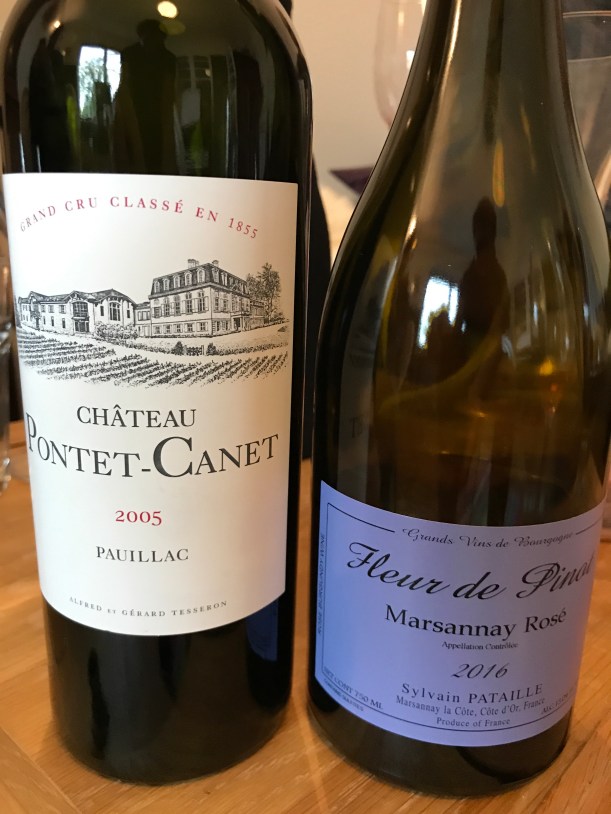
Sylvain Pataille le fleur de pinot 2016 Rose from Pinot oak aged. We tasted this in Sylvain’s cellar last summer and yet we missed it. Shows how hard blind tasting can be.


Kiran’s – Huge whiff of cassis pure black fruits later cedar chocolate some hints of pyrazine picked up by Stu ripe, explained as yellow pepper by K

Adam definitely Cabernet based wine very ripe either excellent year Bordeaux or new world toying on Sophia Craggy Range. Stu def Bordeaux, but A not really getting the classic Bordeaux green pepper herbaceous pyrazine notes

Adam, could not put it down for 30 mins and needed top ups. If not New world then is it favourite BDX red. Pontet Canet?

 Chateau Pontet-Canet Pauillac 2005 – Good shout here!
Stu’s –  Freaky wine very dark colour

Initially blood meat savoury

Then coffee ++ chocolate

Than some red fruit floral

Kept changing on us

Hardest wine yet like a schizophrenic high risk patient, constantly changing character

Dark colour black fruit. Obviously barrel aged possibly Syrah Rhône blend but admittedly no confidence with this

Galatrona Petrolo  Merlot 100% Tuscany – made in the style of the great Pomerols like Le Pin and Petrus, 100% Merlot. A crazy wine.


Learning points

Don’t forget Merlot, it can make the most sensuous and serious wines ! Merlot is also still the most planted grape variety in France with a lot planted in Italy and many other countries below:

  • France (~280,000+ acres) Bordeaux, Languedoc-Roussillon
  • Italy (~93,000+ acres) Toscana, Campania
  • United States (~55,000+ acres) California, Washington
  • Australia (~39,000 acres) South Australia
  • Chile (~25,000 acres) | Argentina (~13,000 acres

Remember more red fruits, raspberry, plum, black cherry and others Mocha ( strong coffee/chocolate in this wine not necessarily wood but from the grape variety) vanilla clove tobacco graphite cedar

Tasting 11 – Stu’s house

Adam’s –  wine white, oak toast, smoke, coconut, vanilla, also ripe stone fruit peach
Nice balance oak alcohol body a bit oak dominated.
Stuart instantly California Chardonnay
Au Bon Climat Los Alamos Santa Barbara 2018

Kiran’s – Nose cheap red, Stuart instantly disliked.
Adam confected pear drop ? Carbonic esterified red and blue fruits some smoke
One dimensional initially then – violets smoke more tannins changed over time
Thought GSM Rhône re low tannins red fruit Med acid

Zaha Toko Vineyard Malbec 2016 Paraje AlteMira Mendoza – fooled yet again by Malbec!

Stu’s – Bretty nose horses leather band aid all tertiary
Can’t find fruit –  Brett/spoiled?
Not much came through poss. green pepper capsicum poss cassis but mainly tertiary thought old BDX
Château Feytit Clinet 2012 – bottle was clearly not in good condition or the wine was just in a dumb funk

Then tried the 2005 Feytit Clinet over cheese and ManuU v. Southampton

This was more Pomerol-like – Liquorice possibly plums coffee chocolate plum soft round tannins

Learning Points – Don’t forget Malbec if getting a GSM (red fruit, med/low acid medium tannin profile)

Other Blind wine tasting thoughts:

  • White wines low acid – Gewurztraminer, Marsanne, Viognier
  • Whites with phenolic bitterness – Gruner Veltliner, Albarino, Pinot gris
  • Oak aged whites Chardonnay -Sauv/Semillon Bordeaux, Marsanne, Viognier Rhone, Rioja Viura
  • Whites with botyritis (ginger, honey bitterness glue) uneven ripening – Chenin Blanc, Gruner Veltliner
  • Aromatic whites – Gewurz, Torrontes, Muscat, Viognier
  • Minerality – Chablis (?phenols,acidity,sulphur compounds) – Chardonnay is a master transmitter of terroir