A one page summary of the: climate, topography, growing hazards, wine law, grape varieties, wine growing and making practices and the main wine producing regions.
Greece has at the time of writing not come up as a country in the D3 tasting exam. However key wines have come up in the mixed bag and if it did wines to look out for include:
Assyrtiko from Crete or Santorini
Xinomavro from Naoussa (or Amynteo)
Moschofilero from Mantinia
Agiorgitiko from Nemea
And don’t forget Retsina!
For a deeper dive, beyond the Diploma curriculum, into the many Greek PDOs and IGTs Wines of Greece website has plenty of information.
Sources include: WSET Diploma Wines of the World, Wines of Greece & various producer wine maps and aerial photography.
Note this document is intended for personal use only not for commercial or promotional use. We accept no liability for any omissions or errors that may be contained in the document.
Greece’s wine story is ancient, its golden age between 500–300 BCE saw Hellenic culture and viticulture spread across the Mediterranean. Wines were often infused with pine resin, herbs or honey, more for preservation than flavour. But centuries of upheaval, from Roman rule to civil wars, meant Greek wine lost ground. Until fairly recently, it was largely defined by Retsina. However, since the 1980s, quality-driven estate bottlings have steadily redefined the landscape. Today, with rising exports and a growing reputation, Greece is quietly producing some seriously characterful and delicious wines.
The country’s geography plays a vital role. A warm Mediterranean climate dominates, though elevation and coastal influences bring vital moderation. Summers can be punishingly hot; Santorini, for example, sees as little as 200mm of annual rainfall. Inland regions swing to harsh winters, while strong island winds can challenge growers.
Greece’s mountainous terrain and low-fertility soils yield naturally limited, quality-focused harvests. Many international varieties are also grown which are still favoured by the domestic market. But around 90% of vineyards are planted with indigenous varieties, some 300 in total, many with real identity and resilience.
Assyrtiko, originally from Santorini, is a flagship white, prized for its tension between ripe fruit and taut acidity. Savatiano and Roditis are widely planted; when grown with care, they offer surprisingly refined expressions. Moschofilero and Malagousia add aromatic flair and freshness.
Among reds, Agiorgitiko is versatile and plush-fruited, while Xinomavro, from Macedonia’s Naoussa PDO, is more structured, with a profile not unlike Barolo.
Increasingly mainstream, Greece is now firmly on the map for thoughtful drinkers seeking something distinct, grounded in tradition, yet confidently modern.
I was delighted to find an old favourite the Argyros Estate Assyrtiko 2020
Made from a blend of vineyards with 100 year old vines, the wine spends 3-4 months on lees. On the nose, stone fruit, sea air and an undertone of herb; tarragon or cut grass. The fruit is ripe, there is cooked lemon with a salty tingling long finish in the mouth. The body is full and acidity bracing. This wine is made for food especially Greek dips, fetta and grilled fish. Delicious.
An old favourite tasted at Flint Wines annual tasting.
The outstanding Plethora from Vassaltis is a truly remarkable wine. It is made from late harvest Assyrtiko and spends 6 months on lees then 8 months in 60 year old vinsanto barrels then 2 years in bottle before release. A gap is left on top and sometimes flor grows. So there really is a lot of wine making influence in this complex drop.
Nose is reminiscent of a vinsanto: roasted nuts, smoke, hint of caramel, touch of balsamic. Very complex, a hint of Christmas spice.
The mouth feel is rich and textured with flavours of cake spices, orange peel and a characteristic sea salt and wet stone tang. Very, very long. An outstanding wine, extraordinary.
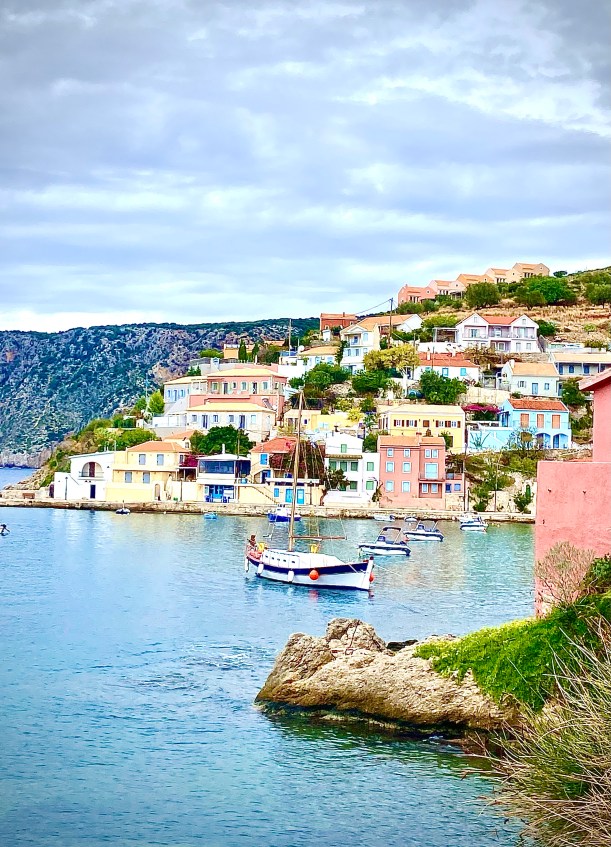
The late afternoon breeze begins to dissipate the heat of the day, the sun gently sinks over the sea, islands in the distance emerge in silhouette as the sky shades pink and purple. Evening time on the Greek islands. Hard to improve on that I hear you murmur?
Well actually there is a way to dial up the experience: make sure you are enjoying a glass of chilled Robola on the island of Cephalonia!
In Captain Corelli’s Mandolin the bottles of Robola that the drunken priest downs while hiding from his flock would bear, I imagine, little relation to the excellent wines the island currently produces. However, the storey does serve to illustrate the very long tradition of wine making on the island which stretches back over centuries of Venetian influence.
Wine is produced on several of the Ionian islands but Cephalonia is known as the home of one of the best Greek white wines Robola. Perhaps not as famous as Santorini’s Assyrtiko but definitely worth searching out particularly if you enjoy fresh, crisp and minerally wines with elegance and structure. The best are grown in poor limestone soils high up on mount Ainos.
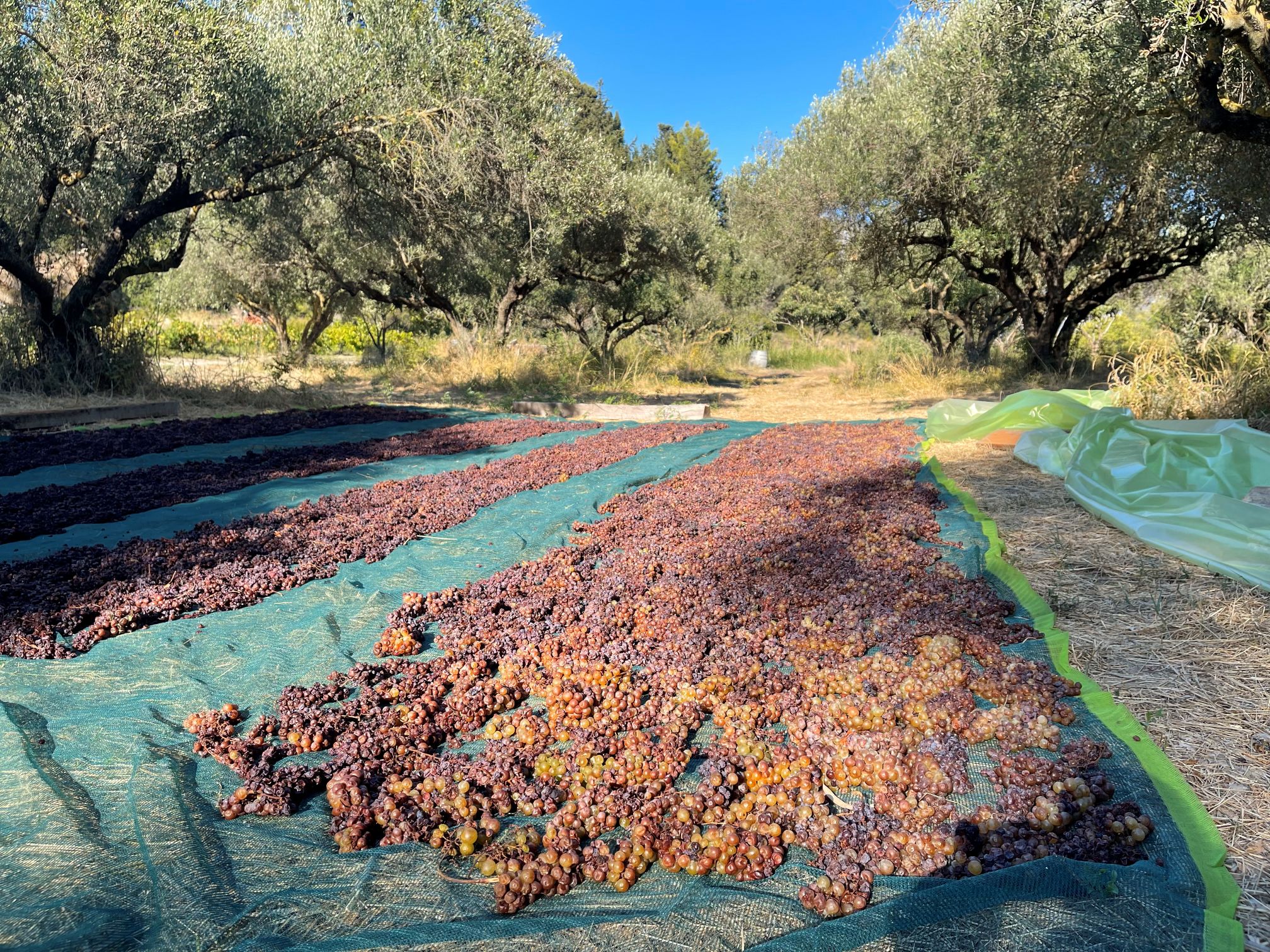
Grapes drying at Sclavos Wines
Robola is not the only show in town though indeed there is a bewildering array of grape varieties grown on the island. The other main grape varieties are Mavrodaphne and Muscat Blanc. Mavrodaphne is a red grape traditionally used to produce a sweet red wine, thanks to the Venetians love of the Passito method of sun drying their grapes, but now also made into a delicious dry reds too.
Local wines are widely available in all the tavernas, many stocking the excellent entry level Robola produced by the Cephalonia Cooperative which arrives in a cloth sack. Also, sometimes some more premium higher altitude and even single vineyard Robolas by the Cooperative and wineries such as Gentilini. Do try the various alarmingly coloured rose wines (think Aperol Spritz) that are made on the island too!
Sadly, I only managed to visit Sclavos Wines and Domaine Foivos whilst on the island and as Adam has recently reviewed Sclavos Winery here I will focus on Domaine Foivos.
Domaine Foivos
Domaine Foivos was formed when Theodore Orkopoulos bought the Matzavino family winery which is one of the oldest wineries in Greece. In fact, Theodore believes that Homer mentions the wines in the Iliad!
The estates vineyards are located in different parts of the island and contain a large range of very old indigenous grape varieties many of which are pre-phylloxera. Since the phylloxera louse killed off most native European vines by attacking their roots nearly all modern vines have been grafted onto American vine roots which are resistant so it is unusual to find old ungrafted vines that have survived.
It became evident during our three hour long tasting that Theodore possesses just the sort of boundless enthusiasm and a relentlessly enquiring mind needed to fully grasp the wine making opportunities that this precious library of vines presents.
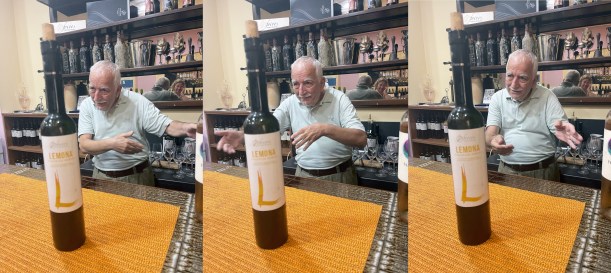
Theodore Orkopoulos winemaker at Domaine Foivos
We started with a master class on Robola show casing different wine making techniques applied to grapes from the vineyards on mount Ainos.
Black Label Cephalonian Robola, 2021.
The vines are fully pressed and allowed a bit of skin contact.
The nose is a little floral with a touch of pink grapefruit. On the palate nice fruit, good balance and freshness and a pleasant prickle from the skin contact. A very nice wine that has tension and character.
Blue Label Cephalonian Robola, 2021.
This wine is also made with a full press but without any skin contact.
A refined nose of peach and wet stone. In the mouth a slimmer body and softer acidity with good length. This wine is available in the UK. It would work well as an aperitif to go with the sunset followed by the black label with dinner at the local Taverna.
Barcarola Cephalonian Robola, 2021.
This version of Robola is made with only the first free run juice of a selection of the grapes.
It has quite a different nose, much more perfumed, floral with delicate citrus notes. Theodore describes it as more pure expression of the grape. Again, a lighter body, very nicely balanced with a long lingering finish. This is a more premium wine.
Orange Robola 2021
This wine is made with 5 days skin contact which is relatively restrained by natural wine making standards so it is not very ‘orange’ in appearance. Possibly why I liked it so much! Ripe fruit on the nose, white peach, rounder on the palate with more ripe fruits and a nice prickly sensation. Very tasty.
Amphora Robola, 2021
This wine is made in small clay amphora.
On the nose more herbal notes over the top of peach, wet stony notes and something floral like lilac. Also complex in the mouth with a very nice texture and length.
East – West Robola + Assyrtiko, 2020
This wine is a 50:50 mix of Robola from Domaine Foivos and Assyrtiko from Zanthi.
It has a rich nose of peach and other tropical fruits and on the palate a lovely a mix of peach fruit and salty citric notes from the Assyrtiko.
Asteris Robola Rose, 2020
A bit of mavrodaphne is added to give a splash of juicy fruit to layer on top of the peach and citrus profile of the Robola. This is not one of the alarming coloured roses mentioned in the introduction, looks very respectable.
Lemona Sun dried Robola, 2012
Grapes are dried in the sun for up to 20 days. Then pressed to make this amazing sweet wine. Around 10kg of grapes are needed for each half bottle!
On the nose sweet fruit, caramel. In the mouth complex flavours of lemon, nuts and honey. Very long, great balance with real lift and length.
Appropriately named after Lemona goddess of the environment.
Foivos is one of the few wineries offering so many versions of Robola and it’s a result of Theodoros’ continuing search to discover all aspects of the grape.
The masterclass of Robola over, Theodore explained what had prompted him to start to experiment with using amphora. It’s understood that the ancient Greeks heavily watered their wine down and Theodore wanted to find out why. He set about making wine using clay amphora in the way that the ancients did, which included adding wooden staves and found that the results were good. However, Theodore realised that storage of the wine in clay amphorae over weeks and months would cause the wine to oxidise badly. So, the theory is that by the time the important religious festivals came around in the new year the wine from the last harvest would have needed to be heavily diluted to make it drinkable.
Theodore also believes that the ancient Greeks stored wines under water possibly to try and prevent it spoiling through oxidation and this has also led Foivos to carry out some very interesting experiments in aging wine under the sea.
Nautilus White, 2021
Made from blend of Tsaousi, Vostilidi, Muscatel and Muscat grapes this wine is bottle aged for 6 months in the winery aquarium which creates and environment of total darkness, constant temperature and lack of oxygen. On the nose lemon pith, lemon peel, fresh green herbs and a floral note. In the mouth round, medium acidity, more pith and citrus notes with a pleasant slight bitter bite at the end. Very vibrant and long. Available in the UK.
Nautilus Rose, 2021.
Mavrodaphne, Muscatel, Muscat, Tsaousi and Vostilidi grapes. Also bottle aged in the winery tank. Very aromatic, wild flowers and wet stones. On the palate soft red fruits, super dry with a fresh lift and a dry salty finish. Very nice in deed. Exported to British Columbia amoungst other places.
47 and 47 Undersea
47, 2017
The wine is a remarkable blend of 47 varieties: 41 whites and 6 reds to make a rose. This is where the field ‘library’ of indigenous grape varieties comes in.
Mineral, stony notes on the nose with fresh cut soft red fruit. On the palate strawberries, raspberries then baked lemon, very fresh. Complex with waves of flavours, long.
47 Undersea, 2017
As if 47 wasn’t extraordinary enough the same 47 varieties have also been bottle aged for 18 months under sea. The wine is stored in cages at depth of 22 m. As with the Nautilus wines this ensures, darkness, constant temperature and lack of oxygen but in addition higher than atmospheric pressure and a saline environment.
This wine has a different nose to the straight 47, with less obvious fruit, the fruit more integrated with the mineral notes. In the mouth tangy fruit salad flavours, complex with a stony and salty edge. Amazing to see the difference to the non-sea aged version
Red varieties.
Myesis, 2017 (initiation)
Made of 3 grapes mostly Mavrodaphne but with Cephalonian varieties: Theiako and Araklino.
A nice whiff of marzipan oh the nose with a bit of spice. A good medium body with soft rounded fruit and subtle barrel notes.
Daphne Daphne, 2016
This is a dry wine made from 100% Mavrodaphne. On the nose, plums, farmyard, smoke. In the mouth medium body, a bit of lift, dark fruits and savoury notes, medium soft tannins. Very tasty.
Amphora Red, 2021.
Another dry red mostly Mavrodaphne with 15% Vostilidi. The clay amphora gives the wine an overdose if oxygen for about 2 weeks while it ferments. Also, the amphora mean that the fermentation temperature is uncontrolled.
Nice balance, medium acidity, soft but mouth coating tannins. Lovely.
42, 2016
Another remarkable blend this time of 42 red varieties from heritage vineyards. Theodore says the grapes compete in the glass to come out on top, a continuing battle with new winners presenting themselves at each stage of the wine’s development. A rich nose of dark and red fruit and smoke. Medium body, a kaleidoscope of fruits, toasty notes, complex. Delicious!
Methyse, 2004.
Named after a follower of Dionysus the god of winemaking.
This is the traditional sweet wine of Mavrodaphne.
Super dark in colour, nose of chocolate, Kirsch, dried oranges and Christmas spices. Sweet but with enough freshness to lift it, complex and very long. A real treat!
Tasting the Foivos range of wines with Theodore at his cellar was a fascinating experience! It is wonderful that way he takes inspiration from the past, cherishes local heritage and yet continues to explore and experiment with new ways of expressing the wines. Do seek out the wines and try them.
After recent visits to Santorini and Crete, I was keen to continue exploring and increasing my knowledge of Greek wines. I could not miss the famous Robola of Cephalonia, the largest of the Ionian Islands. Other important grape varieties found on the Island are Muscat of Kefalonia, Vostilidi, Zakynthino, Tsaoussi and Moschatella, and the red grape Mavrodaphne.
I chose to visit Sclavos wines on the Paniki peninsula, following recommendations from the excellent ‘Wines of Greece’ recently published by Yannis Karaksis MW.
I am grateful to Yiannis Papadimitrakopoulos from the winemaking team who gave us a fantastic introduction to Cephalonia and Sclavos wines.Yiannis has a degree in Oenology from the University of Athens and a Masters degree in vine, wine and terroir from the university of Burgundy in France. He has gained great experience in wineries across the world.
The history of Sclavos commences generations ago. Sclavos’s great grandfather made wines in Odessa.
Evriviadis Sclavos runs the business and is a professional viticulturist and adopted the system of biodynamic agriculture. In 2014 they had to seek investment following extensive damage to the winery following an earthquake.
Biodynamic farming
The concept of Biodynamics started in the 1920’s with an Austrian philosopher, Rudolph Steiner.
Biodynamic winemaking involves a set of farming practices that views the vineyard as one organism. Everything in the universe is considered connected including the moon and planets and stars.
It is important to follow the calendar and lunar cycles. There are particular fruit days for harvesting grapes, root days for pruning , flower days to leave the vineyard to rest and leaf days for watering. It is a holistic and homeopathic approach to viticulture.
Natural materials, soils, and composts are used in the vineyard. Chemical fertilizers and pesticides are forbidden. Animals such as horses, chickens and sheep roam around helping create a more natural fertile environment. Biodynamic farming seeks sustainability aiming to leave the land in as good or better shape as it was found it for future generations.
Whilst touring the winery we witnessed one of the many natural products used. A crate of dried horsetail. This is made into a form of tea which is diluted many times to create a homeopathic spray to use in the vineyard against disease.
Other more bizarre practices involve burying cow horns filled with manure over the winter preferably from a lactating cow. It is then diluted and sprayed on the soil.
Many of these practices may appear wacky and bizarre. They certainly require a deep passion to follow them.
I have to admit to buying into biodynamism.
Some of the best wines I’ve ever had are biodynamic such as Felton Road, Zind Humbrecht ,Chateau Pontet Canet and Chapoutier.
Views from Sclavos, Kostilidi old vines in foreground Mount Ainos in the distance
Sclavos also practice minimum intervention wine making and produce natural wines with no sulphur added and Orange wines often with long aging on lees which protects wine from oxidation
They have 14 hectares of their own vineyards all over the Island including Robola on Mount Ainos
Some grapes are purchased which may not be biodynamic.
Total production is 160000 bottles
They are fortunate enough to have some 100 year old ungrafted phylloxera resistant vines.
Sales are widespread including France and Europe and USA
We were lucky to catch the Last day of the harvest. A team of workers were bringing in the Roditis grapes when we arrived. Interestingly there were red and green grapes. Ioannis explained that they were from the same vines but Roditis can have both colours on the same vine.
I couldn’t resist pinching a few from the sorting table. The pink were decidedly sweeter.
We were led through the process of wine production. First the crates were emptied onto a vibrating conveyer belt with perforations in it so debris falls through.
Then a multitude of workers meticulously picked out debris and any damaged or diseases grapes. At the latter end of the conveyer belt a couple of people snipped the larger bunches into more manageable sizes. They were then fed onto a steeply sloped shelved ramp and fed into the destemming machine.
It was mesmerising watching the destemmer in action. Whole perfectly formed bunches became individual slightly macerated berries and the stripped stems were neatly piled aside ready for composting or feeding to the local goats.
The berries were then pumped via a large bore tube into the hydraulic pressing machine. This is a cleverly designed bit of apparatus.
Once in the metal cylinder a bag inflates inside gently pressing the berries and free flowing juice is pumped off into tanks.
No yeast is added at Sclavos. fermentation begins with naturally occurring yeast.
This method is more risky but leads to more complex wines and is a more natural process.
We followed Ioannis into the winery
I spotted a 1500 litre vat of red grapes. They were releasing a heady aroma of alcohol. They were nearing the end of their 30 day natural fermentation and maceration and needed a daily Pigeage (pumping down)
I was fortunate enough to be allowed to do the manual punch down. I did this with great enjoyment but perhaps not great effectiveness as I didn’t correctly wet the cap on the final motion of punch down.
My first attempt at Pigeage!
More expertise in the winery is needed until I can ever produce my chosen cuvee.
Wines tasted outside surrounded by the wineries cats and dogs.
Alchimiste 2021
Natural yeast, low sulphite,Good sales in Canada.From the Peloponnese high altitude
Mixture of 4 varieties tsaousi, vostilidi, moscatella, rhoditis(50%)
Citric orange, Bitterness on finish,fresh.
Robolla in a Cephalonia
Robola is indigenous to Kefalonia and is restricted to a specific zone, the Robola zone. Robola of Kefalonia VQPRD. The zone extends from the Omala Valley up to the Paliki peninsula and the surrounding of Mount Ainos Natural Park. Robola nose is often described as citrus blossom , peach and green apple.
Recommended to keep for at least 1 year to develop complexity and mineral notes. Ideal 5-7 years. Mostly grown in a bush traditional system. Bush protects grape from wind and sun via shade.
Robolla vino do Sasso Wine of stone
800 meter altitude high vineyard
Nice floral minerally nose, medium body, fresh acidity citrus and riper stone fruit. Stoney finish. Lovely long.
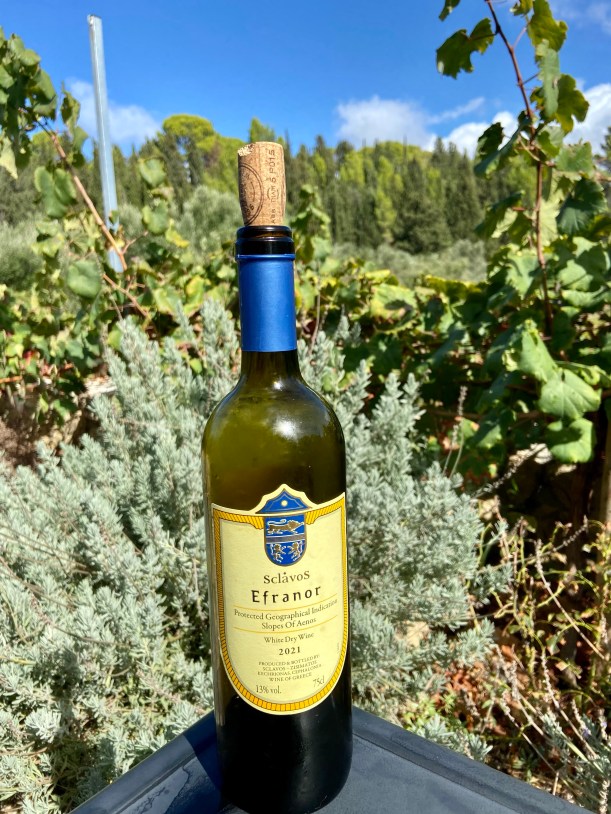
Efranor 2021 Meaning – fills the heart with joy
Muscat of alexandra 70% 30% Vostilidi, 100 year old. Before phyloxera so ungrafted.
Muscat nose, elder flower, grape, nice mouth feel, fresh herbal green twist to the finish.
Alchymiste rose
Mavrodaphne 80%moscatella 20
Medium pink colour, slight orange hue from oxidation but doesn’t affect taste
Characterful rose, some complexity and texture with fruit.
Metagitnion
Biodynamic natural wine, from kostolidi 15 hl per hectare low yield ungraded old vines
Nutty honey complex can age 8 years Urea, clementine very full bodied
Floral develops spice with time good length
Very interesting wine
Muscat orange
Made in same way as a red wine whole grapes destemmed in tank. Natural Orange wine
Concrete eggs nil added unfiltered no sulphites no additives, 30 day maceration
Crushed raspberries, chalk with a smokey slightly gamey nose. Medium all through soft powdery tannins
Monambeles
Organic grapes Mavrodaphne 100%
70 year old vines 250 meters, soil is calcareous (marly limestone – Maltese slate) fermentation with native yeasts, aging in five hundred litre French oak Allier barrels and also in a three ton oak vinifier for at least twelve months.
Black fruits soft long tannins some spice
Quite long concentrated some savouriness
Thiniatiko
From Thinia 2 grapes from grandfather of the new investor. Naturally made with log maceration natural yeast biodynamic
Good black fruits round tannins spice savoury
Needs some time to develop
Vin doux du soliel 2019
Made with passito method dried in vineyard Mavrodaphne grapes
Intense concentrated fruit, good acidity, very long delicious
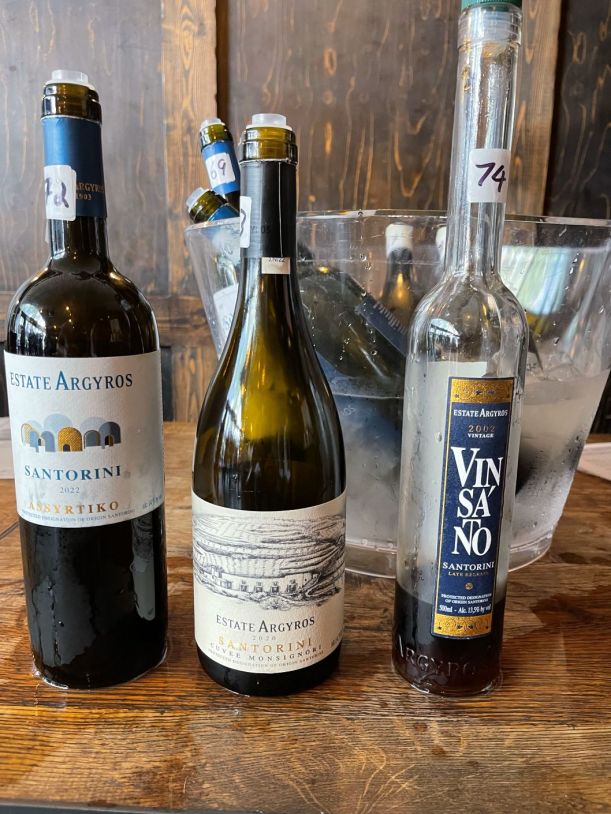
A delicious bottle of Estate Argyros Assyrtiko 2021 made me think of the just how extreme the growing environment on Santorini and admire once again how the combination of unique growing techniques and the special qualities of the Assyrtiko grape variety come to together to produce stunning wines.
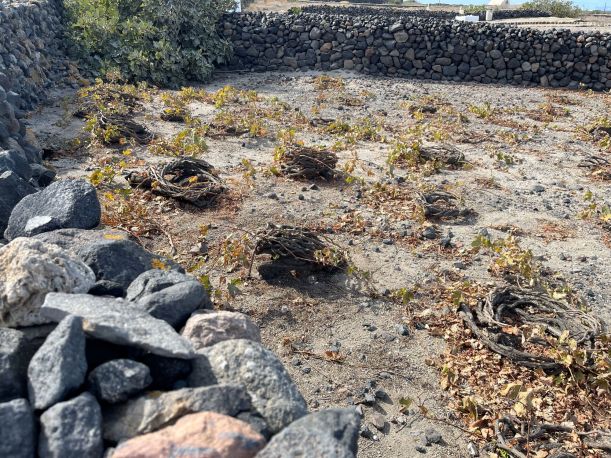
Santorini Instagram central of the Aegean, is home to some of the world’s most unique and resilient vineyards. Here, where volcanic soils and fierce winds challenge even the hardiest of grapevines, local winegrowers have perfected a centuries-old training method known as kouloura—the basket training system.
Unlike the neatly trellised rows seen in most wine regions, Santorini’s vines grow in a low, circular shape, woven carefully by hand into protective nests close to the ground. This technique requiring huge amount of highly skilled labour in the vineyard, is vital to the survival of the island’s vineyards.
One of the primary threats to grapevines on Santorini is the island’s relentless winds, which sweep in from the sea with punishing force. The basket structure shields the delicate grape clusters within its coils, preventing wind damage and reducing the risk of berries drying out or breaking prematurely. This natural windbreak ensures that the vines can thrive despite the extreme conditions.
Moisture retention is another crucial benefit of basket training. Santorini receives minimal rainfall, but the volcanic pumice-rich soil has an extraordinary ability to absorb and store the scarce water available. It does mean vines are planted at very low densities so that there is enough water to go around. At night, humidity from the Aegean condenses on the vine leaves and trickles down into the soil. The low, coiled structure of the vines helps trap this precious moisture, ensuring slow, steady hydration.
This ancient technique, passed down through generations is one to the key factors behind the unique, concentrated and structured expressions of Assyrtiko that the Island produces.
Sclavos winery takes a minimum intervention approach to wine making and is transitioning to biodynamic practices in the vineyards.
Their goal is to craft natural organic wines that showcase the unique characteristics of local grape varieties, influenced by their microclimate. After harvest, grapes undergo careful hand-sorting to remove any unsuitable fruit. Vinification employs modern techniques, including stainless steel tanks, pneumatic presses with nitrogen environments, and oak fermenters.
Mavrodaphne is traditionally made as a sweet wine on Kefalonia and in order to protect the PDO classification dry versions are actually not allowed to be labelled as Mavrodaphne! Sclavos along with others, has long advocated for the recognition of red dry wines from this variety. The winery is introducing new expressions of Mavrodaphne Kefallinia, continuing its pioneering efforts in dry vinification and aging, a practice initiated 25 years ago.
The Mavrodaphne variety undergoes three weeks of fermentation, followed by over a year of aging in French oak barrels of varying sizes (225L, 500L, and large oak tanks).
The winery has 14 hectares of their own vineyards, but buys some grapes in to produce 160, 000 bottles annually.
The wines:
Alchymiste 2020 Mavrodaphne and Moschatela grapes picked relatively early. This wine is made in stainless steel tanks producing a rose colour wine. On the nose crushed raspberries and chalk dust. A nice fruit mix with a smoky slightly animal note – goaty! also malt loaf. It is fresh and medium bodied with soft powdery tannins.
Orgion 2020 Mavrodaphne aged partly in French oak barrels. There is a floral jasmine note also smoke and again malt loaf. The oak is very subtle and fills it all out the wine making it a bit rounder. Very nice.
Xinodos Biodaynamic 2020 From old vine Mavrodaphne + 17% Vostilidi, co-vinified. Matured for one year in big barrels. The wine is dark and concentrate. It is dry with red and blue fruits and has the tannin and acidity to age well.
Vin Doux Du Soleil 2020 Made from sun dried Moschato grapes. Intense concentrated fruit, good acidity, very long.
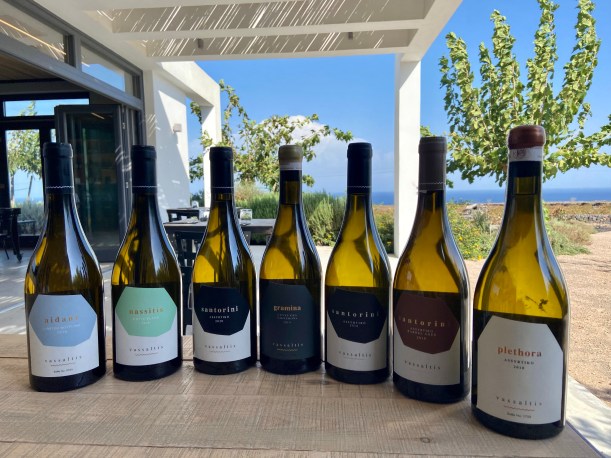
When my good friend Richard, founder of Wanderlust wines knew I was off to Santorini he insisted I go to Vassaltis. ‘Best wines on the Island’ he told me. Started by Yannis Valambous a former financier in London. It is Santorini’s newest winery, outside the village of Vourvoulus. The winery is sleek modern light and spacious with excellent views over his vineyards to the sea.The first wines from Vassaltis were released in 2015. We were lucky enough to meet their two highly talented winemakers, Elias Roussakis and Yiannis Papaeconomou.
Richard was bang on.
The wines are fabulous. The restaurant menu excellent too and the vibe atmosphere and service of the staff lived up to all expectations. Definitely a highlight of our vinous tour of Santorini
Tasting notes below courtesy of Kiran
Aidani 2020
Aged for up to 2 – 3 years
The label design is shape of a volcanic stone.
Nice floral nose.
Fresh with peachy and citrus notes some jasmine florality and medium body with high acidity but less than Assyrtiko A lovely aperitif style wine.
Nassitis 2020
A blend of 3 whites Aidani, about 30% Assyrtiko and Athiri.
Lemon sorbet and wet stone on the nose.
More lemon zest, mineral and lovely salty tangy phenolic bitter finish. A great food wine.
Santorini 2020
100% Assyrtiko a blend of grapes from different vineyards all over Santorini 24 eur.
12 months on lees then bottled.
Immediate hit of dried herbs, rosemary thyme etc. then some lemon zest. Then emerging hyacinth quite floral.
Quite full bodied tannins felt on gums high cripsp acid nice long salty finish.
Gramina 2019
Gramina means field so this is a single vineyard wine from Vourvoulos the village nearby. 100% Assyrtiko grapes are handpicked early morning and the wine spends 12 months on lees and 12 months in bottle.
On the nose an attractive petrolic whiff with an undertow of herbs and wet stones
Full bodied, smooth texture with dried green herbs, fresh acidity and a long lingering salty stony finish. Excellent.
Santorini 2016
Darker richer in colour than the 2020.
A much more complex nose: petrol, honey, baked lemon, over ripe honey dew melon then salted almonds, really interesting.
Lovely silky texture, very complex ripe with some sweetness and nuttiness the saltiness is still there but less aggressive softened out by the other flavours and age. A superb wine showing how well Assyrtiko can age.
Santorini barrel aged. 2019
Smokey lemon and lime sorbet hint of petrol faint tarragon
Taught and almost austere structured wine herbs minerals and sea salt. Long.
Santorini barrel aged 2017
On the nose smoke a bit of vanilla and over ripe mango AKA petrol.
The nuts honey, increasingly complex.
Lovely full body with a silky elastic texture, sweet notes, complex softening out the austerity found in the 2019 Gramina. Very long and persistent. Another fantastic wine.
Laterals would be an aged Riesling or a grand cru Chablis with a few years. In other words, premium wines of complexity and character.
Open to debate but generally the non oaked versions seem to retain more of a unique assertyko character although the oaked versions are extraordinarily well made wines.
Plethora 2018
The outstanding Plethora from Vassaltis- a truly remarkable wine
Late harvest Assyrtiko 6 months on lees then 8 months in old vinsanto barrels which are 60 years old then 2 years in bottle. A gap is left on top and sometimes flor grows.
This closest to Nykteri approach that Vassaltis has.
Nose is reminiscent of a vinsanto, roasted nuts, smoke, hint of caramel, touch of balsamic. Very complex, a hint of Christmas.
Rich mouth feel, spices, orange peel and a characteristic sea salt and wet stone tang. Very very long. An outstanding wine, extraordinary.
The view of the vines from Sigalas outdoor tasting area (harvest was August the earliest in Europe explaining the vines appearance)
Domaine Sigalas is the closest winery to our base in Oia, the Northernmost point of Santorini. It is a very pleasant walk via the village of Finikia with its excellent restaurant Meze Meze.
Sigalas was founded in 1991 by Paris Sigalas a maths teacher.It has been sold recently.
They predominantly make Assyrtiko and other indigenous whites like Athiri and Aidani. Red varietals include Mavrotragano and Mandilaria. More recently they have been exploring the subtle terroir variations of seven individual villages of Santorini.
Paris is seen as a visionary and established the first vertically trained vineyards on the Island, almost heretical at the time.
They have almost 40 hectares of vineyard and produce nearly 200,000 bottles.
Santorini 2020
The wine spends six months on lees in stainless steel barrels.
2020 is apparently great year previous years from 2017 to 2019 suffered heat waves.
A nose of lemon rind and sea salt.
Medium body high acidity, great balance. Lively fresh pithy flavours with a tangy salty nice lingering finish.
Epta (7) Villages
One of a series of seven single vineyard wines exploring the terroir of different regions of the island. Made in stainless steel barrels but aged on lees through to next harvest.
Floral blossom notes some citrus underneath.
Some tinned peach at first followed by ripe lemon pith and characteristic herbal salty finish like rosemary salted fries! Again medium body high acid. Great length. Lovely!
Santorini Barrel 2020
Aged6 months in French oak barrels on lees. One in six are new oak and the rest second and third year.
Subtle vanilla and toast on the nose tiny hint of nice petrol.
In the mouth nice blend of oak and lemon peel, lovely full silky mouth feel, full bodied but with lift and long.
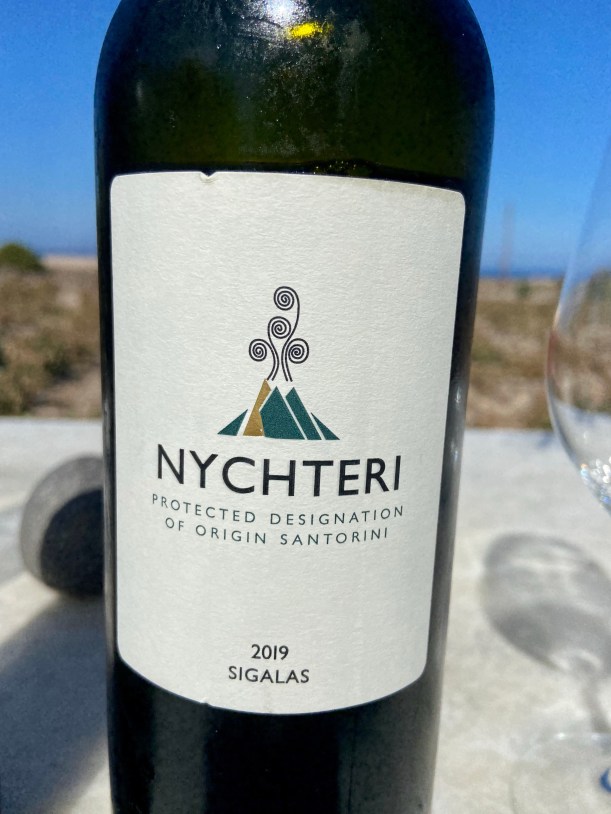
Nychteri. 2019
A truly massive white wine, more like a red, a real heavy weight with a price to match!
Kiran-
Traditionally late harvest, 18 months in oak. 6 grams residual sugar l so only just dry.
Nose of perfume spicy, sweet, nutty and of course vanilla – Coco Channel like!
Round and full bodied a definite sweetness.
Rich spicy fruit, medium plus sweetness, and endless length. Extremely complex.
Adam – From select grapes picked during the night
Aged for longer on lees
Rich highly textured deeper colour
Honeyed feels like a hint of residual sugar
Really smooth and complex, length++
Delicious +++++
Spyros Recommends aging 6-7 years. Salty mineral character keeps building and fruit falls away.
Reds
Mavrotragano 2019
Kiran -Mavrotragano was traditionally grown in the same way as Assyrtiko trained into low but struggled to ripen evenly. Sigalas and Hatzidakis began to train the vines in low linear runs and to irrigate to help ripen the grapes fully and demonstrate the potential of this indigenous grape.
On the nose lots of berries, blueberry and a little smoke then also some red berries and perhaps a bit of cheesecake.
Very appealing and tasty, medium plus body, medium acidity, medium soft tannin experienced upper lip. Ripe Fruity flavours with lashings of toast and vanilla but not overwhelming. Drinking beautifully.
Adam- Sigalas red 18 months in oak Mavrotragano 3 percent vineyard area
First vertical vineyards on island,
Plums, berries spice complexity
Lots of fresh red fruit and blueberries
Good Length a hint of spice, cumin.
Mavrotragano – Mandilaria 2019
Mandilaria blend with Mavrotragano.
18 months in oak Mandilara has high acidity but high tannin so good for a blend.
Nice chewy mix of strawberries and cream with a savoury herby bite.
The food from the restaurant at Sigalas is a fine match with their excellent wines.
We highly recommend the seafood risotto which you must call in advance and reserve as limited amounts made. It was also interesting to taste the caper leaves and stems which were slight aromatic and more delicious than capers themselves.
Santorini is not just about white wine. This red Mavrotragano was fruit packed and delicious
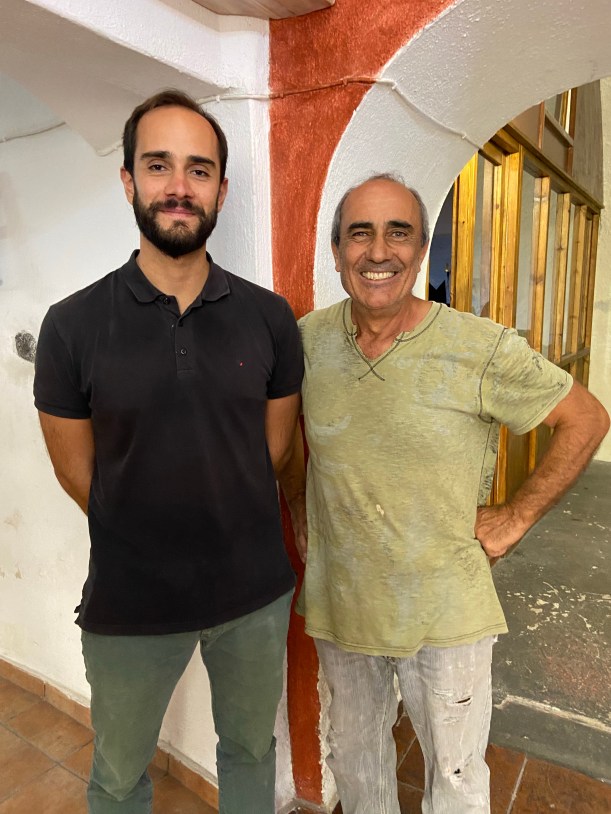
The passionate Vagelis Gavalas stands proudly with his father George
Gavalas winery
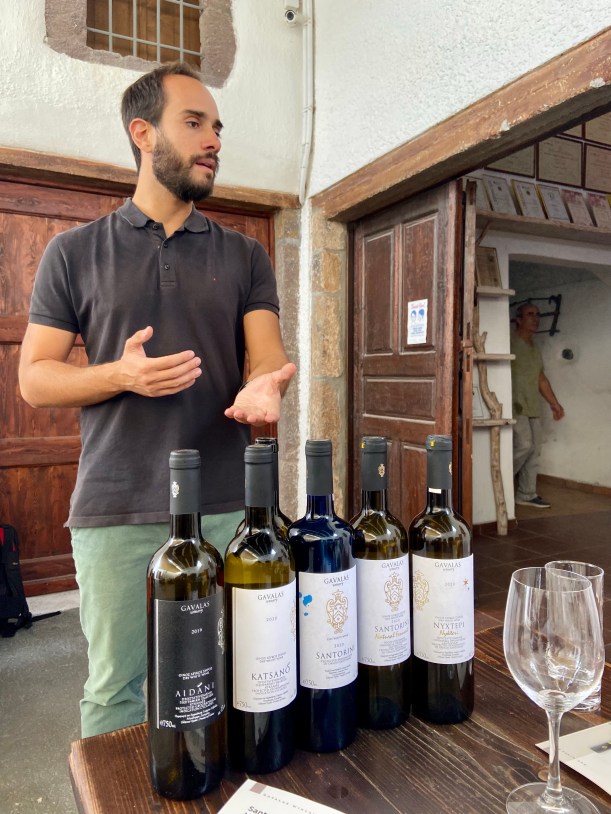
Gavalas was established in 1895 making it one of the oldest in the Cyclades. It is still family run with the fifth generation Vagelis taking on the realms. It is situated in the very beautiful hilltop village of Megalochori. Our Toyota Aygo almost ended up wedged into a tiny narrow street. We would recommend parking up and exploring the delights of Megalochori prior to tasting. We were fortunate to be hosted by Vagelis Gavalas who if he’d had his way would have kept us there all day! They have a broad range of styles and have some lesser known varieties such as Katsano
Wines tasted with Vagelis Gavalas
Aidani 2019
In the past vineyards used to be mostly assyrtiko but other grape varieties mingled in including Aidani. So many wines labelled Assyrtiko were effectively field bends. However, although the PDO still allows a percentage of other varietals all the serious wine makers now select to bottle 100% assyrtiko wines. At least as far as possible.
So as a result there is a fair amount of old vine Aidani and a 100% bottling appears on a number of wine makers lists. Its not made for aging and is best at around 2-3 years
The winemaking includes a cold soak, fermentation in temperature controlled stainless steel tanks and 3- 4 months on lees with batonage , typical for aromatic type grapes.
Indeed, the wine is more aromatic and less acidic than assyrtiko. There is an aroma of rolling tobacco and ripe honey dew melon.
It has medium body, medium acidity, flavours of stone fruit, mineral, citrusy with a bitter lemon pip finish.
Vagelis Gavalas the wine maker explains that Aidani does have a bitter characteristic which the lees aging softens out.
Katsano 2020
This wine is a blend of two rare local grape varieties Katsano 85% and Gaidoura 15%. Made in a similar way to the Aidani and at 12% alcohol a lighter wine.
A floral nose, hyacinth with a green tinge of dried herbs, potpourri quite delicate
Lighter body, higher acidity, floral, green and refreshing. Similar profile to a gavi di gavi
Santorini 2020
100% assyrtiko in a distinctive blue bottle.
Blend of different parcels from across the island all vinified separately
Classically austere in style. Lemon sorbet, a green florality, wet stone and citrus pith.
This is my type of wine, fresh and clean with crisp acidity. More lemon, lemon pith and with a phenolic, herbal tingling finish on upper gums. Great balance the freshness masks the 14% alcohol. Really lovely!
Santorini Natural Ferment. 2020 14%
Made from old vines of 50 plus years and with wild yeasts. Slightly riper grapes with a bit more residual sugar. Some of the harvest matured in old oak barrels then a proportion blended back in.
A wine with a richer flavour and more texture from the longer lees aging. Lime, lemon pith, wet stones, fresh green herbs. A lovely characteristic salty tang on the finish. Excellent!
Nykteri 202014.5%
This is a barrel aged Assyrtiko using the best late harvest grapes using first run juice from grapes treaded into the night.
Vagelis explains that the old style Nykteri were heavy and oxidative wines made from the last batches of grapes, made in often partially filled barrels and intended for the wine makers own consumption. But now better more controlled wine making techniques are used to prevent over oxidation.
A smoky, volcanic nose with a hint of vanilla.
Ripe stone fruit, mineral salty and intense, full bodied but nicely balanced.
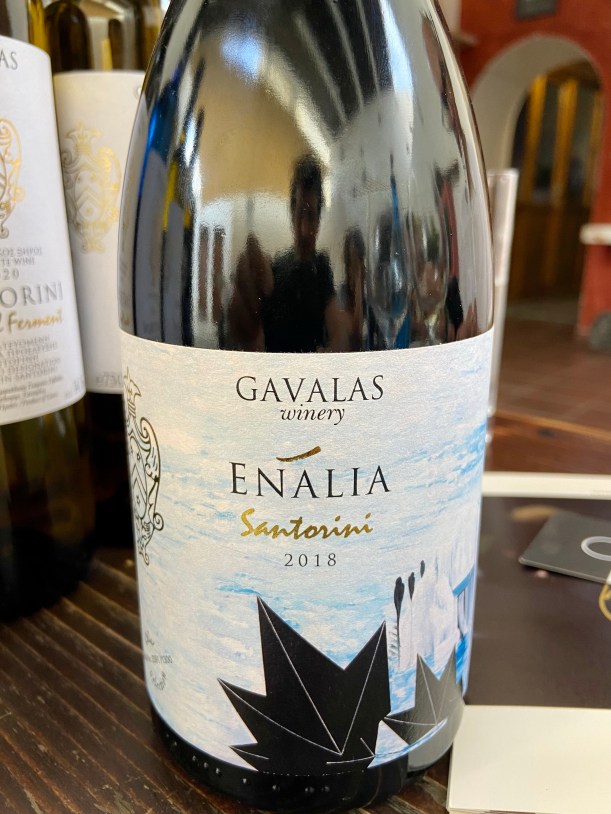
Enalia Santorini 2018
Even older vines at 120 years plus 18 months lees aging.
A pleasant whiff of petrol on the nose, more dried herbs.
A very intense palate, concentrated baked lemon, with a focused sweetness followed salty wet stones, goes on for ever wow!
Full body well balanced by high acidity which masks the alcohol level of 14.5%.
Vinsanto 2013
280 grams residual sugar.
Vinsanto is aging a minimum of 6 years, this one actually 7 years.
A real Corker!
Figs and dates with a hint of crème caramel on the nose.
Luscious velvety mouth feel with more soft dried figs and medjoule dates with faint toffee notes. Obviously sweet but with great lift and balance. Surprisingly low alcohol at 11%.
This lasts and lasts. Complex and delicious!
We could easily have stayed all afternoon, such was the quality of the Gavalas wines and the passion of Vagelis but we were already an hour late for our booking at the highly recommended Metaxi Mas restaurant .
Venetsanos Winery
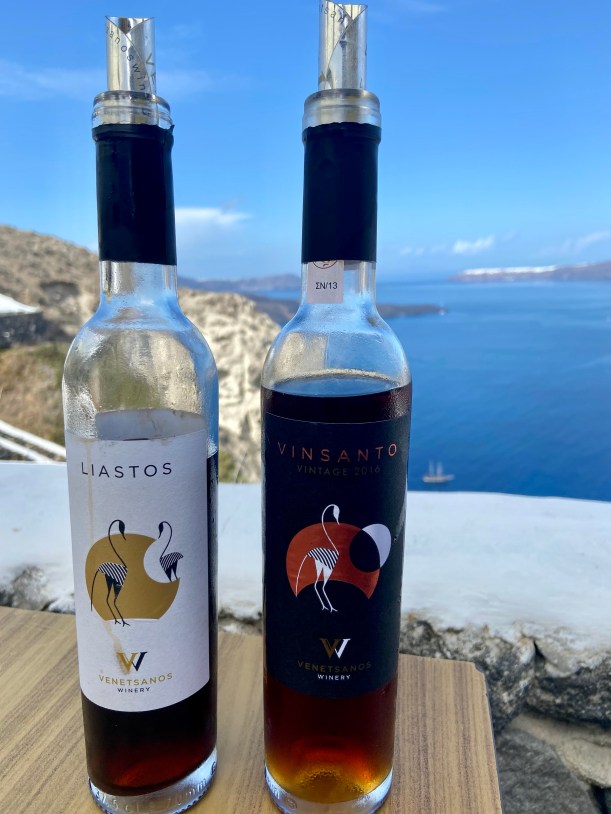
Venetsanos winery perched spectacularly on the edge of the Megalochori Caldera
Venetsanos is one of the oldest wineries in Santorini founded by George Venetsanos in 1947. The winery was excavated vertically inside the volcanic rock. They used gravity for the wine making process. The wine flowing down pipes more than 300m down, to be loaded in the ships in the port of Athinios. The wine was exported to France, Russia and Egypt.The tasting was held on on a rocky terrace with the stunning caldera below and overlooking the port All wines are single vineyard with low production and high quality.
Santorini
Assyrtiko 100%,Crisp acid lemon grapefruit lingering bitterness and salinity
Nykteri
Vanilla whisky creamy texture Rich wine, Nykteri harvest at night, late harvest with oak ageing
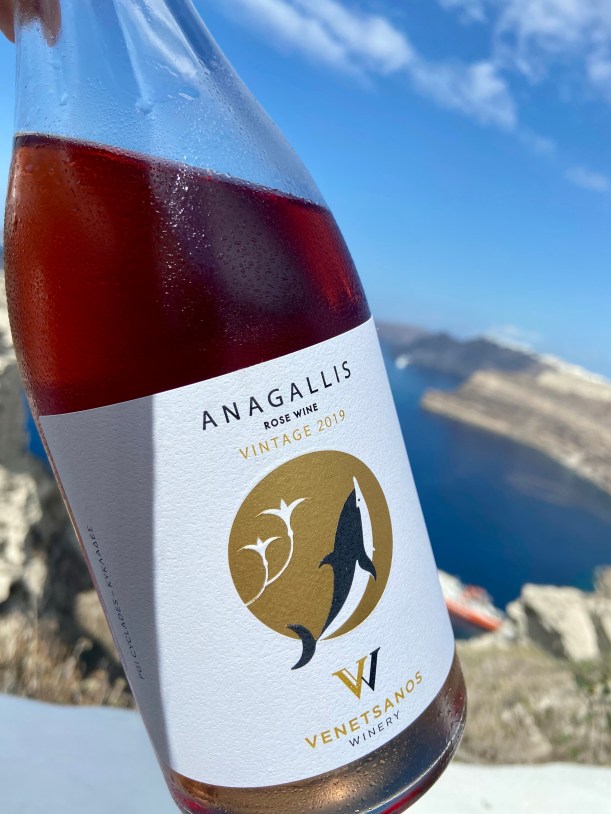
Anagallis
Rose wine deep pink colour ferment with 2 white grapes and mandilaria red.
Delightful perfumed red fruit candied strawberry and red cherry nose
Hint of residual sugar. A crowd pleaser more American in style Mandilaria
Red grapes not overly complex drying tannins all over mouth reminders of an Italian wine possibly Barbera
Vin Santo
Assyrtiko10 to 15 days drying grape, Luscious very sweet some oxidation nuttiness, fig, date, prune and vanilla
View from Venetsanos restaurant overlooking the port of Athinios
















 WanderCurtis Wine