Here is a condensed two page summary of the WSET Diploma D3 material on the central regions of Italy.
The regions include: Tuscany and Lazzio which sit on the western side of the Apennines and have largely Mediterranean climates. Umbria straddles the Apennines and is Mildly Continental. Marche and Abruzzo sit on the eastern side of the mountains bordering the Adriatic. These both have a largely Mediterranean climate except for inland parts of Marche which are mildly Contental.
Again the notes are organised into the key subject areas of: climate, topography, growing hazards, wine law, grape varieties, wine growing and wine making practices.
Note this document is intended for personal use only not for commercial or promotional use. We accept no liability for any omissions or errors that may be contained in the document.
Sangiovese is the most widely planted grape variety in Italy, known for its adaptability and quality potential. It is an early-budding, late-ripening vine that is vigorous and high-yielding, often requiring green harvesting to control crop load for better quality. It performs best on south to southeast-facing slopes at cooler higher elevations ( 200 + meters) which help extend the ripening period. It thrives in the classic Galestro found in Tuscany arguably the home of this grape variety.
It forms the backbone of Chianti, where it must make up at least 70% of the blend, and Chianti Classico, where the minimum is 80%. Vino Nobile di Montepulciano also relies heavily on Sangiovese but in Brunello di Montalcino the wines are 100% Sangiovese producing powerful, long-lived wines.
This contrast between 100% Sangiovese wines and blends was brought home to me recently when advising on the selection of northern Italian wines for a wedding. I was struck by how sensitive Sangiovese wines are to the addition of even quite small amounts of other varieties. Canaiolo and Colorino are the classic varieties added for florality and deeper colour in Chianti Classico. These obviously change the aromatics a bit and the colour. However when international varieties such as Cabernet Sauvignon and Merlot are added that delicate sour cherry and chalky character of Sangiovese seems to disappear.
Given the quantity of the grape grown in Italy it is perhaps not a surprise, it can’t all be grown on these ideal sites and so blending is obviously a useful way of filling in gaps and completing a wine at a certain price point. And there really are some great reasonably priced wines from Tuscany.
En Primeur, the sale of wines as futures, was until a few years ago a method of sale for premium Bordeaux and Burgundy but now it is increasingly being used for fine wines from other regions.
In this tasting the wines are pre-release but not by much. Brunello di Montalcino must be matured for a minimum of 5 years, including at least two in barrel, before being released to the market. These wines are already in bottle, rather than barrel samples and due out in 2025. So this EP seems to be more about marketing and to generate some expert reviews and promotional activity amongst the merchants.
For the customer the days of buying a future wine to help the wine makers cash flow and enjoying a slight discount in exchange are largely long gone. Now EP seems to be more about securing an allocation of rare or prestigious wines.
Brunello di Montalcino is a DOCG south of Siena within Tuscany. It is warmer and drier than Chianti producing more powerful concentrated expressions of Sangiovese. Its not far from the coast so parts receive some cooling breezes and inland the beautiful rolling hills provide a little elevation. Both of these factors help slow ripening down, which helps develop flavour and maintain freshness in the wines.
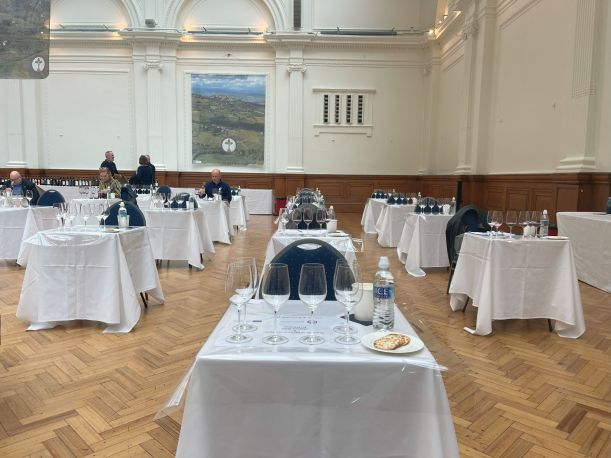
The seated format of the tasting was actually brilliant, no juggling of glass, catalogue (or e-catalogue on your phone) pen and pad, and no elbows required to push through the usual scrums that form around the popular tables – bliss!
It reminded me of how much I like Brunello and I was impressed by how approachable many of the wines were already on release. However with high acidity, fine sandy tannins and that concentrated red fruit they promise much more to come with bottle age. Many displayed classic sour cherry, dusty soft red fruits, bay leaf, dried herbs and a hint of black tea.
It was great to try and compare and contrast the impact of different soil types, those with more clay seeming to display riper fruit. Also to contrast the effect of using either Slavonian or French oak casks. Whilst the French oak did add a layer of spice and sometimes subtle toast, none of the wines I tried seemed overdone.
Of the many great wines on show a few stood out to me:
Argiano BdM – Lovely nose, balanced with a nice touch of spice.
Banfi Vigna Murrucheto BdM – Concentrated fruit and subtle toastiness.
Capanna BdM – Classic sour cherry, black tea and touch of wet stone.
Col d’ Orcia BdM – Intense riper red cherry and plum, dried herbs, bay leaf and a nice dusty finish.
Col d’ Orcia Poggio al Vento Riserva 2016 – Concentrated pot purri, raspberries, sour cherry, black tea, smoke and leather, super long.
Sesti BdM – Consistently fine, roses, sweet cherry, cranberry, dried oregano, black tea and freshly turned soil, amazing concentration.
Sesti Phenomina Reserva 2018 – Knock put too!
Uccelliera BdM – A big wine but still fresh with rich cherry tart, roasted herbs and a bit of toast.
Many thanks to Hunt and Speller and Consorzio del vino Brunello di Montalcino for organising this great tasting and providing so much interesting information about the wines in the catalogue.
By the way don’t forget the Rosso di Montalcino category of wines too. Supposedly entry level but many of the top estates produce what are effectively baby Brunello’s which represent great value for money and can be enjoyed sooner.


 WanderCurtis Wine