

Full disclosure, I have a very soft spot for Austrian wine. It is undoubtably through my partner, who is Austrian, that I have grown to love the many and varied delights that the country and its people have to offer. It’s fair to say that family Curtis pulls its weight when it comes to consumption of Schnitzels, quaffing of Greuner Veltliner and bashing of mogul pistes. Oh, and it goes without question that Semmel are the best bread rolls ever and nobody makes better ryebread.
Anyway, we’ve written at length about Austria’s fabulous white wines: Greuners and Rieslings from the Wachau, Kamptal and increasingly from Traisental along with the characterful Sauvignon Blancs from SudSteirmark, but not enough about the country’s excellent red wines. My suspicion is that a lot of Austrian red wine just doesn’t make it out of the country because demand at home is so healthy. So, I was delighted be invited to a lunch spotlighting Zweigelt and the grape’s many faces organised Neusiedlersee DAC.
Zweigelt is the most planted red grape variety in Austria, second only to Gruener Veltliner in terms of vineyard area. It is a cross between Austria’s other two main red grapes, Blaufraenkisch and St. Laurent, the former, late ripening with high acidity and firm tannins and the later early ripening with delicate fruit and moderate tannins. The result, it is argued, is a wine that displays the best of both and is fruit forward, with gentle acidity and soft tannin. It can be made in a forward fruity style at a great price point or through selection and sometimes aging in barrique as a more structured reserve wine capable of many years bottle age.
Neusiedlersee DAC (designated area of origin) is located to the east of the Neusiedlersee a large lake on the boarder between Austria and Hungary. The designation is only for the production of Zweigelt and sweet wines although most of the winemakers in the area also produce a variety of other wines too.

To demonstrate this the aperitif served before lunch was a Welschriesling Voll Freude 2021 by Georg Preisinger. Fresh with citrus and apple served gespritzt. The perfect refresher: half wine and half sparkling mineral water.
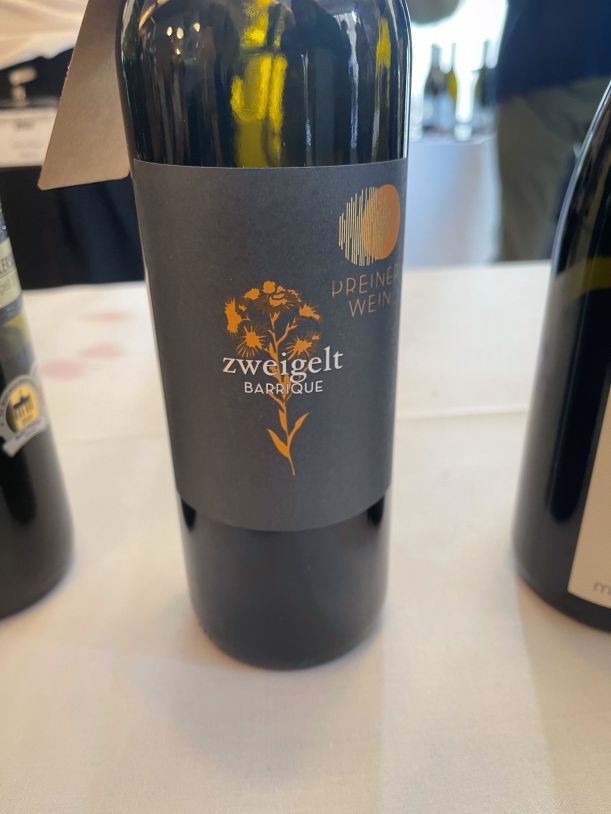
Next a young 2021 Zweiglet by Preiner Wein, served with an autumnal mushroom risotto.
Very fruit forward with accessible berries and a whiff of spice on the nose. A nice midweight body, soft tannins and good freshness. Well balanced and a collaborative partner to the delicate risotto flavours. Tasty!
The main course of grilled sweetbread was served with single vineyard Zweigelt by Gebrueder Nittnaus, Zweigelt Golser Ried Luckenwald 2004.
The wine demonstrated how well the variety can develop in the bottle in the right hands.
On the nose cut strawberries, damp forest floor, a touch of vanilla from the Barriques. It retained a lovely juiciness on the palate with complex tertiary notes of mulch and mushroom. Great length. Excellent and it held its own against the richness of the sweetbread.
Finally with a desert of baked apple and vanilla cream a TBA Welschriesling Siddartha 2018 by Johannes Muenzenrieder. Wow a delicious nose of peach, roasted nut and honey, more of the same in the mouth, lovely balance and length. Sweet wines from near the Neusiedlersee benefit from the morning mist and afternoon sun and somehow retain great freshness.

The line up of Zweigelts on the free pour table displayed a spectrum of wines most of which were juicy and tasty from the off with some cellared samples that had developed lovely complexity. There were nice examples by Artisan Wines, Weingut Kummer, Keringer, Preiner Wein, Hannes Reeh, Salzl Seewinkelhof and Allacher.
Hopefully we’ll start seeing some of these lovely Zweigelts appearing in shelves in the UK soon!
 WanderCurtis Wine