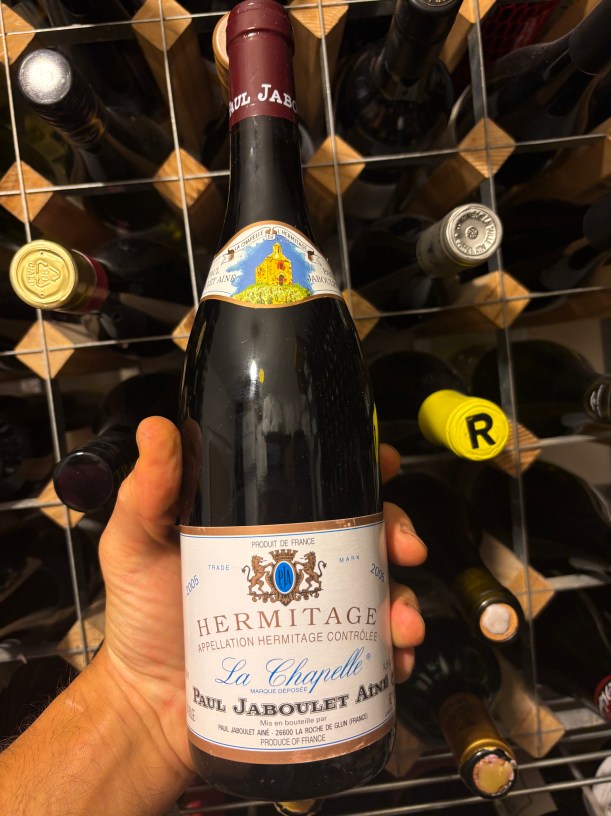
A memorable wine dinner moment was when Marcel Orford-Williams, the then Wine Society buyer for the Rhone, turned up to our Domaine Paul Jaboulet Aine dinner with two bottles of the 1991 La Chapelle, from his own cellar, to generously share. At 22 years old the wine was amazingly vigorous and layered and has stayed in the memory ever since. So I was excited to take the 2005 La Chapelle along to a recent blind tasting dinner and see what it was like.
The colour was very deep garnet with a brick rim. On the nose: violets in bloom, red & black cherry, baked blackberry tart and toast. A touch of classic ground black pepper, then earth, dried Iberico ham and a whiff of polish.
In the mouth it was bone dry, with bags of refreshing acidity, plenty of ripe fine grained tannin. These were felt on the gums and cheeks but also as a knot on the tongue. There was subtle oak so probably mostly old oak with a smaller proportion of new. The wine was concentrated and the fruit fresh and still prominent after 20 years. There were more dried herbs and pepper corns on palate and hints of loamy earth and chestnut mushrooms seemed to only grudgingly speak of the wine’s maturity. The finish was long and savoury.
What balance! even with 14.5% alcohol the wine remained cool and classy. This wine has developed at a glacial pace, earlier bottles only opening up after many hours of decanting and only now is it reaching maturity. Still the core of fruit and abundant freshness and tannic grip mean it should happily go on for another decade.
It’s widely reported that the quality of La Chapelle diminished after the 1991 vintage but then gradually recovered once Caroline Frey of Chateau La Lagune took over in 2006. The 2005 must have still been in barrel so perhaps benefited from Frey’s hand in the final blend if not the subsequent conversion of the vineyards to organic and biodynamic practices and the change to Bordeaux style French oak barrels in later vintages. Whatever the case the 2005 wine is superb!
By the way you won’t find La Chapelle under the Jaboulet name any more it has now been turned into a separate winery called Domaine de la Chapelle.
A one page summary of the: climate, topography, growing hazards, wine law, grape varieties, wine growing and making practices and the main wine producing regions.
Greece has at the time of writing not come up as a country in the D3 tasting exam. However key wines have come up in the mixed bag and if it did wines to look out for include:
Assyrtiko from Crete or Santorini
Xinomavro from Naoussa (or Amynteo)
Moschofilero from Mantinia
Agiorgitiko from Nemea
And don’t forget Retsina!
For a deeper dive, beyond the Diploma curriculum, into the many Greek PDOs and IGTs Wines of Greece website has plenty of information.
Sources include: WSET Diploma Wines of the World, Wines of Greece & various producer wine maps and aerial photography.
Note this document is intended for personal use only not for commercial or promotional use. We accept no liability for any omissions or errors that may be contained in the document.
On a recent trip to Alsace the main focus was of course the ‘noble varieties’ (as they call them there) Riesling, Gewürztraminer and Pinot Gris along with the excellent Pinot Noirs also produced. However it also switched me onto the often excellent Crémants coming from this region.
Image by Domaine Frédéric Mochel
These sparkling wines are made by the same traditional method as used in Champagne. Much of it though tends to be made using Pinot Blanc from less exciting vineyards on the valley floor and spends the minimum time of 9 months on the lees before disgorgement, leading to enjoyable but unremarkable fizz.
This wine on the other hand is an example of Alsatian Crémant made with greater ambition. From a small biodynamic estate it is a blend of 80% Chardonnay and 20% Pinot Noir and has been aged for over three years on the lees.
There is fine stream of persistent bubbles and a nose of orchard fruit, lemon tart, bread and a pleasing struck match note.
Its dry with crisp acidity, mid weight body and moderate 12% alcohol. In the mouth more lemon, ripe apple, lemon tart, pastry and that struck match note, enough to keep you interested. The finish is extended and ends on a nice lemon, brioche and slightly caramelised note from the long aging.
It is moreish and really delivers a lot for the price. Available at The Wine Society
The last bottle of a case bought on release which I’ve held onto just to see how it evolved. I suspect that the Kumeu River Estate has been wine of the month before but on the basis of this delicious bottle it fully deserves to be again.
On the nose, baked lemon, tart citron (lemon, custard and pastry) vanilla, toast, smoke, both ripe and preserved fruit.
Dry, with a firm persistent freshness the wine is full bodied with a creamy texture but wears its 13.5% alcohol well. The new oak is now nicely integrated and the fruit remains pronounced with ripe citrus and pineapple. Lees aging and malolactic fermentation are evidenced by the yummy custard and pastry notes that combine with the lemon to come across as a baked lemon tart. All this now overlayed with honey and preserved lemon. The finish is complex and super long.
Still going strong at 12 years this is at a lovely point now but will hold for several years more. These wines drink well on release and so it’s hard to resist polishing them off in their youth, but a decade or so of bottle age has really brought all the elements together beautifully.
Viticulture is an art steeped in tradition, terroir, and let’s face it, chemicals. The sad truth is that grape growing is one of the most chemically intensive forms of agriculture on the planet, with vineyards receiving more fungicide, pesticide, and herbicide input per hectare than almost any other crop. These inputs, do help suppress disease and pests but come at a steep cost, both financially and ecologically. Soil health suffers, biodiversity declines and waterways are polluted. In the face of climate change and a growing appetite for sustainability, this model of winegrowing is increasingly becoming untenable.
But what if vines didn’t need constant chemical protection to thrive? Well as it happens the non-vinifera species of vines don’t. While Vitis vinifera, the species behind nearly all fine wines, succumbs under the pressure of diseases like downy mildew, powdery mildew and botrytis bunch rot, (not to mention Pierce’s disease, and virus carrying nematodes) other Vitis species possess natural resistance to many of these threats. Vitis labrusca, riparia, rotundifolia, and others evolved in conjunction with some of the most damaging of these diseases and so developed defences that could transform viticulture.
There’s just one catch: they don’t taste all that nice when vinified. Non-vinifera grapes often carry what’s politely called a “foxy” flavour, a musky, wild, and sometimes animalistic character that isn’t welcomed by lovers of elegant Pinot Noir or noble Riesling.
This is where hybrids come in. By crossing disease-resistant American or Asian grape species with classic vinifera varieties, breeders have developed grapes that combine the best of both worlds: resilience in the vineyard and drinkability in the glass. Hybrid grapes are not a new phenomenon. The 19th and 20th centuries saw waves of innovation, from the American hybrids developed to battle phylloxera, to the French and German breeding programmes that gave us the Pilzwiderstandsfähige Rebsorten (PiWi) literally, “fungus-resistant varieties.”
Some of these hybrids have already found homes in certain wine styles and regions. Vidal Blanc is the backbone of Canadian ice wine, capable of surviving both freezing temperatures and fungal pressure. Seyval Blanc has become a staple in English sparkling wine and WineGB reports that planting of PiWis including Seyval Blanc, Solaris, Rondo, and Regent increases year on year and now stands at 10%. Yet despite these successes, widespread adoption of hybrids has lagged. Part of the issue is perception, hybrids don’t carry the same prestige or name recognition as Chardonnay or Cabernet Sauvignon, and in markets that prize varietal labelling, that’s a tough sell.
Still, change is in the air. Breeding new hybrid varieties has always been a long, painstaking process. But now, advances in gene sequencing allow scientists to more precisely identify the disease resistance traits they’re after and so grow and bring new grape varieties to trail much quicker than in the past.
And while traditional wine markets may be slow to adapt, there’s one community that’s embracing hybrids with open arms: natural and sustainable winemakers. For these growers and vintners, avoiding inputs and considering their environmental footprint is often an intrinsic part of their philosophy. With minimal intervention, no chemical sprays, and low-sulphur winemaking, hybrids offer a way to farm in line with their values. Since natural wines often eschew strict varietal labelling anyway, the lack of name recognition becomes less of a barrier.
Names like Phoenix, Regent, Solaris, Chardonel, and Traminette are cropping up in forward-thinking vineyards. Solaris, in particular, is gaining traction in northern Europe for its ability to ripen in cooler climates, while maintaining fresh acidity and low disease susceptibility. Regent is showing promise for red wines with depth and spice, and Traminette, a relative of Gewürztraminer, is celebrated for its aromatic complexity.
It’s time to reconsider our relationship with hybrids and perhaps rebadge them “next generation” varieties as Karl Renner (see review here) likes to call them. Puligny Montrachet and Pomerol may spring to mind at the mention of Chardonnay and Merlot but let’s be honest the majority of wines labelled with these varieties are actually inexpensive wines produced by industrial viticulture. New generation hybrid varieties may never replace the pinnacle expressions of the classics but they’re certainly capable of producing delicious, high quality wines without all the nastycides.
Go on have a little adventure and give them a try.
This week’s Vessel Sustainable Wine Fair in Islington gave me pause for thought. I meet wine makers and distributors equally passionate about wine and sustainability and I tasted some great wines. I wondered whether I (I suspect like many other wine lovers) have been too quick to dismiss wine packaged in alternative formats?
The image of a glass wine bottle, corked, labelled, and gently sweating in a cool cellar, is ingrained in our collective wine consciousness. But while beautiful, the traditional bottle is far from benign. In fact, the production and shipping of glass bottles contribute a disproportionately high share of wine’s overall carbon footprint. Heavy, fragile, and energy-intensive to produce, glass packaging is one of the most environmentally taxing aspects of modern winemaking. As the industry searches for greener alternatives, a host of smart, sustainable packaging solutions are gaining traction, not just for the planet, but for our pockets and lifestyles, too.
Here’s an overview:
PET Bottles Lightweight, shatterproof and recyclable, PET (polyethylene terephthalate) bottles dramatically cut emissions during transport, thanks to being up to 90% lighter than glass, and cost significantly less to produce. However, their permeability to oxygen means they’re best suited to wines designed for short-term enjoyment, typically within 6–12 months of bottling. The Wine Society, after extensive trials of alternative formats, now offers flat PET bottles for several of its wines, optimising both shelf space and environmental impact. While they still carry a perception hurdle with traditionalists, PET bottles are gaining favour among everyday drinkers seeking lighter footprints without sacrificing flavour.
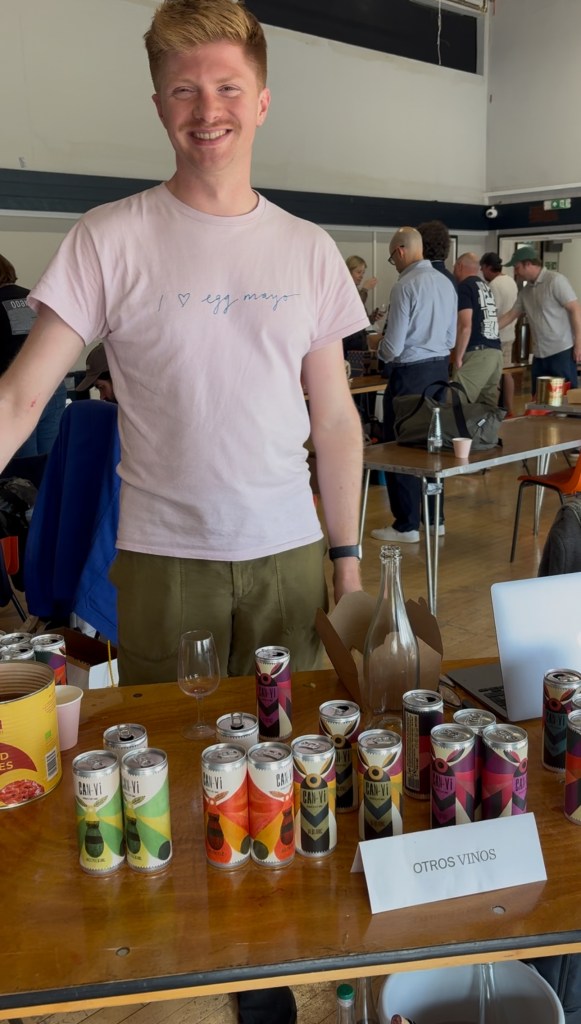
Aluminium Cans Wine in a can might still raise eyebrows among purists, but the popularity of their eye catching graphics, especially with younger and casual drinkers, is undeniable. Cans are ultra-light, fully recyclable, and offer the ultimate in portion control and portability. They chill quickly and are perfect for picnics, concerts, and midweek sipping without committing to a full bottle. Shelf life typically ranges from 12–18 months, ideal for most fresh, fruit-driven styles. While fine Burgundy in a can may never catch on, this format has found a clear place in the modern wine landscape, breaking down barriers with its convenience and accessibility.
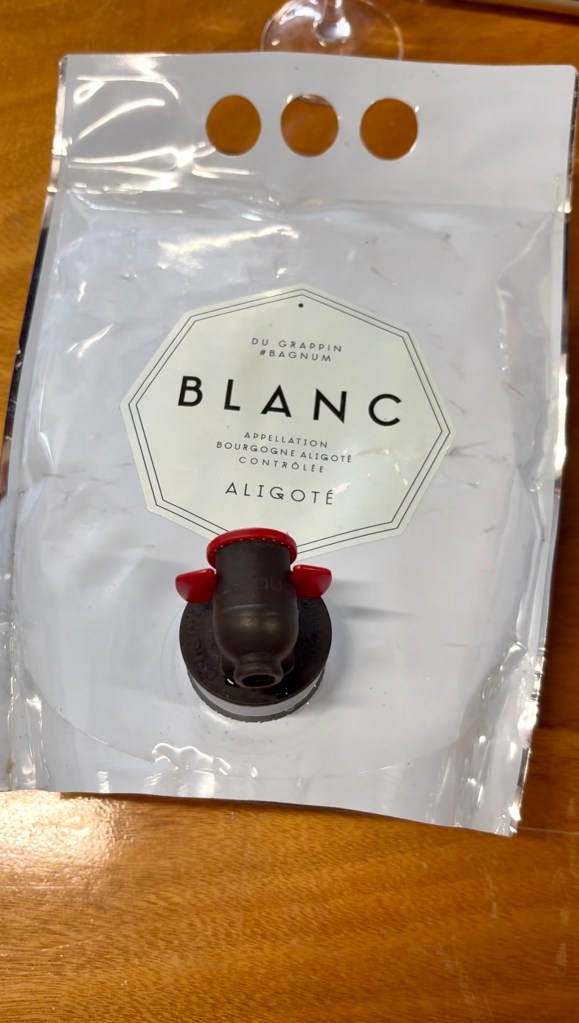
Bag-in-Box Once a symbol of bargain-basement wine, bag-in-box (BiB) has undergone a quiet revolution. Today’s BiB wines are often well-sourced, thoughtfully made, and remarkably sustainable. The format consists of a plastic bladder inside a cardboard box, which collapses as wine is dispensed, minimising oxidation and keeping wine fresh for up to six weeks after opening, brilliant for drinking a glass at time. Unopened, they can last 6–12 months. However I tasted a pinot noir that had been stored for 2 years at Vessel and it was in great shape. With lower packaging-to-wine ratios and reduced transport emissions, BiB is one of the greenest ways to package wine. The Wine Society now offers an impressive range of BiB wines, showing that good wine doesn’t need glass to deliver quality. Consumer perception is shifting too, especially among environmentally aware and value-driven buyers. At Vessel Le Grappin were showing a range of delicious Burgundy wines in a very smart looking ‘Bagnum’, basically the bag without the box.
Tetra Pak Tetra Paks, paper-based cartons familiar from juice aisles, are becoming a practical option for entry-level wines. Lightweight, compact, and cheap to produce, they offer a low-impact alternative to glass. Their recyclability depends on local infrastructure, which can be a drawback, but their portability and convenience are appealing. Shelf life is 6-12 months. While still limited in consumer popularity, they’re gaining ground among producers aiming to reach new, sustainability-minded markets.
Kegs Mostly found in restaurants and wine bars, reusable stainless steel kegs eliminate packaging waste almost entirely. A single keg can replace dozens of bottles and dramatically reduce cost and emissions over time. Wines stay fresh for up to two months once tapped, making them ideal for by-the-glass service. Though upfront investment and dispensing equipment are required, kegs are making appearances at refill shops and festivals. As the infrastructure grows, we may see this model expand into more consumer-facing settings.
The truth is, only 10–15% of wines globally are made for long-term aging. The vast majority are intended for enjoyment within a year or two of bottling, at their freshest, brightest and most expressive. For these wines, the traditional bottle is more about habit than necessity. By embracing more sustainable packaging like PET, cans, BiB, and Tetra Paks, we can preserve the pleasure of wine while reducing its environmental impact, and often, the cost. The future of wine doesn’t need to be corked and glassed. It just needs to be thoughtful, delicious, and a little lighter on the Earth.
After all the most important wine vessel is actually a nice long stemmed wine glass for most wine how it got there is less important.
A one-page summary flow chart of the key stages in Red Wine making.
I have reworked these from notes that I made during my Diploma and am sharing them on these pages for anyone studying a formal WSET course or just interested in learning.
These notes are absolutely not a substitute for the course books provided by WSET or indeed any other reference books. However I have found it helpful to condense information and present it visually in a way that tries to draw out the what, how and why that links things together or the similarities and contrasts that can help to make sense of everything. These note are very much prompts to the memory rather than full or detailed explanations.
Please beware there may still be errors in these notes and if you spot any do let me know.
Sources include: WSET Diploma, Oxford Wine Companion by Julia Harding and Jancis Robinson, Understanding Wine Technology by David Bird & Nicolas Quille.
Note: this document is intended for personal use only not for commercial or promotional use. We accept no liability for any omissions or errors that may be contained in the document.
I have reworked these from notes that I made during my Diploma and am sharing them on these pages for anyone studying a formal WSET course or just interested in learning.
These notes are absolutely not a substitute for the course books provided by WSET or indeed any other reference books. However I have found it helpful to condense information and present it visually in a way that tries to draw out the what, how and why that links things together or the similarities and contrasts that can help to make sense of everything. These note are very much prompts to the memory rather than full or detailed explanations.
Please beware there may still be errors in these notes and if you spot any do let me know.
Note: this document is intended for personal use only not for commercial or promotional use. We accept no liability for any omissions or errors that may be contained in the document.
Sources include: WSET Diploma Wine Production, Understanding Wine Technology by David Bird & Nicolas Quille and Oxford Wine Companion by Julia Harding and Jancis Robinson.
It’s often asserted that wines from low yielding vineyards are better quality, the argument being that the vine struggles and focuses its energy into producing small concentrated grapes with thick skins.
The idea that managing vineyards to achieve ‘low yields’ results in better grape quality is also enshrined in the European AOC (Appellation d’Origine Contrôlée) system. Each wine region sets an upper limit to the yield that is permitted from a vineyard. The yield is measured as either the volume of wine in hectolitres, or the tonnage of grapes, per hectare of vineyard produced.
As you ascend the appellation hierarchy the permitted yield reduces. For instance in France IGP Pays d’Oc, where huge quantities of every day drinking bottles of Merlot and other single variety wines are produced, the maximum yield for red wines is 100 hL/ha but in the smaller Bandol AOC, which produces concentrated age worthy reds from Mourvèdre it is only 40 hL/Ha.
Many wineries talk about the way they restrict the yields from their vineyards through bud rubbing and green harvesting in order to produce high quality grapes for their premium wines. However when one looks more closely, they are often rather coy about stating the exact yield.
To examine whether the relationship holds true its worth asking a few questions:
Firstly what do we mean by high quality grapes when it comes to wine making?
Secondly is there any evidence that yield and quality are directly correlated?
Thirdly even if restricted yield is a contributary factor in determining the how well the grape ripens how important is it compared to other factors in the vineyard?
Finaly in practice to what extent is the wine grower able manage the yield with a view to improving quality and meeting AOC targets?
Grape quality.
For wine making, a good quality grape delivers enough sugar for the juice to be fermented into an enjoyable beverage. At the same time the tart and harsh components within an unripe grape, including malic acid and methoxypyrazines, must have had time to metabolise and reduce in quantity. Pleasant flavours and flavour precursors need time to develop, for instance terpenes that add floral and fruity notes. For black grapes the skins need to ripen developing anthocyanins for colour and softening harsh tannins through polymerization. When this all comes together the grape is optimally ripe.
For the grapes to be optimally ripe the vine needs just the right amount of warmth and sunlight. Too little and the grapes remain unripe, tart and lacking in flavour. For example the cool and variable climate of the UK makes it challenging to grow high quality late ripening black grapes such as Grenache Noir. However too much heat and sun and the grapes accumulate sugar and loose acidity too quickly. In this case resulting in unbalanced high alcohol wines lacking in flavour concentration. For example the very warm central valley in California produces high volumes of wine but the area is not generally known for producing premium quality wines.
Correlation of quality to yield.
In Burgundy there is certainly a correlation between the high quality wines produced from Grand Cru vineyards such as Echezeaux in the village of Vosne Romanee where the yield is restricted to 35 hL/Ha and the generic Bourgogne wines produced at up to 69/ hL/Ha.
However looking at Bordeaux there are certainly many great vintages such as 1982, 2005 and 2010 where both quality and volume of production was high. There were also years, such as 2013 and 2017, where production volumes were low but which are not generally classed as great vintages.
The issue here is that there are lots of reasons why the yield can be low. These include frost damage, diseases such as mildew, pests such as birds, viruses such as leaf roll along with drought and heat stress. These factors do not necessarily result in the surviving grapes reaching optimal ripeness. In fact many can also actually lead to lower quality because the grapes fail to ripen or are spoiled.
Other vineyard factors that contribute to optimum ripening.
There are many and they start with matching the grape variety with the vineyard and climate type. Clearly Cabernet Sauvignon which likes warmth and is late ripening is not a good match for the cool shorter season of the Mosel Valley even with the effects of climate change. Likewise growing high quality Pinot Noir which ripens early will be problematic in Stellenbosch’s warm mediterranean climate.
Following this the wine grower aims to grow vines that are in ‘balance’ where the quantity of grapes the vine produces equates to the quantity that it is able to properly ripen. It is quite possible for a vine to produce lots of un-optimally ripe grapes, it is after all growing them for the birds who are less fussy than the vintner. The availability of water and nutrients effects the vines ability to ripen the grapes but also the exposure to warmth and sunlight. By balancing the vine planting density, spacing of rows and training system of the vines with the local meso-climate the vine has a chance to properly ripen grapes. Dr Richard Smart has shown through research that what matters most is the leaf to grape ratio and to avoid shading the fruit zone. This might well mean that in a cool continental climate the point at which the vine gets enough heat and sunshine to ripen the grapes results in a yield that is lower than in a warmer mediterranean climate where the vine can support higher cropping whilst still fully ripening the grapes.
What can the wine grower influence in the vineyard.
Once a vineyard is established it is actually not straightforward to control the final yield at the end of the growing season. Growers can ‘rub buds’ out after bud burst or green harvest the smallest outer bunches before veraison. However it is risky to remove buds so early in the season as hazards such as frost and mildew could still arise and further reduce yield. Green harvesting encourages growth of the remaining bunches so doesn’t reduce the final weight as much as might be expected. It can also result in larger berries which might undesirably reduce the skin to pulp ratio for red wines.
Stephen Skelton reports that what often happens in practice is that, if at harvest time the AOC maximum yields are likely to be exceeded, grapes are often simply left in the fields. If hand harvested selection of the best bunches in the vineyard might improve quality. However if mechanically harvested this method of lowering yield will not benefit quality.
Dr Richard Smart argues that it the wine grower has more control over reaching optimal ripeness than predetermined yields. By managing the canopy through the growing season to balance the leaf area with the fruit crop and importantly to avoid shading the fruit zone, not only can better quality grapes be grown, but often larger quantities too.
So it appears that although low yields and high quality can be coincident as the say in the medical world the relationship isn’t necessarily causal. It is more important to get the right balance in the vine whereby for the given climate, topography and soils the vine is trained and the canopy managed through the season, to optimally ripen the bunches it bears.
Continuing our blind tasting training we recently lined up a number of Grenache / Garnacha based wines from different regions to taste and discover what common characteristics they had and what regional variation there might be.
Grenache Noir:
This is a late-ripening grape variety that thrives in warm, dry climates. Its resilience to drought makes it well-suited to regions with low rainfall, and it is often cultivated as a bush vine on low-fertility, well-drained soils. Known for its high yields, Grenache accumulates sugar quickly, leading to wines with elevated potential alcohol levels, often exceeding 14–15% ABV.
In the glass, Grenache typically produces wines with a pale ruby hue, low acidity, and soft, supple tannins. On the palate, it offers ripe red fruit flavours such as strawberry, raspberry, and red cherry, accompanied by herbal notes of dried thyme and rosemary, along with subtle spicy nuances like white pepper and clove.
Grenache is frequently used in blends, particularly in the Southern Rhône, where it contributes fruitiness, alcohol, and body. It plays a key role in Châteauneuf-du-Pape, alongside Syrah and Mourvèdre. The grape also thrives in Spain (where it is known as Garnacha), especially in Priorat and Campo de Borja. Other prominent regions include Australia’s Barossa Valley and McLaren Vale, and Sardinia (as Cannonau).
Tasting advice:
Nick Jackson describes the tannin of Grenache as having ‘structureless structure’. This means that you feel tannin all over the cheeks, gums and roof of the mouth.
Tim Gaiser suggests looking out for ripe and cooked fruit, savoury herbs and animal notes in a high alcohol full bodied wine. Thick slow legs in the glass.
So what did we find?
In planning a Grenache tasting we focused on the classic wine regions but favoured examples that are 100%. In some ways this is atypical as the grape is by and large used as a blending partner that traditionally reliably ripens and tolerates a warm mediterranean climate. On the other hand the examples we chose probably are representative of the current trend to make Grenache in a perfumed, lighter, unoaked style, picked a little earlier for freshness.
What this highlighted was that the addition of the other grapes changes the character of the wine enormously. The only blend was the Gigondas which was still 80% Grenache but even the small proportion of Syrah and Mourvèdre added significant black fruits, earthy and dried meat notes.
Key findings:
The light colour intensity of the pure wines was consistent and even the blend was still fairly light.
All the wines had mid-range acidity, pretty full body and alcohol on the way to high.
The mid-level tannins were consistently felt all over the inside of the mouth and were ripe.
The pure Grenache wines were really quite aromatic, with pretty soft fruit, and consistent a dried herb, sometimes animal note. Including the one new world example from Barossa.
In the mouth the fruit character of all the ‘old world’ wines was much less ripe and often quite tart. The finish was always savoury and very dry. Even the Barossa example finished dry and although fruity contained an herbal note.
So the good news is that there do seem to be quite a few distinguishing features that spread across different regions of origin.
Tasting notes:
Finca L’Argata, Montsant 2016 14%
Light ruby towards garnet, slightly dull sheen. Slightly hazy, unfiltered? Medium legs.
Very aromatic nose, wild bright red strawberry, wild herbs, oregano, strawberry tart, spice, cherry cola. Very giving. Floral notes, then dried rose and an orange peel note.
Much tarter fruit on the palate than the nose promises. Dry, medium acidity, medium plus body, medium slightly prickly grainy tannins all over the mouth: cheeks, gums, roof of mouth. A biting into a lemon sensation, very tart cherry, underripe strawberry, a cranberry flush of freshness. Savoury and drying finish. Complex Finish medium.
Contino San Rafael Garnacha, Rioja2021. 13.5%
Mid ruby through to the core. Medium thickness and speed legs.
Ripe red and black cherries, raspberry, strawberry chew, dried basil, roasted rosemary, slight animal fir. Toast, and vanilla. Pronounced nose. Much more fruit forward.
Dry, medium acid, full body, medium alcohol, medium grainy tannins again all over the mouth, again more savoury in the mouth than the nose, strawberry, orange, dried herbs and a wet stone and very dry finish. Good length.
Le Gril du Mas Cristine 2022, Cotes de Rousillon.13.5%
Old vines, no oak aging.
Pale ruby to a watery edge, medium thickness and speed of legs.
Red cherry, raspberry, ripe fruit, strawberry sweet wine gum, dried wild herbs, touch of rosemary, dried oregano. Interestingly much more perfumed and fruitier in a burgundy glass.
Dry, medium acid, med+ body, med alcohol, medium tannin finer grained all over the mouth again. Again more savoury the palate, herbs, wet stone, dry finish which is med +.
Vino de Altura Garnacha. WS Gen Series. El Escoces Volante. 2023. Calatayud. Spain. 13%
Old vines. Altitude 750-950 m
Darker colour, still medium depth. Red and black cherries, green stems, and herbs, very nicely perfumed and floral.
Dry, medium upper end acidity, medium body, medium – tannin all over, tart fruit, orange peel. Medium plus length dry and savoury finish.
Yalumba Bush Vine Grenache. 2019. Barossa Valley, Australia. 14%
100% old vine 35%. Pale but a bit darker and goes closer to the rim. legs bit more viscous and slower.
Strawberry, wild strawberry, cranberry, banana fruit salad, dairy, yogurt vanilla, sandalwood, pot puri. Pronounced. More fruit driven than others. The herbal nature manifests as more of animal, and an amaro herb liquor. In the small glass some green pepper corns but in the big glass sweet red fruit.
Dry, medium acid, full body, high alcohol, really soft medium powdery tannin all over the mouth. Fruit is sweeter and rounder in the mouth, fruit is the main event, there is an underlying herbal note and the finish is fruity but with a bit of ash and cinders.
Moulin de la Gardette, Gigondas 2020. 14.5%
80% grenache, Mourvèdre and Syrah
Much deeper colour. Legs are very slow to form and slow,
Cut grass, smoke, grilled meat, wild strawberry, balsamic vinegar, black cherries, ripe black berry, spice, dried herbs, pepper black. Carraway seeds. In the big glass much more fruit dominant and interestingly sweeter on the palate from the big glass.
Dry, medium / medium + acid, tart blackberry, ripe black cherry, fruit is a little tarter but not as much as earlier wines. There is an earthy note from the Mourvèdre probably. Tannin is medium grainy and all over, finishes long dry and savoury. Most powerful and concentrated of the wines.





 WanderCurtis Wine