WanderCurtis Wine

Wine tastings, corporate events, reviews and recommendations


2 Comments

Barbaresco Weekend: Annual Barbaresco a Tavola 2019 Vintage Blind Tasting Dinner notes

Casa Nicolini, Barbaresco May 27th 2022

Introduction

The WanderCurtis team were delighted to have been invited to attend our first Barbaresco a Tavola dinner on Friday May 27th 2022. For the unacquainted, this is an annual tradition held by the region’s winemakers to showcase their latest bottled vintage. Held over three successive weekends in different restaurants, wine makers from across the area bring and pour their latest bottled vintage to other wine makers, members of the trade, journalists and others, to give a sense of how the vintage has turned out.

For those who have yet to encounter the Barbaresco region, well, the best thing to say is that what is commonly referred to as one region is comprised of the three regions of Barbaresco, Neive and Treiso, that collectively work under the single communal name of Barbaresco DOCG. While the star of the show must be made from 100% Nebbiolo, aged for a minimum of 12 months in oak with a further 9 months of bottle ageing, the region is also widely planted to Barbera, Dolcetto, Arneis and many other international varietals that can be bottled and sold under the Langhe DOC label. This affords the local winemakers an opportunity to honour more ancient traditions of blends, provides an outlet for the wines made from young vines and gives opportunities to experiment with more international varietals such as Chardonnay, Sauvignon Blanc and Merlot.

We attended the third of the three Tavola dinners, held at the restaurant Casa Nicolini in Tre Stelle. Set on one of many sensational ridges that run across the top of the vineyards, we were greeted with breath-taking views of key Barbaresco vineyards such as Asili, Rabaja, Rio Sordo and Martinenga. The potent aromas of ripe jasmine, although enticing, made it difficult find some of the finer edges of the aromas in these very young wines. We were the guests of Jeff Chilcott, Kiwi cellar master of Marchesi di Gresy, who we visited on Sunday for an amazing tasting (more on this later).

The format of the dinner is simple: 20 wines are set up on a central table, labelled 1-19, and you are invited to taste and score your way through the wines. Later in the evening, the wines are revealed, and you find out that most of people pouring the wines are the wine makers themselves. Over the course of the evening, we were served a typical and delicious multi-course regional meal. As the light faded, our palates tingling from the young vintage’s tannins and acidity, we left feeling full, fortunate to have taken part and maybe just a little tipsy.

The wines uncovered

Impression of the vintage

The 2019 vintage has been described by many as pure, energetic, and authentic with good fruit expression, fine abundant tannins and elevated levels of acidity – all typical characteristics of strong vintages. Our tasting left an impression of a vintage of balance, elegance and with good bones for the long haul. We would caveat this to say that with many having been bottled within a few weeks of the dinner, there was a high degree of wood on show, with many wines showing baking spice characteristics of cinnamon, and nutmeg, with a muted fruit expression. There were a range of wine making styles on show, with many made in the traditional neutral oaked manner and some showing the signs of flashy new barriques. We scored all the wines fully blind on a scale of 1-20, and frequently returned to wines that, on discussion, proved either hard to understand or sparked an interest.

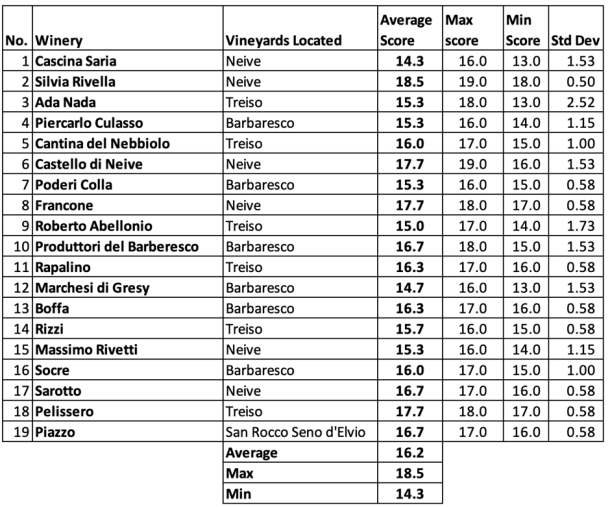
I have put our scores together in a table by wine, with our average, maximum, minimum and standard deviation scores listed (for those who like a bit of statistical wine geekiness).

Casa Nicolini Barbaresco

Tasting note comments

On balance, you will see that our average across all wines from the evening scores a 16.2 out of 20, which one could normally interpret as representing an average to good vintage. In context, however, given the extraordinarily young, freshly bottled wines, and examining the structural characteristics (acidity and tannin) and winemaking styles on show, I believe these wines will be showing beautifully in the medium term, and will reward the patient given their exquisite balance and structure.

In terms of individual wines, there was much debate on which of these was our favourite on the night. Initially, we were besotted with number 18 (Pelissero), a producer that clearly likes the full barrique approach, creating a ravishing, fuller bodied version of Barbaresco. On reflection and discussion, we marked it down on the basis that vanilla is not something that we feel belongs so overtly in Barbaresco of any age.

While our collective scores of number 12, the Marchesi di Gresy Barbaresco Martinenga, was rather low, our tasting on Sunday showed just how wonderful their wines are with a bit more age, and we therefore conclude that this wine was being a little shy. We would say the same for number 3 from Ada Nada, which split opinions, and whom we visited the next afternoon and had a wonderful tasting.

Our clear favourite, number 2 from Silvia Rivella, shone out as both an approachable yet structured newer style barrique-aged wine with potential to age into something truly beautiful. Other strong showings included the Castello di Neive (6), the ever-dependable Produttori del Barbaresco (10) and the Francone (8) which all stood out.

Stuart Grostern

Leave a comment

Bioweinbau Obermann in Grinzing, Vienna

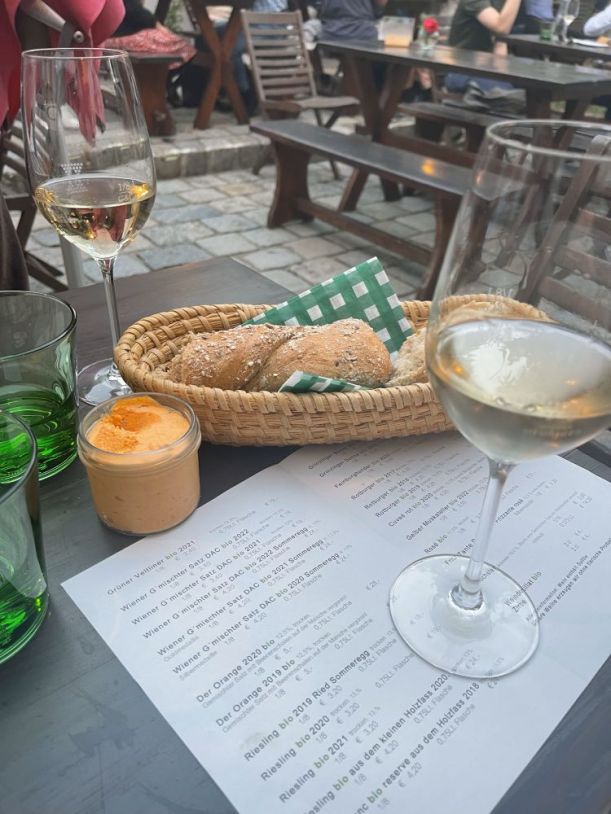
Another great Heurigen evening this time at Bioweinbau Obermann in Grinzing on the edge of Vienna. Here the specialty is Wiener #Gemischtersatz to wash down a selection of meats, spreads, cheeses and salads from the buffet. 

🍇 Weiner Gemischter Satz is traditional white made from a field blend of grape varieties harvested and co-fermented together. 

🌟 Normally its a mix which includes Grüner Veltliner, Riesling, Pinot Blanc & Chardonnay and to ensure the wine is genuinely ‘gemischt’ no one variety can make up more than 50% and the variety that is third largest must be at least 10%! 

😋 The wines range from crisp and zingy through to more concentrated age-worthy single vineyard bottlings showing stone fruit and spice but always racy acidity. 

🥂 Great wine in a great setting.


Leave a comment

Osteria Fernanda, & Osteria Giulia Rome

A cab ride from the ancient centre of Rome this restaurant is located on the ground floor of decidedly unhistoric looking apartment block, 1980’s at a guess! One wonders if you are in the right place.

This is obviously not the Osteria but the incredible Pantheon on the Piazza della Rotonda

However the interior is very stylish with tall shelves of wine lining the walls, wooden tables and simple lamps hanging from the tall ceiling.

This is the place to come for contemporary Italian food, a great tasting menu and a superb wine list.

Worth the journey.

Link to Osteria Feranda website.

Osteria Giulia is within walking distance of the Pantheon but again slightly off piste. The food as well as the decor is also contemporary and the atmosphere friendly and relaxed. Ask for by the glass wine pairing with your meal and the waiters will happily do this for you.

We also ate at a couple of the many restaurants lining Piazza della Rotonda and Piazza Navona where you can sit outside and enjoy the very scenic outlook and soak in the atmosphere but for great food and wine you need to explore further afield.


2 Comments

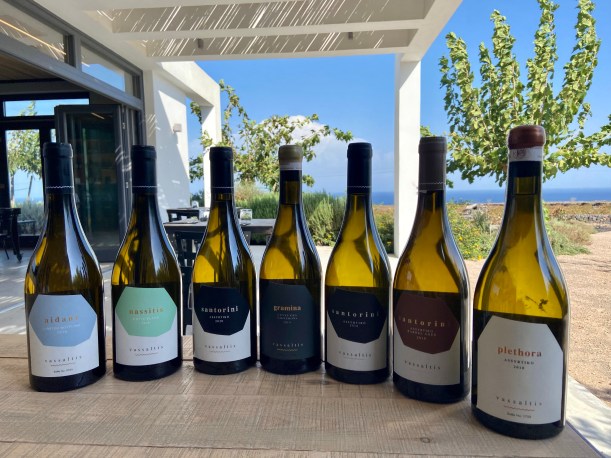
Vassaltis Winery, Vourvoulos Santorini

Vassaltis Vineyards

When my good friend Richard, founder of Wanderlust wines knew I was off to Santorini he insisted I go to Vassaltis. ‘Best wines on the Island’ he told me. Started by Yannis Valambous a former financier in London. It is Santorini’s newest winery, outside the village of Vourvoulus. The winery is sleek modern light and spacious with excellent views over his vineyards to the sea.The first wines from Vassaltis were released in 2015. We were lucky enough to meet their two highly talented winemakers, Elias Roussakis and Yiannis Papaeconomou.

Richard was bang on.

The wines are fabulous. The restaurant menu excellent too and the vibe atmosphere and service of the staff lived up to all expectations. Definitely a highlight of our vinous tour of Santorini

Tasting notes below courtesy of Kiran

Aidani 2020

Aged for up to 2 – 3 years

The label design is shape of a volcanic stone.

Nice floral nose.

Fresh with peachy and citrus notes some jasmine florality and medium body with high acidity but less than Assyrtiko A lovely aperitif style wine. 

Nassitis 2020

A blend of 3 whites Aidani, about 30% Assyrtiko and Athiri.

Lemon sorbet and wet stone on the nose.

More lemon zest, mineral and lovely salty tangy phenolic bitter finish.  A great food wine. 

Santorini 2020

100% Assyrtiko  a blend of grapes from different vineyards all over Santorini 24 eur. 

12 months on lees then bottled.

Immediate hit of dried herbs, rosemary thyme etc. then some lemon zest.  Then emerging hyacinth quite floral. 

Quite full bodied tannins felt on gums  high cripsp acid  nice long salty finish.

Gramina 2019

Gramina means field so this is a single vineyard wine from Vourvoulos the village nearby. 100% Assyrtiko grapes are handpicked early morning and the wine spends 12 months on lees and 12 months in bottle. 

On the nose an attractive petrolic whiff with an undertow of herbs and wet stones

Full bodied, smooth texture with dried green herbs, fresh acidity and a long lingering salty stony finish. Excellent. 

Santorini 2016

Darker richer in colour than the 2020.

A much more complex nose: petrol, honey, baked lemon, over ripe honey dew melon then salted almonds, really interesting. 

Lovely silky texture, very complex ripe with some sweetness and nuttiness the saltiness is still there but less aggressive softened out by the other flavours and age. A superb wine showing how well Assyrtiko can age. 

Santorini barrel aged. 2019

Smokey lemon and lime sorbet hint of petrol faint tarragon

Taught and almost austere structured wine herbs minerals and sea salt. Long. 

Santorini barrel aged 2017

On the nose smoke a bit of vanilla and over ripe mango AKA petrol.

The nuts honey, increasingly complex.

Lovely full body with a silky elastic texture, sweet notes, complex softening out the austerity found in the 2019 Gramina. Very long and persistent. Another fantastic wine.

Laterals would be an aged Riesling or a grand cru Chablis with a few years. In other words, premium wines of complexity and character. 

Open to debate but generally the non oaked versions seem to retain more of a unique assertyko character although the oaked versions are extraordinarily well made wines. 

Plethora 2018

The outstanding Plethora from Vassaltis- a truly remarkable wine

Late harvest Assyrtiko 6 months on lees then 8 months in old vinsanto barrels which are 60 years old then 2 years in bottle. A gap is left on top and sometimes flor grows. 

This closest to Nykteri approach that Vassaltis has.

Nose is reminiscent of a vinsanto, roasted nuts, smoke, hint of caramel, touch of balsamic. Very complex, a hint of Christmas.

Rich mouth feel, spices, orange peel and a characteristic sea salt and wet stone tang. Very very long. An outstanding wine, extraordinary.


Leave a comment

Domaine Sigalas – Santorini, Oia region

The view of the vines from Sigalas outdoor tasting area (harvest was August the earliest in Europe explaining the vines appearance)

Domaine Sigalas is the closest winery to our base in Oia, the Northernmost point of Santorini. It is a very pleasant walk via the village of Finikia with its excellent restaurant Meze Meze.

Sigalas was founded in 1991 by Paris Sigalas a maths teacher.It has been sold recently.

They predominantly make Assyrtiko and other indigenous whites like Athiri and Aidani. Red varietals include Mavrotragano and Mandilaria. More recently they have been exploring the subtle terroir variations of seven individual villages of Santorini.

Paris is seen as  a visionary and established the first vertically trained vineyards on the Island, almost heretical at the time.

They have almost 40 hectares of vineyard and produce nearly 200,000 bottles.

Santorini 2020

The wine spends six months on lees in stainless steel barrels.

2020 is apparently great year previous years from 2017 to 2019 suffered heat waves.

A nose of lemon rind and sea salt.

Medium body high acidity, great balance. Lively fresh pithy flavours with a tangy salty nice lingering finish.

Epta (7) Villages

One of a series of seven single vineyard wines exploring the terroir of different regions of the island.  Made in stainless steel barrels but aged on lees through to next harvest. 

Floral blossom notes some citrus underneath.

Some tinned peach at first followed by ripe lemon pith and characteristic herbal salty finish like rosemary salted fries! Again medium body high acid. Great length. Lovely!

Santorini Barrel 2020

Aged6 months in French oak barrels on lees. One in six are new oak and the rest second and third year.

Subtle vanilla and toast on the nose tiny hint of nice petrol. 

In the mouth nice blend of oak and lemon peel, lovely full silky mouth feel, full bodied but with lift and long. 

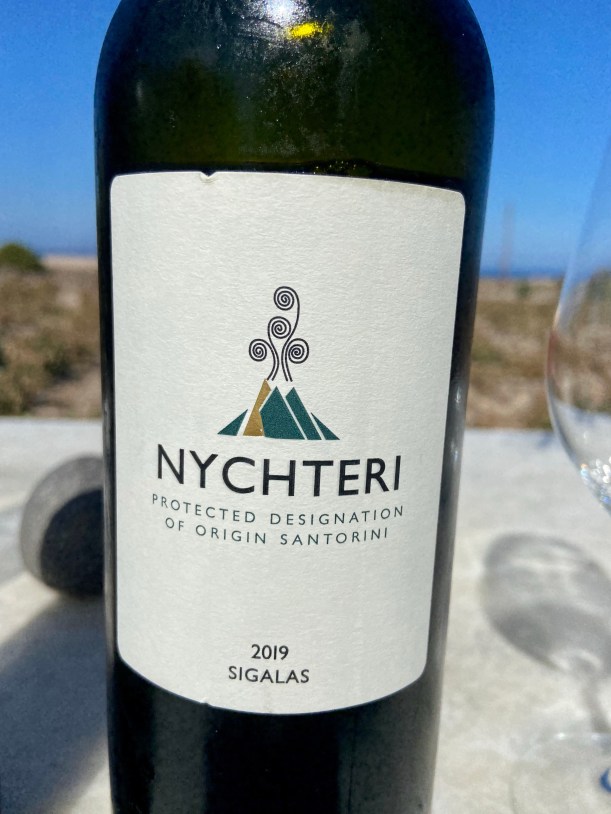
Nychteri. 2019

A truly massive white wine, more like a red, a real heavy weight with a price to match!

Kiran-

Traditionally late harvest, 18 months in oak. 6 grams residual sugar l so only just dry. 

Nose of perfume spicy, sweet, nutty and of course vanilla – Coco Channel like!

Round and full bodied a definite sweetness.

Rich spicy fruit, medium plus sweetness, and endless length. Extremely complex. 

Adam –
From select grapes picked during the night

Aged for longer on lees

Rich highly textured deeper colour

Honeyed feels like a hint of residual sugar

Really smooth and complex, length++

Delicious +++++

Spyros Recommends aging 6-7 years. Salty mineral character keeps building and fruit falls away. 

Reds

Mavrotragano 2019 

Kiran -Mavrotragano was traditionally grown in the same way as Assyrtiko trained into low but struggled to ripen evenly. Sigalas and Hatzidakis began to train the vines in low linear runs and to irrigate to help ripen the grapes fully and demonstrate the potential of this indigenous grape.

On the nose lots of berries, blueberry and a little smoke then also some red berries and perhaps a bit of cheesecake. 

Very appealing and tasty, medium plus body, medium acidity, medium soft tannin experienced upper lip.  Ripe Fruity flavours with lashings of toast and vanilla but not overwhelming.  Drinking beautifully. 

Adam- Sigalas red 18 months in oak Mavrotragano 3 percent vineyard area

First vertical vineyards on island,

Plums, berries spice complexity

Lots of fresh red fruit and blueberries

Good Length a hint of spice, cumin.

Mavrotragano – Mandilaria 2019

Mandilaria blend with Mavrotragano.

18 months in oak Mandilara has high acidity but high tannin so good for a blend. 

Nice chewy mix of strawberries and cream with a savoury herby bite. 

The food from the restaurant at Sigalas is a fine match with their excellent wines.

We highly recommend the seafood risotto which you must call in advance and reserve as limited amounts made. It was also interesting to taste the caper leaves and stems which were slight aromatic and more delicious than capers themselves.

Santorini is not just about white wine. This red Mavrotragano was fruit packed and delicious


Leave a comment

Santorini, Megalochori- Gavalas and Venetsanos Wineries

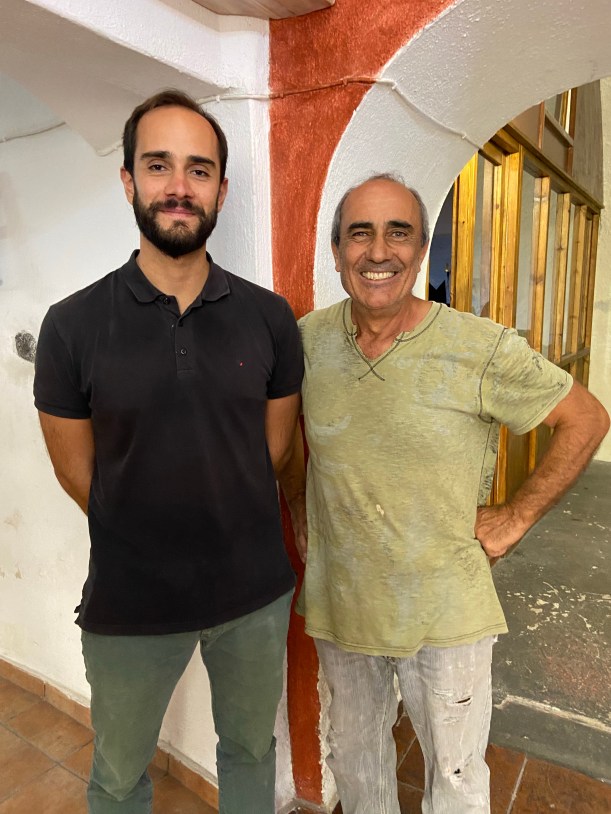
The passionate Vagelis Gavalas stands proudly with his father George

Gavalas winery

Gavalas was established in 1895 making it one of the oldest in the Cyclades. It is still family run with the fifth generation Vagelis taking on the realms. It is situated in the very beautiful hilltop village of Megalochori.
Our Toyota Aygo almost ended up wedged into a tiny narrow street.
We would recommend parking up and exploring the delights of Megalochori prior to tasting.
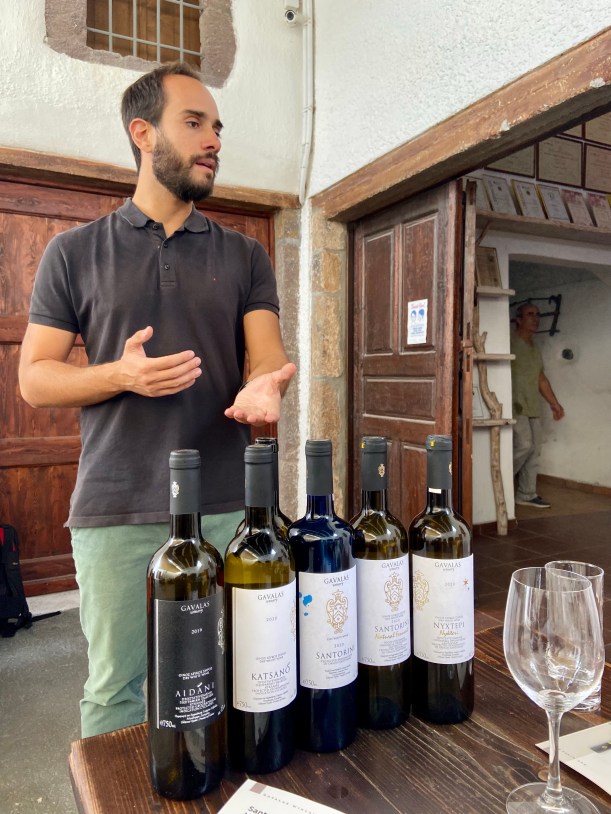
We were fortunate to be hosted by Vagelis Gavalas who if he’d had his way would have kept us there all day! They have a broad range of styles and have some lesser known varieties such as Katsano

Wines tasted with Vagelis Gavalas

Aidani 2019

In the past vineyards used to be mostly assyrtiko but other grape varieties mingled in including Aidani. So many wines labelled Assyrtiko were effectively field bends. However, although the PDO still allows a percentage of other varietals all the serious wine makers now select to bottle 100% assyrtiko wines.  At least as far as possible.

So as a result there is a fair amount of old vine Aidani and a 100% bottling appears on a number of wine makers lists.  Its not made for aging and is best at around 2-3 years

The winemaking includes a cold soak, fermentation in temperature controlled stainless steel tanks and 3- 4 months on lees with batonage , typical for aromatic type grapes.

Indeed, the wine is more aromatic and less acidic  than assyrtiko.  There is an aroma of rolling tobacco and ripe honey dew melon.

It has medium body, medium acidity, flavours of stone fruit, mineral, citrusy with a bitter lemon pip finish. 

Vagelis Gavalas the wine maker explains that Aidani does have a bitter characteristic which the lees aging softens out. 

Katsano 2020

This wine is a blend of two rare local grape varieties Katsano 85% and Gaidoura 15%. Made in a similar way to the Aidani and at 12% alcohol a lighter wine.

A floral nose, hyacinth with a green tinge of dried herbs, potpourri quite delicate

Lighter body, higher acidity, floral, green and refreshing.  Similar profile to a gavi di gavi

Santorini 2020

100% assyrtiko in a distinctive blue bottle.

Blend of different parcels from across the island all vinified separately 

Classically austere in style. Lemon sorbet, a green florality, wet stone and citrus pith.

This is my type of wine, fresh and clean with crisp acidity. More lemon, lemon pith and with a phenolic, herbal tingling finish on upper gums. Great balance the freshness masks the 14% alcohol. Really lovely!

Santorini Natural Ferment. 2020 14%

Made from old vines of 50 plus years and with wild yeasts. Slightly riper grapes with a bit more residual sugar. Some of the harvest matured in old oak barrels then a proportion blended back in. 

A wine with a richer flavour and more texture from the longer lees aging.  Lime, lemon pith, wet stones, fresh green herbs. A lovely characteristic salty tang on the finish. Excellent!

Nykteri 202014.5%

This is a barrel aged Assyrtiko using the best late harvest grapes using first run juice from grapes treaded into the night. 

Vagelis explains that the old style Nykteri were heavy and oxidative wines made from the last batches of grapes, made in often partially filled barrels and intended for the wine makers own consumption.   But now better more controlled wine making techniques are used to prevent over oxidation.

A smoky, volcanic nose with a hint of vanilla.

Ripe stone fruit, mineral salty and intense, full bodied but nicely balanced. 

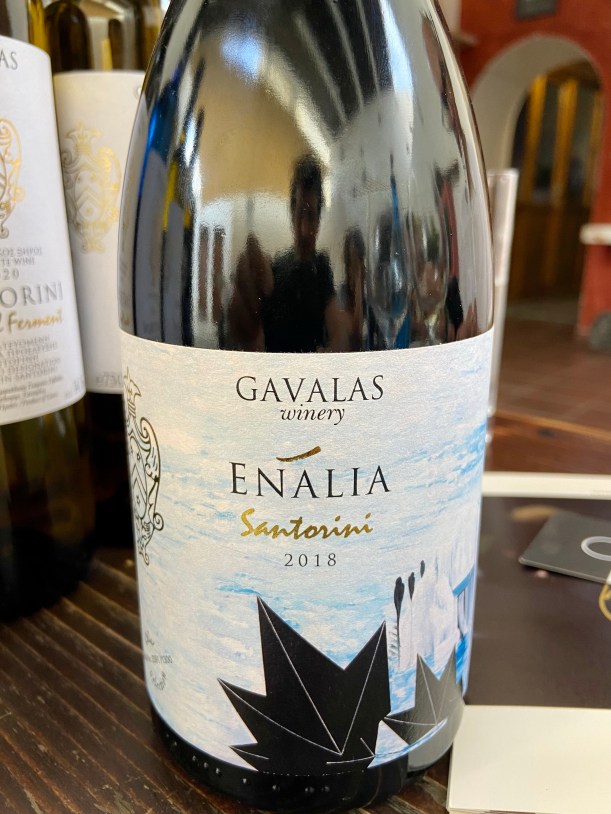
Enalia Santorini 2018

Even older vines at 120 years plus 18 months lees aging.

A pleasant whiff of petrol on the nose, more dried herbs.

A very intense palate, concentrated baked lemon, with a focused sweetness followed salty wet stones, goes on for ever wow!

Full body well balanced by high acidity which masks the alcohol level of 14.5%.

Vinsanto 2013

280 grams residual sugar.

Vinsanto is aging a minimum of 6 years, this one actually 7 years. 

A real Corker!

Figs and dates with a hint of crème caramel on the nose.

Luscious velvety mouth feel with more soft dried figs and medjoule dates with faint toffee notes. Obviously sweet but with great lift and balance. Surprisingly low alcohol at 11%.

This lasts and lasts. Complex and delicious!

We could easily have stayed all afternoon, such was the quality of the Gavalas wines and the passion of Vagelis but we were already an hour late for our booking at the highly recommended Metaxi Mas restaurant .

Venetsanos Winery

Venetsanos winery perched spectacularly on the edge of the Megalochori Caldera

Venetsanos is one of the oldest wineries in Santorini founded by George Venetsanos in 1947. The winery was excavated vertically inside the volcanic rock. They used gravity for the wine making process. The wine flowing down pipes more than 300m down, to be loaded in the ships in the port of Athinios. The wine was exported to France, Russia and Egypt.The tasting was held on on a rocky terrace with the stunning caldera below and overlooking the port
All wines are single vineyard with low production and high quality.


Santorini

Assyrtiko 100%,Crisp acid lemon grapefruit lingering bitterness and salinity

Nykteri

Vanilla whisky creamy texture Rich wine, Nykteri harvest at night, late harvest with oak ageing

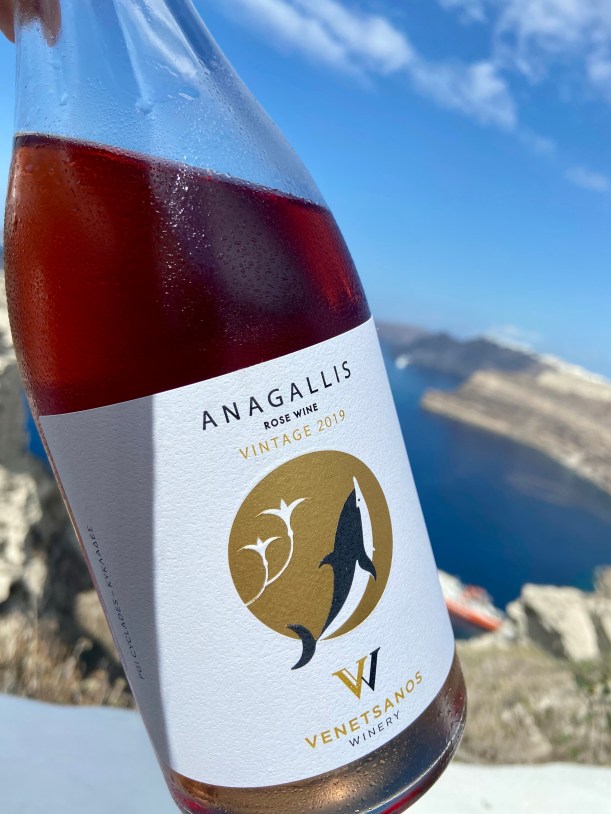
Anagallis

Rose wine deep pink colour ferment with 2 white grapes and mandilaria red.

Delightful perfumed red fruit candied strawberry and red cherry nose

Hint of residual sugar. A crowd pleaser more American in style
Mandilaria

Red grapes not overly complex drying tannins all over mouth reminders of an Italian wine possibly Barbera

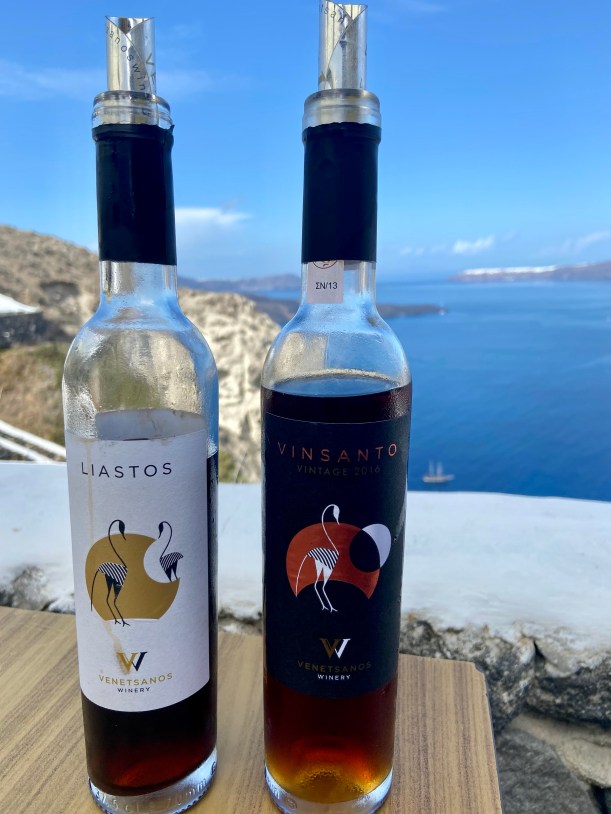
Vin Santo

Assyrtiko10 to 15 days drying grape, Luscious very sweet some oxidation nuttiness, fig, date, prune and vanilla

View from Venetsanos restaurant overlooking the port of Athinios


1 Comment

Sensational Santorini

I first tried Assyrtiko at Pete Barry’s home in the Clare Valley, Australia. It was early November 2016. That day he launched Australia’s first Assyrtiko from vines he brought back from Santorini many years before.
I was struck by its vibrant, crisp, fresh, citric qualities, superbly made wine as you would expect from the Jim Barry wines.
Pete talked sentimentally about Santorini and it has been on my list of places to visit since.
It has taken a few years, with other priorities and of course Covid! Five years later I have made the trip and will review some of the best wines and wineries one the Island. Those who appreciate all things vinous also seek the best cuisine. So I have included restaurant tips and a few other general recommendations.

Firstly a bit of factual background –
Santorini is the southernmost Island out of the 33 Cyclades islands in the South Aegean Sea.
The vineyards are over 3,500 years old, among the most ancient viticultural regions in the world.
The volcanic soils have protected the vineyards from the phylloxera, so the vines survived the epidemic of the late 19th century.
Historically Santorini was renowned for its sweet dessert wine “Vinsanto”.
More recently, with modern winemaking techniques and preferences, Santorini is known for producing highly-regarded, complex quality wines. It is most famous for its dominant variety Assyrtiko– which which along with Athiri, Aidani , constitutes 80% of the vineyard area. The remaining 20% are red varieties Mandilaria and Mavrotragano

We arrived early October. On the drive from the airport to the Northern most tip Oia we passed through a harsh dry unforgiving landscape.
Harvest had well passed, being of the earliest in Europe. The vines appeared sad dry and dejected.
I wondered how anything could grow here given to dry arid heat and hard stony volcanic soils. This harsh environment creates a low yield, highly prized harvest which reflect the terroir.
They have developed a innovative pruning system the Kouloura. This is a basket-weaved shape close to the ground to minimise wind damage during flowering and to protect against sunburn. It also helps collect any moisture from the rocks on the ground.

Another method used is Kladeftiko (small ring). This method is slightly higher off the ground allowing more aeration.

What to expect from the Assyrtiko variety?

Previous wines I have tried displayed the characteristic citric, high acid, mineral salty notes with a distinct phenolic bitterness of the finish. Other elements were of a herbal smoky nose. Only one way to find out…

By chance, Kiran had chosen to visit the same week, on the same Island, in the same town! We chose five wineries to visit from recommendations and personal contacts. Tasting notes are a mixture of mine and Kiran’s.

Estate Argyros

Wines tasted

Wine production at Arygyros dates back to 1903. I had been drinking their introductory Atlantis range red from Mavrotragano .Served slightly chilled as an aperitif. It was a lovely way to watch the sunset on our terrace at Oia Mare villas.
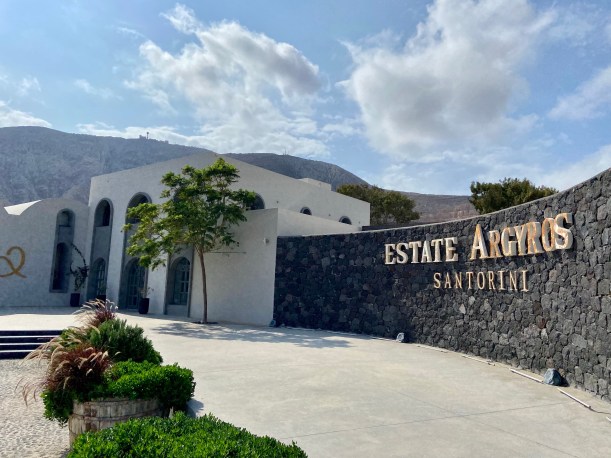
I was particularly looking forward to the Vinsanto, the longest aged in Santorini and one of the best sweet wines in Greece. Argyros have a stunning new modern winery. Very spacious clean and bright near the village of Pyrgos. They own some of the Island’s oldest vines two hundred or more years old The fourth generation of the family produces three Assyrtikos, an Aidani, a full-bodied red from the Mavrotragano grape. We were lucky enough to be hosted by the delightful and informed Elisavet Loukaki.

Estate Aidani 2020
Spends 3 months on lees in stainless steel from 40 year old vines. Retails at 25 eurFloral nose, peach and herbs, lovely.On the palate, stone fruit, lemon rind, medium body, medium plus acidity. Nice length.A nice aperitif wine to sit in the autumnal sunLess acidic and more aromatic than Assyrtiko .
.
Estate Assyrtiko 2020

A blend of vineyards with 100 year old vines, spends 3-4 months on lees.Stone fruit, sea air and an undertone of herb, tarragon or cut grass.Ripe stone fruit, cooked lemon with a salty tingling long finish in the mouth.Fuller body and high acidity.This wine is made for food especially Greek dips, fetta and grilled fish.
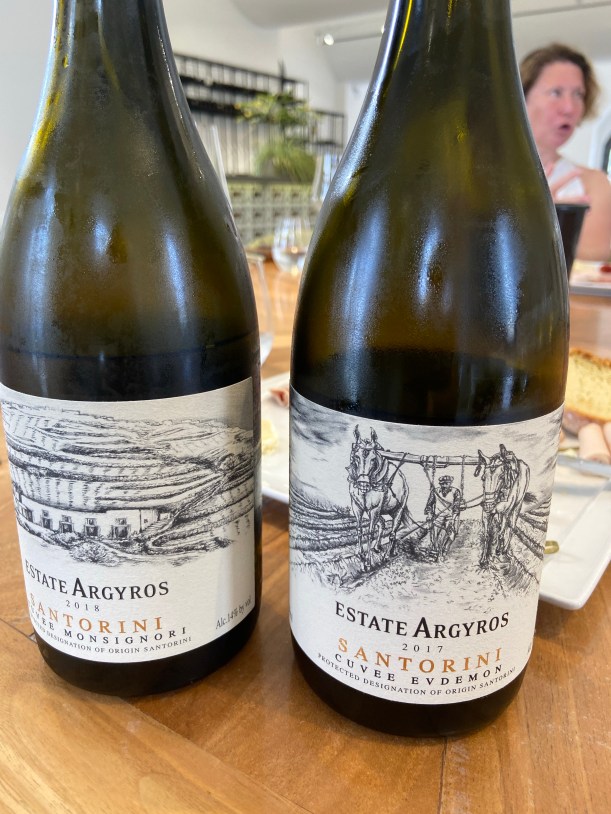
Estate Cuvee Monsignori 2018
From 200 year old vines and spends 11 months in stainless steel vats on lees with batonage. 14% alcohol retails at 30 eurA pleasant whiff of petrol, apricots and ground hazel nuts honeyAgain ripe fruit, concentrated, full bodied but balanced by high acid. Nice tension from a green note underneath, very long. Delicious. A lateral would be a minerally full bodied Austrian Smaragd from the Wachau.


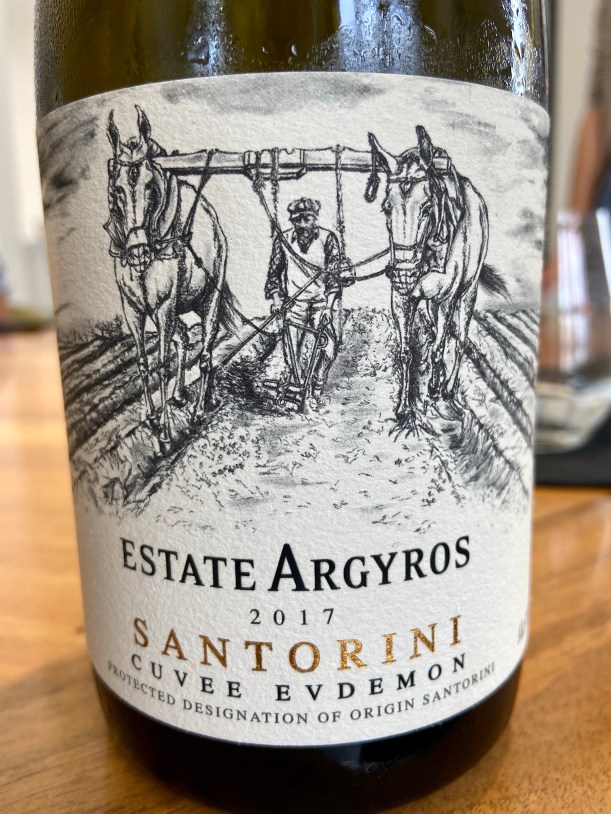
Estate Cuvee Evdemon 2017
From two parcels 150 year old vines near Pyrgos biodynamically cultivated. Fermented in 25% in French oak barrels then blended and aged for 30 months in stainless steel vats on lees. 45 eurToasty smoky notes with apricot jam, baked fruits and a note of cream. Intense.Very concentrated with full body, high alcohol but balanced by high acidity. Again a salty finish Very long. Again a ripe Gruner Veltliner comes to mind as a lateral such as the oaked Brundelmayer Ried Lamm
Vin Santo 2013 13.5 %
Mostly Assyrtiko but some other grapes in the blend. Assyrtiko 80 Aida I 10 athiri 10Grapes are sun dried grapes for10 days. The wine spends 3 years in cement vats and 4 years in barrels.The nose is complex a mix of figs, nuts & dates and spices.Great balance sweet 220g/l but with great freshness.
Vin Santo late release 2001
For this wine the grapes are sun dried for 14 days. It spends 3 years cement vats but then 16 years in used barrels. Topped up in a kind of solera system Brown tinges are clearly visible showing the wines 20 years.The nose is rich with raisins, dates,hazel nuts and dried ginger. 
The palate is complex with figs dates and nuts and a spicy gingery tang. The sweetness is perfectly balanced with the fresh acid zing and it is very long and delicious. Outstanding

This was an impressive introduction to the wines of Santorini. The Vin Santo 2001 clearly something very special. Wines available in the UK via Clark Foyster. We were keenly anticipating the rest of the week


Leave a comment

New Zealand Wine Tour February 2020, Part 4, Waiheke Island

Back in 1995 I tried one of the early 1990 vintages of Goldwater Estates Cabernet blends. It was clear then that Waiheke Island had great potential as a wine producing region.
A quarter of a century later wine is a thriving industry with around 30 boutique wineries bringing many tourists over from the mainland for tastings, dinners and weddings.
The hilly terrain, with a warm maritime climate and generally poor well drained soils provide many perfect sites for viticulture. It is possibly slightly warmer then the mainland with less rainfall as there is some sheltering from the Auckland isthmus.
Cabernet Merlot blends are still shining however there is some excellent Syrah.
I was fortunate to have arranged a house swap for a week and based myself in the lovely beach area of Sandy Bay, Enclosure Bay and Palm Beach.
With so many excellent wines to try options the most difficult decision was where to start tasting.
Stonyridge was a must, being one of the earliest pioneers and producer of one of the world’s top Bordeaux blends.

Stonyridge Estate

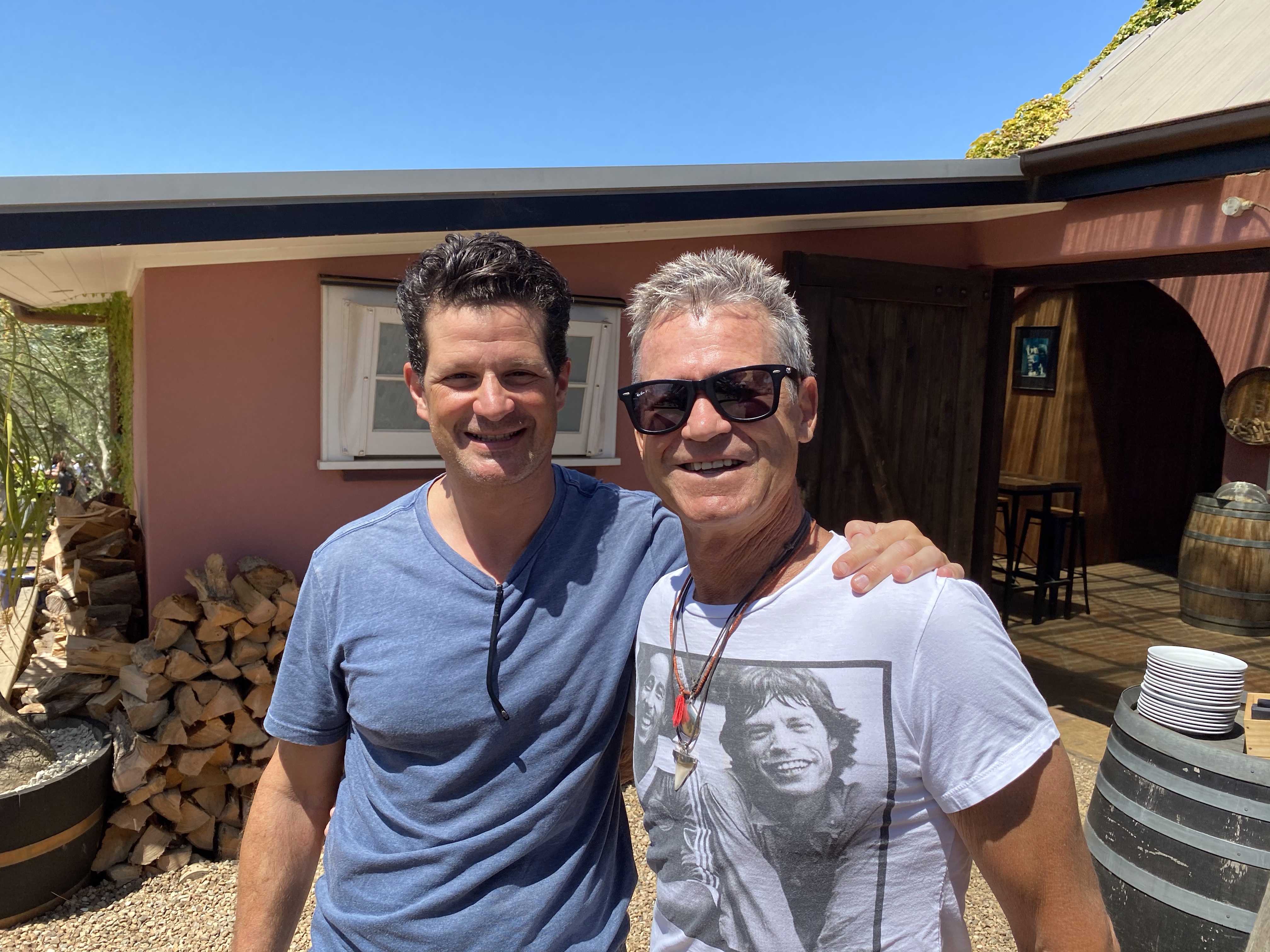
Stephen White Founder and owner of Stonyridge Vineyard

Stephen White, founder of Stonyridge is quite a character. He was sporting a T shirt with Mick Jagger and Bob Marley and appeared to be in very chill mood. He was preparing his speech for his son’s wedding the following day but still made time to come and meet me. I asked him what he was going to crack open on the big day, ‘A 3 litre bottle of one of our earlier vintages of Larose, and it’ll be staying on my table!’

He is into yoga and has previously sailed around the world. His life experience and passion has led to   some great Mantras displayed on the walls of the property, such as ‘We are very serious about what we do….but what we do is not very serious’

‘The time to be happy is NOW, the place to be happy is HERE, the way to be happy is to make someone else HAPPY’

Stonyridge is the second vineyard on Waiheke, starting in 1982 after Goldwater Estate (now Goldies) They are renowned for their Larose a Bordeaux blend which is only sold en primeur through members. It is a sheltered site protected from winds by Stonyridge. Stephen had great vision to buy the land for a tiny fraction of today’s price, and identify ideal sites for Bordeaux blends.

I tasted their 1 barrel production of Chardonnay 2018 which was oak influenced. I was only the 10th person to try the 2019 which had more elegance, stone fruit and subtle oak. The Larose 2018 was fruity, appealing and had soft tannins. I was then ushered into the wine cellar which was full of purple hydrangeas ready for the wedding day to try a barrel sample of the 2019. This was big, brooding, intense with excellent structure and length and was clearly a magnificent vintage.

Stephen said he’d like to keep 50 cases of the 300 to himself for this one!

I was so impressed that I joined the VIP club and ordered a case en primeur. Roll on November when it will arrive in the UK and I’ll have to try and keep my hands off it for a decade or so!

This slideshow requires JavaScript.


Leave a comment

New Zealand Wine Tour January 2020, Part 3, Hawkes Bay, Gimblett Gravels


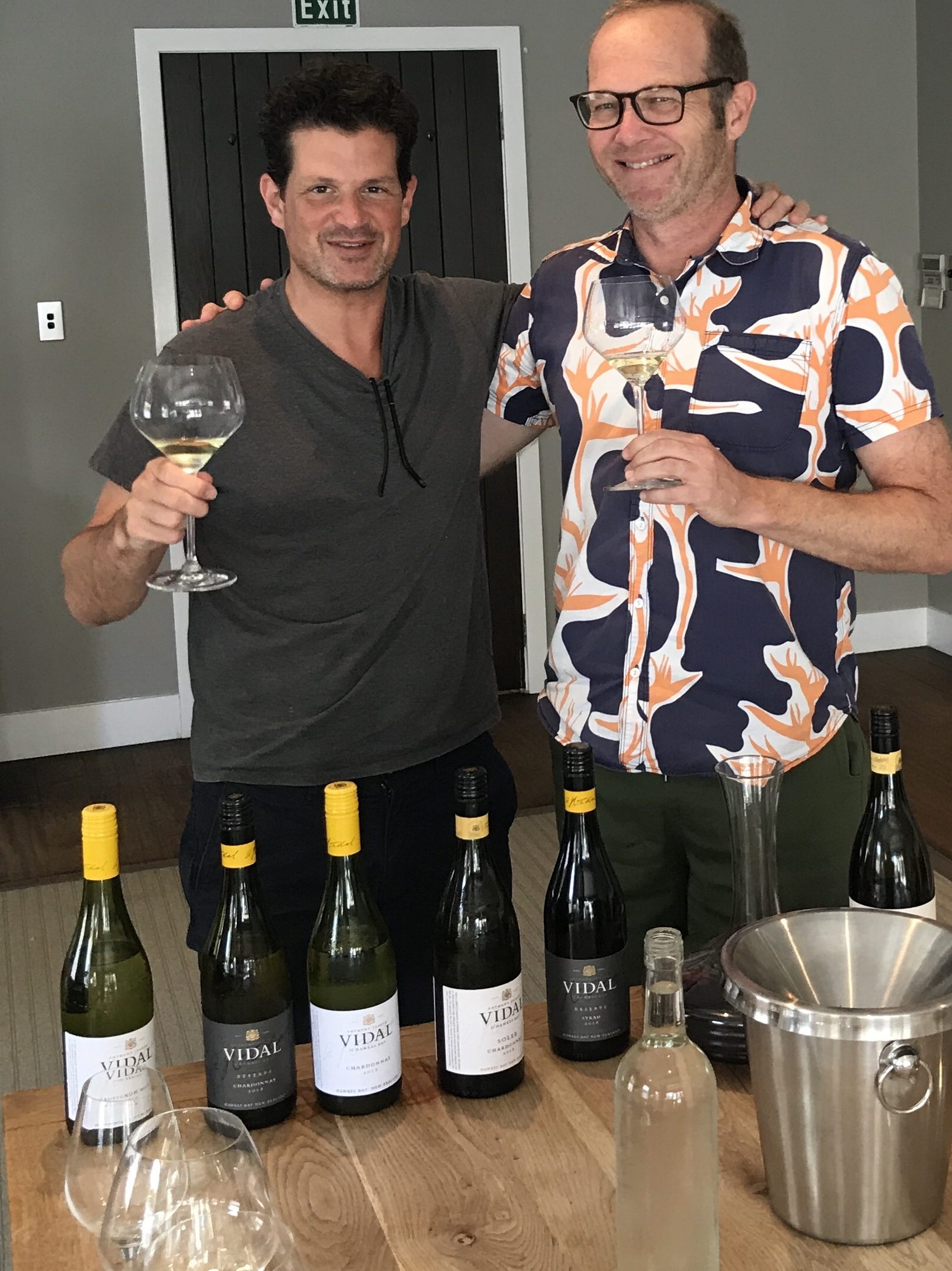
Vidal wines

I was looking forward to seeing Hugh Crichton again. We had done a dinner together in London a few years ago and his wines really impressed. He trained as a winemaker at Plumpton College, then gained experience in St Emilion, Central Otago, Gisborne and Italy and has been Vidal’s winemaker since 2006. They are renowned for their powerful Legacy Chardonnay. Vidal wines are some of the oldest in New Zealand, started by Spaniard Anthony Joseph Vidal who bought an acre of land in 1905.  They were bought by Villa Maria in 1976. Vidal’s winemaking facility has just been moved to the Te Awa Estate in Gimblett Gravels, bringing new challenges however Hugh also sees advantages of having several winemakers under the same roof.

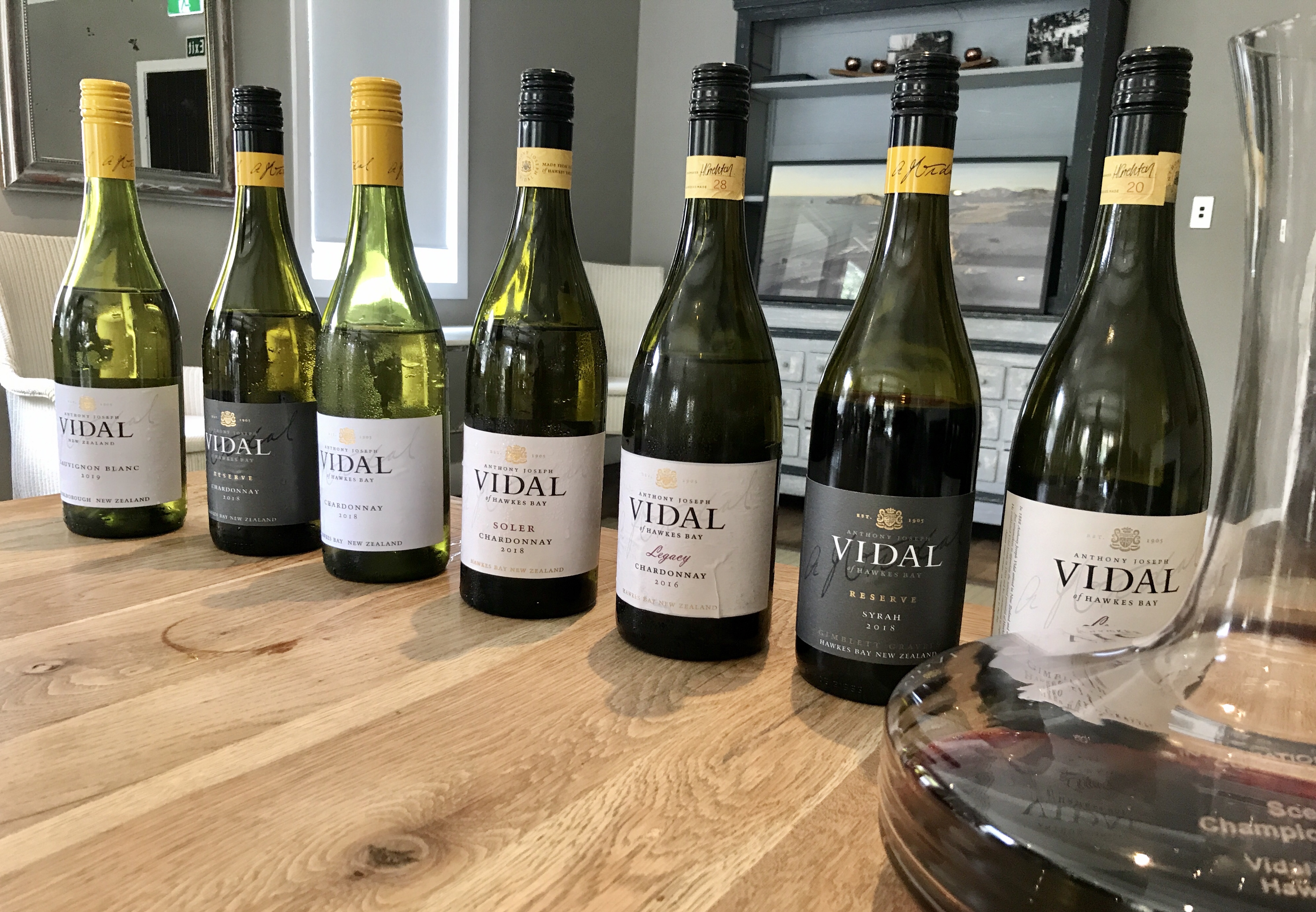
The wines are  tiered from  Estate, Reserve, Soler to Legacy


Wines tasted-

Vidal Sauvignon Blanc 2019

From fruit in Awatere Valley more grassy herbaceous cool than warmer Wairau Valley fruit which can give  more tropical flavours Gently pressed and cool fermented lees ageing, Lovely texture, passion fruit, acidity,  classic Marlborough style

Vidal Estate Chardonnay 2018

Citrus stone fruit and vibrant acid

Vidal réserve Chardonnay 2018

From premium Hawkes bay sites, Keltern, Kokako and Lyons. Flinty smoky buttery partial Malo, partial wild yeast lees, aged lovely soft texture.

Vidal Soler Chardonnay 2018

Fruit from Ohiti valley low crop 10 months on lees with regular stirring, reduced nose, Full bodied Chardonnay, oak toast brioche smoke minerality butter 100% wild yeast great length full body + lovely Chardonnay

Vidal Reserve Syrah 2018

Gimblett Gravels 800 hectares Omaha And Twyford alluvial gravel with silt and sand free draining low vigour low yields natural and green harvesting keeps warmth in the night. Floral red fruit nose loganberry perfumed (2% Viognier co ferment)

Vidal legacy Syrah 2014 from decanter

Black pepper, blackberry spice, perfume soft dry tannins, fresh natural acid good balance delicious wine


Leave a comment

New Zealand Wine Tour January 2020, Part 3, Hawke’s Bay, Esk Valley

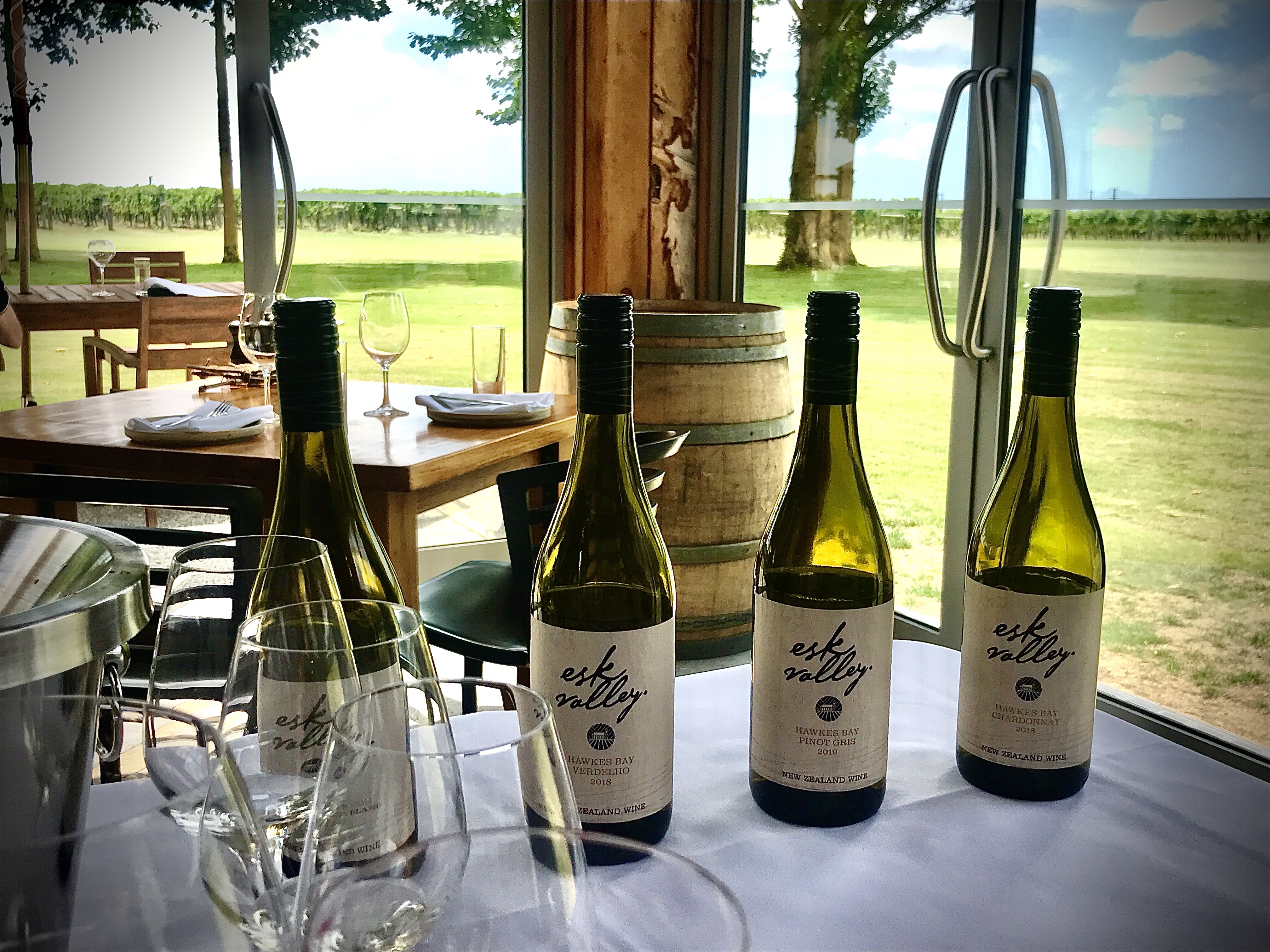
Gordon Russell winemaker at Esk Valley for 25 years

We were hosted by the winemaker of over 25 years Gordon Russell. Esk Valley like Vidal are under the umbrella of Sir George Fistonich’s Villa Maria brand. They have recently moved their wine production  to Te Awa in Gimblett gravels. Esk valley vineyards are some of original plantings 10 km North of Napier and amongst the first to plant Verdelho and Malbec and Merlot. They maintain Gordons philosophy, a specific concrete vat was made for the new winery at Te Awa.

Wines tasted

Esk Valley Marlborough Sauvignon Blanc 2019

Marlbourough fruit, sites from 69% Wairau Valley, mix of gravel and clay warmer than Awatere ValleyPlenty of texture here from lees ageing and richness is obvious, Aromatic gooseberry fresh wine good balance and length

Esk Valley Verdelho 2018 ( only 7 hectares nationwide)

Planted in 1998 and 2002 first Verdelho vines in New Zealands history, 1 hectare in Gimblett gravels low cropped, on stony soils,oak barrel fermented, wild yeast lees stirring, Citrus slight, orange full bodied  fresh acidity.

Esk Valley Pinot Gris 2019

Slight rose tint, tank and old barrels ferment lees ageing and stirring, Pear citrus lovely texture and finish

Esk Valley Chardonnay 2018

Tropical fruit subtle oak butter vanilla 27% Malolactic 75% barrel fermented, minimal intervention

Esk Valley winemakers réserve 2016

lovely smooth fresh ripe tannins blackberry plum, Cabernet Sauvignon Merlot Malbec one of First New Zealand Merlot producers, oak aged 17 months 40% new


Esk Valley the terraces Malbec Merlot Cabernet 2016

Co-fermented together 40/33/27 one hectare site above Esk Valley winery originally planted in 1940.

Concrete vat ferment hand plunging 50% new oak 17 months unfined, unfiltered, Velvety tannins fragrant black fruit

Interestingly for a New Zealand wine this is sold en primeur.

Esk Valley wines appear to be excellent value for money especially the entry level range. They reflect  Gordon’s   wine making talent and experience.