
Founded in 1776, Boekenhoutskloof can be found way down the scenic Franschhoek valley. The farm’s name means “ravine of the Boekenhout” (pronounced Book-n-Howed). Boekenhout is an indigenous Cape Beech tree greatly prized for furniture making. Hence the 7 wooden chairs that the wine labels feature.

As with many wineries there was a change of ownership and reboot in the early 1990s and new vineyards were planted including Syrah, Cabernet Sauvignon, Cabernet Franc, Grenache, Semillon and Viognier.
The winery also produces a number of brands: Porcupine Ridge, The Chocolate Blick, The Wolftrap. Producing 7 million bottles a year it is one of the biggest wineries.
One needs to book about 6 months in advance to visit and taste at the estate but it quite a special experience hosted by Godfried Mocke the wine maker in Franschhoek.
Godfried explained that they now have vineyards in Swartland home of the famous Porseleinsberg Syrah, for Rhone varietals. The grow Cabernet Sauvignon in Franschhoek and Stellenbosch and Semillion in Franschhoek. They’ve set up a fairly new venture to grow and make Burguindian varieties in Hemel en Aarde called Cap Maritime.
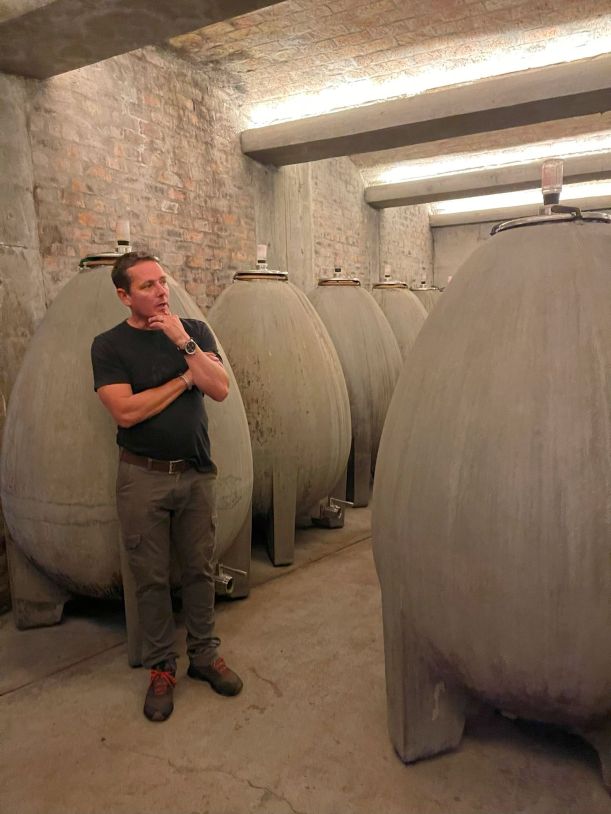
A tour through the winery revealed further details of their approach to wine making. They generally let wild yeast take care of fermentation. For red wine the concrete vessels used have rough surface that encourages a flora of yeast and so the cellar itself imparts a particular character in the same way that a cheesemakers cellar does. A part of the terrior.
Concrete eggs are used to ferment the whites, the egg shape makes vortex which moves wine around, stirring the lees and it is also gently oxidative too.
However they often ferment some in barrique and blend to achieve the final wines.
Boekenhautskloof are also using amphora made of clay fired at high temperature so this format doesn’t breath they use it for muscat.
Reds are matured in barrels. Large Foudre for Syrah to slow oxidation. Barrique for the Cabernets.
Interestingly Boekenhautskloof do not acidify their wines which is actually widely practiced to achieve balance in the wines of South Africa.
Tasting notes:
Cap Maritime 2020, Chardonnay Hemel en Aarde
Creamy, toasty, smoky with citrus zest. Great balance, full but firm body, nice structure, long.
Semillon 2019
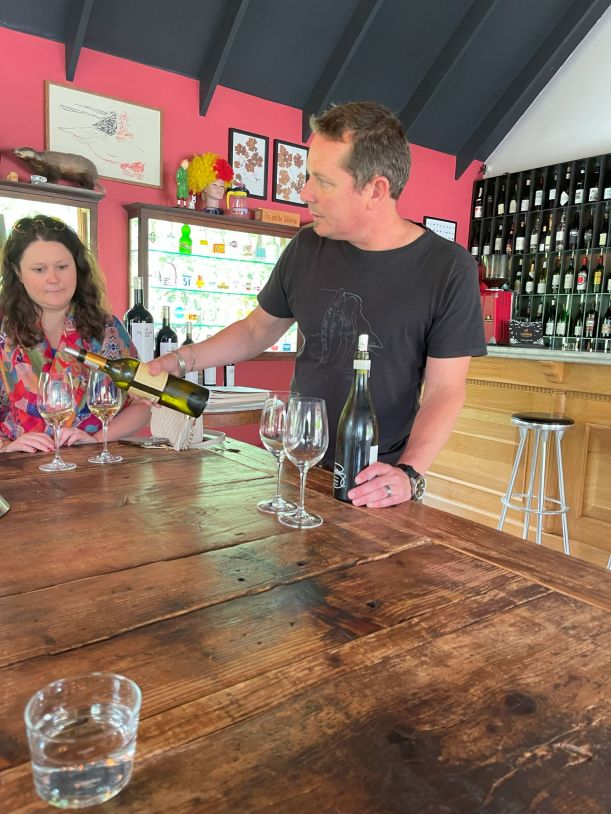
Made from old vines the youngest planted in 1942 which are more resilient to the droughts recently experienced. Bit of polish, wax, bit of smoke, pleasant petrol aroma. Nice elastic mouth feel, baked lemon, slightly salty tang, some smoke. Capable of bottle aging and developing great complexity. Think Hunter Valley.
Cap Maritime Pinot Noir 2020
Difficult year not much energy to ripen so needed whole bunch to give a lift. Cherry, green herbs. Sweet red fruit, good lift medium body.
The Chocolate Block 2021 (1 M bottles!)
Made from 5 varieties the lend percentages always shift and change. Blind tasted to pick best but will always reflect the vintage characteristics.
Mix if red crunchy berries, dark black current then brambles, a touch of vanilla. Good balance, structured, high acid, medium body, clayey tannins present. Fruity with a tough of menthol. Med length.
Syrah 2019
Grown on blue schist in Swartland. Nose of crushed raspberries, blueberries, light spice. Fruit forward creamy texture, clove ripe fruit finish. Long.
Cabernet Sauvignon 2017
Stellenbosch fruit. Dark fruit, iodine and black current. Ripe fruit, lots of nice powdery tannin. High acid, dry savoury finish.
These are amazing age worthy, high quality wines representing superb value!

 WanderCurtis Wine