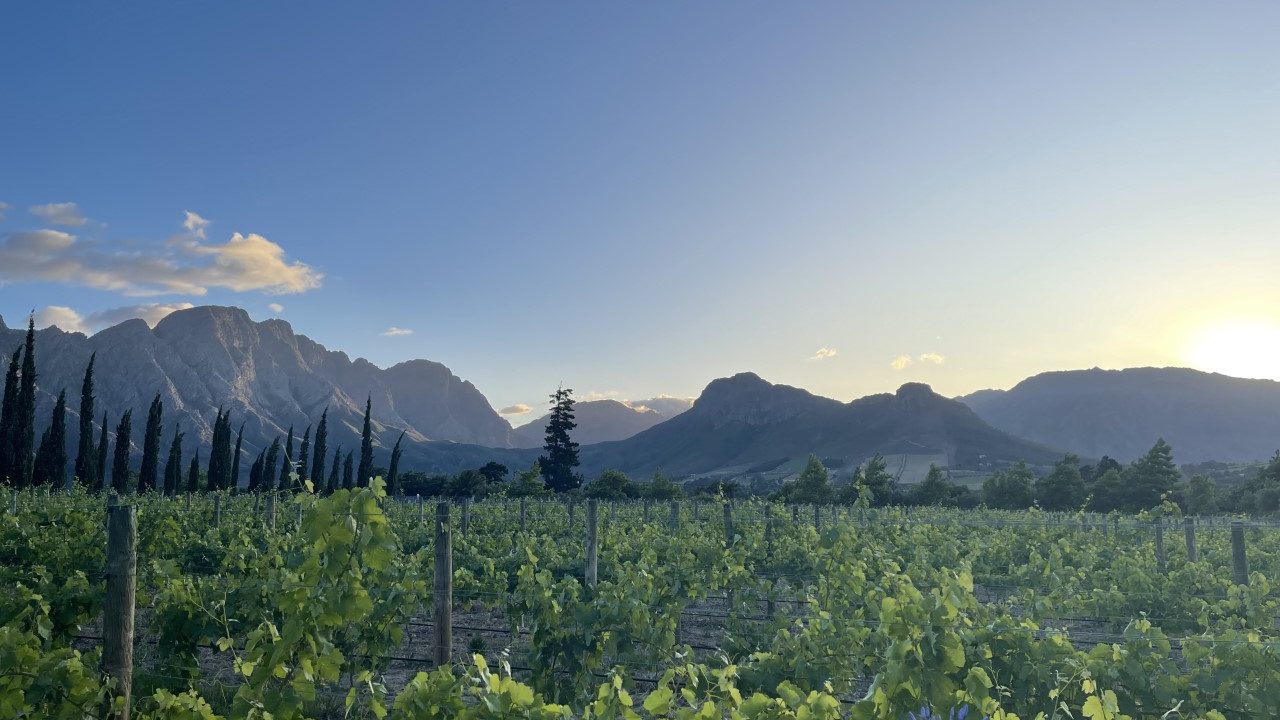
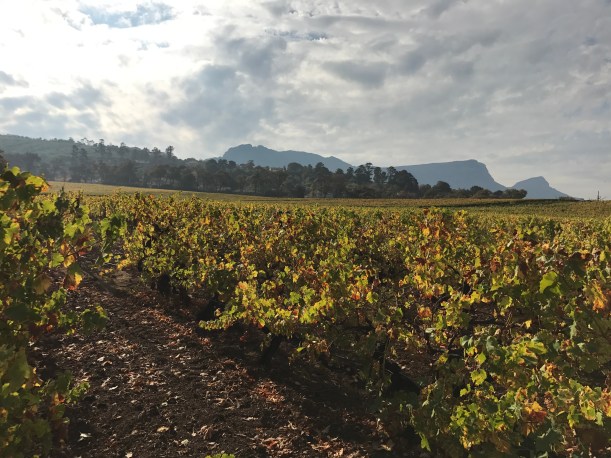
From vineyards close to False Bay in Stellenbosch, South Africa. There is a noticeable cooling effect from breezes, in this part of the region, that push inland from the cold waters of the Bay really slowing the ripening season down and allowing concentrated and flavourful grapes to grow.
Founded in 1756 Meerlust Estate does call into question the use of the term ‘New World’ when comes to the wines of South Africa (see our review of Constancia which tells the story of how wine growing started in the country). On the other hand it is fair to say that the birth, or probably rebirth, of quality wine production only properly got under way after the fall of apartheid in 1994.
The idea of ‘crossing the Rubicon’, at which point there was no turning back for Julius Ceasar, inspired the name of the wine. Nico Myburgh, part of the founding family, created the wine from Cabernet Sauvignon, Merlot and Cabernet Franc, inspired by the use of blending in Bordeaux crossing the line and helping to establish the style in South Africa.
Indeed this wine is easy to mistake for a classic right back Bordeaux when tasted blind, there is something about the way that the growing conditions in Stellenbosch allow restrained and elegant wines to be made that whilst ripe retain notes of capsicum and black currant leaf characteristic of classic Claret.
This wine already shows some bricking on the garnet rim. The nose is expressive with ripe black currant, capsicum, black pepper, baked blackcurrant tart, smoke, toast and coffee grounds, signifying use of French Oak. It also has nice notes of earth and leather from the years in bottle.
In the mouth it is fresh, with ripe but firm tannin, the body is full but the alcohol well integrated. Elegant and well balanced with a very long tasty finish. This wine is widely available and great value for a wine showing enough maturity to drink now but with capacity to develop further.
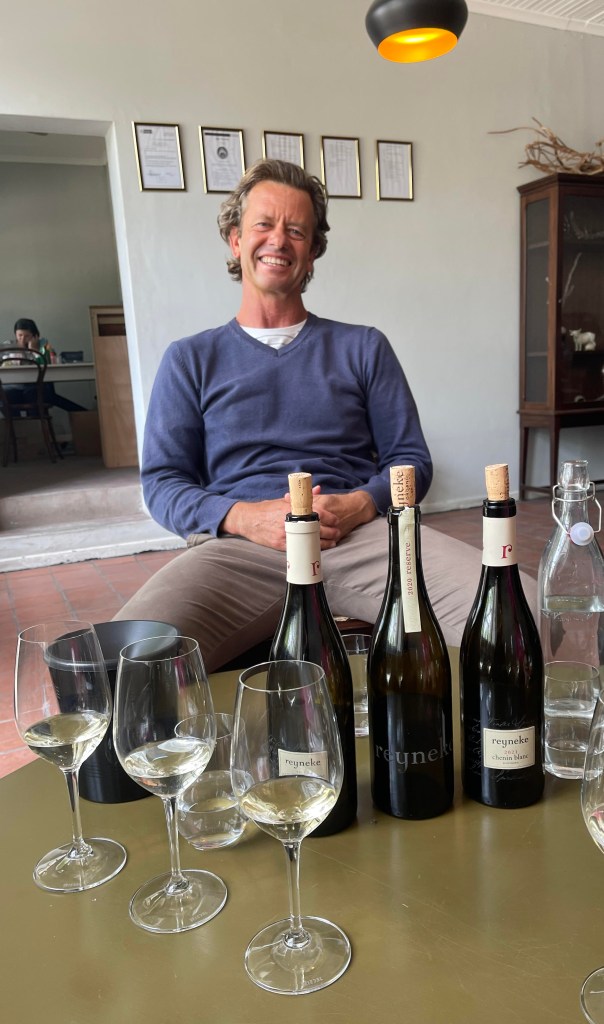
Our recent offer to followers of the wines of Reyneke in South Africa has delivered an obvious wine of the month.
This is 100% Sauvignon Blanc. The reserve is made from selected pockets of grapes within the vineyard which have their own character. It gets 24 hours on the skins and the new oak barriques. More stone fruit on the nose also a bit of hay and a subtle touch of vanilla. Lovely textured mouth feel, more peach and bit of toast, rich but balanced, great length.
Wild fermented in oak barrels with minimal intervention, this is not your identikit new world Sauvignons and much more interesting and complex for it . Hay, a touch of gooseberry, a whiff of custard, lovely balance and freshness white peach, pineapple, creamy and a touch of toast. Complex and long. I think these are fantastic value wines.
Mostly when I ask winemakers about what they are doing to be more sustainable and to reduce their environmental impact the answer is all about stewardship of the land; vineyard practice, avoidance of pesticides, and perhaps a bit of onsite recycling. All good stuff, but as the drive towards Net Zero Carbon builds obviously the wine industry also needs to step up and make a start down this road.
Challenging though it may be, without plotting a route and taking the first step, the target will never be reached. Equally we consumers need vote with our wallets and make it clear we care, not just about how tasty the wine in our glass is, but also about the journey has taken to get there.
Happily, there are some great wineries out there, leading the way on sustainability and one of them is Reyneke Wines in Stellenbosch.
Since the early noughties Johan Reneke has been working towards achieving the three pillars of sustainability: environmental, social and economic. As he eloquently argues, how can a wine be beautiful if there is ugliness, in the form of glaring social inequity, involved in its making? He also makes the point that only a financially healthy business is going to be able to achieve any sort of environmental and social goals.
Johan sees Biodynamic farming as part of a larger picture of regenerative farming. Agriculture is one of top five contributors to climate change but regenerative agriculture actually provides the opportunity to turn this around. It can actually sequester carbon back into the earth by improving soil health and increasing humus content. Another win is by moving away from monoculture biodiversity can also be improved.
Reyneke works with nature to maintain vine health without recourse to chemical pesticides, herbicides and fertilizers. This ‘land caring’ element of the approach uses for example dandelions and other cover crops to provide a preferential home for pests. It also involves ducks trotting around the vineyards hoovering up snails.
Land within the farm is also ‘spared’ so that there are pockets of wilderness left between the vineyards which are rich in flora and fauna. The farm’s herd of cattle currently roaming in pasture below the winery, are let into the dormant vineyards over winter to fertilize them. In a lovely example of the vineyard’s circular like economy the winery produces feed for the cows in the form of the grape pressings which according to Yohan they love!
Looking back towards False Bay with the farm herd of cattle in the foreground.
Improved soil health and biodynamic farming has made the vines more resilient to pest, fungus and drought and so by extension perhaps some of the other effects of climate change?
As we visit the Reyneke wine farm is currently being extended into a neighbouring farm recently acquired. Some of the vineyards are being kept and some replanted. One can see where strips running along the contours of the hillside are being set side for biodiversity corridors between the vines. Old vines are piled up and will be turned into bio-charcoal that will be mixed in with the soil, locking in the carbon long term.
New vineyards in preparation. A pocket of Fynbos top left, horozontal lines on the hill side mark out future biodiversity corridors
When looking at the road to net zero carbon any organisation needs to look at its Scope 1, 2 and 3 emissions. Scope 1 emissions are C02 emissions arising from operations directly controlled by the organisation. Scope 2 are emissions up stream caused indirectly by the organisation when it buys in goods and services from elsewhere, for instance electricity or bottles. Finally scope 3 emissions are those downstream arising from the activities of distributors and consumers transporting, consuming and disposing of goods.
At Reyneke the farm is now carbon negative but Johan continues to look at the winery operations. He is investigating renewable energy in the form of photo voltaic (PV) panels, possibly in combination with electric tractors which could double up by providing some energy storage too. The Cape is lovely and sunny but electricity is currently rationed in ‘load shedding’ which adds another reason for moving off grid.
Reyneke is also trailing the use of Tetra Pak type packaging as an option, starting with their entry level organic wines in Scandinavian countries who seem more open to the idea. Clearly there is a challenge here in shifting negative consumer perceptions of ‘bag in a box’ type wine. Moving away from bottles would deliver valuable reductions in carbon footprint in terms of packaging and transport.
A non-interventionist approach follows through into the wine making. Instead of temperature controlled stainless steel and yeast inoculation at Reyneke wild fermentation in oak barrels is the order of the day. The wooden containers and smaller volumes successfully manages the temperature during fermentation in a passive way. The wild yeast and breathability of the oak also give a different character to the wines in particular the Sauvignon Blancs.
Johan’s story is so fascinating, and the challenges he and his team have taken on are so inspiring that this intro’ section could easily run on and on so let’s get to the wines, which do not disappoint!
Reyneke Sauvignon Blanc 2021
On the nose, hay, a touch of gooseberry, a whiff of custard. Good body with lovely balance and freshness. A nice supple mouth feel, white peach, exotic fruit pineapple, creamy gooseberry fool. Complex with good length a wine that evolves. Excellent. (Tasted at the farm and again back in London with consistent results)
Reyneke Reserve White 2020.
This is also 100% Sauvignon Blanc. The reserve is made from selected pockets of grapes within the vineyard which have their own character. It gets 24 hours on the skins and the new oak barriques.
More stone fruit on the nose also a bit of hay and a subtle touch of vanilla. Lovely textured mouth feel, more peach and bit of toast, rich but balanced, great length. Neither of these wines are your identikit new world SBs, much more interesting and complex.
Reyneke Chenin Blanc 2021
The vineyards here are part of the South African old vine project so more than 35 years old.
The nose is floral and nutty. In the mouth apricot, honey and a slightly salty finish. Vibrant.
Reyneke Syrah 2019
On the nose, sweet blackberry, dried herbs and crushed pepper. In the mouth dried black fruits, iodine, ripe tannins, full bodied but fresh. Long. (Tasted at the farm and again back in London where the wine benefited with time in the glass.)
Reyneke Reserve Red. 2019
The wine is 100% Syrah and again from selected parcels of the vineyard.
On the nose, blueberry pie, ripe fruit, pie crust, vanilla, coffee grounds, fresh garigue herbs. Iodine? Ripe blue and blackberries, powdery tannins, a herbal liquor note, savoury notes of grilled meat, full body and fresh acidity. Complex and very long. So good now that it will be hard to keep ones hands off this to let it mature! (Tasted at the farm and again back in London where again the wine benefited with time in the glass.)
Cornerstone 2019
A blend of Cabernet Franc and Cabernet Sauvignon in this vintage.
The wine is named after the Cornerstone project. Johan sees the workers as the cornerstone of the business, farm workers generally receive low wages as there is high unemployment and viticulture is the least profitable part of the industry. Scheme aims to empower workers with housing and education using profits from the winery.
Classic cassis, black current leaf, black current jam and a touch of sawdust on the nose. Austere at first, black fruits, green pepper, coffee grounds, slightly drying grainy tannins. Tasted again in London it opens up and fruit fills out the palate with bit of air. Still fairly primal at this young stage but good potential.
There is a vibrancy and depth to these wines which is compelling and it’s a quality that the Wander Curtis team have noticed on multiple occasions in other Biodynamic wines by producers such as Felton Road and Chateau Pontet-Canet. On every level there is definitely something to Biodynamic wine making.
Not only does wine making in South Africa go back a very long way but winemaking in the Cape actually has a birthday: 2 February 1659! On that day Jan van Riebeeck recorded in his diary “Today, praise be to God, wine was made for the first time from Cape grapes.’
Sent by the Dutch East India Company in 1652, to establish a staging post to supply ships on their way around the Cape of Good Hope, Van Riebeeck lost no time on the important business of planting vines and making wine. Apparently was essential to the treatment of sailors with scurvy. Yet more historical evidence of the health benefits of red wine!
Constantia
Constantia lays claim to have the oldest vineyards in the southern hemisphere dating from 1685 when Simon van der Stel, the Cape’s first Governor established a farm on the southern slopes of Table Mountain facing False Bay. False bay is of course a ‘real’ bay, it was just the wrong one from the point of view of sailors returning from India when they realised that they hadn’t quite reached the Cape Bay and still had to round the treacherous Cape of Good Hope.
Vin de Constance has since been revived by Klein Constantia and Groot Constantia also makes a sweet Grand Constance. However, the comparatively cool climate, elevated altitude and generous rainfall (twice that of London apparently) means that modern Constantia is now home to a wide range of red and white varieties.
Where Van Riebeeck’s relied on enthusiasm Van der Stel brought to bear some viticultural knowledge and his name is firmly stamped on the Cape winelands. Quite literally as he named Stellenbosch town after himself and the imposing back drop of Simonsberg mountain serves as an ever present reminder. The wines of Constantia attained international acclaim in the late 18th and early 19th C boosted by the war between France and England which made French wine hard to get hold of. Famously Napoleon’s suffering during his exile on St Helena was greatly eased by a steady supply of Vin de Constance. The wine at the time is thought to have been sweet and quite possibly fortified. Once there was peace and a trade agreement between England and France the market for Vin de Constance diminished and in the end the vineyards did not survive the onset of Phylloxera.
Groot Constantia
Groot Constantia (pronounce the G as if you are clearing your throat) is the largest part of the Van de Stel’s original farm. A trust now owns the estate and it is even a National Monument. The old Cape Dutch style farm house houses a museum which tells the story of the wine farm. Simon van der Stel’s mother was daughter of a freed Indian slave and after him Johannes Colijn, who heralded in the heyday of Vin de Constance in Europe, was also of mixed race. The exhibition gives a sobering understanding of the part that colonisation and slavery played in the history of the farm and Cape’s wider wine heritage.
An easy drive from Cape Town the history, wine, restaurants and beautiful setting make the estate well worth a visit.
Rose 2022
A blend of Cabernet Sauvignon, Merlot, Semillon and Sauvignon Blanc made with minimal grape skin contact. Pale orange pink colour. Nose of honey dew melon. Nice balance, peachy notes and good freshness. Easy drinking in the sunshine.
Sauvignon Blanc 2022
Constantia has a reputation for fresh Sauvignon Blanc. Floral nose with elderflower blossom and a touch of grassiness. Again good balance, melon and tropical fruits flavour, fullish body but with freshness.
Chardonnay 2021
Smokey vanilla nose. Lemon, vanilla, spicy wood, full boded mid-level acidity and medium length. Tasty ‘new world’ style.
Gouverneurs Reserve White 2020
A blend of Sauvignon Blanc and Semillon partly aged in new oak Barrique.On the nose green pepper, hay, meadow flowers, herbs, tarragon. Fullish body, mid-level acidity, dry herbs, hay, grapefruit pith. Complex with very good length and a lovely citrus persistence.
Lady of Abundance 2018
A red blend of Pinotage, Merlot, Shiraz and Tannat.Mixed macerated red and dark fruit nose. Ripe plum, blackberry, clove and toast favours with soft tannin. Easy drinking.
Merlot 2018
A nose of classic plum and milk chocolate and a whiff of vanilla. Ripe capsicum, red fruit, soft tannins, medium length. Tasty.
Cabernet Sauvignon 2019
Initially mulberry, then a leafy green aroma. Touch of strawberry, dried cranberries. In the mouth more dried fruit, nice chalky tannins, medium body, good acidity. Reasonable length. Give it a year or two and this should round out nicely.
Pinotage 2020
Baked dark plum with ferrous notes and a sprinkle of cake spice. Rounded full body but not flabby, more spicy baked blackberries, finishes with sweet fruit and is quite long.
Shiraz 2019
Plush fine oaky nose, iodine and dried cherry. Good balance and length, dark cherries, hint of blood, good length. Firm tannins sit squarely on the tongue, this should age quite nicely.
Gouverneurs Reserve 2028
A Bordeaux blend. Plums, cedar wood, milk chocolate, nice furniture polish. very Claret like. Mix of red and black fruit, Black Forest Gateaux, great balance and a long savoury finish! Excellent.
Grand Constance 2017
Made from Muscat d’Frontignan the white Muscat is complemented with a small percentage of red Muscat.
Burnt orange colour. On the nose orange peel, ginger powder, dried apple, cinnamon, cake spices, furniture polish. Lusciously sweet but with enough lift to keep it fresh. A strangely a floral note, rose water or something like that and more dried orange. Very long.
Hemel-en-Aarde
Hemel en Aarde is known for growing Burgundian grapes and is divided into three areas: Hemel-en-Aarde Valley, closest to Walker Bay, Upper Hemel-en-Aarde Valley further up the valley and Hemel-en-Aarde Ridge the highest area in terms of altitude. Each area has different soils and micro-climates.
The received wisdom is that in the lower section clay soils produce broader more structured Pinots, the decomposed granite in the Upper part results in a crunchy, elegant style and due to the altitude and recurrence of some clay the Ridge produces something in between. That said many other wines are also produced here including some crisp Sauvignon Blancs and Rhone blends.
Overall the region’s proximity to Walker Bay, the cold Benguela current as well as the prevailing Southeaster results in a particularly strong cooling maritime influence. Hemel-en-Aarde also has higher than average rainfall.
Hamilton Russell was the first winery in the area, the eponymous owner was looking for land and was attracted by the cooler climate. A risky move back in the 1970s as the vineyards had no quota for wine making under the then restrictive rules and so winemaking was technically illegal. Having planted a wind variety of grapes including Pinot and Chardonnay they eventually restricted wine making to just these two varietals. The winery has spawned several other neighbouring wineries as successive winemakers have left to set up their own ventures in the valley, these include Buchard Finlayson, Creation and Storm wineries.
The Wine Village, Hermanus.
At the bottom of the valley in the whale watching town of Hermanus is the Wine Village store with is a treasure trove of South African wines and will ship overseas.
Stephen was on the counter and let me taste Hamilton Russell Vineyards’ 2021 Chardonnay and Pinot Noir. Both from the Valley were beautiful rich, structured, and perfectly balances wines with lashings of fine oak. Immediately pleasurable for such young wines which for me puts them in the New World but with a level of Burgundian understatement.
Newton Johnson Family Vineyards
Newton Johnson is located in Upper Hemel-en-Aarde Valley located in a beautiful spot with spectacular views.
Resonance 2019
75% Sauvignon Blanc and 25% oaked Semillon. Flinty nose, gooseberry, Semillon gives the wine a nice body, good length with a slight toasty finish. Very nice.
Albariño 2021
The first planting of this grape in SA were here at Newton Johnson. Made 20% in old oak barrels. Floral notes with sea breeze, a nice saline note in the mouth, fresh. A bit more breadth than you would find in a Spanish version but no shortage in bracing acidity.
Family vineyard Pinot Noir 2020. 13.5%
A blend of several vineyards including Sea dragon and Windandsea each bringing different characteristics to the wine. On the nose red soft fruit, some nice vegetal notes. In the mouth sweet fruit, more herbs, delicious rounded body, good freshness, and a lovely long finish.
Full Stop Rock 2020
79% Syrah and the rest Grenache grown in decomposed rocky granite. The wine is aged in 5% new oak barrels and the rest used for18 months. Blackberry, ripe fruit forward nose. In the mouth ripe sandy, rounded tannins, very approachable now. Long.
Granum 2016.
A blend of 75% Syrah and Mouvedre. Darker colour. Black fruit, meatiness, oxo cubes on the nose. A nice stoniness, more ripe black fruit and savoury notes. Full bodied developing some earthy notes.
Boekenhoutskloof have also started making a Chardonnay and Pinot under their Cap Maritime label from vineyards in the valley. See the full review of this winery posted separately.
Wines of South Africa podcasts
Finaly just a quick shout out for the excellent series of podcasts that Jim Clarke and the Wines of South Africa (WOSA) have made. Packed with regional information, interviews with winemakers and some really interesting historical background these and Jim’s book really are essential further reading. To access the podcasts click on the link below.
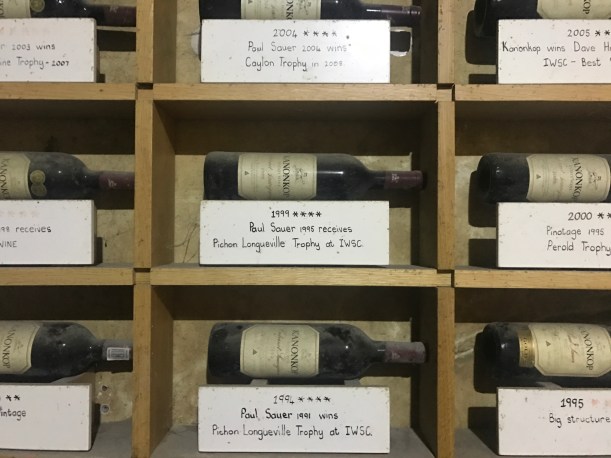
Nestled on the slopes of Simonsberg Mountain, Kanonkop Wine Estate is a proud custodian of South African winemaking heritage. Now in the hands of fourth-generation brothers Paul and Johann Krige, the estate produces around three million bottles annually, with sales evenly split between domestic and international markets. Known exclusively for its red wines, Kanonkop champions two hero grapes: Cabernet Sauvignon and Pinotage. The estate’s flagship wines are meticulously matured in French oak barrels, incorporating a portion of new wood to enhance complexity and elegance.
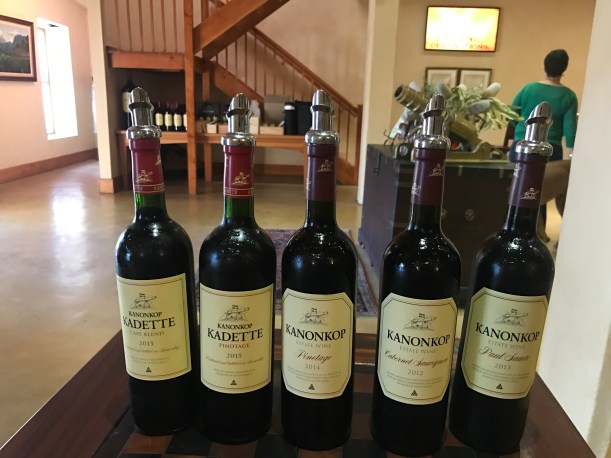
The Kadette range, meanwhile, showcases fruit sourced from 30 local farmers, with Kanonkop’s own viticulturalist overseeing the growing process to ensure quality and consistency,. The estate traces its name to a nearby hill (or kop) where, in the 17th and 18th centuries, a cannon (kanon) thundered to signal the arrival of ships in Table Bay. This booming call once rallied local farmers to race their wagons to the harbor, laden with fresh produce.
Since bottling its first wine in 1973, Kanonkop has become a benchmark for South African reds, carrying forward the legacy of the visionary Paul Sauer.
Tasting notes:
Kadette Range – A Young soldier ready for action!
Kadette dry Pinotage rose 2022
Short skin contact, blush colour and burst of floral notes.
50% Pinotage plus Cabernet Sauvignon and Cabernet Franc, 14% ABV.
Nice brambly nose with a bit of smoke, an inky note and touch of vanilla.
Lovely juicy fruit, fullish body but good lift and spicy finish, good length.
Pinotage 2020 14%
100% Pinotage 14% ABV. Really sweet red and black berries, touch of vanilla.
More fruit on palate, soft chewy tannins, medium acidity, good length. Slight herbal finish. Very tasty
Cabernet Sauvignon 2020 14%
Classic blackberry and black currant leaf on the nose.
Nice dry fruit, herbal, savoury, nice grainy tannin, medium length. Lovely and great value.
Estate wine Pinotage 2020
Old vineyards with 60 year old bush vines. Pinotage is dry farmed
Matured in 80% new oak. Classy barrel room notes of toast and spice.
Lovely balance, and structure, brambly fruit, coffee notes, lots of length.
Estate Cab Sauvignon 2020
Classic blackcurrant leaf and whiff of smoke.
Blackberry is ripe but not over ripe ,mineral notes, very fine ripe tannin, lingering length. Long savoury finish!
Estate Paul Sauer 2020
70% Cabernet Sauvignon, 15% Merlot and 15% Cab Franc. Matured in 100% new oak for 2 years.
More of everything. Black plum, coco powder and spice.
More talcum powdery ripe and super soft tannins. Lovely rounded fruit breadth. Very long.
In recent years Kanonkop have experienced very consistent vintages harvesting at same time of year but it is always a race against time to harvest everything as it ripens all at once. They have not apparently noticed much effect in terms of global warming.
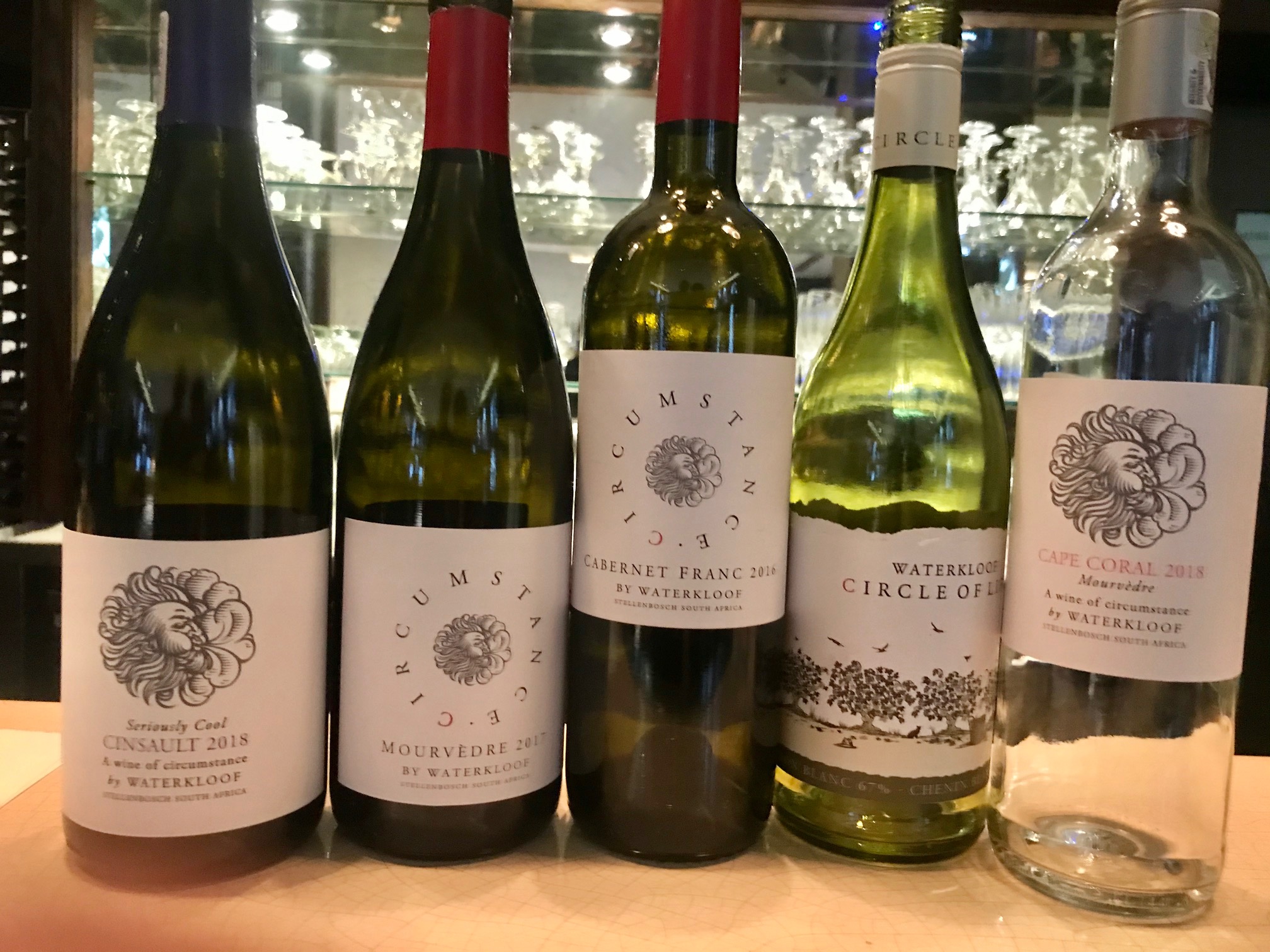
We were delighted to welcome Paul Boutinot founder of Waterkloof.
Paul is originally from Manchester and started Boutinot Wines. He founded Waterkloof in 2004. It is a family owned, organic, biodynamic and WWF Biodiversity Champion farm overlooking the Atlantic Ocean, False Bay near Stellenbosch, South Africa.
I had met Paul recently at a South African wine tasting at Hammer and Tongs
We instantly hit it off being fellow Mancunians, also I spent a lot of my childhood in Heald Green where his family ran La Bonne Auberge.
His wines took my attention with their meticulous balance and beautiful tannins. After tasting them I found out that the wines are from Biodynamic vineyards, this didn’t surprise me as they stood out from the crowd.
At other tastings I have recently attended I have marked my favourites, Domaine Zind Humbrecht, Chateau Pontet Canet and Felton Road all produced biodynamically. I believe there’s something very special about looking after the land in this way.
It was an honour to have Paul talking about himself and his wines. He’s an incredibly humble down to earth chap who is very easy to warm too. Being a Man United fan helps too!
The wines displayed a beautiful balance.
I loved the Circle of white for its great texture balance and length. The Mourvedre with its characteristic savouriness went very well with the Welsh lamb.
“Aged in old 600-litre barrels.
Deep crimson. Not what I expected on the nose – peppery and fragrant, almost floral. Then shows the reductive character of the variety on the palate, but in a good way – smoky, dark and savoury. Even a hint of char. Blind I might have thought this was Syrah. Compact, fine and dry in texture. Lovely but embryonic. Julia Harding
Vergelegen means situated far away, as it was three days from the coast by Ox.
It has a long history dating back to 1685 and it was transformed into a flourishing estate by Governer Willem Adriaan Van Der Stel. Five magnificent Camphors are the oldest living officially documented trees on the continent, which front the magnificent beautifully preserved Cape Dutch homestead. After successive family ownerships including the Barlow family, Anglo American bought the property in 1987 leading to extensive restoration and vineyards planting .
The Estate is breathtaking and includes a library with Sir Lionel Phillips collection of old books , 18 themed gardens, the formal octagonal garden rise garden, international camellia gardens, oak arboretum .
Wines tasted with Frieda Stanridge
Reserve 2016 shappenberg
Vineyard specific requirements, to have single vineyard on label,mineral flint citrus young
Vergelegen GVB 2013 (Grown Vinified and Bottled), Blend Sauvignon and Sémillon
wax, honey, wet hay+,white truffles, lees, oak new barrels 7- 8months absolutely top drawer phenomenal wine, my favourite of the trip. (UK distributor John Fells)
Andre the winemaker is a great admirer of Pierre Lurton of cheval Blanc, 50:50 CF Merlot,Tomato Leafy herbaceous bell pepper length
Vergelegen GVB 2012
Bordeaux style 22 mths French oak Pichon trophy 🏆 best Bordeaux blend in the world, a lovely alluring nose of cassis bell pepper spice chocolate, beautiful integrated tannins
Vergelegen is a must visit on a trip to Stellenbosch. The history, buildings and stunning landscaped gardens including the arboretum, rose gardens and other delights are amazing. The wines totally lived up to the rest of the experience.
This beautiful Italianate wine estate is simply jaw dropping. Extensive clementine orchards and lavender gardens front the Tuscan style villa.
Started by Jeremy Ord of Dimensions Data and wine maker Kevin Arnus . It has a spectacular location with panoramic views towards Cape Town and False Bay surrounded by the Overberg and Stellenbosch mountain ranges.
We were greeted by a glass of MCC Blanc de Blanc Vintage 2009 in the quadrangle.
Lovely length, toast and biscuity up there with top Vintage Champagnes having spent over 5 years on Lees . A real insight into what South Africa can achieve in the sparkling wine market .
We boarded the 4 wheel drive Land Rover and commenced the excellent Waterford Wine Safari . The water level and river flow was diminished secondary to their worst drought for about 70 years and Dam levels at 15 % of capacity leading to some serious concerns in the region.
Decreased yields were offset by serious concentration and quality making this a much anticipated Vintage .
Sustainability is very much on show with water recycling for irrigation and composting of old grape skins.
The views are spectacular and the first stop to try their whites paired with gourmet food selections overlooked the Overberg Mountain range and a small lake surrounded by local fynbos and wild rosemary.
We were lucky to find a few forgotten clusters of Chardonnay grapes which had become late harvest and delivered a burst on unctuous sweet grape juice .
Wines tasted
Waterford Rose Mary 2016
Made from a gentle pressing of Shiraz Merlot Sangiovese Malbec Tempranillo fresh and crispServed with rice paper smoked salmon spring rolls
Waterford Estate Sauvignon Blanc 2014
from single vineyard 30 yr old vines,With deep roots capable of showing off the varied soils .Served with wild mushroom wrap,floral elegant lemon bold sophisticated minerality on lees for 10 months textured and Long.Served with Bread with wild rosemary and olive oil
Waterford Estate Chardonnay 2014
8 month French oak, cooler temp to control Malolactic fermentation,buttery oaky
paired with savoury cheesecake with melon preserve and spring onion
Back in the jeep for a trip back past the winery and up higher into the red Varietals vineyards overlooking False Bay and Table Mountain in the distance.A gentle breeze swept in from False Bay
Wines Tasted
Kevin Arnold Shiraz (winemaker )2012 88% Shiraz 8% Grenache 4% Mourvèdre, 20% maturation in French oak
Spice pepper soft elegant fine tannins
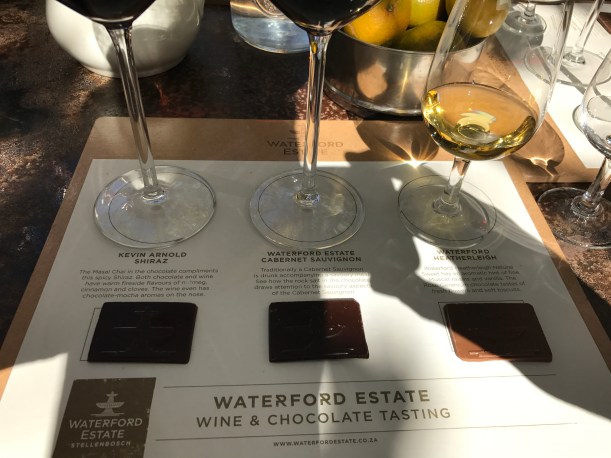
Paired with cold sliced nested olives and red pepper stuffed with feta.Later paired with masal chai 70 % cocoa
Waterford estate Cabernet Sauvignon 2014
This area is excellent for Cabernet Sauvignon and often called the Golden triangle 30 km from coast, False Bay, possibly leading to a saltiness in soil and Helderberg breeze from sea.Stones retain heat in soil from table mountain sandstone widening ripening and maturation.
Closed nose hints of Cedar wood cassis restrained
Paired with rock salt 70 % chocolate
The Jem 2001 named after Jeremy Orde owner, 8 varietals including CS Cf Merlot
Complex nose liquorice cassis herbaceous fine firm tannin structure tobacco hints mint long round finish still a baby
Weatherford heatherleigh
Muscat Viognier Chardonnay CheninRipe apricots peach honey
Matched with rose geranium chocolate
I highly recommend visiting Waterford for their full wine safari experience. It’s a great way to learn about the terroir and the jeep ride through the vineyard with stops for food and wine matching provides a unique insight into their philosophy.
This historic winery is situated on the slopes of the Simonsberg mountains.Its name is derived from ‘Koppie’ from which a canon was fired in the 17th century to alert farmers of ships entering table Bay .They have 100 hectares of vineyards mainly pinotage and Cabernet Sauvignon . Focus is on top quality red wines especially Pinotage. Kanonkop is run by 2 brothers Johann and Paul Krige. The family run ethos have resulted in only three winemakers in the last 48 years. Arbrie Beeslaar is the current winemaker whose mother in law I coincidentally sat next to on the flight from London !
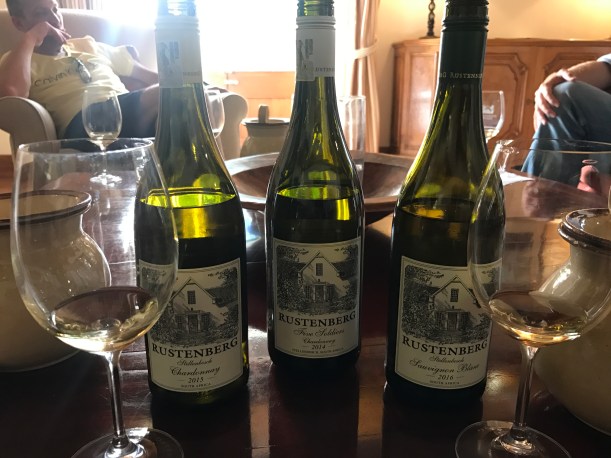
Rustenberg was founded in 1682 and is situated at the foot of the Simonsberg Mountains . It’s a Cape gem with beautiful Cape Dutch thatched roofed buildings, a historic gabled manor house , extensive landscaped gardens and vineyards. John X Merriman, a former Cape Prime minister bought the property in 1892. In 1941 Peter and Pamela Barlow bought Rustenberg their sons now run the business
Wines tasted with Willem, marketing manager ( Importer in the UK is seckfords, available waitrose majestic)
Rustenberg Sauvignon Blanc 2016
Grown at altitude 550m + Can smell from end of table, Pineapple tropical fruit lemons,Crisp fresh ++ aged in lees 3 months
Rustenberg Stellenbosch Chardonnay 2015,Butter toast creamy citrus fermented in oak
Five soldiers Chardonnay 2014,Creamy textured long marzipan citrus nutty crisp +
Rustenberg Grenache 2015,Blueberries red currant cut bunches in half before harvest to concentrated
Rustenberg Merlot 2015,Plummy fruity soft tannins
RM Nicholson 2015 Shiraz blend slight perfume black cherries
John x Merriman 2014,Bordeaux blend,very good structure needs age a little tight Black fruits
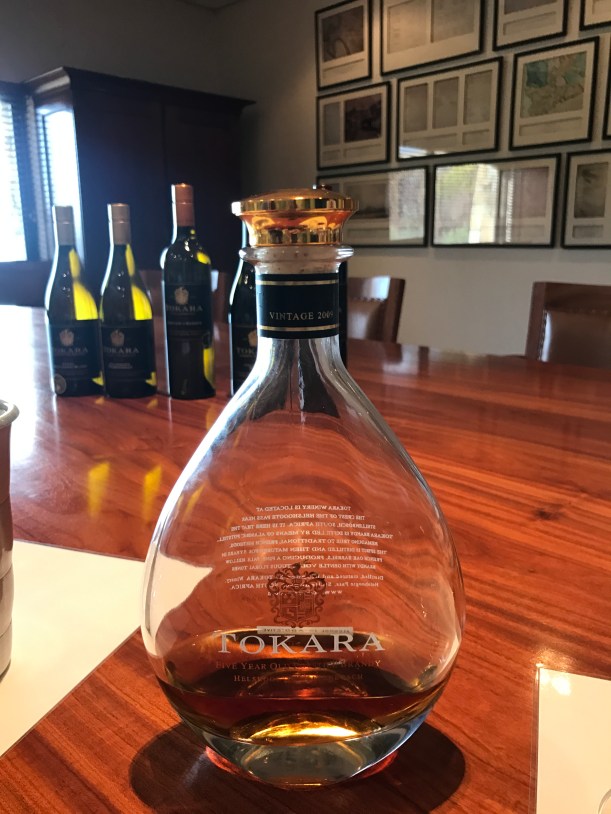
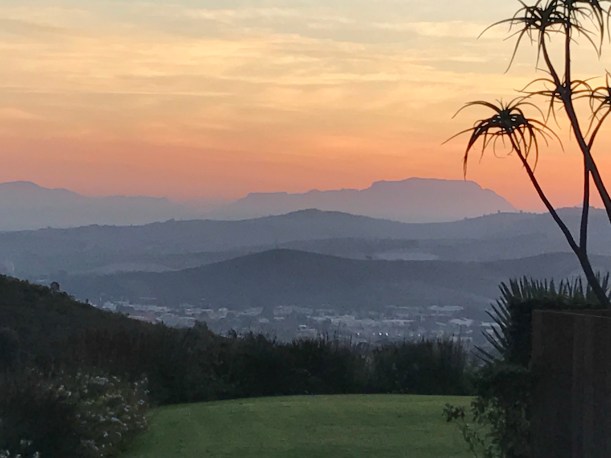
Our first tasting in Stellenbosch was at the magnificent Tokara Estate owned by GT Ferreira , situated at the crest of the Helshoogte Pass. The exceptional location allows panoramic views over Olive Groves, valleys and Mountains from Simonsberg to Table Mountain. The tasting room has a huge stone fireplace and contemporary architecture, there’s also a sculpture garden delicatessen and restaurant.
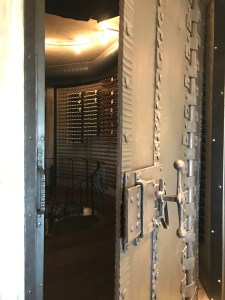
We were greeted by Karl the GM and Suzanne .This stunning property has 60 hectares of vineyards and was built in 1999 with first vintage in 2001. Grapes are sourced from a variety of sites including the lovely Elgin Sauvignon blanc on a site which was a fruit farm. 2007 to 2016 ten year tasting shows exceptional development of these wines Back vintages are stored in a monumental four storey cylindrical cellar hidden behind a vast cast iron door off the tasting room .
Luckily I was inquisitive enough to encourage Carl to not only give us a peek inside but also to sneak out the delightful 2006 Directors reserve Semillon.
Tokara is named after the owners 2 children Distribution is mainly in Holland U.K. Germany. ABS wines distribute in the U.K The German market is very big partly due to historical factors , the Germans colonized SW Africa.25% of Somerset West has German owned homes
The high altitude vineyard on the slopes of Botmaskop was originally a lookout for boats entering Table Bay Harbour .
No expense was spared on their multifaceted property, with a winery, two restaurants, a lifestyle boutique,a diamond store, a five star lodge and spa transformed by Laurence Graff founder and chairman of Graff Diamonds International Ltd.
The cellar is one of the most advanced and well equipped in the Southern Hemisphere the first wines made in 2008.
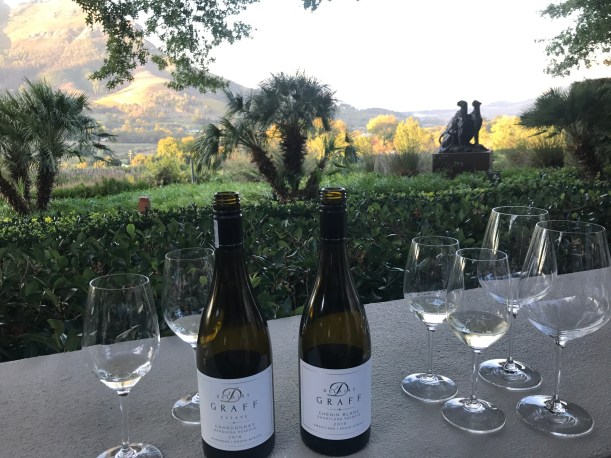
Wines Tasted on the terrace
Cabernet franc rose 2016
strawberry crisp fresh finish
Delaire Graff Sauvignon Blanc 2015
beautifully fresh hint gooseberry and lemon
Delaire Graff Sauvignon Blanc coastal cuvée Olifants river 2015
3 km from sea has 4% sémillon Franschoek Textured structured great mouthfeel length gooseberry tropical fruit
Delaire Graff Banghoek reserve Chardonnay 2015
vanilla peaches toast long 10 months French oak barriques seductive nose long lingering finish
Delaire Graff Swartland Chenin Blanc 2015
Honey citrus
Delaire Graff Botmaskop 2015
Alcohol stands out Tomato leaf nose cassis soft tannins Needs another year or more
Winemaking dates back to 1695 . Now run by ex lawyer Kobus Basson with extensive renovation and modernization.The property includes an 18 hole golf course a luxury residential developments a boutique hotel and a top Provençal inspired restaurant
Terroir Dinner with Anthony van schalkwyk atTerroir restaurant
Four clearly defined ranges exist . the foot of Africa range , The cellar selection range , the vineyard range and their flagship family reserve range.
Wines tasted with dinner
Vintage 2009 Blanc De Blanc Methode cap classique.
Family Reserve Chenin Blanc 2015
Family Reserve, Cabernet 2012
Family Reserve Shiraz 2012
For full tasting notes see details from our wine dinner in London with Kleine Zalze .
I highly recommend this as a destination to base yourselves in Stellenbosch, complete with infinity pool , majestic views , mountain bike trail , excellent restaurant and easy access to wineries .











 Butter toast creamy citrus fermented in oak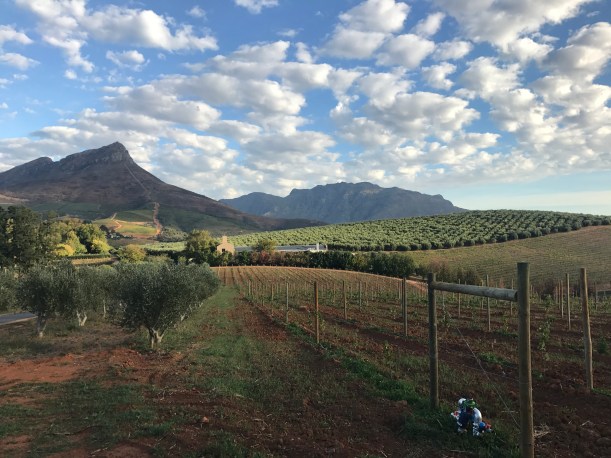




 WanderCurtis Wine