Our recent offer to followers of the wines of Reyneke in South Africa has delivered an obvious wine of the month.
This is 100% Sauvignon Blanc. The reserve is made from selected pockets of grapes within the vineyard which have their own character. It gets 24 hours on the skins and the new oak barriques. More stone fruit on the nose also a bit of hay and a subtle touch of vanilla. Lovely textured mouth feel, more peach and bit of toast, rich but balanced, great length.
Wild fermented in oak barrels with minimal intervention, this is not your identikit new world Sauvignons and much more interesting and complex for it . Hay, a touch of gooseberry, a whiff of custard, lovely balance and freshness white peach, pineapple, creamy and a touch of toast. Complex and long. I think these are fantastic value wines.
This pale gold sherry is made from a single vineyard and has been aged a solera system of 10 criaderas or layers of barrel. This means that the youngest element of the wine is at least 10 years old.
It has a pronounced nose with blossom, bruised apple indicating light oxidation, ripe peach and melon. Characteristic aromas of wet bread dough, rancid apple and olive brine speak of the wine’s maturation under flor yeast and the notes of almond and mushroom testify to its maturity.
On the palate it is bone dry, the flor notes balance moderate acidity and although 15% the alcohol is low for a sherry and body medium. The saline finish lingers long and cries out for tapas!
This is an outstanding wine at perfect point of development on release and although stable should not be cellared for any significant period.
Mostly when I ask winemakers about what they are doing to be more sustainable and to reduce their environmental impact the answer is all about stewardship of the land; vineyard practice, avoidance of pesticides, and perhaps a bit of onsite recycling. All good stuff, but as the drive towards Net Zero Carbon builds obviously the wine industry also needs to step up and make a start down this road.
Challenging though it may be, without plotting a route and taking the first step, the target will never be reached. Equally we consumers need vote with our wallets and make it clear we care, not just about how tasty the wine in our glass is, but also about the journey has taken to get there.
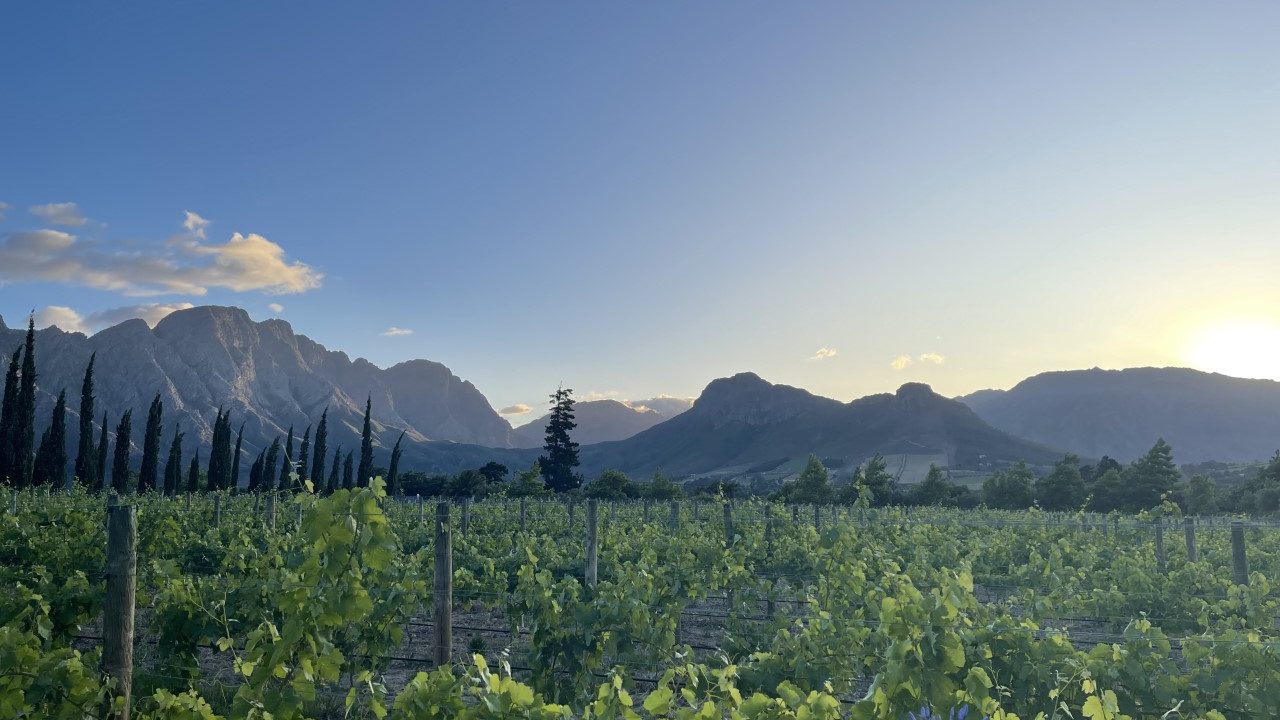
Happily, there are some great wineries out there, leading the way on sustainability and one of them is Reyneke Wines in Stellenbosch.
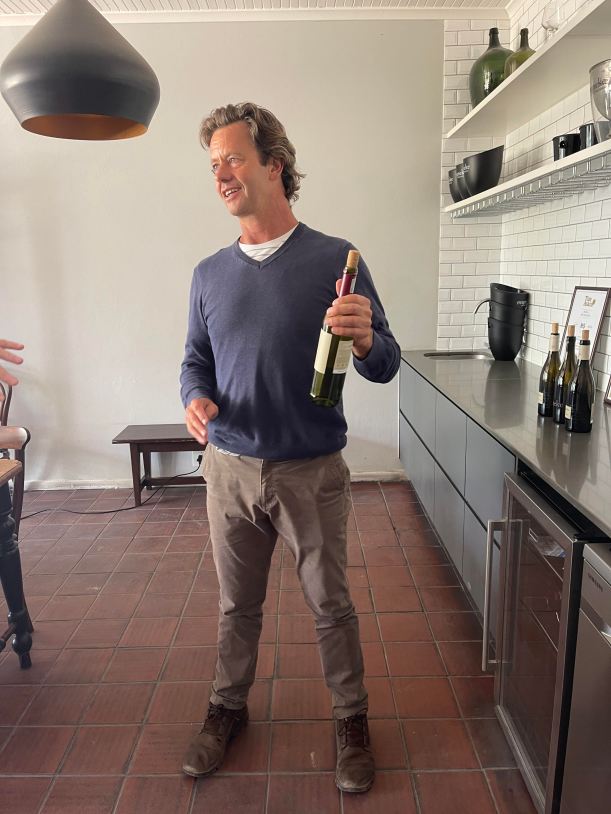
Since the early noughties Johan Reneke has been working towards achieving the three pillars of sustainability: environmental, social and economic. As he eloquently argues, how can a wine be beautiful if there is ugliness, in the form of glaring social inequity, involved in its making? He also makes the point that only a financially healthy business is going to be able to achieve any sort of environmental and social goals.
Johan sees Biodynamic farming as part of a larger picture of regenerative farming. Agriculture is one of top five contributors to climate change but regenerative agriculture actually provides the opportunity to turn this around. It can actually sequester carbon back into the earth by improving soil health and increasing humus content. Another win is by moving away from monoculture biodiversity can also be improved.
Reyneke works with nature to maintain vine health without recourse to chemical pesticides, herbicides and fertilizers. This ‘land caring’ element of the approach uses for example dandelions and other cover crops to provide a preferential home for pests. It also involves ducks trotting around the vineyards hoovering up snails.
Land within the farm is also ‘spared’ so that there are pockets of wilderness left between the vineyards which are rich in flora and fauna. The farm’s herd of cattle currently roaming in pasture below the winery, are let into the dormant vineyards over winter to fertilize them. In a lovely example of the vineyard’s circular like economy the winery produces feed for the cows in the form of the grape pressings which according to Yohan they love!
Looking back towards False Bay with the farm herd of cattle in the foreground.
Improved soil health and biodynamic farming has made the vines more resilient to pest, fungus and drought and so by extension perhaps some of the other effects of climate change?
As we visit the Reyneke wine farm is currently being extended into a neighbouring farm recently acquired. Some of the vineyards are being kept and some replanted. One can see where strips running along the contours of the hillside are being set side for biodiversity corridors between the vines. Old vines are piled up and will be turned into bio-charcoal that will be mixed in with the soil, locking in the carbon long term.
New vineyards in preparation. A pocket of Fynbos top left, horozontal lines on the hill side mark out future biodiversity corridors
When looking at the road to net zero carbon any organisation needs to look at its Scope 1, 2 and 3 emissions. Scope 1 emissions are C02 emissions arising from operations directly controlled by the organisation. Scope 2 are emissions up stream caused indirectly by the organisation when it buys in goods and services from elsewhere, for instance electricity or bottles. Finally scope 3 emissions are those downstream arising from the activities of distributors and consumers transporting, consuming and disposing of goods.
At Reyneke the farm is now carbon negative but Johan continues to look at the winery operations. He is investigating renewable energy in the form of photo voltaic (PV) panels, possibly in combination with electric tractors which could double up by providing some energy storage too. The Cape is lovely and sunny but electricity is currently rationed in ‘load shedding’ which adds another reason for moving off grid.
Reyneke is also trailing the use of Tetra Pak type packaging as an option, starting with their entry level organic wines in Scandinavian countries who seem more open to the idea. Clearly there is a challenge here in shifting negative consumer perceptions of ‘bag in a box’ type wine. Moving away from bottles would deliver valuable reductions in carbon footprint in terms of packaging and transport.
A non-interventionist approach follows through into the wine making. Instead of temperature controlled stainless steel and yeast inoculation at Reyneke wild fermentation in oak barrels is the order of the day. The wooden containers and smaller volumes successfully manages the temperature during fermentation in a passive way. The wild yeast and breathability of the oak also give a different character to the wines in particular the Sauvignon Blancs.
Johan’s story is so fascinating, and the challenges he and his team have taken on are so inspiring that this intro’ section could easily run on and on so let’s get to the wines, which do not disappoint!
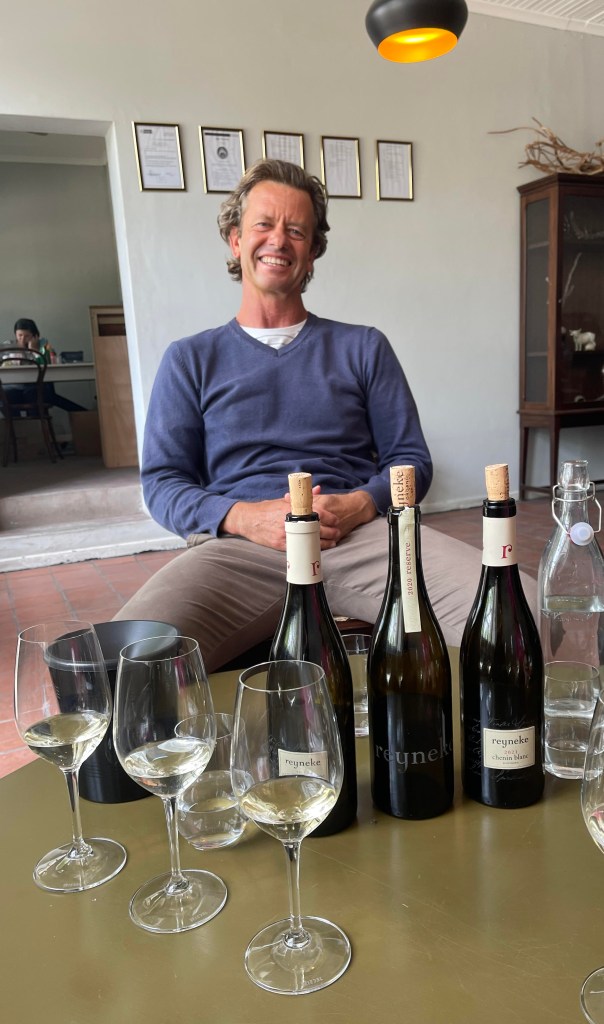
Reyneke Sauvignon Blanc 2021
On the nose, hay, a touch of gooseberry, a whiff of custard. Good body with lovely balance and freshness. A nice supple mouth feel, white peach, exotic fruit pineapple, creamy gooseberry fool. Complex with good length a wine that evolves. Excellent. (Tasted at the farm and again back in London with consistent results)
Reyneke Reserve White 2020.
This is also 100% Sauvignon Blanc. The reserve is made from selected pockets of grapes within the vineyard which have their own character. It gets 24 hours on the skins and the new oak barriques.
More stone fruit on the nose also a bit of hay and a subtle touch of vanilla. Lovely textured mouth feel, more peach and bit of toast, rich but balanced, great length. Neither of these wines are your identikit new world SBs, much more interesting and complex.
Reyneke Chenin Blanc 2021
The vineyards here are part of the South African old vine project so more than 35 years old.
The nose is floral and nutty. In the mouth apricot, honey and a slightly salty finish. Vibrant.
Reyneke Syrah 2019
On the nose, sweet blackberry, dried herbs and crushed pepper. In the mouth dried black fruits, iodine, ripe tannins, full bodied but fresh. Long. (Tasted at the farm and again back in London where the wine benefited with time in the glass.)
Reyneke Reserve Red. 2019
The wine is 100% Syrah and again from selected parcels of the vineyard.
On the nose, blueberry pie, ripe fruit, pie crust, vanilla, coffee grounds, fresh garigue herbs. Iodine? Ripe blue and blackberries, powdery tannins, a herbal liquor note, savoury notes of grilled meat, full body and fresh acidity. Complex and very long. So good now that it will be hard to keep ones hands off this to let it mature! (Tasted at the farm and again back in London where again the wine benefited with time in the glass.)
Cornerstone 2019
A blend of Cabernet Franc and Cabernet Sauvignon in this vintage.
The wine is named after the Cornerstone project. Johan sees the workers as the cornerstone of the business, farm workers generally receive low wages as there is high unemployment and viticulture is the least profitable part of the industry. Scheme aims to empower workers with housing and education using profits from the winery.
Classic cassis, black current leaf, black current jam and a touch of sawdust on the nose. Austere at first, black fruits, green pepper, coffee grounds, slightly drying grainy tannins. Tasted again in London it opens up and fruit fills out the palate with bit of air. Still fairly primal at this young stage but good potential.
There is a vibrancy and depth to these wines which is compelling and it’s a quality that the Wander Curtis team have noticed on multiple occasions in other Biodynamic wines by producers such as Felton Road and Chateau Pontet-Canet. On every level there is definitely something to Biodynamic wine making.
Now deep garnet with the sort of dignified, autumnal hue that only time can bestow, this vintage Port is a glorious study in how wine ages gracefully. The nose is super expressive, a heady mix of violet and rose that gives way to layers of bramble fruit, black plum and that unmistakable Port signature of stewed, baked cherries. But it’s in the tertiary notes that the magic lies: think old leather armchairs, damp earth, roasted walnuts, black tea, tobacco leaf, even a faint whiff of game and mushroom.
On the palate, it’s everything you’d want from a mature vintage Port. Silky, mouth-coating tannins, a warm embrace of alcohol, and a tension between sweetness and acidity that keeps everything in perfect balance. The fruit is still very much alive, but now draped in dried fig, prune and savoury undertones that unfold in waves. The finish? Long, layered, and deeply satisfying.
This is top class wine not in the shouty, blockbuster sense, but in the way that the best old Ports are: poised, deeply flavoured, and full of quiet confidence. It’s drinking beautifully now, but there’s still more to come for those patient enough to wait. There’s enough structure and fruit to see it evolve even further, inching ever closer to those haunting, nutty, leathery highs that only the best aged Ports achieve.
Not only does wine making in South Africa go back a very long way but winemaking in the Cape actually has a birthday: 2 February 1659! On that day Jan van Riebeeck recorded in his diary “Today, praise be to God, wine was made for the first time from Cape grapes.’
Sent by the Dutch East India Company in 1652, to establish a staging post to supply ships on their way around the Cape of Good Hope, Van Riebeeck lost no time on the important business of planting vines and making wine. Apparently was essential to the treatment of sailors with scurvy. Yet more historical evidence of the health benefits of red wine!
Constantia
Constantia lays claim to have the oldest vineyards in the southern hemisphere dating from 1685 when Simon van der Stel, the Cape’s first Governor established a farm on the southern slopes of Table Mountain facing False Bay. False bay is of course a ‘real’ bay, it was just the wrong one from the point of view of sailors returning from India when they realised that they hadn’t quite reached the Cape Bay and still had to round the treacherous Cape of Good Hope.
Vin de Constance has since been revived by Klein Constantia and Groot Constantia also makes a sweet Grand Constance. However, the comparatively cool climate, elevated altitude and generous rainfall (twice that of London apparently) means that modern Constantia is now home to a wide range of red and white varieties.
Where Van Riebeeck’s relied on enthusiasm Van der Stel brought to bear some viticultural knowledge and his name is firmly stamped on the Cape winelands. Quite literally as he named Stellenbosch town after himself and the imposing back drop of Simonsberg mountain serves as an ever present reminder. The wines of Constantia attained international acclaim in the late 18th and early 19th C boosted by the war between France and England which made French wine hard to get hold of. Famously Napoleon’s suffering during his exile on St Helena was greatly eased by a steady supply of Vin de Constance. The wine at the time is thought to have been sweet and quite possibly fortified. Once there was peace and a trade agreement between England and France the market for Vin de Constance diminished and in the end the vineyards did not survive the onset of Phylloxera.
Groot Constantia
Groot Constantia (pronounce the G as if you are clearing your throat) is the largest part of the Van de Stel’s original farm. A trust now owns the estate and it is even a National Monument. The old Cape Dutch style farm house houses a museum which tells the story of the wine farm. Simon van der Stel’s mother was daughter of a freed Indian slave and after him Johannes Colijn, who heralded in the heyday of Vin de Constance in Europe, was also of mixed race. The exhibition gives a sobering understanding of the part that colonisation and slavery played in the history of the farm and Cape’s wider wine heritage.
An easy drive from Cape Town the history, wine, restaurants and beautiful setting make the estate well worth a visit.
Rose 2022
A blend of Cabernet Sauvignon, Merlot, Semillon and Sauvignon Blanc made with minimal grape skin contact. Pale orange pink colour. Nose of honey dew melon. Nice balance, peachy notes and good freshness. Easy drinking in the sunshine.
Sauvignon Blanc 2022
Constantia has a reputation for fresh Sauvignon Blanc. Floral nose with elderflower blossom and a touch of grassiness. Again good balance, melon and tropical fruits flavour, fullish body but with freshness.
Chardonnay 2021
Smokey vanilla nose. Lemon, vanilla, spicy wood, full boded mid-level acidity and medium length. Tasty ‘new world’ style.
Gouverneurs Reserve White 2020
A blend of Sauvignon Blanc and Semillon partly aged in new oak Barrique.On the nose green pepper, hay, meadow flowers, herbs, tarragon. Fullish body, mid-level acidity, dry herbs, hay, grapefruit pith. Complex with very good length and a lovely citrus persistence.
Lady of Abundance 2018
A red blend of Pinotage, Merlot, Shiraz and Tannat.Mixed macerated red and dark fruit nose. Ripe plum, blackberry, clove and toast favours with soft tannin. Easy drinking.
Merlot 2018
A nose of classic plum and milk chocolate and a whiff of vanilla. Ripe capsicum, red fruit, soft tannins, medium length. Tasty.
Cabernet Sauvignon 2019
Initially mulberry, then a leafy green aroma. Touch of strawberry, dried cranberries. In the mouth more dried fruit, nice chalky tannins, medium body, good acidity. Reasonable length. Give it a year or two and this should round out nicely.
Pinotage 2020
Baked dark plum with ferrous notes and a sprinkle of cake spice. Rounded full body but not flabby, more spicy baked blackberries, finishes with sweet fruit and is quite long.
Shiraz 2019
Plush fine oaky nose, iodine and dried cherry. Good balance and length, dark cherries, hint of blood, good length. Firm tannins sit squarely on the tongue, this should age quite nicely.
Gouverneurs Reserve 2028
A Bordeaux blend. Plums, cedar wood, milk chocolate, nice furniture polish. very Claret like. Mix of red and black fruit, Black Forest Gateaux, great balance and a long savoury finish! Excellent.
Grand Constance 2017
Made from Muscat d’Frontignan the white Muscat is complemented with a small percentage of red Muscat.
Burnt orange colour. On the nose orange peel, ginger powder, dried apple, cinnamon, cake spices, furniture polish. Lusciously sweet but with enough lift to keep it fresh. A strangely a floral note, rose water or something like that and more dried orange. Very long.
Hemel-en-Aarde
Hemel en Aarde is known for growing Burgundian grapes and is divided into three areas: Hemel-en-Aarde Valley, closest to Walker Bay, Upper Hemel-en-Aarde Valley further up the valley and Hemel-en-Aarde Ridge the highest area in terms of altitude. Each area has different soils and micro-climates.
The received wisdom is that in the lower section clay soils produce broader more structured Pinots, the decomposed granite in the Upper part results in a crunchy, elegant style and due to the altitude and recurrence of some clay the Ridge produces something in between. That said many other wines are also produced here including some crisp Sauvignon Blancs and Rhone blends.
Overall the region’s proximity to Walker Bay, the cold Benguela current as well as the prevailing Southeaster results in a particularly strong cooling maritime influence. Hemel-en-Aarde also has higher than average rainfall.
Hamilton Russell was the first winery in the area, the eponymous owner was looking for land and was attracted by the cooler climate. A risky move back in the 1970s as the vineyards had no quota for wine making under the then restrictive rules and so winemaking was technically illegal. Having planted a wind variety of grapes including Pinot and Chardonnay they eventually restricted wine making to just these two varietals. The winery has spawned several other neighbouring wineries as successive winemakers have left to set up their own ventures in the valley, these include Buchard Finlayson, Creation and Storm wineries.
The Wine Village, Hermanus.
At the bottom of the valley in the whale watching town of Hermanus is the Wine Village store with is a treasure trove of South African wines and will ship overseas.
Stephen was on the counter and let me taste Hamilton Russell Vineyards’ 2021 Chardonnay and Pinot Noir. Both from the Valley were beautiful rich, structured, and perfectly balances wines with lashings of fine oak. Immediately pleasurable for such young wines which for me puts them in the New World but with a level of Burgundian understatement.
Newton Johnson Family Vineyards
Newton Johnson is located in Upper Hemel-en-Aarde Valley located in a beautiful spot with spectacular views.
Resonance 2019
75% Sauvignon Blanc and 25% oaked Semillon. Flinty nose, gooseberry, Semillon gives the wine a nice body, good length with a slight toasty finish. Very nice.
Albariño 2021
The first planting of this grape in SA were here at Newton Johnson. Made 20% in old oak barrels. Floral notes with sea breeze, a nice saline note in the mouth, fresh. A bit more breadth than you would find in a Spanish version but no shortage in bracing acidity.
Family vineyard Pinot Noir 2020. 13.5%
A blend of several vineyards including Sea dragon and Windandsea each bringing different characteristics to the wine. On the nose red soft fruit, some nice vegetal notes. In the mouth sweet fruit, more herbs, delicious rounded body, good freshness, and a lovely long finish.
Full Stop Rock 2020
79% Syrah and the rest Grenache grown in decomposed rocky granite. The wine is aged in 5% new oak barrels and the rest used for18 months. Blackberry, ripe fruit forward nose. In the mouth ripe sandy, rounded tannins, very approachable now. Long.
Granum 2016.
A blend of 75% Syrah and Mouvedre. Darker colour. Black fruit, meatiness, oxo cubes on the nose. A nice stoniness, more ripe black fruit and savoury notes. Full bodied developing some earthy notes.
Boekenhoutskloof have also started making a Chardonnay and Pinot under their Cap Maritime label from vineyards in the valley. See the full review of this winery posted separately.
Wines of South Africa podcasts
Finaly just a quick shout out for the excellent series of podcasts that Jim Clarke and the Wines of South Africa (WOSA) have made. Packed with regional information, interviews with winemakers and some really interesting historical background these and Jim’s book really are essential further reading. To access the podcasts click on the link below.
Full disclosure, I have a very soft spot for Austrian wine. It is undoubtably through my partner, who is Austrian, that I have grown to love the many and varied delights that the country and its people have to offer. It’s fair to say that family Curtis pulls its weight when it comes to consumption of Schnitzels, quaffing of Greuner Veltliner and bashing of mogul pistes. Oh, and it goes without question that Semmel are the best bread rolls ever and nobody makes better ryebread.
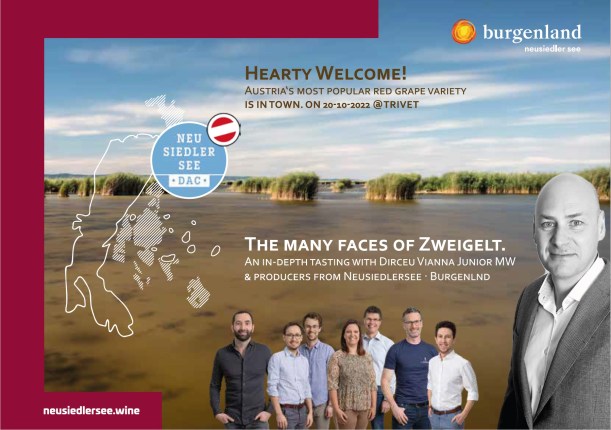
Anyway, we’ve written at length about Austria’s fabulous white wines: Greuners and Rieslings from the Wachau, Kamptal and increasingly from Traisental along with the characterful Sauvignon Blancs from SudSteirmark, but not enough about the country’s excellent red wines. My suspicion is that a lot of Austrian red wine just doesn’t make it out of the country because demand at home is so healthy. So, I was delighted be invited to a lunch spotlighting Zweigelt and the grape’s many faces organised Neusiedlersee DAC.
Zweigelt is the most planted red grape variety in Austria, second only to Gruener Veltliner in terms of vineyard area. It is a cross between Austria’s other two main red grapes, Blaufraenkisch and St. Laurent, the former, late ripening with high acidity and firm tannins and the later early ripening with delicate fruit and moderate tannins. The result, it is argued, is a wine that displays the best of both and is fruit forward, with gentle acidity and soft tannin. It can be made in a forward fruity style at a great price point or through selection and sometimes aging in barrique as a more structured reserve wine capable of many years bottle age.
Neusiedlersee DAC (designated area of origin) is located to the east of the Neusiedlersee a large lake on the boarder between Austria and Hungary. The designation is only for the production of Zweigelt and sweet wines although most of the winemakers in the area also produce a variety of other wines too.
Some nice Burgenlaendlisch drinking slang!
To demonstrate this the aperitif served before lunch was a Welschriesling Voll Freude 2021 by Georg Preisinger. Fresh with citrus and apple served gespritzt. The perfect refresher: half wine and half sparkling mineral water.
Next a young 2021 Zweiglet by Preiner Wein, served with an autumnal mushroom risotto.
Very fruit forward with accessible berries and a whiff of spice on the nose. A nice midweight body, soft tannins and good freshness. Well balanced and a collaborative partner to the delicate risotto flavours. Tasty!
The main course of grilled sweetbread was served with single vineyard Zweigelt by Gebrueder Nittnaus, Zweigelt Golser Ried Luckenwald 2004.
The wine demonstrated how well the variety can develop in the bottle in the right hands.
On the nose cut strawberries, damp forest floor, a touch of vanilla from the Barriques. It retained a lovely juiciness on the palate with complex tertiary notes of mulch and mushroom. Great length. Excellent and it held its own against the richness of the sweetbread.
Finally with a desert of baked apple and vanilla cream a TBA Welschriesling Siddartha 2018 by Johannes Muenzenrieder. Wow a delicious nose of peach, roasted nut and honey, more of the same in the mouth, lovely balance and length. Sweet wines from near the Neusiedlersee benefit from the morning mist and afternoon sun and somehow retain great freshness.
The line up of Zweigelts on the free pour table displayed a spectrum of wines most of which were juicy and tasty from the off with some cellared samples that had developed lovely complexity. There were nice examples by Artisan Wines, Weingut Kummer, Keringer, Preiner Wein, Hannes Reeh, Salzl Seewinkelhof and Allacher.
Hopefully we’ll start seeing some of these lovely Zweigelts appearing in shelves in the UK soon!
Founded in 1776, Boekenhoutskloof can be found way down the scenic Franschhoek valley. The farm’s name means “ravine of the Boekenhout” (pronounced Book-n-Howed). Boekenhout is an indigenous Cape Beech tree greatly prized for furniture making. Hence the 7 wooden chairs that the wine labels feature.
As with many wineries there was a change of ownership and reboot in the early 1990s and new vineyards were planted including Syrah, Cabernet Sauvignon, Cabernet Franc, Grenache, Semillon and Viognier.
The winery also produces a number of brands: Porcupine Ridge, The Chocolate Blick, The Wolftrap. Producing 7 million bottles a year it is one of the biggest wineries.
One needs to book about 6 months in advance to visit and taste at the estate but it quite a special experience hosted by Godfried Mocke the wine maker in Franschhoek.
Godfried explained that they now have vineyards in Swartland home of the famous Porseleinsberg Syrah, for Rhone varietals. The grow Cabernet Sauvignon in Franschhoek and Stellenbosch and Semillion in Franschhoek. They’ve set up a fairly new venture to grow and make Burguindian varieties in Hemel en Aarde called Cap Maritime.
A tour through the winery revealed further details of their approach to wine making. They generally let wild yeast take care of fermentation. For red wine the concrete vessels used have rough surface that encourages a flora of yeast and so the cellar itself imparts a particular character in the same way that a cheesemakers cellar does. A part of the terrior.
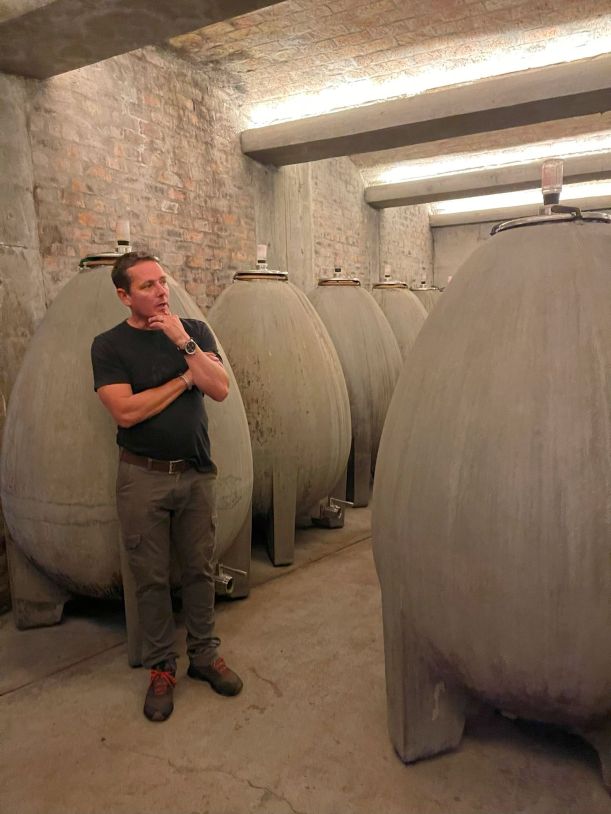
Concrete eggs are used to ferment the whites, the egg shape makes vortex which moves wine around, stirring the lees and it is also gently oxidative too.
However they often ferment some in barrique and blend to achieve the final wines.
Boekenhautskloof are also using amphora made of clay fired at high temperature so this format doesn’t breath they use it for muscat.
Reds are matured in barrels. Large Foudre for Syrah to slow oxidation. Barrique for the Cabernets.
Interestingly Boekenhautskloof do not acidify their wines which is actually widely practiced to achieve balance in the wines of South Africa.
Tasting notes:
Cap Maritime 2020, Chardonnay Hemel en Aarde
Creamy, toasty, smoky with citrus zest. Great balance, full but firm body, nice structure, long.
Semillon 2019
Made from old vines the youngest planted in 1942 which are more resilient to the droughts recently experienced. Bit of polish, wax, bit of smoke, pleasant petrol aroma. Nice elastic mouth feel, baked lemon, slightly salty tang, some smoke. Capable of bottle aging and developing great complexity. Think Hunter Valley.
Cap Maritime Pinot Noir 2020
Difficult year not much energy to ripen so needed whole bunch to give a lift. Cherry, green herbs. Sweet red fruit, good lift medium body.
The Chocolate Block 2021 (1 M bottles!)
Made from 5 varieties the lend percentages always shift and change. Blind tasted to pick best but will always reflect the vintage characteristics.
Mix if red crunchy berries, dark black current then brambles, a touch of vanilla. Good balance, structured, high acid, medium body, clayey tannins present. Fruity with a tough of menthol. Med length.
Syrah 2019
Grown on blue schist in Swartland. Nose of crushed raspberries, blueberries, light spice. Fruit forward creamy texture, clove ripe fruit finish. Long.
Cabernet Sauvignon 2017
Stellenbosch fruit. Dark fruit, iodine and black current. Ripe fruit, lots of nice powdery tannin. High acid, dry savoury finish.
These are amazing age worthy, high quality wines representing superb value!
Nestled on the slopes of Simonsberg Mountain, Kanonkop Wine Estate is a proud custodian of South African winemaking heritage. Now in the hands of fourth-generation brothers Paul and Johann Krige, the estate produces around three million bottles annually, with sales evenly split between domestic and international markets. Known exclusively for its red wines, Kanonkop champions two hero grapes: Cabernet Sauvignon and Pinotage. The estate’s flagship wines are meticulously matured in French oak barrels, incorporating a portion of new wood to enhance complexity and elegance.
The Kadette range, meanwhile, showcases fruit sourced from 30 local farmers, with Kanonkop’s own viticulturalist overseeing the growing process to ensure quality and consistency,. The estate traces its name to a nearby hill (or kop) where, in the 17th and 18th centuries, a cannon (kanon) thundered to signal the arrival of ships in Table Bay. This booming call once rallied local farmers to race their wagons to the harbor, laden with fresh produce.
Since bottling its first wine in 1973, Kanonkop has become a benchmark for South African reds, carrying forward the legacy of the visionary Paul Sauer.
Tasting notes:
Kadette Range – A Young soldier ready for action!
Kadette dry Pinotage rose 2022
Short skin contact, blush colour and burst of floral notes.
50% Pinotage plus Cabernet Sauvignon and Cabernet Franc, 14% ABV.
Nice brambly nose with a bit of smoke, an inky note and touch of vanilla.
Lovely juicy fruit, fullish body but good lift and spicy finish, good length.
Pinotage 2020 14%
100% Pinotage 14% ABV. Really sweet red and black berries, touch of vanilla.
More fruit on palate, soft chewy tannins, medium acidity, good length. Slight herbal finish. Very tasty
Cabernet Sauvignon 2020 14%
Classic blackberry and black currant leaf on the nose.
Nice dry fruit, herbal, savoury, nice grainy tannin, medium length. Lovely and great value.
Estate wine Pinotage 2020
Old vineyards with 60 year old bush vines. Pinotage is dry farmed
Matured in 80% new oak. Classy barrel room notes of toast and spice.
Lovely balance, and structure, brambly fruit, coffee notes, lots of length.
Estate Cab Sauvignon 2020
Classic blackcurrant leaf and whiff of smoke.
Blackberry is ripe but not over ripe ,mineral notes, very fine ripe tannin, lingering length. Long savoury finish!
Estate Paul Sauer 2020
70% Cabernet Sauvignon, 15% Merlot and 15% Cab Franc. Matured in 100% new oak for 2 years.
More of everything. Black plum, coco powder and spice.
More talcum powdery ripe and super soft tannins. Lovely rounded fruit breadth. Very long.
In recent years Kanonkop have experienced very consistent vintages harvesting at same time of year but it is always a race against time to harvest everything as it ripens all at once. They have not apparently noticed much effect in terms of global warming.
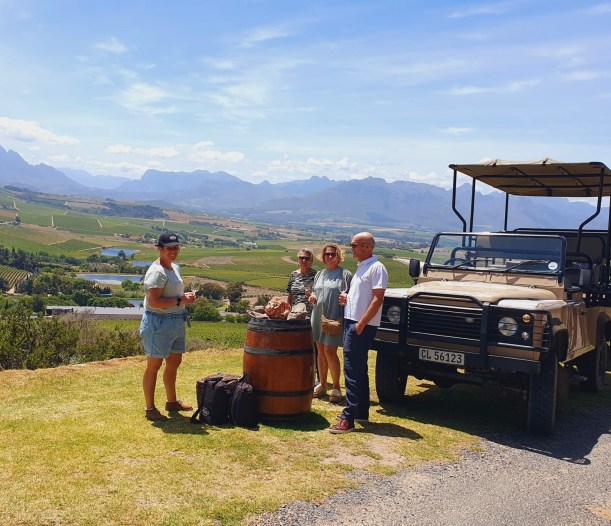
We loved the innovative safari, bumping along the dirt tracks through the vineyards at Jordan Winery in Stellenbosch. We travelled in a safari-style open topped Land Rover up to the top of the hillside to take in amazing views in one direction out to Table Top Mountain and Table Bay and the other towards False Bay. One the way we stopped for what has to be the most scenic venue for a wine tasting ever, looking out across Stellenbosch towards Simonsberg.
Along the way, we encountered the rich flora and fauna of the Cape Winelands, while gaining insight into Jordan’s unique terroir. The estate’s vineyards span altitudes from 160 to 410 meters above sea level, with slopes facing all four compass directions. Benefiting from cool coastal breezes and maritime fog, the vines thrive in soils ranging from ancient Cape Granite clay-loam to gravelly, sandy duplex. The trip finished off in the cellar with a tour and with more wine samples enjoyed in the on the sunlit restaurant terrace overlooking the lake, a great place for lunch. —a true celebration of Jordan’s exceptional terroir.
Try the Blanc de Blanc special cuve 2017 11%
Matured on lees for 54 months. Greenish gold in colour. Lovely chalky citrus notes, fresh cut granary loaf and a touch of ground almonds. Fresh, tight body, grapefruit pith and a long steely finish.
The restaurant name means spice that that is exactly what you get but in the most amazingly nuanced and innovative way.
I hate to say it was a ‘journey’, as that word is so overused, but the tasting menu with wine pairing really was quite an experience. The theatrics of table side prep, and wafts of dry ice all helped but the food was just incredibly complex and delicious.
For me the stand out dish was the normally humble bread course. First a large brass plate is sprinkled with spices: caraway, cumin, coriander, turmeric, black pepper and more, then warm wagyu dripping is poured over it. I had to soak up every drop with the bread it was so good. Actually the pairing with this was a wheat beer which worked very well.
Every member of the team was warm and friendly and super attentive. Book ahead to make sure to get a table, you do not want to miss out.















 WanderCurtis Wine