WanderCurtis Wine

Wine tastings, corporate events, reviews and recommendations


Leave a comment

Choosing the next NYN Wine Co Vinho Verde Blend

Alex and Manuel cofounders of The Not Yet Named Wine Co hosted an event recently which asl always put subscriber participation at the heart of their next bonus Vinho Verde wine release.

The very first wine that NYNW made was an Alvarinho from Vinho Verde made at Quinta de Soalheiro. Now they are making a bonus Vinho Verde with VineVinu which is Manuel’s family winery.

A bit of background on the region before revealing how the evening went.

Situated in the northwest of Portugal, the Vinho Verde region is renowned for its fresh, aromatic wines. Its location between the Atlantic Ocean to the west and mountain ranges to the east creates a moderate maritime climate, ideal for grape growing. The Atlantic’s cooling influence brings humidity and gentle breezes, while the mountains provide shelter from harsher inland weather. The region is further shaped by its river valleys, including the Minho, Lima, and Dour, which connect the coast to the interior, creating diverse microclimates and promoting balanced grape ripening.

Vinho Verde is best known for its white wine blends, crafted from native grape varieties that thrive in the region’s cool, damp conditions. The main grapes include:

  • Loureiro – Floral and fragrant, with aromas of citrus blossom and green apple.
  • Alvarinho ( same as Alborino grown in Rias Biaxas just to the north) – Known for its structure and elegance, offering notes of peach, citrus, and minerality.
  • Pederna (also called Arinto) – Crisp and zesty, contributing bright acidity and citrus flavors.
  • Avesso – Richer and fuller-bodied, with stone fruit notes and a creamy texture.
  • Trajadura – Delicate and fresh, adding subtle orchard fruit flavors and softness to blends.
  • Maria Gomes (known as Fernão Pires elsewhere) – Aromatic and fruity, with notes of citrus, tropical fruit, and subtle spice.

While most Vinho Verde wines are blends, the Monção and Melgaço sub-region produces 100% Alvarinho wines.

On the evening we were presented with three blends. Each was based on Alvarinho and Loureiro with varying additions of Arinto and Maria Gomes.

We were not told what the blends were but served the wines blind to taste.  Everyone then voted for their favourite and runner up blend.

The winning blend was then announced based strictly on receiving the most votes and will go on sale in the summer!

A fun and interesting experience and I would definitely recommend subscribing to NYNW as its both fun and educational. 

Was it the best wine? Well lets just say it was obviously the crowd pleaser!


Leave a comment

If you like Pinot Noir try Beaujolais Crus

This is a piece of advice that I’ve often been given over the years but have normally been disappointed when taken until recently.

In our last blinders Stuart and I were convinced that a wine Adam had brought was a pinot noir. Not only that but one with concentrated fruit, spice, savoury notes, lifted aromatics and aging potential.  Too savoury probably to be a new world example and perhaps not concentrates enough to be Central Otago so quite possibly a very good village Burgundy.

Well it turned out to the a Morgon Beaujolais Cru!

Situated just south of Burgundy, the Beaujolais wine region is renowned for its Gamay-based wines, offering a range of styles from light and fruity to complex and age-worthy. The region’s climate is semi-continental, with warm summers and cool winters, creating ideal conditions for grape cultivation.

Beaujolais’ landscape is defined by rolling hills and diverse soils, which significantly influence wine quality. The northern part is home to the Beaujolais Crus, where vineyards are planted on granite and schist slopes, producing more structured and complex wines. Notable Crus include Moulin-à-Vent and Morgon, known for their aging potential and Burgundian finesse. In contrast, the southern part of the region is flatter, with more fertile clay-limestone soils. This area produces Beaujolais AOC and Beaujolais-Villages wines, which are typically lighter and designed for early drinking.

Most Beaujolais and Beaujolais-Villages wines are made using semi-carbonic maceration, a technique that enhances the wine’s fruitiness and freshness. Whole grape clusters are placed in tanks, where fermentation begins inside the berries, resulting in wines with bright red fruit aromas, low tannins, and a lively, juicy character but often a slight bubble gum / banana taste.

In contrast, the winemaking approach in for the Crus employs more Burgundian techniques, including traditional fermentation, oak aging, and longer maceration periods. This produces wines with greater complexity, depth, and aging potential. Moulin-à-Vent offers firm tannins and spice, while Morgon is known for its fuller body and earthy character.

Climate change and investment are clearly having an impact on this regions ability to produce outstanding quality wines at compared to its northern neighbour very reasonable prices. For instance check out the Wine Society’s 150th Anniversary Moulin-à-Vent 2019.


Leave a comment

Wine dinner with Familia Zuccardi – Mendoza, Argentina with Eugenia González, UK Brand Ambassador Tuesday 11th February 2025 at Frederick’s Restaurant

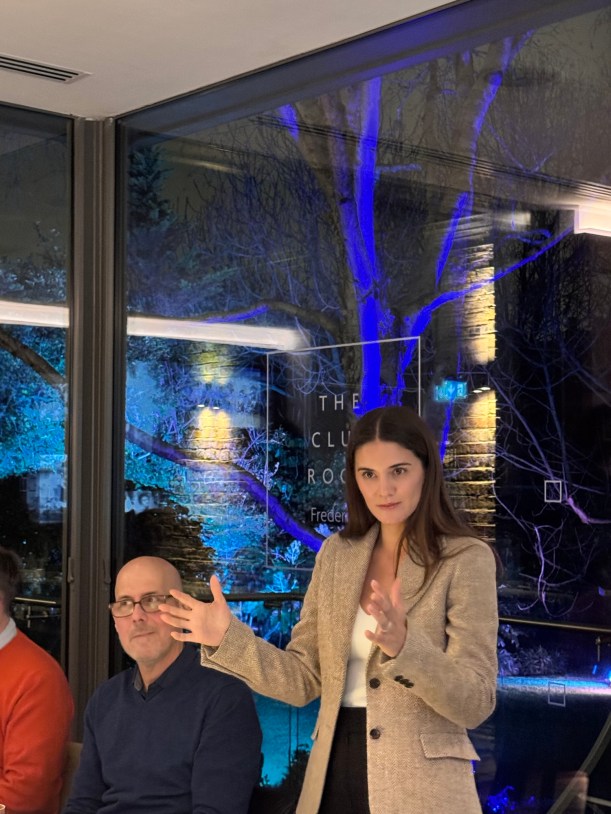
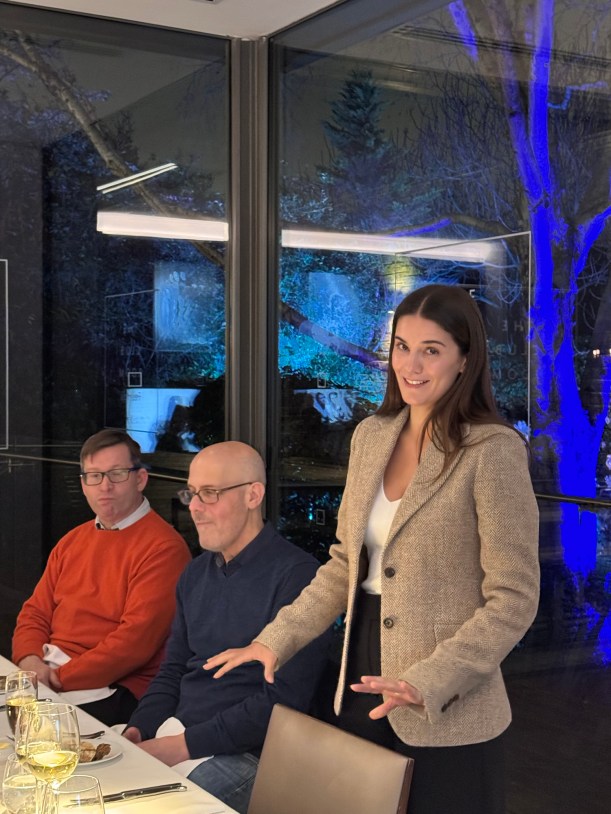
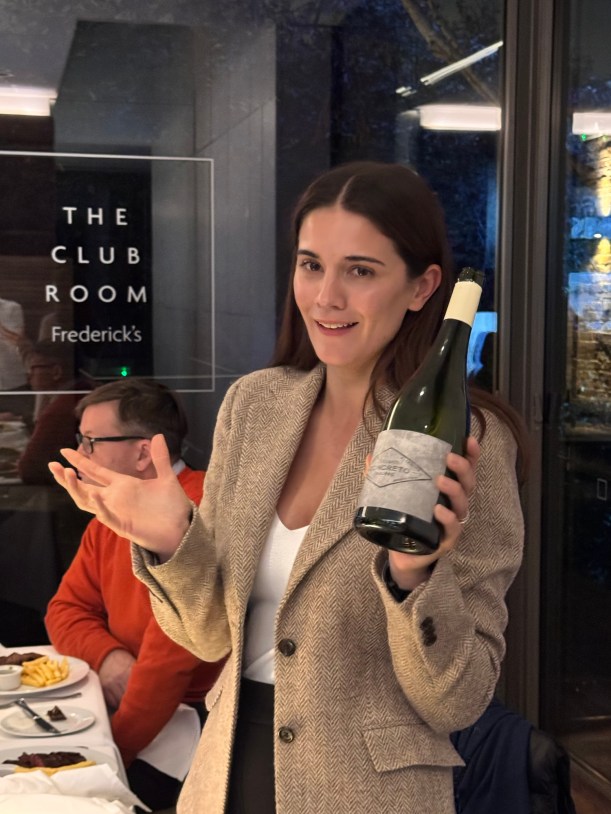
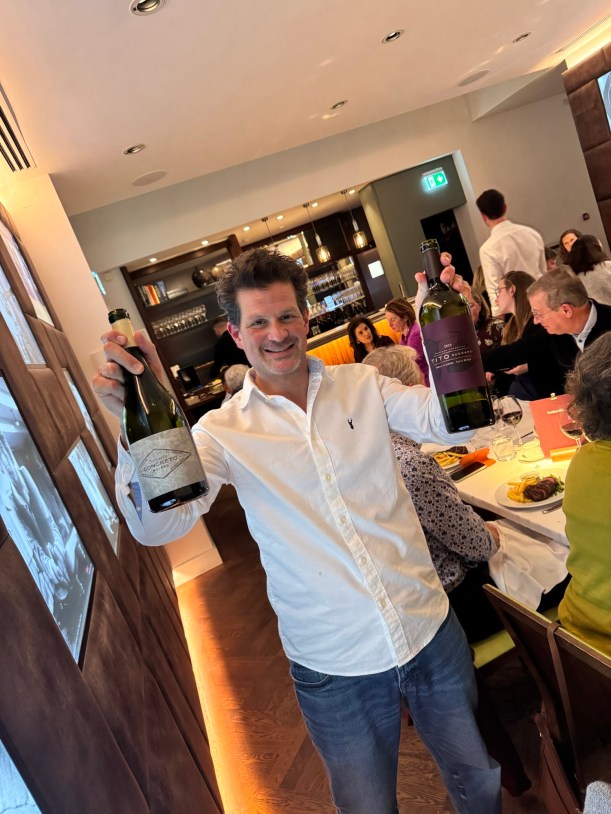
We had another great wine dinner with Familia Zuccardi – Mendoza, Argentina presented by Eugenia González, UK Brand Ambassador, on Tuesday 11th February 2025 at Frederick’s Restaurant in Islington.

Alberto Zuccardi, planted the first Zuccardi vines in a small plot in the Maipu region in 1963. Located in the Uco Valley, Mendoza which is at the foothills of the Andes Mountains in Argentina

They were voted The World’s Best Vineyard in 2020. Sebastián Zuccardi the third generation of the family, continues the family business and is one of South America’s finest winemakers. He added a Research and Development Wing in the family winery, to learn and analyse more about the terroirs.

They are known to produce some of the highest quality of wines in South America. The vineyards enjoy the benefits of altitude and a cool dry climate throughout the year.

 They are high-altitude wines (from grapes grown at least 500 metres above sea level). At high-altitudes, vines get more sun during the day and are cool at night. This diurnal variation intensifies the flavour of the grapes. Zuccardi’s San Pablo vineyards are situated 1500m above sea level. Their Paraje Altamira vineyards are at 1,100 metres altitude.

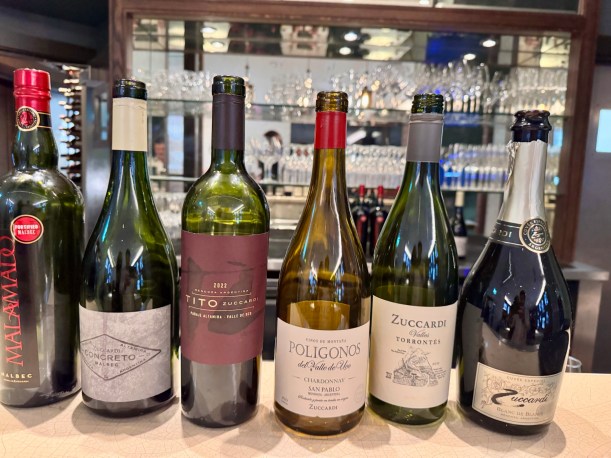
We had six brilliant wines including their single-varietal estate wines, primarily made from Malbec with a matched three course menu.

  Zuccardi Blanc de Blancs  Vintage 2017   Delicious, very Champagne like, autolytic with a lovely freshness and showing characters of 8 years of age. Made from single vineyard chardonnay grapes at an altitude of 5,000 feet

Zuccardi Blanc De Blancs Vintage 2017

Starter            

Chilli prawns “Pil Pil” pappardelle ˝
Superfood winter salad; roast pepper, butternut squash, avocado,
broad beans, pearl barley, pumpkin seeds (vegetarian/vegan)˝

Zuccardi Serie A / Valles Torrontés – A more restrained version of Torrontes, some florality reflecting it’s familial connection with Muscat but not overtly floral. Beautifully textured lovely mouthfeel. Really paired well with mild chilli prawn pappardelle.

  Zuccardi Polígonos Chardonnay a rich creamy Burgundian style Chardonnay with beautiful integration from 30% ageing in oak barrels. Pineapple hints of peach with minerality and flint. Really well balanced.


Pan-fried fillet of hake, seafood risotto ˝
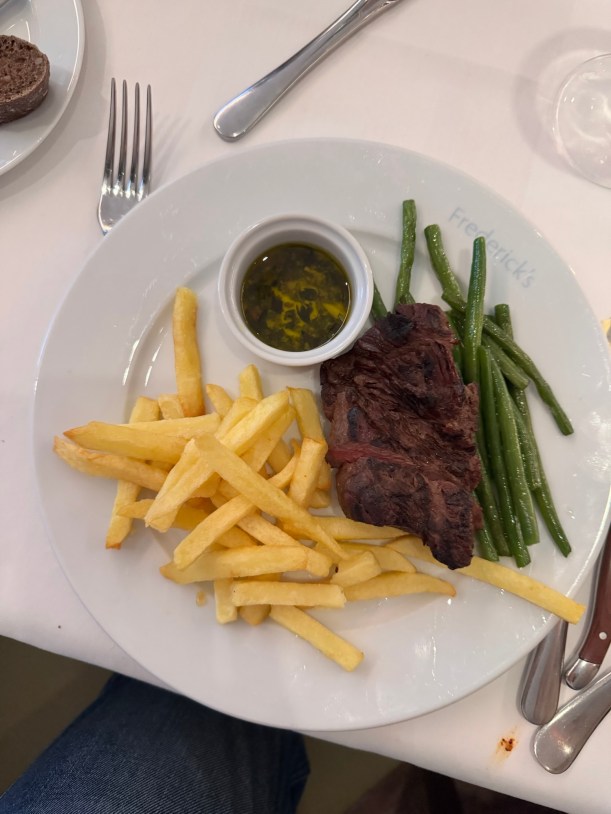
Chateaubriand steak, chips, French beans, chimichuri
Zuccardi Tito Malbec
Zuccardi Concreto Malbec˝ aged in concrete, egg shaped vessels, helps to retain the fresh red and black fruits

Tiramisu
Zuccardi Malamado Fortfiled Malbec NV


Leave a comment

Not Yet Named Wine Co:  ‘I helped make that wine’

Last year I signed up to the Not Yet Named Wine Co. at the suggestion of one of our regular wine dinner guests (thanks Carrie)

The attraction was that Alex Brogan who runs the venture offers an ingenious way of involving wine lovers of all levels to become part of the winemaking process. Founded by Alex and Manuel two Plumpton College Viticulture and Oenology students seeking a way to fund their own wines, the project has evolved into a vibrant community of wine enthusiasts, united by a shared passion for creating something truly unique.

At its core, the concept is beautifully simple: members pay a monthly subscription to participate in crafting two wines per year, one from the northern hemisphere and one from the southern. In return, they receive six bottles twice annually. What makes it special, however, is the democratic decision-making process. At every key stage, whether selecting fermentation methods, maturation vessel or blending styles, members vote on how the wine should be made, guided by detailed, jargon-free educational emails outlining the pros and cons of each option. Normally these emails come with an added dash of humour or at the very least a pun or two.

For those seeking deeper engagement a WhatsApp group offers a space to debate decisions with fellow members. The company also organizes annual vineyard visits (northern hemisphere), where subscribers can taste their wine in barrel and participate in blending or acidity trials transforming the experience from theoretical to hands-on.

The current vintage is being produced in Slovenia and Alex and Ales Rodica from the winery hosting the vintage, brought over some barrel samples of the Malvazija that we’re making for us to taste. And that’s the great thing about this, you do feel as if you are a part of the wine making team even if Alex is doing all the work.


Leave a comment

Vasse Felix: A Margaret River pioneer

If you’ve ever wondered how Margaret River came to produce some of the world’s finest Cabernet Sauvignon led Bordeaux blends, Dr. Tom Cullity is no small part of the answer.

Back in 1965 Dr. John Gladstones of the University of Western Aus had identified the ridge running north south in Margaret River as having good potential for viticulture.

Enter Tom Cullity, Perth cardiologist and, most importantly, lover of Bordeaux. He bought land in 67 and planted Cabernet, Malbec and Riesling establishing Vasse Felix wines

The Riesling didn’t make it but the Cabernet and Malbec vines still go into the winery’s flagship Tom Cullity bordeaux blend. The 2020 of which is pure silk and elegance.

It’s pretty dry during the growing season and at 34 degrees latitude it would be hot but for the cool cape current hugging the peninsula which moderates the summer temperature. As a result grapes ripen slowly and the wines to stay fresh.

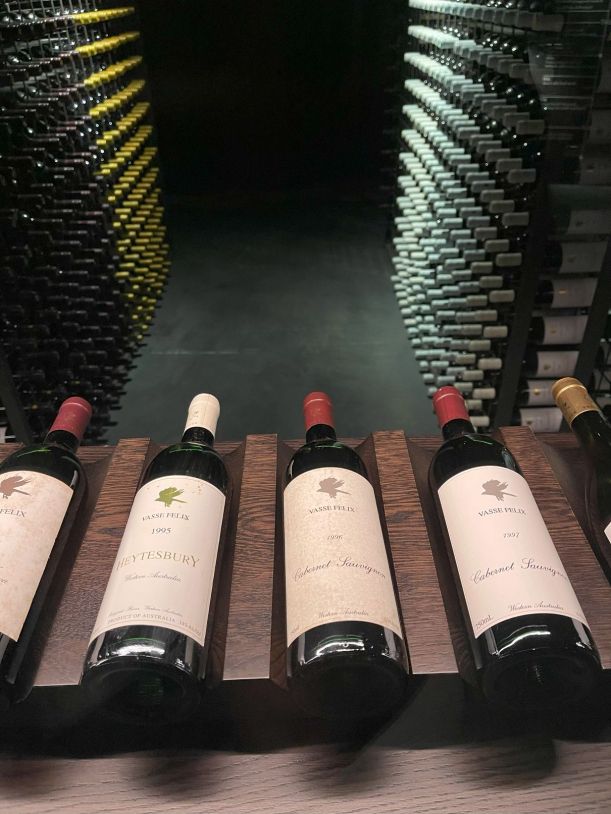
Vasse Felix also make excellent chardonnays, the ripe yet restrained Heytsbury is the premium offering, but both the estate Cabernet Sauvignon and Chardonnay are also tremendous wines.

A visit and lunch at their amazing restaurant overlooking the vineyards is definitely a must if you are in the region.


Leave a comment

Regenerative Viticulture: Farming for the Future

Regenerative Viticulture (RV) is quietly revolutionising how some of the world’s most thoughtful winegrowers approach their craft. It’s more philosophy than prescription, rooted in ecology and driven by a desire to transform vineyards into thriving self-sustaining ecosystems now and for generations to come.

At its heart, RV aims to restore soil health, improve resilience to climate extremes, reduce chemical inputs, sequester carbon, and nurture biodiversity. These are lofty ambitions, but for many growers, they’re fast becoming the only way forward.

Why Regenerative Viticulture?

The motivations behind RV vary. For some, it’s about producing better wine with less interference. Others are adapting to the escalating challenges of climate change; heatwaves, erratic rainfall, and soil erosion. Toby Buck of Te Mata is looking toward the horizon: “Our estate has to be sustainable for there to be a viable legacy.”

RV also speaks to the growing desire among wine drinkers for transparency, ecological integrity, and authenticity. In a world increasingly wary of greenwashing, it’s no surprise that many pioneers of organic and biodynamic win, like Tablas Creek and Felton Road, see RV as the next evolution.

But what makes RV different isn’t just the list of things it avoids. It’s the things its doing to build the growing environment back up.

The Methods

Rather than following a fixed set of rules, RV offers a toolbox of practices. Growers adapt methods to their particular environment, soils, and climate, to create resilient, biodiverse agro-ecosystems with healthier vines and deeper-rooted sustainability.

Soil First

Soil health is the cornerstone. Cover crops are sown between vine rows, preventing erosion, locking in moisture, and supporting underground networks of fungi and microbes. These relationships, vital to nutrient cycling and carbon storage, create a self-sustaining system beneath the vines.

Legumes fix nitrogen. Grasses manage vine vigour. Compost (including grape pomace, manure, and even biochar from prunings) replenishes nutrients and increases humus. This aids water retention and carbon sequestration. Johan Reyneke, whose South African vineyard was an early adopter, says humus levels have risen significantly thanks to high-density cattle grazing in the dormant season and careful composting.

Designing with Nature

Regenerative vineyards are often shaped at a landscape level. Incorporating trees and permanent wild habitat attracts predatory insects, supports biodiversity, and buffers weather extremes. Trees help cool vineyards during heatwaves and provide modest frost protection, but they must be carefully placed to avoid shading vines.

Water management, too, is critical. Techniques like keyline planting slow runoff and help retain moisture.

Integrating Animals

Animals, ducks, sheep, and cattle, are another key component. They manage weeds, fertilise the soil, and reduce the need for mechanical inputs. Reyneke uses ducks to tackle snails, and a herd of cattle in winter. Trellising systems can be adapted to allow grazing even during the growing season.

From Chemicals to Complexity

RV reduces reliance on synthetic inputs, especially pesticides and herbicides, which often damage beneficial biodiversity. Alternatives include organic-approved treatments and the cultivation of disease-resistant Piwi hybrids, which dramatically reduce the need spray against mildew. But organic practices like tilling can damage soil structure and release carbon, so many regenerative growers aim for minimal or no tillage, using mulches and interrow planting instead.

RV doesn’t pretend to be a silver bullet. Some growers still use herbicides, or till occasionally. But the emphasis is on long-term soil health, not short-term fixes.

The Costs and the Payoff

Transitioning to RV takes time, skill, and often money. Johan Reyneke openly speaks of the “school fees to pay”, yield drops during early experimentation, the need for new equipment, and a steep learning curve. Managing a vineyard as a living ecosystem means more complexity, more hands-on work, and more multidisciplinary knowledge.

Certification can also be costly and fragmented. Still, frameworks like Regenified offer tiered pathways that make entry more accessible.

On the other hand, RV can reduce dependence on costly external inputs like fertilisers and fuel, whose prices have soared in recent years. Tablas Creek believes improved soil health will extend vineyard lifespans beyond the usual 25-year cycle, reducing replanting costs and boosting profitability.

Yields may initially dip, but often recover, and some growers report even better quality grapes and more reliable harvests in extreme conditions. Extended ripening seasons, preserved acidity, and lower alcohol levels are just a few of the benefits Reyneke and others have observed.

Building a Business and a Legacy

Beyond the balance sheet, RV aligns with a growing desire to create purposeful, resilient wine businesses. Tablas Creek embraced ROC certification for its inclusion of social fairness. Felton Road is pushing towards net zero carbon. RV is simply one part of a larger mission.

In the end

Regenerative Viticulture won’t save the planet on its own. But as the wine world increasingly looks at lifecycle carbon footprints, packaging, distribution, winery energy, it’s clear RV is an important piece of a larger sustainability puzzle.

It offers something compelling: a way of farming that puts the ecosystem first, builds resilience, and returns power to the soil. It’s a way of producing authentic wines and perhaps these wines are just better too?  Give them a try and see what you think……….

This article is based upon my independent research project for the WSET diploma.


Leave a comment

Kumeu River: Producing champion chardonnays

The story of Kumeu River (pronounced: Koo-MEE-oo River) Wines is intertwined with the origins of New Zealand’s wine industry itself. From its early pioneering days as Croation immigrants who established a vineyard to its current reputation for producing world-class Chardonnay, the Brajkovich family has been at the forefront, earning international acclaim for their exceptional wines.

In 2015 Stephen Browett of Farr Vintners, organised a series of blind tastings against some of the finest Premier Cru and Village white Burgundies. The events brought together top critics, sommeliers, and wine writers to assess the wines side by side. In an upset to the established order Kumeu’s Maté’s, Coddington, Hunting Hill, and Estate Chardonnays triumphed in every flight except one, where they placed joint first with a leading Burgundy. This achievement cemented Kumeu River’s reputation for incredible quality and value wines.

The winery’s 30 hectares of vineyards, located on clay-rich soils with a sandstone base, play a vital role in their success. These soils retain enough moisture at depth to keep the vines hydrated through the dry summer months, eliminating the need for irrigation. This ensures the vines produce grapes of great concentration and balance.

With Auckland’s urban sprawl encroaching on vineyard land, Kumeu expanded in 2017, acquiring the Rays Road vineyard in Hawke’s Bay. Here, they have planted Chardonnay, alongside Sauvignon Blanc and Pinot Noir, on limestone slopes, adding further diversity to their portfolio.

In the winery, grapes are meticulously hand-harvested and sorted before whole-bunch pressing. Fermentation takes place in French oak barrels, the mix of new and old is tailored to the vintage and vineyard plots.  Wild yeast is always used to enhance the wines’ complexity.

A recent tasting of the 2023 vintage confirmed once again that these refined, elegant Chardonnays rival the best in the world.


Leave a comment

Albury Organic Vineyard leaf stripping and green harvest volunteer day.

Nestled below woodland on the gentle slopes of the Surrey Hills is Albury Organic Vineyard.

The dynamic Alex Valsecchi manages the estate with her team where they grow organically, biodynamically and use regenerative viticulture practices to make wine as sustainably and environmentally friendly as they can.

Alex admits that she and Nick Wenman, the owner, must be ‘a bit mad’ to take on the challenge of growing wine in this way in the damp and fickle English climate.

But really what they’re doing is showing just what amazing results can be achieved when you have a vision (no doubt determination and a lot of hard work come into it too!).

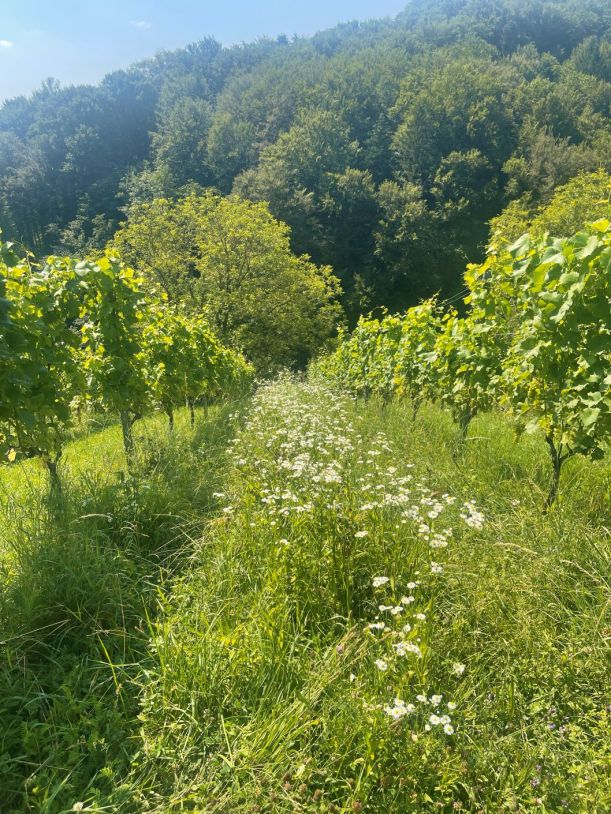
On a sunny day the vineyards are idyllic. A carpet of flowering clovers, herbs, legumes, orchids, yarrows, grasses and even wild strawberries, which are all native to the chalk hills of Surrey, has been allowed to colonise the space between the vine rows.

This along with a wildlife pond and wild flower meadow creates a diversity of habitats for beneficial insects and wildlife. 

By having diverse plants with their roots in the ground and by using only light tillage, Alex’s aim has also been to improve soil health and biodiversity below ground.

All this is on London’s doorstep and Albury welcome volunteers through the season to help out in the vineyard and experience it all first hand.

I spent a day in July helping leaf strip and green harvest in the newest section of the vineyard. Planted in 2022 these young vines need this type of tough love to strengthen them up for the future.

I can thoroughly recommend joining in and there’s a refreshing glass of Seyval Blanc fizz (tasting note bellow) and some lunch to keep you going. Harvest will most likely be in the first two weeks of October and will be an amazing opportunity to get in involved. You can sign up on their website.

Albury Estate Seyval Blanc 2021

Very pale, with fine bubbles. Blossom, hawthorn, jasmine, lemon verbena, green and yellow apple, pear, quince, thyme and a lovely touch of biscuit and croissant. Crisp acidity but rounded out by the apple & pastry flavours which linger nicely. Invigorating and Refreshing at a pleasing 11%.

I didn’t try Attila’s bite, she was at the vet!


Leave a comment

Are wine makers leaning too heavily on SO₂?

Wine making is a process full of potential pitfalls: oxidation, microbial spoilage, unwanted fermentations to mention but a few. To manage these, winemakers have relied for centuries on sulphur dioxide (SO₂), a highly effective antioxidant and antimicrobial. But with modern tools and shifting consumer expectations, there’s a growing question: are winemakers leaning too heavily on SO₂?

SO₂ plays several roles in the winery. It protects white wines from oxidation, which causes browning, dulls fruity aromas, and leads to acetaldehyde development (that bruised-apple note). It also suppresses unwanted bacteria such as Acetobacter, which can turn wine to vinegar.  It also helps control fermentation by weakening wild yeasts or halting it altogether to retain sugar in sweet wines. In red wines, natural phenolics offer some antioxidant protection, but SO₂ is still used to preserve freshness and stability.

It’s important to understand that SO₂ exists in both bound and free forms in wine. Only the free, molecular form is active in preventing spoilage. However, as SO₂ reacts with other compounds suchs as sugars, anthocyanins and aldehydes, it becomes bound and inactive. This means it is gradually “used up” during the winemaking process and must be carefully monitored and topped up.

As a wine is made there are several key intervention points:

  • At harvest and transport, SO₂ (often as potassium metabisulfite) is added to prevent microbial activity and oxidation during the vulnerable period between picking and processing.
  • After crushing, the must is tested, and additional SO₂ may be added, particularly in white wines, which are very prone to oxidation before fermentation begins.
  • During fermentation, SO₂ levels are typically kept low to allow yeast to function, but it can be used to inhibit spontaneous fermentation or halt it early, especially in the case of sweet wines.
  • Post-fermentation, SO₂ helps to prevent malolactic fermentation (MLF) where it’s not desired and maintains wine stability during aging. Barrels may be sterilised with burning sulphur, and free SO₂ levels are monitored throughout maturation.
  • At bottling, a final SO₂ addition protects against oxidation and microbial spoilage during storage and transport.

All this is standard practice. But is it always necessary?

SO₂ is not without controversy. Although most wine contains far less SO₂ than permitted by law, health concerns remain. Some individual, particularly asthmatic, may react to sulphites, and although the connection to headaches is unproven, it persists in the public mind. Beyond health, the use of SO₂ has become a philosophical issue in the natural wine movement, where minimal intervention is the goal.

The good news is, modern winemaking offers alternatives and supports more precise SO₂ management. Improved hygiene, use of inert gases (like nitrogen or CO₂), careful oxygen control, and alternative antioxidants such as ascorbic acid can reduce reliance on sulphur. Similarly, fermentation can be controlled by lowering temperature, sterile filtration, and stabilising agents like sorbic acid, again reducing the need for heavy SO₂ additions.

Crucially, SO₂ additions should be based on analysis, not routine. Monitoring pH, oxygen levels, microbial activity, and the free amount of SO₂ at each stage allows winemakers to tailor additions to actual need, rather than defaulting to maximum thresholds.

The “safe” amount of SO₂ depends on wine style, stability targets, and customer expectations. For example, a fresh, aromatic white like Marlborough Sauvignon Blanc requires more protection than an oxidative white Rioja, which is intentionally exposed to oxygen. Sweet wines and those with residual sugar, such as German Rieslings or Californian White Zinfandels, also require more SO₂ due to sugar’s reactivity and red wines less in general.

While it’s entirely possible to produce low or no-sulphur wines, these often show oxidative notes, haze, or instability that some consumers embrace and others reject. Conventional wine drinkers generally expect clarity, freshness, and shelf-stability and delivering that usually requires some level of SO₂.

Ultimately, SO₂ is not the enemy. It’s a critical tool, but not the only one. Good winemakers will find the right balance. Whatever style of wine is being made the science and the tools are available to reduce reliance on sulphur to a minimum whilst meeting the expectations of their customers.


Leave a comment

Wine Dinner with Te Mata Wines of Hawkes Bay, New Zealand, with Toby Buck at Bocca Di Lupo Restaurant, Soho London April 16th 2024

Te Mata Estate is New Zealand’s oldest winery, dating from the early 1890’s. Vines were first planted at Te Mata Estate in 1892. The original three vineyards produce its most famous wines: Coleraine, Awatea and Elston.

It is a New Zealand family-owned winery, based in Hawkes Bay, North Island. John & Wendy Buck have been co-owners of Te Mata Estate since 1978. Te Mata’s wines are renowned as the country’s finest.

They produce a stunning array of red and white wines including Coleraine and Awatea Cabernet/Merlots, Bullnose Syrah, Elston Chardonnay, and Cape Crest Sauvignon Blanc.

Coleraine was first made in 1982 vintage. It is a Bordeaux style wine described by Decanter magazine as “New Zealand’s First Growth”. It is made from their finest selections of Cabernet Sauvignon, Merlot, and Cabernet Franc. It is one of New Zealand’s iconic wines.

We were delighted to welcome Toby Buck, the son of the owner, over from New Zealand. Toby talked us through the history and his family wines.

We had a selection of five wines including Coleraine, served with a three-course dinner in the private room of the award-winning Boca Di Lupo restaurant in Soho.Tickets were priced is £95pp. We had a full house of 32 people.

Te Mata Estate Sauvignon Blanc 2021

Rigatoni with ricotta, broad beans & basil

Te Mata Estate Chardonnay 2023

Tagliata (served on sharing platters) Potatoes garlic & rosemary

Te Mata Bullnose Syrah 2019

Te Mata Coleraine Cab/Merlot 2018

Dessert

Te Mata Estate Gamay Noir 2023

Te Mata Wines Hawkes Bay New Zealand
Some readings of the best wine descriptions of the night

Our first time at Bocca Di Lupo was a great success. The Tagliata (Thin slices of perfectly cooked beef tenderloin) was so good it almost overwhelmed the wines! Te Mata wines lived up to their expectations and previous tastings. Beautifully crafted and immaculately balanced.