WanderCurtis Wine

Wine tastings, corporate events, reviews and recommendations


Leave a comment

Tasting Grenache/Garnacha

Continuing our blind tasting training we recently lined up a number of Grenache / Garnacha based wines from different regions to taste and discover what common characteristics they had and what regional variation there might be.

Grenache Noir:

This is a late-ripening grape variety that thrives in warm, dry climates. Its resilience to drought makes it well-suited to regions with low rainfall, and it is often cultivated as a bush vine on low-fertility, well-drained soils. Known for its high yields, Grenache accumulates sugar quickly, leading to wines with elevated potential alcohol levels, often exceeding 14–15% ABV.

In the glass, Grenache typically produces wines with a pale ruby hue, low acidity, and soft, supple tannins. On the palate, it offers ripe red fruit flavours such as strawberry, raspberry, and red cherry, accompanied by herbal notes of dried thyme and rosemary, along with subtle spicy nuances like white pepper and clove.

Grenache is frequently used in blends, particularly in the Southern Rhône, where it contributes fruitiness, alcohol, and body. It plays a key role in Châteauneuf-du-Pape, alongside Syrah and Mourvèdre. The grape also thrives in Spain (where it is known as Garnacha), especially in Priorat and Campo de Borja. Other prominent regions include Australia’s Barossa Valley and McLaren Vale, and Sardinia (as Cannonau).

Tasting advice:

Nick Jackson describes the tannin of Grenache as having ‘structureless structure’.  This means that you feel tannin all over the cheeks, gums and roof of the mouth.

Tim Gaiser suggests looking out for ripe and cooked fruit, savoury herbs and animal notes in a high alcohol full bodied wine. Thick slow legs in the glass.

So what did we find?

In planning a Grenache tasting we focused on the classic wine regions but favoured examples that are 100%. In some ways this is atypical as the grape is by and large used as a blending partner that traditionally reliably ripens and tolerates a warm mediterranean climate.  On the other hand the examples we chose probably are representative of the current trend to make Grenache in a perfumed, lighter, unoaked style, picked a little earlier for freshness.

What this highlighted was that the addition of the other grapes changes the character of the wine enormously.  The only blend was the Gigondas which was still 80% Grenache but even the small proportion of Syrah and Mourvèdre added significant black fruits, earthy and dried meat notes.

Key findings:

  • The light colour intensity of the pure wines was consistent and even the blend was still fairly light.
  • All the wines had mid-range acidity, pretty full body and alcohol on the way to high.
  • The mid-level tannins were consistently felt all over the inside of the mouth and were ripe.
  • The pure Grenache wines were really quite aromatic, with pretty soft fruit, and consistent a dried herb, sometimes animal note. Including the one new world example from Barossa.
  • In the mouth the fruit character of all the ‘old world’ wines was much less ripe and often quite tart. The finish was always savoury and very dry. Even the Barossa example finished dry and although fruity contained an herbal note.

So the good news is that there do seem to be quite a  few distinguishing features that spread across different regions of origin.

Tasting notes:

Finca L’Argata, Montsant 2016 14%

  • Light ruby towards garnet, slightly dull sheen. Slightly hazy, unfiltered? Medium legs.
  • Very aromatic nose, wild bright red strawberry, wild herbs, oregano, strawberry tart, spice, cherry cola. Very giving.  Floral notes, then dried rose and an orange peel note.
  • Much tarter fruit on the palate than the nose promises. Dry, medium acidity, medium plus body, medium slightly prickly grainy tannins all over the mouth: cheeks, gums, roof of mouth. A biting into a lemon sensation, very tart cherry, underripe strawberry, a cranberry flush of freshness. Savoury and drying finish. Complex  Finish medium.

Contino San Rafael Garnacha, Rioja 2021. 13.5%

  • Mid ruby through to the core. Medium thickness and speed legs.
  • Ripe red and black cherries, raspberry, strawberry chew, dried basil, roasted rosemary, slight animal fir. Toast, and vanilla. Pronounced nose. Much more fruit forward.
  • Dry, medium acid, full body, medium alcohol, medium grainy tannins again all over the mouth, again more savoury in the mouth than the nose, strawberry, orange, dried herbs and a wet stone and very dry finish. Good length.

Le Gril du Mas Cristine 2022, Cotes de Rousillon.13.5%

  • Old vines, no oak aging.
  • Pale ruby to a watery edge, medium thickness and speed of legs.
  • Red cherry, raspberry, ripe fruit, strawberry sweet wine gum, dried wild herbs, touch of rosemary, dried oregano. Interestingly much more perfumed and fruitier in a burgundy glass.
  • Dry, medium acid, med+ body, med alcohol, medium tannin finer grained all over the mouth again. Again more savoury the palate, herbs, wet stone, dry finish which is med +.

Vino de Altura Garnacha. WS Gen Series. El Escoces Volante. 2023. Calatayud. Spain. 13%

  • Old vines. Altitude 750-950 m
  • Darker colour, still medium depth. Red and black cherries, green stems, and herbs, very nicely perfumed and floral.
  • Dry, medium upper end acidity, medium body, medium – tannin all over, tart fruit, orange peel. Medium plus length dry and savoury finish.

Yalumba Bush Vine Grenache. 2019. Barossa Valley, Australia. 14%

  • 100% old vine 35%. Pale but a bit darker and goes closer to the rim. legs bit more viscous and slower.
  • Strawberry, wild strawberry, cranberry, banana fruit salad, dairy, yogurt vanilla, sandalwood, pot puri. Pronounced. More fruit driven than others. The herbal nature manifests as more of animal, and an amaro herb liquor. In the small glass some green pepper corns but in the big glass sweet red fruit.
  • Dry, medium acid, full body, high alcohol, really soft medium powdery tannin all over the mouth. Fruit is sweeter and rounder in the mouth, fruit is the main event, there is an underlying herbal note and the finish is fruity but with a bit of ash and cinders.

Moulin de la Gardette, Gigondas  2020. 14.5%

  • 80% grenache, Mourvèdre and Syrah
  • Much deeper colour. Legs are very slow to form and slow,
  • Cut grass, smoke, grilled meat, wild strawberry, balsamic vinegar, black cherries, ripe black berry, spice, dried herbs, pepper black. Carraway seeds. In the big glass much more fruit dominant and interestingly sweeter on the palate from the big glass.
  • Dry, medium / medium + acid, tart blackberry, ripe black cherry, fruit is a little tarter but not as much as earlier wines. There is an earthy note from the Mourvèdre probably. Tannin is medium grainy and all over, finishes long dry and savoury. Most powerful and concentrated of the wines.
Leave a comment

Bulgarian wine producing regions

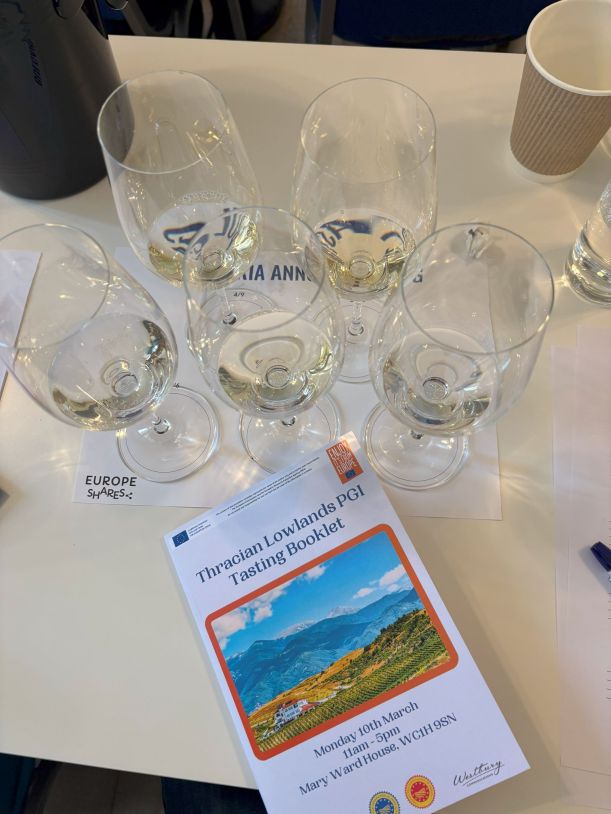
A recent masterclass organised by ThracianLowlands PGI and presented by Jamie Goode provided a great overview of Bulgarian wines produced from native grape varieties. Since the fall of communism which focused on mass produced wine, the return of land to winegrowing families and support for the industry upon joining the EU the industry has experienced something of a revival.  Indigenous grape varieties are being show cased but also wines from international grapes. Back in the 80s it was popular for its quaffable Merlot and now makes for instance some excellent value Pinot Noir too.

There are currently only two PGIs: the Danubian Plains and The Thracian Lowlands which between them cover pretty much all of the country. Its pointed out that Bulgaria is on similar latitude to Tuscany and Bordeaux but this just means it is in the zone and actually has its own unique climatic influences and these vary dramatically across these large regions.

The Thracian Low Lands PGI lies to the south below the line of the Balkan Mountains. The climate is continental and the summers are warm.  The region is large and varied and informally divided into the Struma Valley with mediterranean influences to the west, Thracian Valley to the south, the Rose valley between the Balkan and Sredna Gora mountains and the Black Sea Coast with maritime influences which spans both PGIs.

The Danubian Plains PGI to the north of the Balkan Mountains is continental in climate and cooler than the Thracian Lowlands.  Influences include the wide water body of the Danube and to the east the Black Sea. It is therefore informally subdivided into the Danube River Plains to the west and the Black Sea Coast.

The Native Wine Grapes of Bulgaria:

Varieties include aromatic whites through to bold, structured reds.  Some are old and some the product of crossings produced during the communist era many with a terpenic Muscat quality.

White Varieties: Aromatic and Expressive

Red Misket, despite its name, is a white grape with a faint blush hue. It is also unrelated to the other Misket varieties. One of Bulgaria’s oldest varieties, it thrives in the Rose Valley, yielding floral, citrus-driven wines with crisp acidity. These wines are often vinified dry but retain an alluring perfume reminiscent of Muscat.

Dimyat is a sun-loving variety with Thracian origins, predominantly grown along the Black Sea coast. Known for its delicate body and bright acidity, it produces refreshing white wines typically with aromatic notes of roses. The sample we tasted ‘Why Not Red Misket’ by Milkov was actually more orchard fruity, with a nice wet stone and brine finish with light body and only 11% ABV.

Vrachanski Misket an old variety, hails from northern Bulgaria, offering intensely aromatic wines with citrus, herbal, and floral nuances. It shares a kinship with Muscat varieties, often resulting in vibrant, expressive wines. The example we tasted from Tipchenitza Winery was blended with Chardonnay and matured in French oak barrels and had an interesting mix of floral and peach notes and smoky wood.

Tamay Anka, is actually a clone of Muscat Blanc a Petit Grains so native but not autochthonous. It displays a characteristic exotic floral and spicy character.

Sandanski Misket, a rarity found in the Struma Valley, a crossing of Melnik and Tamayanka. It delivers aromatic, peach-tinged wines with a distinct herbal undertone, often crafted into fresh, dry styles.

Red Varieties: Both Power and Elegance.

Broadleaved Melnik, a signature variety of the southwest, produces complex, age-worthy wines with rich red fruit, spice, and tobacco notes. Named after the town of Melnik it flourishes in the Struma Valley, needing the warm Mediterranean influence to fully ripen.

Melnik 55, a modern crossing of Broadleaved Melnik, ripens earlier and delivers softer, fruit-driven reds with vibrant cherry and peppery spice. One example we tasted from Villa Melnik was ripe, full bodied with black fruits and spice and over 15% ABV, the other from biodynamic AYA estate elegant structured with slightly sour fruit notes and a little pleasant funk.

Mavrud, an ancient Thracian variety, is Bulgaria’s boldest red. It exudes dark berry, leather, and earthy tones, crafting robust wines with firm tannins and great aging potential. The example we tasted from Cheval de Katarzyna was indeed round and fleshy with tasty ripe fruits.

Rubin, a cross between Nebbiolo and Syrah, offers deep colour, ripe fruit, and velvety tannins, blending elegance with power. The results are surprisingly as attractive as the mix sounds. I tasted a couple of examples which had structure yet freshness and worked well oaked and unoaked.

Pamid, one of the country’s oldest grapes, is light-bodied and easy-drinking, producing fresh, fruit-forward reds best enjoyed young.

Gamza, known as Kadarka in Hungary, thrives in northern Bulgaria, yielding delicate, cherry-laden wines with lively acidity, often compared to Pinot Noir in finesse. We tasted two examples. The first Thomas Gamza single vineyard 2022 by Burgozone Collection which was light in colour, perfumed with red cherry, medium acidity and a nice savoury edge. Delicious. The second Koshava Gamza 2023 by Bononia Estate had 25% cabernet franc in the blend which gave it a slight herbal note and a little extra grip.  Still with soft red fruit and freshness a lovely excellent value wine.

There is a broad range of well-made wine styles here at attractive prices that will have wide appeal. I particularly liked some of the Gamza and Rubin wines which will appeal to lovers of Pinot Noir and Nebbiolo.


Leave a comment

WanderCurtis and Jackson Family Wines at Bocca di Lupo October 30th 2024

We welcomed Michele Fazari, DWWA judge and Prestige Account Manager at Jackson Family Wines of California on Wednesday October 30th at 7pm
Jackson Family Wines are based in Sonoma County – in the heart of California’s wine country. Their flagship brand is Kendall-Jackson but their portfolio now includes 40 brands, sourced from vineyards and wineries in California, Oregon and many other wine regions worldwide. They produce wines with  broad appeal including some of the world’s best Cabernet Sauvignon.
They are very focused on sustainability. Their founder Jess Jackson said, “Take care of the land and it will take care of you.”

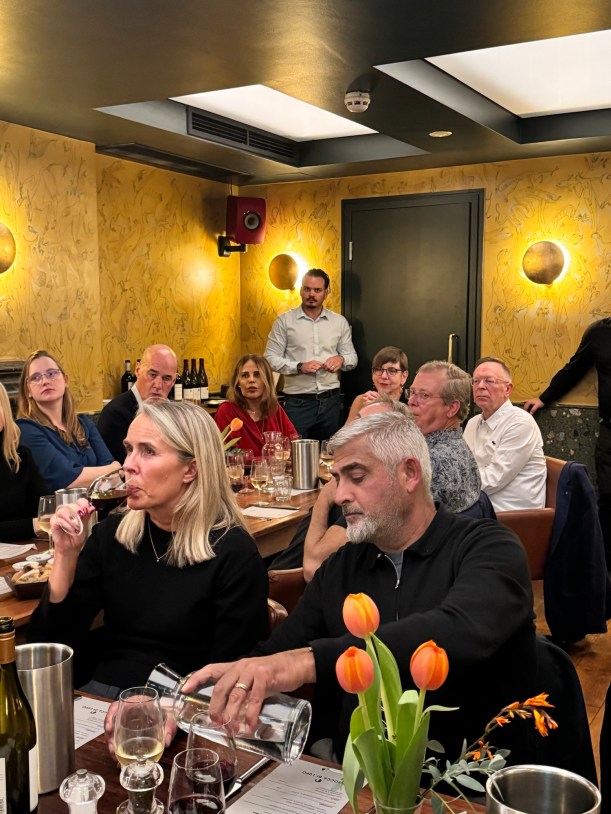
We tasted a selection of five wines from the finest Californian wine regions  served with a three-course dinner in the newly refurbished private room of the award-winning Bocca Di Lupo restaurant in Soho on Wednesday 30th October at 7pm. 

The wines served include one of Napa Valley’s best Cabernet Sauvignon’s – Mt. Brave Mount Veeder see tasting note in our Wines of the month

Kiran’s Instagram post gives a feel of the evening

Aperitif 
 Kendall Jackson Vintners Reserve chardonnay
Starter
  JFW La Crema Sonoma coast Chardonnay 2020
      JFW Hartford Court Pinot Noir Russian River 2021

Main
   JFW Edmeades Mendocino Zinfandel
     Mt. Brave Mount Veeder  Cabernet Sauvignon 2018


Leave a comment

Wine Dinner with Te Mata Wines of Hawkes Bay, New Zealand, with Toby Buck at Bocca Di Lupo Restaurant, Soho London April 16th 2024

Te Mata Estate is New Zealand’s oldest winery, dating from the early 1890’s. Vines were first planted at Te Mata Estate in 1892. The original three vineyards produce its most famous wines: Coleraine, Awatea and Elston.

It is a New Zealand family-owned winery, based in Hawkes Bay, North Island. John & Wendy Buck have been co-owners of Te Mata Estate since 1978. Te Mata’s wines are renowned as the country’s finest.

They produce a stunning array of red and white wines including Coleraine and Awatea Cabernet/Merlots, Bullnose Syrah, Elston Chardonnay, and Cape Crest Sauvignon Blanc.

Coleraine was first made in 1982 vintage. It is a Bordeaux style wine described by Decanter magazine as “New Zealand’s First Growth”. It is made from their finest selections of Cabernet Sauvignon, Merlot, and Cabernet Franc. It is one of New Zealand’s iconic wines.

We were delighted to welcome Toby Buck, the son of the owner, over from New Zealand. Toby talked us through the history and his family wines.

We had a selection of five wines including Coleraine, served with a three-course dinner in the private room of the award-winning Boca Di Lupo restaurant in Soho.Tickets were priced is £95pp. We had a full house of 32 people.

Te Mata Estate Sauvignon Blanc 2021

Rigatoni with ricotta, broad beans & basil

Te Mata Estate Chardonnay 2023

Tagliata (served on sharing platters) Potatoes garlic & rosemary

Te Mata Bullnose Syrah 2019

Te Mata Coleraine Cab/Merlot 2018

Dessert

Te Mata Estate Gamay Noir 2023

Te Mata Wines Hawkes Bay New Zealand
Some readings of the best wine descriptions of the night

Our first time at Bocca Di Lupo was a great success. The Tagliata (Thin slices of perfectly cooked beef tenderloin) was so good it almost overwhelmed the wines! Te Mata wines lived up to their expectations and previous tastings. Beautifully crafted and immaculately balanced.


Leave a comment

Boekenhoutskloof

Founded in 1776, Boekenhoutskloof can be found  way down the scenic Franschhoek valley. The farm’s name means “ravine of the Boekenhout” (pronounced Book-n-Howed). Boekenhout is an indigenous Cape Beech tree greatly prized for furniture making. Hence the 7 wooden chairs that the wine labels feature.

As with many wineries there was a change of ownership and reboot in the early 1990s and new vineyards were planted including Syrah, Cabernet Sauvignon, Cabernet Franc, Grenache, Semillon and Viognier.

The winery also produces a number of brands: Porcupine Ridge, The Chocolate Blick, The Wolftrap. Producing 7 million bottles a year it is one of the biggest wineries.

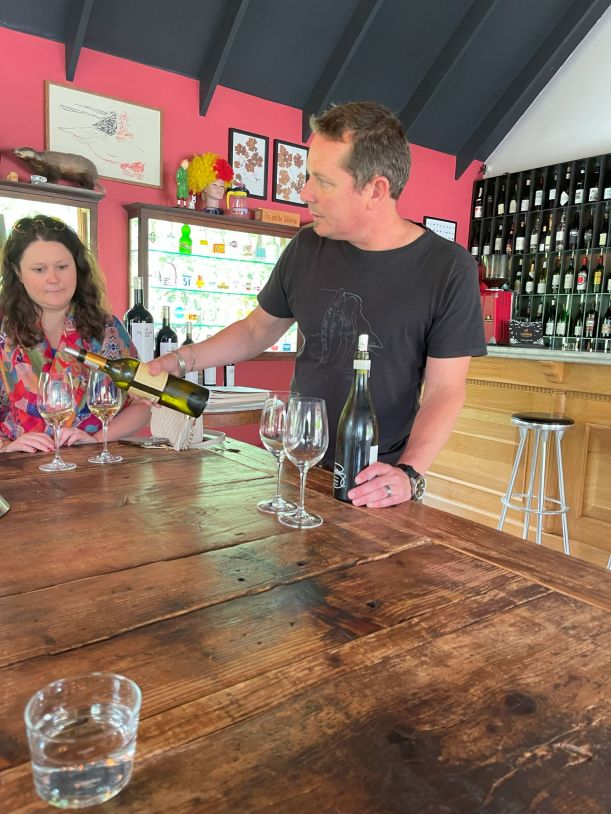
One needs to book about 6 months in advance to visit and taste at the estate but it quite a special experience hosted by Godfried Mocke the wine maker in Franschhoek.

Godfried explained that they now have vineyards in Swartland home of the famous Porseleinsberg Syrah, for Rhone varietals. The grow Cabernet Sauvignon in Franschhoek and Stellenbosch and Semillion in Franschhoek.  They’ve set up a fairly new venture to grow and make Burguindian varieties in Hemel en Aarde called Cap Maritime.

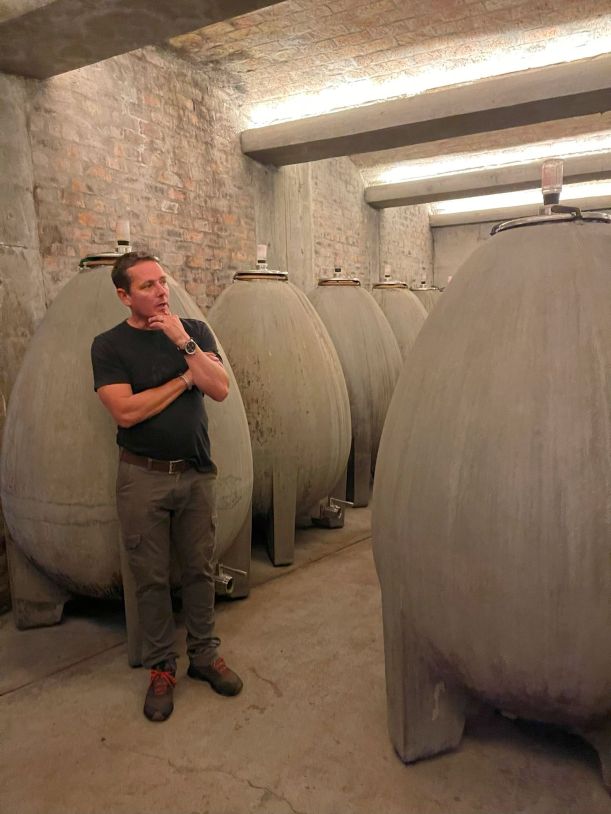
A tour through the winery revealed further details of their approach to wine making. They generally let wild yeast take care of fermentation. For red wine the concrete vessels used have rough surface that encourages a flora of yeast and so the cellar itself  imparts a particular character  in the same way that a cheesemakers cellar does.  A part of the terrior.

Concrete eggs are used to ferment the whites, the egg shape makes vortex which moves wine around, stirring the lees and it is also gently oxidative too.

However they often ferment some in barrique and blend to achieve the final wines.

Boekenhautskloof  are also using amphora made of clay fired at high temperature so this format doesn’t breath they use it for muscat.

Reds are matured in barrels.  Large Foudre for Syrah to slow oxidation. Barrique for the Cabernets.

Interestingly Boekenhautskloof do not acidify their wines which is actually widely practiced to achieve balance in the wines of South Africa.

Tasting notes:

Cap Maritime 2020, Chardonnay Hemel en Aarde

Creamy, toasty, smoky with citrus zest. Great balance, full but firm body, nice structure, long.

Semillon 2019

Made from old vines the youngest planted in 1942 which are more resilient to the droughts recently experienced. Bit of polish, wax, bit of smoke, pleasant petrol aroma. Nice elastic mouth feel, baked lemon, slightly salty tang, some smoke.  Capable of bottle aging and developing great complexity.  Think Hunter Valley.

Cap Maritime Pinot Noir 2020

Difficult year not much energy  to ripen so needed whole bunch to give a lift. Cherry, green herbs. Sweet red fruit, good lift medium body.

The Chocolate Block 2021 (1 M bottles!)

Made from 5 varieties the lend percentages always shift and change. Blind tasted to pick best but will always reflect the vintage characteristics.

Mix if red crunchy berries, dark black current then brambles, a touch of vanilla. Good balance, structured, high acid, medium body, clayey tannins present. Fruity with a tough of menthol. Med length.

Syrah 2019

Grown on blue schist in Swartland. Nose of crushed raspberries, blueberries, light spice. Fruit forward creamy texture, clove ripe fruit finish. Long.

Cabernet Sauvignon 2017

Stellenbosch fruit. Dark fruit, iodine and black current. Ripe fruit, lots of nice powdery tannin. High acid, dry savoury finish.

These are amazing age worthy, high quality wines representing superb value!


Leave a comment

Kanonkop Estate, Stellenbosch

Nestled on the slopes of Simonsberg Mountain, Kanonkop Wine Estate is a proud custodian of South African winemaking heritage. Now in the hands of fourth-generation brothers Paul and Johann Krige, the estate produces around three million bottles annually, with sales evenly split between domestic and international markets. Known exclusively for its red wines, Kanonkop champions two hero grapes: Cabernet Sauvignon and Pinotage. The estate’s flagship wines are meticulously matured in French oak barrels, incorporating a portion of new wood to enhance complexity and elegance.

The Kadette range, meanwhile, showcases fruit sourced from 30 local farmers, with Kanonkop’s own viticulturalist overseeing the growing process to ensure quality and consistency,. The estate traces its name to a nearby hill (or kop) where, in the 17th and 18th centuries, a cannon (kanon) thundered to signal the arrival of ships in Table Bay. This booming call once rallied local farmers to race their wagons to the harbor, laden with fresh produce.

 Since bottling its first wine in 1973, Kanonkop has become a benchmark for South African reds, carrying forward the legacy of the visionary Paul Sauer.

Tasting notes:

Kadette Range – A Young soldier ready for action!

Kadette dry Pinotage rose 2022

  • Short skin contact, blush colour and burst of floral notes.
  • Nice prickly mouth feel, sweet strawberry notes, peach, fresh acidity.

Cape Blend 2020

  • 50% Pinotage plus Cabernet Sauvignon and Cabernet Franc, 14% ABV.
  • Nice brambly nose with a bit of smoke, an inky note and touch of vanilla.
  • Lovely juicy fruit, fullish body but good lift and spicy finish, good length.

Pinotage 2020 14%

  • 100% Pinotage 14% ABV.  Really sweet red and black berries, touch of vanilla.
  • More fruit on palate, soft chewy tannins, medium acidity, good length. Slight herbal finish. Very tasty

Cabernet Sauvignon 2020 14%

  • Classic blackberry and black currant leaf on the nose.
  • Nice dry fruit, herbal, savoury, nice grainy tannin, medium length.  Lovely and great value.

Estate wine Pinotage 2020

  • Old vineyards with 60 year old bush vines. Pinotage is dry farmed
  • Matured in 80% new oak. Classy barrel room notes of toast and spice.
  • Lovely balance, and structure, brambly fruit, coffee notes, lots of length.

Estate Cab Sauvignon 2020

  • Classic blackcurrant leaf and whiff of smoke.
  • Blackberry is ripe but not over ripe ,mineral notes, very fine ripe tannin, lingering length. Long savoury finish!

Estate Paul Sauer 2020

  • 70% Cabernet Sauvignon, 15% Merlot and 15% Cab Franc. Matured in 100% new oak for 2 years.
  • More of everything. Black plum, coco powder and spice.
  • More talcum powdery ripe and super soft tannins. Lovely rounded fruit breadth. Very long.

In recent years Kanonkop have experienced very consistent vintages harvesting at same time of year but it is always  a race against time to harvest everything as it ripens all at once. They have not apparently noticed much effect in terms of global warming.