WanderCurtis Wine

Wine tastings, corporate events, reviews and recommendations


Leave a comment

The Wine Regions of Eastern Spain

Here is a condensed  two page summary of the WSET Diploma D3 material on regions along the eastern Mediterranean coastal strip of Spain.

The regions are mostly Mediterranean in climate and include: Catalunya with sub-regions Penedes, Montsant, Priorat, and Costers Del Segre the last two of which further inland become more Continental than Mediterranean. Also further south Valencia, Alicante and Yeculla are close enough to the coast to be Mediterranean whilst Jumilla and Utiel-Requenia in the foot hills are more Continental.

Again the notes are organised into the key subject areas of: climate, topography, growing hazards, wine law, grape varieties, wine growing and wine making practices.

See the Spanish wine regions overview to put this in context.

Sources include: WSET Diploma Wines of the World.

Note this document is intended for personal use only not for commercial or promotional use. We accept no liability for any omissions or errors that may be contained in the document.


Leave a comment

The Wine Regions of Spain – Overview

Spain boasts the largest planted vineyard area of any country in the world. However much of this area on the arid Meseta plateau where un-irrigated bush vines can only squeeze out very low yields. It is also the largest exporter of wine but only receives the lowest average price for it.

The Meseta dominates the country, a large raised plateau from 600 to 1000m in altitude, framed by several mountain ranges. The Duero, Guadiana, Tajo and Guadalquivir rivers have carved large valleys through the plateau which drain westwards. The River Ebro flows east along the North-Eastern boundary of the Meseta, through Rioja and down past Priorat, to the Med.

Spain is a large country with a wide range of climatic and growing conditions, however they broadly split into three zones: The Atlantic coast where Moderate Maritime conditions prevail, the Meseta plateau which is Warm Continental and arid and the western and southern Mediterranean coastal strip where is Warm and Mediterranean. This neat summary is slightly undermined by the fact that there are several sub-regions on the slopes of the mountains, that rise up from the coastal strip to the central plateau, that become less Mediterranean and more Continental.  However I found the generalisation a helpful way to categorise and remember the wine regions of Spain. 

I have condensed the WSET Diploma D3 material on Spain into these three broad zones. The Maritime zone along with an overall summary is posted here. The Meseta (with major continental inland regions) and the regions along the Mediterranean coastal strip, will be posted separately.  Again the notes are organised into the key subject areas of: climate, topography, growing hazards, wine law, grape varieties, wine growing and wine making practices.

To date (Oct 25) wines from Spain have come up fairly regularly in the country, region and mixed bag questions. For instance in both 2025 exams wines came up in the mixed bag; a Campo Viejo Reserva Rioja and a Verdejo from Rueda. Prior to that in October 2023 it was the Q2 country with an Albarino, a Rioja and a Priorat. In 2022 Rioja was the region with a Joven, Reserva and Gan Reserva and it has been in the Q4 mixed bag on 3 other occasions in the last 10 years. 

A Mencia from Bierzo, Godello from Valdeorras or even one of the modern perfumed Garnachas coming out of high altitude Calatayud (as part of a Q1 Grenache trio?) are yet to come up……

In the theory paper, a question on the white wines of Rias Biaxas, Rueda and Rioja just come up in October 2025 and before that one on Rias Biaxas and Priorat in October 2023.

Sources include: WSET Diploma Wines of the World.

Note this document is intended for personal use only not for commercial or promotional use. We accept no liability for any omissions or errors that may be contained in the document.

Leave a comment

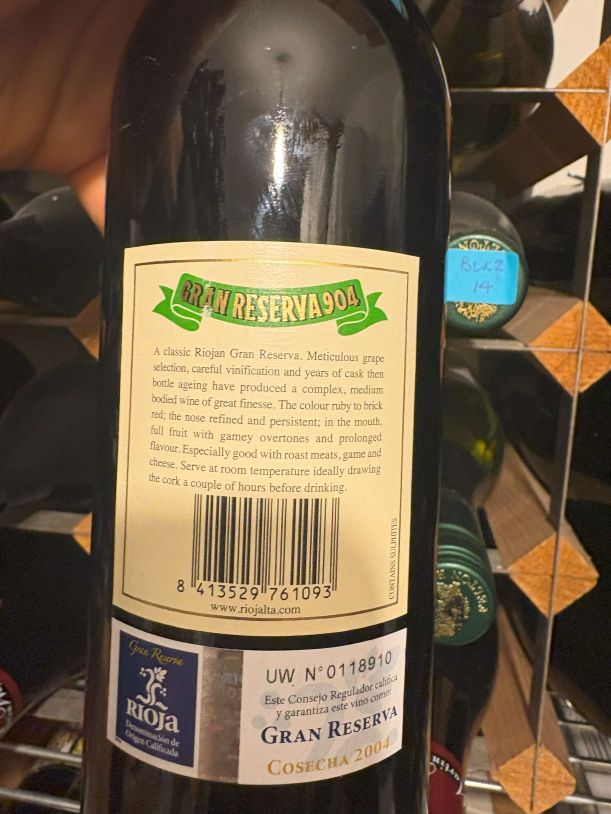
La Rioja Alta Gran Reserva 904 2004

The 10% Graciano in this wine (the rest Tempranillo) adds a perfumed lift to the beautiful aromas and extra freshness on the palate. Although low yielding, late ripening and prone to mildew interest in the grape and plantings have recovered in Rioja and there are some exceptional single varietal bottlings (see our note on Contino).

La Rioja Alta always far exceed the minimum aging requirements set by the DOCA (the highest of the protected origin denominations) in this case after fermentation the wine was matured in old American oak barrels for 5 years and then a further 2 years in bottle before release.

The traditional classification system has come under the criticism that simply aging a wine for successively longer periods, from Crianza to Reserva and finally Gran Reserva, does not necessarily mean that you are getting a higher quality of wine.  Also, there an increasing number of Chateau style wineries focusing on wines from a single place, vineyard or grape rather than the traditional approach of blending and barrel aging.  This approach is certainly producing some great wines for instance the single vineyard and varietal wines of Contino.

However, the Gran Reserva 904 exemplifies the beauty of the traditional approach.  10 years ago, upon release this wine was already drinking wonderfully with a rich array of primary fruit, secondary barrel flavours and complex tertiary notes from long aging. Today the wine has developed further into something extraordinary.

The nose is a heady concoction of plum, raspberry, cinnamon, and smoke along with dried fruits, leather armchair and moist earth. The tell for me on this wine are the characteristic notes of balsamic vinegar and coconut. On the palate fresh, a mid-weight agile body, fine grained tannins that dust your cheeks and underwrite the still intense fruit. The wine is complex and giving with a superb long finish of dried fruits and wet leaves.

Long may Rioja produce amazing traditional wines like this!

For more information see our visit to the winery.


Leave a comment

Bodegas Valdespino’s cellar

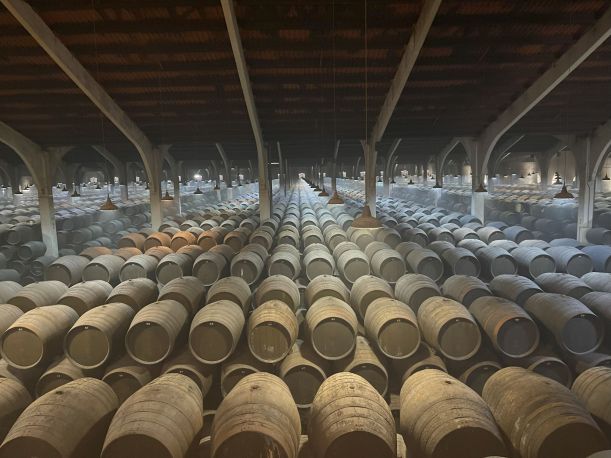
Jerez de la Frontera, so named as the boundary between warring Christians and Moors in the 13th Century is the home of bodegas Valdespino. And just look at this amazing cellar, in the dim light and controlled moisture haze it seems to go on as far as the eye can see!

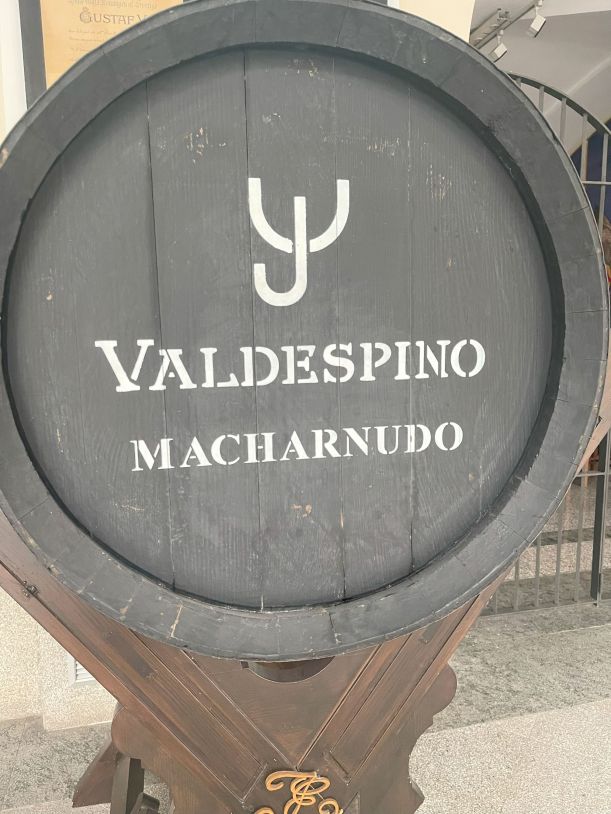
This is where the solera for the excellent Inocente Fino and the Tio Diego Amontillado live. Both contain wine made from the highest point of the Macharnudo Alto single vineyard.

Doors to the west open to allow the cool Poniente breeze in

The best vineyards in the sherry triangle have Albariza soils which are a mix of limestone, silica and clay. These soils absorb moisture in the winter and then form a crust during the dry growing season retaining moisture and slowly releasing it to the vines. The gently sloping vineyards have a series of troughs, called Asperpia, worked into them to catch water and let it soak into the soil.  

The Macharnudo Alto vineyard has a little more elevation than elsewhere and so catches the cooling Poniente breeze from the Atlantic and the albariza soils here contain a particularly high level of limestone both contributing to more concentrated grapes.

In the cellar the solera systems sit side by side each with 10 criadera and the final tier of solera.  The Inocente barrels all contain flor and as with all Finos the resulting wine has been fully matured under a layer of yeast. Wine is removed for bottling from the bottom solera layer, where the wines are oldest, each spring and autumn when the flor is thickest. The wines therefore have an average age of around 10 years. The barrels in the solera are then topped up successively each from the criadera above it until new wine is added to the first set of barrels. The nutrients within the fresh wine added helps to feed the flor yeast and keep it alive.

The first three criadera of the Tio Diego Amontillado solera system have flor and then more spirit is added fortifying the wines up to 17% ABV which kills it off.  The wine matures in the remaining layers of the solera oxidatively resulting in a wine with both yeasty flor character and nutty, caramel type notes and a of course a darker colour. There is more evaporation without the floor and so the abv rises by another few degrees. Wine is only drawn off the solera once a year meaning that the average age of the Tio Diego is more like 17-18 years.

There is one other wine connected with these soleras and that is the Palo Cortado. Every now and then the wine maker recognises that one or two of the barrels ‘want to be’ Palo Cortado. It may be that the flor has died or the barrel displays some extra concentration or individual character.  These barrels are moved over to join the Palo Cortado solera producing Viejo C.P. or even the PC  VOS (Very Old Sherry).

There are 11 layers within these solera systems and there are 70 barrels in each making 770 in total. This sounds like a lot but less than 40% is taken out each year and with an average age of 10 and 17 years respectively it takes a lot of time and space not mention care and attention to make these fantastic wines.  

For tasting notes of the Inocente Fino see wine of the month


Leave a comment

Sparkling Wines Germany

A condensed summary of sparkling wines from Germany including history,  regions, growing environment, vineyard management, grape varieties, wine making, styles, wine law and business.

Sources include: WSET Diploma Wines of the World, Oxford Wine Companion by Julia Harding and Jancis Robinson, various producer websites.

Note this document is intended for personal use only not for commercial or promotional use. We accept no liability for any omissions or errors that may be contained in the document.

© Kiran Curtis 2023. Personal use only not to be used for commercial or promotional purposes.


Leave a comment

Palo Cortado Viejo C.P , Valdespino

This rich amber colour sherry starts off its life under flor and then the wine maker selects certain barrels increases the fortification to kill the yeast and moves them to a separate solera to oxidatively mature the wine.  There are no fixed rules for the production of Palo Cortado but they generally combine subtle yeast derriven notes with nutty notes.  

This wine has bruised ripe apple a touch of melon, bread dough, dried apricots, raisins, orange peel then hazel nuts and almonds. The finish of the wine is long with orange peel and raisin flavours lingering beyond the alcohol. Delicious!

WSET Systematic Approach to Tasting style:

Palate:

  • Dry
  • Medium acidity
  • High  alcohol (20%)
  • Medium (+) body
  • Pronounced flavour intensity.
  • Flavour characteristics: Bruised ripe apple, sour bread dough, acetaldehyde, apricot, raisins, orange peel, hazel nuts, almonds. Complex.
  • Long finish.

Quality: Balance  – 1, Length – 1  Intensity – 1 , Complexity – 1  = 4.0 The wine is outstanding.


Leave a comment

Fortified Wines – Sherry

A condensed summary of Sherry wines including history,  regions, growing environment, vineyard management, grape varieties, wine making, styles, wine law and business.

Sources include: WSET Diploma Wines of the World, Oxford Wine Companion by Julia Harding and Jancis Robinson, various producer websites.

Note this document is intended for personal use only not for commercial or promotional use. We accept no liability for any omissions or errors that may be contained in the document.
© Kiran Curtis 2023. Personal use only not to be used for commercial or promotional purposes.


1 Comment

Inocente Fino Sherry, Jerez-de-la-Frontera NV, Valdespino

This pale gold sherry is made from a single vineyard and has been aged a solera system of 10 criaderas or layers of barrel. This means that the youngest element of the wine is at least 10 years old.

It has a pronounced nose with blossom, bruised apple indicating light oxidation, ripe peach and melon. Characteristic aromas of wet bread dough, rancid apple and olive brine speak of the wine’s maturation under flor yeast and the notes of almond and mushroom testify to its maturity.  

On the palate it is bone dry, the flor notes balance moderate acidity and although 15% the alcohol is low for a sherry and body medium. The saline finish lingers long and cries out for tapas!   

This is an outstanding wine at perfect point of development on release and although stable should not be cellared for any significant period.

WSET Systematic Approach to Tasting style:

Palate:

  • Dry
  • Medium acidity
  • Low  alcohol (15% – no evaporation)
  • Medium body
  • Pronounced flavour intensity.
  • Flavour characteristics: Bruised ripe apple, peach, melon, wet bread dough, acetaldehyde, rancid apple, olive brine. Almonds, mushroom
  • Long finish.

Quality: Balance  – 1, Length – 1  Intensity – 1 , Complexity – 1  = 4.0 The wine is outstanding.


Leave a comment

Familia Torres wine dinner hosted by Lucas Gailhac on September 17th 7.00pm at Frederick’s Restaurant


Torres started producing wine in 1870, they are one of the best known wine families in Spain. Their estate is based in Penedes near Barcelona however they have Vineyards in Priorat, Ribera Del Duero, Rioja , Costers Del Segre Conca de Barbera and other areas. They also produce premium wines in Chile and California.


Aperitif

Torres Esplendor by Vardon Kennet 2013

Loch Duart salmon & avocado tartare, edamame beans

Torres Milmanda 2016 (chardonnay)

Duck breast, dauphinois potatoes, diced butternut squash & peas

Torres Perpetual 2015 (Priorat) Torres Mas La Plana 2013 (Cabernet)

Selection of cheese from The Cheese Plate

Torres Mas Borras (Pinot Noir)

The evenings favourite was the fruit driven Mas La Plana 100% Cabernet Sauvignon, closely followed by The Perpetual Priorat which was more restrained.


Leave a comment

Godello Caixas Albarinho 2016

Our May 2018 Wine of the month available at Majestic.

A refreshing wine as the summer arrives Godello Caixas Albarinho 2016