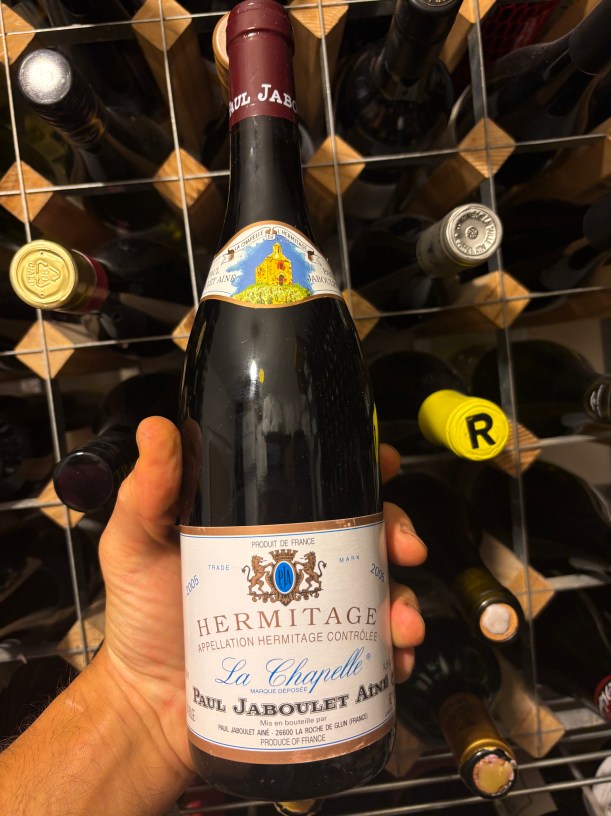
A memorable wine dinner moment was when Marcel Orford-Williams, the then Wine Society buyer for the Rhone, turned up to our Domaine Paul Jaboulet Aine dinner with two bottles of the 1991 La Chapelle, from his own cellar, to generously share. At 22 years old the wine was amazingly vigorous and layered and has stayed in the memory ever since. So I was excited to take the 2005 La Chapelle along to a recent blind tasting dinner and see what it was like.
The colour was very deep garnet with a brick rim. On the nose: violets in bloom, red & black cherry, baked blackberry tart and toast. A touch of classic ground black pepper, then earth, dried Iberico ham and a whiff of polish.
In the mouth it was bone dry, with bags of refreshing acidity, plenty of ripe fine grained tannin. These were felt on the gums and cheeks but also as a knot on the tongue. There was subtle oak so probably mostly old oak with a smaller proportion of new. The wine was concentrated and the fruit fresh and still prominent after 20 years. There were more dried herbs and pepper corns on palate and hints of loamy earth and chestnut mushrooms seemed to only grudgingly speak of the wine’s maturity. The finish was long and savoury.
What balance! even with 14.5% alcohol the wine remained cool and classy. This wine has developed at a glacial pace, earlier bottles only opening up after many hours of decanting and only now is it reaching maturity. Still the core of fruit and abundant freshness and tannic grip mean it should happily go on for another decade.
It’s widely reported that the quality of La Chapelle diminished after the 1991 vintage but then gradually recovered once Caroline Frey of Chateau La Lagune took over in 2006. The 2005 must have still been in barrel so perhaps benefited from Frey’s hand in the final blend if not the subsequent conversion of the vineyards to organic and biodynamic practices and the change to Bordeaux style French oak barrels in later vintages. Whatever the case the 2005 wine is superb!
By the way you won’t find La Chapelle under the Jaboulet name any more it has now been turned into a separate winery called Domaine de la Chapelle.
Mostly when I ask winemakers about what they are doing to be more sustainable and to reduce their environmental impact the answer is all about stewardship of the land; vineyard practice, avoidance of pesticides, and perhaps a bit of onsite recycling. All good stuff, but as the drive towards Net Zero Carbon builds obviously the wine industry also needs to step up and make a start down this road.
Challenging though it may be, without plotting a route and taking the first step, the target will never be reached. Equally we consumers need vote with our wallets and make it clear we care, not just about how tasty the wine in our glass is, but also about the journey has taken to get there.
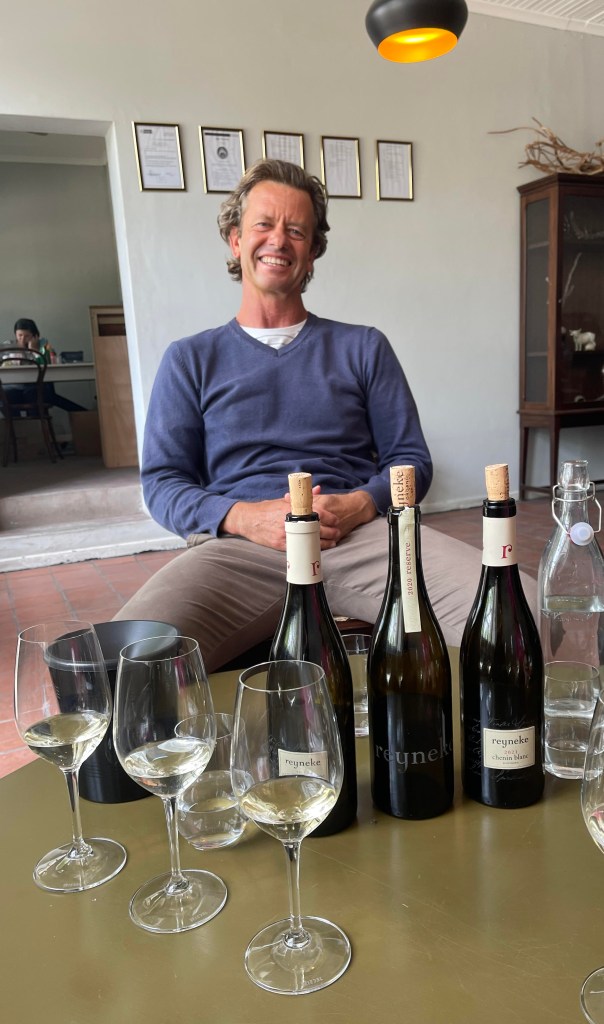
Happily, there are some great wineries out there, leading the way on sustainability and one of them is Reyneke Wines in Stellenbosch.
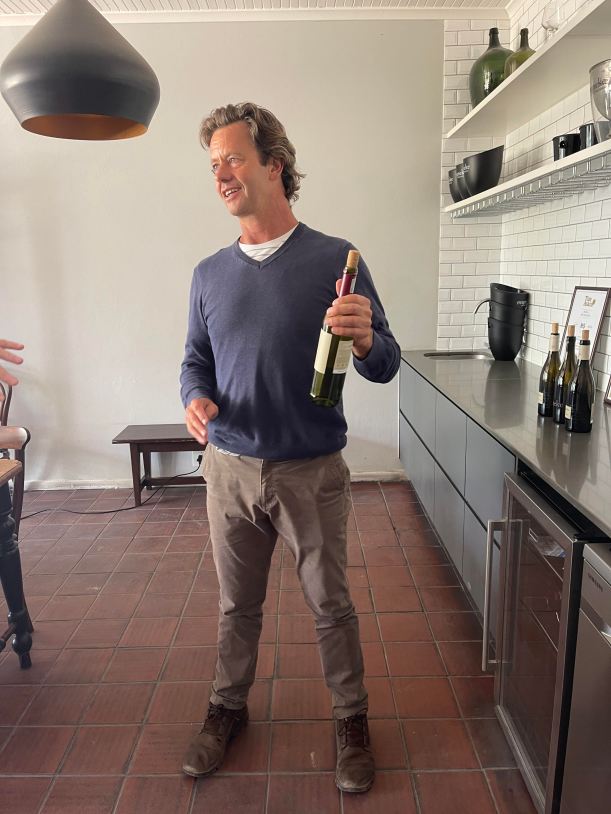
Since the early noughties Johan Reneke has been working towards achieving the three pillars of sustainability: environmental, social and economic. As he eloquently argues, how can a wine be beautiful if there is ugliness, in the form of glaring social inequity, involved in its making? He also makes the point that only a financially healthy business is going to be able to achieve any sort of environmental and social goals.
Johan sees Biodynamic farming as part of a larger picture of regenerative farming. Agriculture is one of top five contributors to climate change but regenerative agriculture actually provides the opportunity to turn this around. It can actually sequester carbon back into the earth by improving soil health and increasing humus content. Another win is by moving away from monoculture biodiversity can also be improved.
Reyneke works with nature to maintain vine health without recourse to chemical pesticides, herbicides and fertilizers. This ‘land caring’ element of the approach uses for example dandelions and other cover crops to provide a preferential home for pests. It also involves ducks trotting around the vineyards hoovering up snails.
Land within the farm is also ‘spared’ so that there are pockets of wilderness left between the vineyards which are rich in flora and fauna. The farm’s herd of cattle currently roaming in pasture below the winery, are let into the dormant vineyards over winter to fertilize them. In a lovely example of the vineyard’s circular like economy the winery produces feed for the cows in the form of the grape pressings which according to Yohan they love!
Looking back towards False Bay with the farm herd of cattle in the foreground.
Improved soil health and biodynamic farming has made the vines more resilient to pest, fungus and drought and so by extension perhaps some of the other effects of climate change?
As we visit the Reyneke wine farm is currently being extended into a neighbouring farm recently acquired. Some of the vineyards are being kept and some replanted. One can see where strips running along the contours of the hillside are being set side for biodiversity corridors between the vines. Old vines are piled up and will be turned into bio-charcoal that will be mixed in with the soil, locking in the carbon long term.
New vineyards in preparation. A pocket of Fynbos top left, horozontal lines on the hill side mark out future biodiversity corridors
When looking at the road to net zero carbon any organisation needs to look at its Scope 1, 2 and 3 emissions. Scope 1 emissions are C02 emissions arising from operations directly controlled by the organisation. Scope 2 are emissions up stream caused indirectly by the organisation when it buys in goods and services from elsewhere, for instance electricity or bottles. Finally scope 3 emissions are those downstream arising from the activities of distributors and consumers transporting, consuming and disposing of goods.
At Reyneke the farm is now carbon negative but Johan continues to look at the winery operations. He is investigating renewable energy in the form of photo voltaic (PV) panels, possibly in combination with electric tractors which could double up by providing some energy storage too. The Cape is lovely and sunny but electricity is currently rationed in ‘load shedding’ which adds another reason for moving off grid.
Reyneke is also trailing the use of Tetra Pak type packaging as an option, starting with their entry level organic wines in Scandinavian countries who seem more open to the idea. Clearly there is a challenge here in shifting negative consumer perceptions of ‘bag in a box’ type wine. Moving away from bottles would deliver valuable reductions in carbon footprint in terms of packaging and transport.
A non-interventionist approach follows through into the wine making. Instead of temperature controlled stainless steel and yeast inoculation at Reyneke wild fermentation in oak barrels is the order of the day. The wooden containers and smaller volumes successfully manages the temperature during fermentation in a passive way. The wild yeast and breathability of the oak also give a different character to the wines in particular the Sauvignon Blancs.
Johan’s story is so fascinating, and the challenges he and his team have taken on are so inspiring that this intro’ section could easily run on and on so let’s get to the wines, which do not disappoint!
Reyneke Sauvignon Blanc 2021
On the nose, hay, a touch of gooseberry, a whiff of custard. Good body with lovely balance and freshness. A nice supple mouth feel, white peach, exotic fruit pineapple, creamy gooseberry fool. Complex with good length a wine that evolves. Excellent. (Tasted at the farm and again back in London with consistent results)
Reyneke Reserve White 2020.
This is also 100% Sauvignon Blanc. The reserve is made from selected pockets of grapes within the vineyard which have their own character. It gets 24 hours on the skins and the new oak barriques.
More stone fruit on the nose also a bit of hay and a subtle touch of vanilla. Lovely textured mouth feel, more peach and bit of toast, rich but balanced, great length. Neither of these wines are your identikit new world SBs, much more interesting and complex.
Reyneke Chenin Blanc 2021
The vineyards here are part of the South African old vine project so more than 35 years old.
The nose is floral and nutty. In the mouth apricot, honey and a slightly salty finish. Vibrant.
Reyneke Syrah 2019
On the nose, sweet blackberry, dried herbs and crushed pepper. In the mouth dried black fruits, iodine, ripe tannins, full bodied but fresh. Long. (Tasted at the farm and again back in London where the wine benefited with time in the glass.)
Reyneke Reserve Red. 2019
The wine is 100% Syrah and again from selected parcels of the vineyard.
On the nose, blueberry pie, ripe fruit, pie crust, vanilla, coffee grounds, fresh garigue herbs. Iodine? Ripe blue and blackberries, powdery tannins, a herbal liquor note, savoury notes of grilled meat, full body and fresh acidity. Complex and very long. So good now that it will be hard to keep ones hands off this to let it mature! (Tasted at the farm and again back in London where again the wine benefited with time in the glass.)
Cornerstone 2019
A blend of Cabernet Franc and Cabernet Sauvignon in this vintage.
The wine is named after the Cornerstone project. Johan sees the workers as the cornerstone of the business, farm workers generally receive low wages as there is high unemployment and viticulture is the least profitable part of the industry. Scheme aims to empower workers with housing and education using profits from the winery.
Classic cassis, black current leaf, black current jam and a touch of sawdust on the nose. Austere at first, black fruits, green pepper, coffee grounds, slightly drying grainy tannins. Tasted again in London it opens up and fruit fills out the palate with bit of air. Still fairly primal at this young stage but good potential.
There is a vibrancy and depth to these wines which is compelling and it’s a quality that the Wander Curtis team have noticed on multiple occasions in other Biodynamic wines by producers such as Felton Road and Chateau Pontet-Canet. On every level there is definitely something to Biodynamic wine making.
Founded in 1776, Boekenhoutskloof can be found way down the scenic Franschhoek valley. The farm’s name means “ravine of the Boekenhout” (pronounced Book-n-Howed). Boekenhout is an indigenous Cape Beech tree greatly prized for furniture making. Hence the 7 wooden chairs that the wine labels feature.
As with many wineries there was a change of ownership and reboot in the early 1990s and new vineyards were planted including Syrah, Cabernet Sauvignon, Cabernet Franc, Grenache, Semillon and Viognier.
The winery also produces a number of brands: Porcupine Ridge, The Chocolate Blick, The Wolftrap. Producing 7 million bottles a year it is one of the biggest wineries.
One needs to book about 6 months in advance to visit and taste at the estate but it quite a special experience hosted by Godfried Mocke the wine maker in Franschhoek.
Godfried explained that they now have vineyards in Swartland home of the famous Porseleinsberg Syrah, for Rhone varietals. The grow Cabernet Sauvignon in Franschhoek and Stellenbosch and Semillion in Franschhoek. They’ve set up a fairly new venture to grow and make Burguindian varieties in Hemel en Aarde called Cap Maritime.
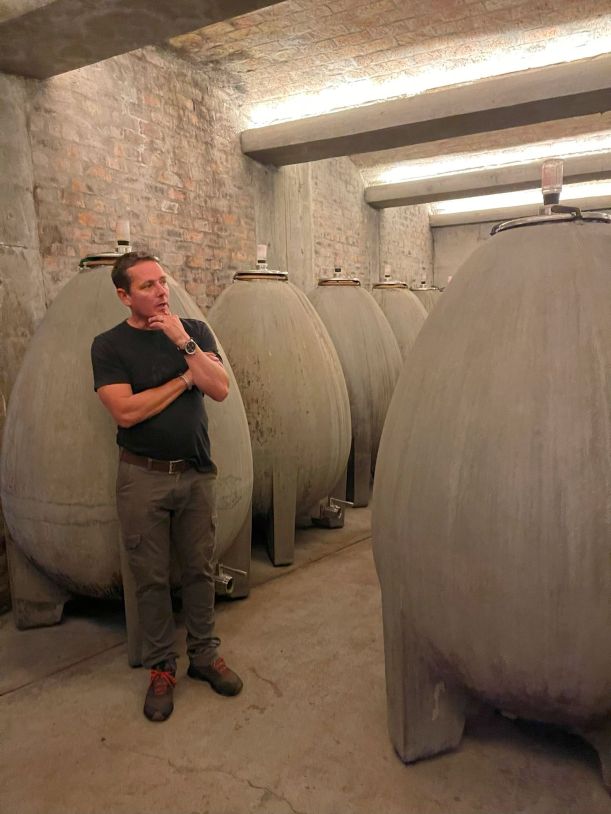
A tour through the winery revealed further details of their approach to wine making. They generally let wild yeast take care of fermentation. For red wine the concrete vessels used have rough surface that encourages a flora of yeast and so the cellar itself imparts a particular character in the same way that a cheesemakers cellar does. A part of the terrior.
Concrete eggs are used to ferment the whites, the egg shape makes vortex which moves wine around, stirring the lees and it is also gently oxidative too.
However they often ferment some in barrique and blend to achieve the final wines.
Boekenhautskloof are also using amphora made of clay fired at high temperature so this format doesn’t breath they use it for muscat.
Reds are matured in barrels. Large Foudre for Syrah to slow oxidation. Barrique for the Cabernets.
Interestingly Boekenhautskloof do not acidify their wines which is actually widely practiced to achieve balance in the wines of South Africa.
Tasting notes:
Cap Maritime 2020, Chardonnay Hemel en Aarde
Creamy, toasty, smoky with citrus zest. Great balance, full but firm body, nice structure, long.
Semillon 2019
Made from old vines the youngest planted in 1942 which are more resilient to the droughts recently experienced. Bit of polish, wax, bit of smoke, pleasant petrol aroma. Nice elastic mouth feel, baked lemon, slightly salty tang, some smoke. Capable of bottle aging and developing great complexity. Think Hunter Valley.
Cap Maritime Pinot Noir 2020
Difficult year not much energy to ripen so needed whole bunch to give a lift. Cherry, green herbs. Sweet red fruit, good lift medium body.
The Chocolate Block 2021 (1 M bottles!)
Made from 5 varieties the lend percentages always shift and change. Blind tasted to pick best but will always reflect the vintage characteristics.
Mix if red crunchy berries, dark black current then brambles, a touch of vanilla. Good balance, structured, high acid, medium body, clayey tannins present. Fruity with a tough of menthol. Med length.
Syrah 2019
Grown on blue schist in Swartland. Nose of crushed raspberries, blueberries, light spice. Fruit forward creamy texture, clove ripe fruit finish. Long.
Cabernet Sauvignon 2017
Stellenbosch fruit. Dark fruit, iodine and black current. Ripe fruit, lots of nice powdery tannin. High acid, dry savoury finish.
These are amazing age worthy, high quality wines representing superb value!
There was no better way to celebrate our first wine dinner since the start of the Covid pandemic than with the inimitable wines of Michel Chapoutier.
Maison Chapoutier was founded in 1808 and Michel Chapoutier took charge in 1988, he became the seventh generation of his family to run the Domaine. All his vineyards are farmed biodynamically.
We were lucky enough to meet the eccentric and amiable Michel at a party in his Maison when we arrived in Tain Hermitage some years ago. His wines are extremely high quality.
They have vineyards in the best sites including Hermitage, Crozes-Hermitage, Saint-Joseph, St Peray, Côte-Rôtie, Condrieu and Châteauneuf-du-Pape.
They also produce in other areas of France such as Roussillon and outside France including Australia Portugal and Germany
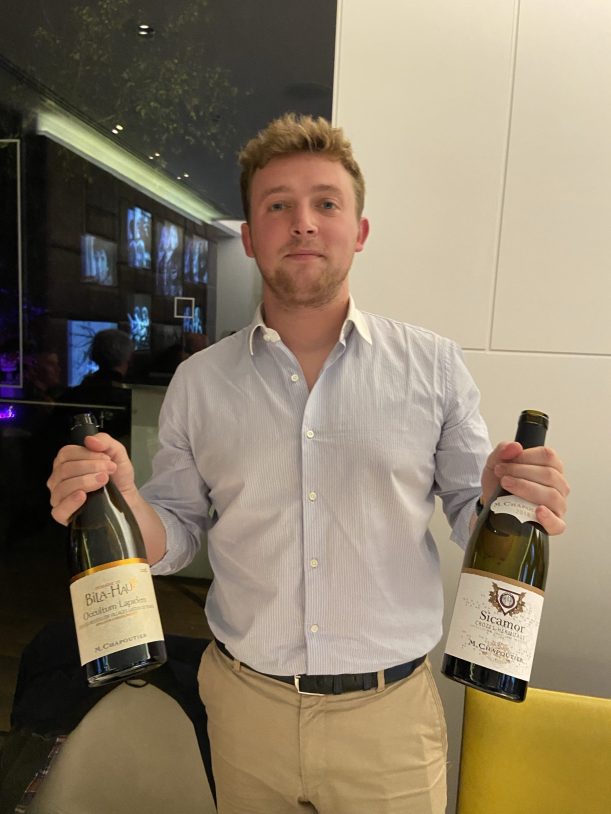
Guillaume Lafragette, Brand Manager of M.Chapoutier presenting excellent wines
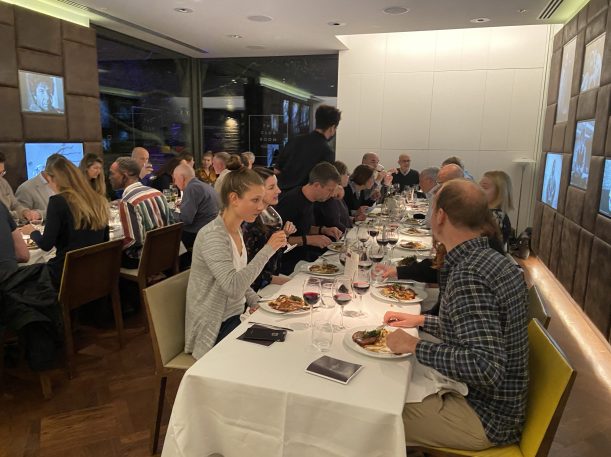
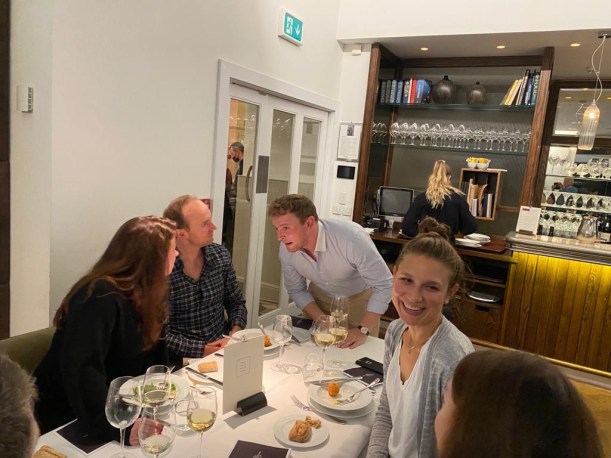
The atmosphere in the Club room at Frederick’s marked the occasion. A packed crowd on 34 wine lovers included new recruits including a cohort of wine enthusiasts, currently doing their WSET exams. We started with an introduction of Chapoutier. Guillaume Lafragette Chapoutier brand manager was equally as excited to be back to live events as our attendees
The wines showed incredibly well. Stuart’s Tasting notes below-
Esteban, Domaine de la Combe Pilate, VDF, Sparkling, White
Made using methode ancestralle where there is only a single fermentation which is stopped while the wines are put in a capped bottle to finish without any added yeast or sugar (unlike methode champenoise/traditionelle).
Light bubbles, bready, with a faint apricot nose. Opened up as it warmed up to expose more Viognier character. 9% ABV, very drinkable, not overly complex.
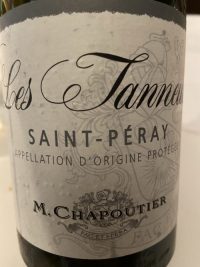
M. Chapoutier Les Tanneurs, Saint-Péray, White
100% Marsanne made in stainless steel. Apples, citrus fruit, mineral nose. Body medium +, acidity med +, very good balance between the fruit and acidity, with a lingering saline and slightly bitter finish. Very elegant, long and worthy of its place.
M. Chapoutier Mathilde Duché d’Uzès Southern rhone blend
A fuller wine made from a blend of Viognier, Grenache blanc, Marsanne and Roussane, fermented and aged in stainless steel, from clay-limestone soils. Apricots and other ripe fruit, some white flowers (Viognier), balanced with the cut of acidity from the Marsanne and Roussane, creating a beautiful blend that somehow balanced all the different weights and flavours.
M. ChapoutierSicamor, Crozes-Hermitage, Red
100% Syrah from Crozes Hermitage, made in concrete tanks. A very typical Syrah nose of leather, spices, pepper, and black fruit, with great balance. Showing some meaty notes as the wine opened up, with a penetrating fruit concentration, fine tannins and lovely overall balance. A very classic example of Crozes.
Bila-Haut Occultum Lapidem Cotes de Roussillon
Blend of Grenache, Syrah and Carignan from Roussillon. A brute of a wine, dark in colour, exploding with garrigue and dried dark fruit, very herbaceous and spicy nose. On the palate, the wine overwhelms, with a bit of fiery bite, biting tannins as you get a sense of the individual parts of this wine as well as a good dollop of the 14.5% ABV. The wine is still quite primary, not quite knit, but based on experience, will evolve into a balanced beautiful expression of the terroir. Give it 5-7 yrs same to tame and settle.
M. Chapoutier Bila-Haut Banyuls
Made from 100% Grenache noir, fermentation stopped by the addition of alcohol to create this 17% sweet and elegant dessert wine. Chocolate powder notes with kirsch, liquer dipped cherries. Smooth and delicious with both the chocolate pot and surprisingly, the Stilton. From 500cl bottles
My favourites on the night were the St Peray 100% Marsanne for it smooth full body and texture. Stuart was more of a fan of the Clos d’uzes Mathilde and the fruit packed well balanced Sicamor Crozes Hermitage.
I was pining for mature cheese with the Banyuls rather than the chocolate dessert. True to form my father delved into his travel bag and delivered a selection of mature cheeses including Michel Chapoutier personal favorite Blue Stilton.
We would like to especially thank the excellent Hatch Mansfield for their great assistance with this dinner.
Tasting a range of the wines of Northern Rhone the overall delicacy and freshness of these wines comes across with several great recent vintages there are great wines to be found at every level.
Hosted by Marie Cordonier of Maison Jaboulet Aîné and attended by Marcel Orford Williams, chief buyer of the Wine Society & fellow Crouch End resident.
Bistro Aix, Crouch End
La Chapelle
The wines:
Le Grand Pompee St Joseph Blanc 2010 Approx price: £14
Served as an aperitif. Nice floral nose, good creamy texture in the mouth, great balance and good length. 100% Marsanne. Lovely.
Condrieu Les Grands Amandiers 2008 (Viognier) Approx price: £43
Smokey nose, peaches lurking underneath, more oily texture, stone fruit, medium length. We tasted the 2010 at Maison Jaboulet in Tain L’Hermitage which was floral and fruity and had greater freshness.
Hermitage Le Chevailier de Sterimberg 2008 Approx price: £44
Served together with the H Sterimberg with pate starter.
Named after the knight crusader Gaspard de Sterimberg who established a hermitage on the hill. This blend of approx. 70% marsanne and 30% rousanne is sensational. A compact and concentrated nose of pear flesh with a whiff of wood, on the palate again tight complex flavours mixing fruit and nuttiness: apricot stones. This wine has a beautiful mouth feel and great length, still a baby. At Maison Jaboulet in Tain L’Hermitage we tasted the 2010 which was even more concentrated, had more vigour and freshness and delicious note. One of the wines of the trip Excellent!
St Joseph Le Grand Pompee Rouge 2010 Approx price: £15
Nice fruity peppery nose, sweet black fruit, savoury notes emerging, medium body, more fruit great lift and freshness, reasonably sustained. This is good now but with a few years in bottle will fill out with more savoury substance. From granite soils. Great value from a great year. All the 2010 wines we tasted on our trip were stunning with great clean fruit, balance and freshness. Marcel also felt that one could hardly go wrong buying this vintage.
Cornas Grandes Terrasses: 2009 Approx price: £27
Served with Confit de Canard main course.
Decanted for about an hour this delicious fruit driven wine had a nose of really ripe blackberry with a touch of chocolate almost new world in its exuberance. Concentrated in the mouth packed with more sweet fruit, powerful, plenty of good tannin and enough balance. 2009 was another great year but riper and this has a good future.
Croze Hermitage Domaine de Thalabert 2007 Approx price: £23
A long standing favourite of mine this Croze is special. Marcel explained that it is one of the oldest vineyards in the area, established by Jaboulet and pre-dating the appellation. Although received wisdom is that Croze from the hilly area north of Hermitage is generally the best this vineyard on the plain consistently produces very fine wine because of a subtle elevation and difference in soil make up. Whatever the reason I love it and have found that it is best to forget about it for at least 6 – 7 years at which point it begins to sing.
The 2007 is approachable now with nice fruit reflecting yet another good year in the Rhone (though more so in the south). I would still tuck this away for another couple of years though and have resisted opening any bottled of my case bought EP from the Wine Society.
Served side by side with the Cornas the contrast is clear this is all elegance and restraint in comparison to the exuberance of the Cornas. Black cherry, touch of coffee, white pepper on the nose, still a little tight on the palate but then more black fruit, spice and characteristic great vigour from the acidity, medium long. Promises wonderful drinking. (currently10% discount at Bibendum)
Hermitage La Petite Chapelle 2007 Approx price: £60
In Tain this was a little closed by having been decanted for a couple of hours it was much more expressive. Served blind with the Chapelle 01 it was fairly clear which was the more youth full wine. Nice fruit on the nose, a scented nose with whiff of flowers and savoury notes underneath. Lots going on in the mouth, really fresh sweet fruit, savoury note making a vibrant mix, long and exciting. A super wine which will no doubt develop beautifully.
Hermitage La Chapelle 2001 Approx price: £94
On the nose, more mushroom, earth and secondary flavours but still with baked fruit tart sweetness. On the palate amazing bright acidity and plenty of spicy fruit. Tastes a lot younger than the bouquet even though it is 12 years old. Marcel says this was a tannic year that has taken a long time to come around but it now is coming into its own.
Hermitage La Chapelle 1991
An amazing treat brought by Marcel to share with us. And what a demonstration in what Hermitage is all about. Marcel feels that the true expression of Hermitage is a blend of the different vineyards (Michel Chapoutier would disagree but diversity of opinion is the spice of life) and La Chapelle is mostly from Le Meal which produces riper more opulent fruit with some wine from Le Bessards which is more tannic and structured.
This wine at over 22 years is from a very good vintage overshadowed by the 1990 and 1989 vintages. Decanted for about half an hour un-agitated the nose begins as sweet celery sticks then a little soy sauce. With air a world of aromas opens up each arriving hot on the heels of the other in that way that complex great wines have of continually giving more and more: confit de canard, candied fruits, horse leather, orange peel, oriental spices, baked blackberry pie all this in the mouth too but with great core of freshness and a salty tang. Amazing persistence and vigour, hauntingly lingering in the mouth. Some wines cerebral and others sensual this is both, simply outstanding.
Thanks to Marie Cordonier of Maison Jaboulet for helping to organise the evening and being such a great host.
Also big thanks to Marcel Orford Williams (Wine Society) for sharing his knowledge to give such detail and colour to the evening and also for sharing this wonderful wine.
Finally we were as always well looked after by the team at http://www.bistroaix.co.uk/ serving delicious french cuisine.
Opened on the TGV on the way from Lille to Valence, with a group of friends en route to northern Rhone odyssey. Popped and poured, no decanters available on the train I’m afraid. Poured into assembled plastic glasses, very finely rimmed, I might add…
Deep red, no signs of age showing. Nose characteristic Chave, roasted smokey peppery, initial pure blackberry, and then red berries, then organic garrigue, some earthy aromas, leather in the background and then more deep blackberries coated with sugars which accentuate the flavours, but not overripe. ‘It just smells like serious wine’. You just want to keep smelling it,
Palate is initially tannic, but immediately fills the mouth with flavours. Fills it, deep and wide. Perfectly ripe, neither over or under, red and black berries pervade, with a deep core pushing down the middle of the tongue. Balance is impeccable, perfect blends of tannin, fruit, acidity. The sous bois carries into the taste, leaving an umami finish that is exceptionally long, a minute and a half plus. My friends think this has provoked an out of body, synaesthetic experience verging on euphoria. The mood very tangibly lifted a notch (it was good to start).
Universally praised wine, everyone wanted to know where the next bottle was. Average rating of the group is 95, I am on the higher end at 96. Pure class.
Credit to my buddies for contributing to the comments in this note – it was a team effort. Tasting Note courtesy of Stuart Grostern
Some great wines on show at this en primeur tasting. Highlights were:
Lovely Condrieu Vieille Vignes by Ogier,
Floral, full with a fresh salty tang.
Superb wines poured by Rene Rostaing included the perfumed, finely balanced and restrained Cote Blonde contrasting with dark manly La Landonne.
Domaine du Colombier Croze and Hermitage delivered well above their price.
In the south loved meeting Jean-Michel Vache of Le Clos de Cazaux whose refined Vacqueyras I have long been a fan of. He makes the Wine Society’s Exhibition Vacqueras which is tremendous value.
I have to admit that the massively concentrated, extracted & ‘over the top’ nature of most of the Chateauneuf du Papes nearly caused me to lose faith with this region.
That was until I got to the marvellous, classic & refined wines of both Vieux Telegraphe and Cht Beaucastel. Wines made to last but with clean fruit and freshness.
Lovely coastal South African Syrah, the splash of viognier adds floral, apricot notes on the base of plummy, fruity, slightly burnt toasted syrah. A real bargain recently in Majestic, also available at SWIG .
A surprise gift from Dr Ranald Davidson following our Ramsay treat. It was with some anticipation that I opened the Fortnum and Mason Verget du Sud 2007 Syrah when dad popped in, impromptu, following the birth of my new nephew Rafael Leon.
Phew! What a nose! Musty, mossy, like a newly struck match… sulphur. How did they get away with supplying this one?! I will leave it overnight and do some further tastings, but don’t expect too much. Coq au vin tomorrow!













 WanderCurtis Wine