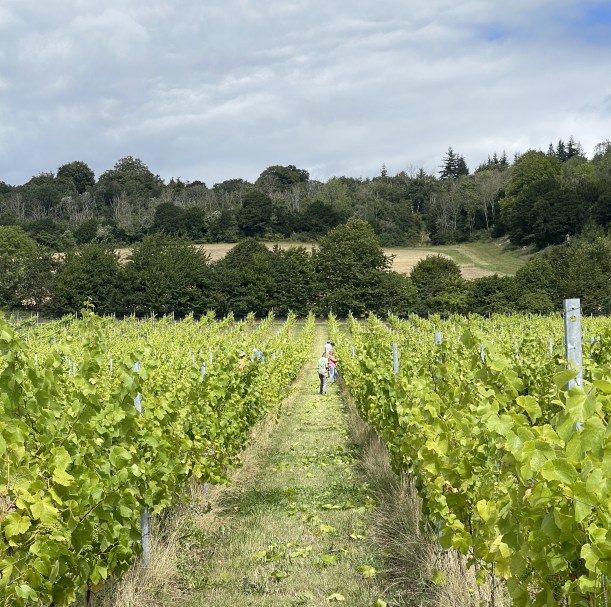
Nestled below woodland on the gentle slopes of the Surrey Hills is Albury Organic Vineyard.
The dynamic Alex Valsecchi manages the estate with her team where they grow organically, biodynamically and use regenerative viticulture practices to make wine as sustainably and environmentally friendly as they can.
Alex admits that she and Nick Wenman, the owner, must be ‘a bit mad’ to take on the challenge of growing wine in this way in the damp and fickle English climate.
But really what they’re doing is showing just what amazing results can be achieved when you have a vision (no doubt determination and a lot of hard work come into it too!).
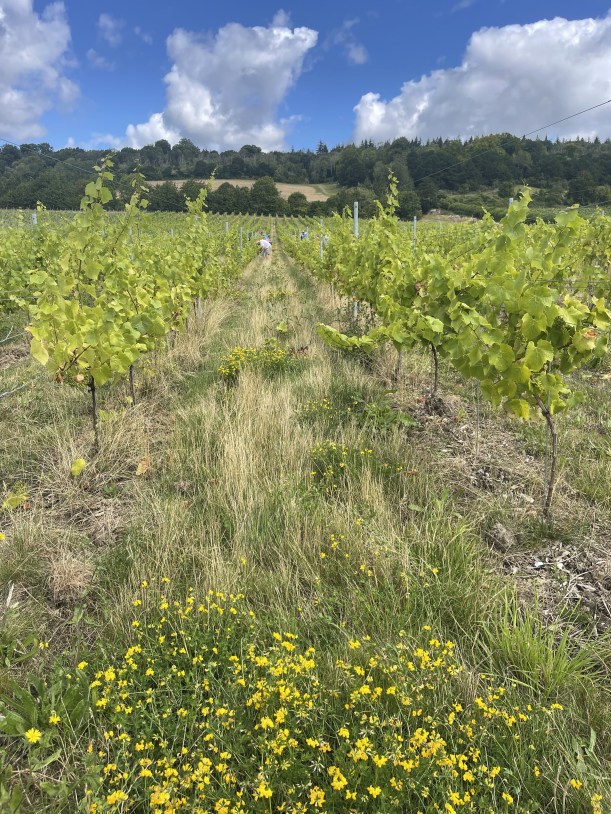
On a sunny day the vineyards are idyllic. A carpet of flowering clovers, herbs, legumes, orchids, yarrows, grasses and even wild strawberries, which are all native to the chalk hills of Surrey, has been allowed to colonise the space between the vine rows.
This along with a wildlife pond and wild flower meadow creates a diversity of habitats for beneficial insects and wildlife.
By having diverse plants with their roots in the ground and by using only light tillage, Alex’s aim has also been to improve soil health and biodiversity below ground.
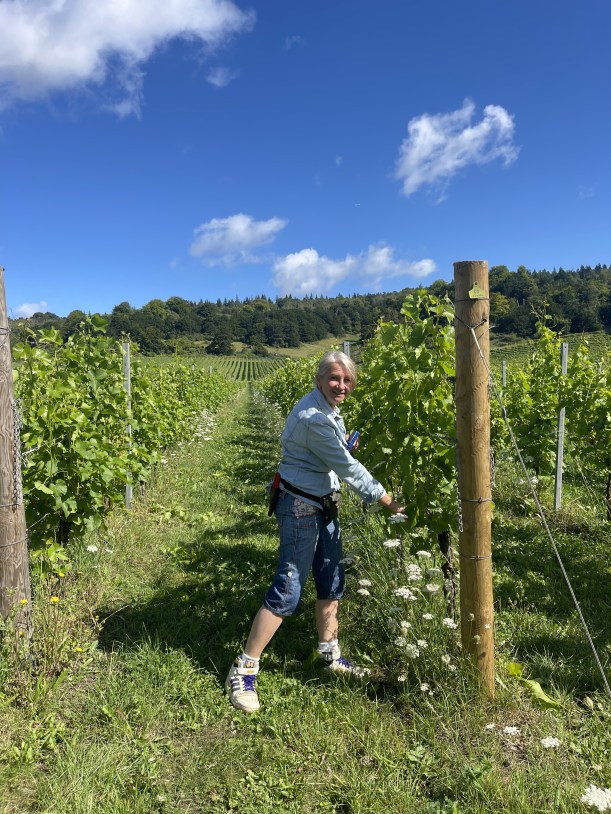
All this is on London’s doorstep and Albury welcome volunteers through the season to help out in the vineyard and experience it all first hand.
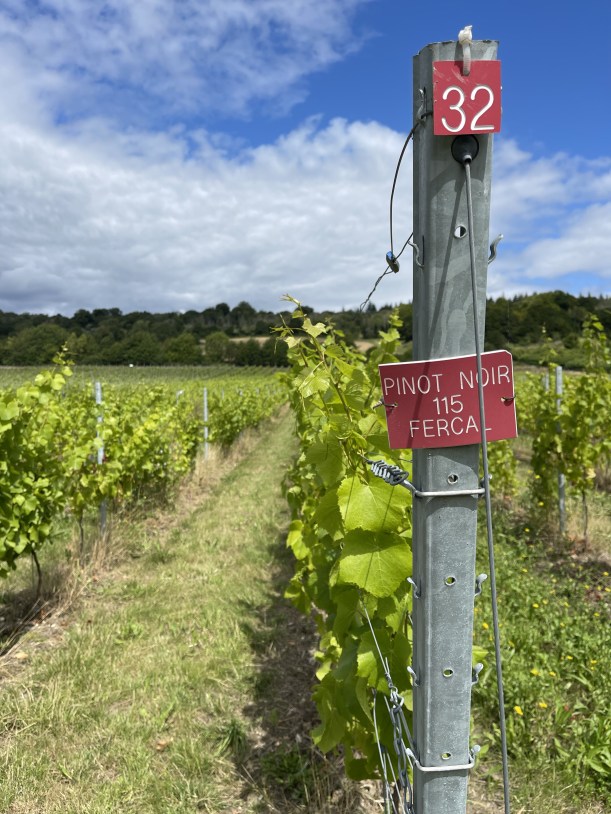
I spent a day in July helping leaf strip and green harvest in the newest section of the vineyard. Planted in 2022 these young vines need this type of tough love to strengthen them up for the future.
I can thoroughly recommend joining in and there’s a refreshing glass of Seyval Blanc fizz (tasting note bellow) and some lunch to keep you going. Harvest will most likely be in the first two weeks of October and will be an amazing opportunity to get in involved. You can sign up on their website.
Albury Estate Seyval Blanc 2021
Very pale, with fine bubbles. Blossom, hawthorn, jasmine, lemon verbena, green and yellow apple, pear, quince, thyme and a lovely touch of biscuit and croissant. Crisp acidity but rounded out by the apple & pastry flavours which linger nicely. Invigorating and Refreshing at a pleasing 11%.
Wine making is a process full of potential pitfalls: oxidation, microbial spoilage, unwanted fermentations to mention but a few. To manage these, winemakers have relied for centuries on sulphur dioxide (SO₂), a highly effective antioxidant and antimicrobial. But with modern tools and shifting consumer expectations, there’s a growing question: are winemakers leaning too heavily on SO₂?
SO₂ plays several roles in the winery. It protects white wines from oxidation, which causes browning, dulls fruity aromas, and leads to acetaldehyde development (that bruised-apple note). It also suppresses unwanted bacteria such as Acetobacter, which can turn wine to vinegar. It also helps control fermentation by weakening wild yeasts or halting it altogether to retain sugar in sweet wines. In red wines, natural phenolics offer some antioxidant protection, but SO₂ is still used to preserve freshness and stability.
It’s important to understand that SO₂ exists in both bound and free forms in wine. Only the free, molecular form is active in preventing spoilage. However, as SO₂ reacts with other compounds suchs as sugars, anthocyanins and aldehydes, it becomes bound and inactive. This means it is gradually “used up” during the winemaking process and must be carefully monitored and topped up.
As a wine is made there are several key intervention points:
At harvest and transport, SO₂ (often as potassium metabisulfite) is added to prevent microbial activity and oxidation during the vulnerable period between picking and processing.
After crushing, the must is tested, and additional SO₂ may be added, particularly in white wines, which are very prone to oxidation before fermentation begins.
During fermentation, SO₂ levels are typically kept low to allow yeast to function, but it can be used to inhibit spontaneous fermentation or halt it early, especially in the case of sweet wines.
Post-fermentation, SO₂ helps to prevent malolactic fermentation (MLF) where it’s not desired and maintains wine stability during aging. Barrels may be sterilised with burning sulphur, and free SO₂ levels are monitored throughout maturation.
At bottling, a final SO₂ addition protects against oxidation and microbial spoilage during storage and transport.
All this is standard practice. But is it always necessary?
SO₂ is not without controversy. Although most wine contains far less SO₂ than permitted by law, health concerns remain. Some individual, particularly asthmatic, may react to sulphites, and although the connection to headaches is unproven, it persists in the public mind. Beyond health, the use of SO₂ has become a philosophical issue in the natural wine movement, where minimal intervention is the goal.
The good news is, modern winemaking offers alternatives and supports more precise SO₂ management. Improved hygiene, use of inert gases (like nitrogen or CO₂), careful oxygen control, and alternative antioxidants such as ascorbic acid can reduce reliance on sulphur. Similarly, fermentation can be controlled by lowering temperature, sterile filtration, and stabilising agents like sorbic acid, again reducing the need for heavy SO₂ additions.
Crucially, SO₂ additions should be based on analysis, not routine. Monitoring pH, oxygen levels, microbial activity, and the free amount of SO₂ at each stage allows winemakers to tailor additions to actual need, rather than defaulting to maximum thresholds.
The “safe” amount of SO₂ depends on wine style, stability targets, and customer expectations. For example, a fresh, aromatic white like Marlborough Sauvignon Blanc requires more protection than an oxidative white Rioja, which is intentionally exposed to oxygen. Sweet wines and those with residual sugar, such as German Rieslings or Californian White Zinfandels, also require more SO₂ due to sugar’s reactivity and red wines less in general.
While it’s entirely possible to produce low or no-sulphur wines, these often show oxidative notes, haze, or instability that some consumers embrace and others reject. Conventional wine drinkers generally expect clarity, freshness, and shelf-stability and delivering that usually requires some level of SO₂.
Ultimately, SO₂ is not the enemy. It’s a critical tool, but not the only one. Good winemakers will find the right balance. Whatever style of wine is being made the science and the tools are available to reduce reliance on sulphur to a minimum whilst meeting the expectations of their customers.
Te Mata Estate is New Zealand’s oldest winery, dating from the early 1890’s. Vines were first planted at Te Mata Estate in 1892. The original three vineyards produce its most famous wines: Coleraine, Awatea and Elston.
It is a New Zealand family-owned winery, based in Hawkes Bay, North Island. John & Wendy Buck have been co-owners of Te Mata Estate since 1978. Te Mata’s wines are renowned as the country’s finest.
They produce a stunning array of red and white wines including Coleraine and Awatea Cabernet/Merlots, Bullnose Syrah, Elston Chardonnay, and Cape Crest Sauvignon Blanc.
Coleraine was first made in 1982 vintage. It is a Bordeaux style wine described by Decanter magazine as “New Zealand’s First Growth”. It is made from their finest selections of Cabernet Sauvignon, Merlot, and Cabernet Franc. It is one of New Zealand’s iconic wines.
We were delighted to welcome Toby Buck, the son of the owner, over from New Zealand. Toby talked us through the history and his family wines.
We had a selection of five wines including Coleraine, served with a three-course dinner in the private room of the award-winning Boca Di Lupo restaurant in Soho.Tickets were priced is £95pp. We had a full house of 32 people.
Te Mata Estate Sauvignon Blanc 2021
Rigatoni with ricotta, broad beans & basil
Te Mata Estate Chardonnay 2023
Tagliata (served on sharing platters) Potatoes garlic & rosemary
Te Mata Bullnose Syrah 2019
Te Mata Coleraine Cab/Merlot 2018
Dessert
Te Mata Estate Gamay Noir 2023
Te Mata Wines Hawkes Bay New Zealand
Some readings of the best wine descriptions of the night
Our first time at Bocca Di Lupo was a great success. The Tagliata (Thin slices of perfectly cooked beef tenderloin) was so good it almost overwhelmed the wines! Te Mata wines lived up to their expectations and previous tastings. Beautifully crafted and immaculately balanced.
The onset of 2024 has left me reflecting on my inherent Francophilia. This got the better of me towards the end of last year. I had been meaning to visit Alsace for years. It took so long partly because of my preference for red wine and more recently due to Covid.
My favourite varietal though is Gewürztraminer. This is very much a marmite love or hate grape. For me it’s love. The most textured, succulent, floral powerhouse of a wine I’ve ever tasted was a Matawherho Gewürztraminer from Gisborne in New Zealand. It was an early 1990’s vintage tasted at a masterclass with my boss of the time Dr David Durham at his home next to Cloudy Bay, Marlborough New Zealand in 1995.
The 1976 Hugel Gewürztraminer with a nose distinctly reminiscent of cannabis was a highlight of many years of wine tasting.
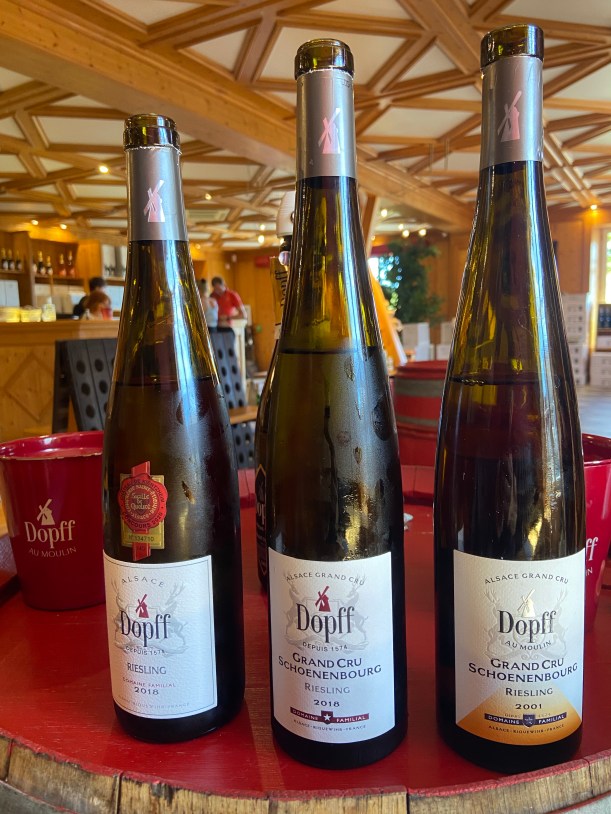
This grape has mesmerised me since. I also have great appreciation of the other white Alsatian varieties. Well made Pinot Gris is also beautifully textured and aromatic. Riesling whilst not my first go to drink due to its high acidity playing havoc with my gastrointestinal equilibrium is still a wine I highly regard.
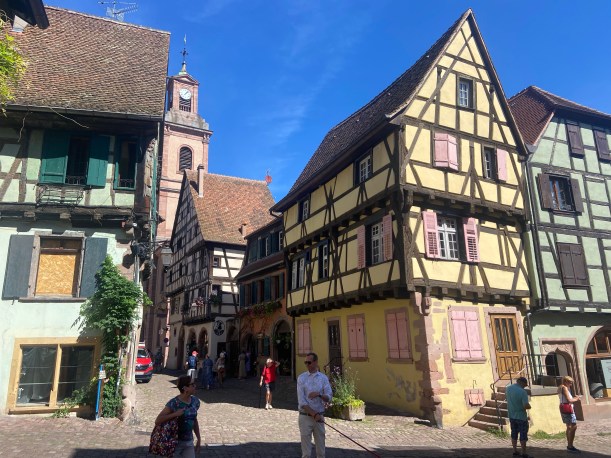
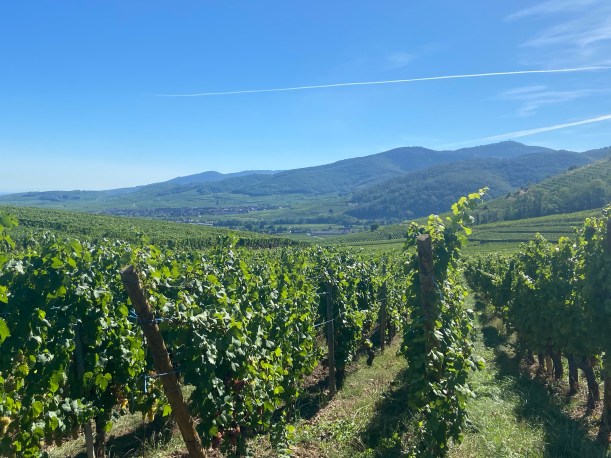
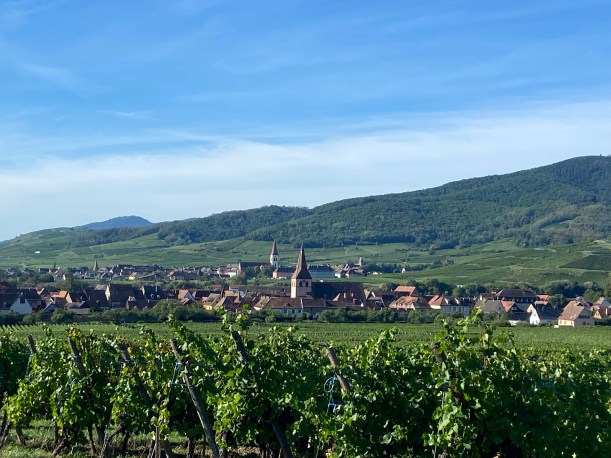
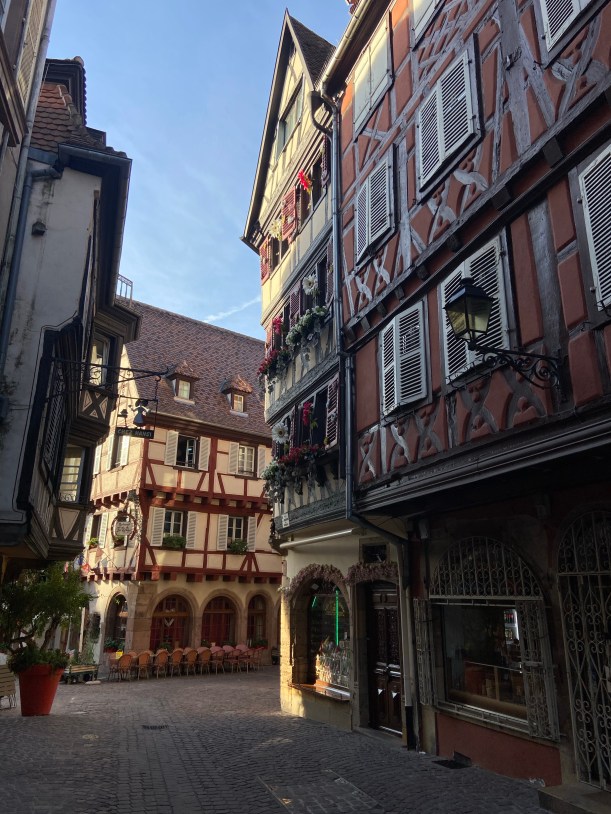
So I finally made it to Alsace, and the wait was worth it. Not only for the wines but for the delightfully preserved chocolate box towns and villages such as Colmar, Riquewihr and Ribeauville. It really feels like an amalgamation of France and Germany as its geography and history suggest.
I stayed in central Colmar at the Hotel Le Colombier. This is very conveniently located centrally and for the electric bike store on the same street. This is an excellent way to explore the region as there are many dedicated wine cycle routes throughout the area.
I wasn’t wild about the food, quite pork base and Germanic. They do an interesting pizza type of thing called a Tarte Flambee in French and FlammeKueche in German.
It was the first day of the Rugby World Cup so the flight was awash with excited fans.
I’d had also long wished to visit Chateau Coutet in Barsac having met Aline Baly on many occasions in London. I’m also a fan of dessert wines, again not everyone’s taste. Aline was in Paulliac but generously arranged the Maitre du Chai, Laurier Girardot to entertain us.
We started in the vineyards surrounding the pristine opulent Chateau.
Laurier discussed the terroir, which is slightly different to Sauternes and a little further from the River Garonne. The style here being a little less unctuous than Sauternes and perhaps less botrytis. They also make a dry white. The wines as ever, were finely balanced, long and delicious with complexity evident in older vintages.
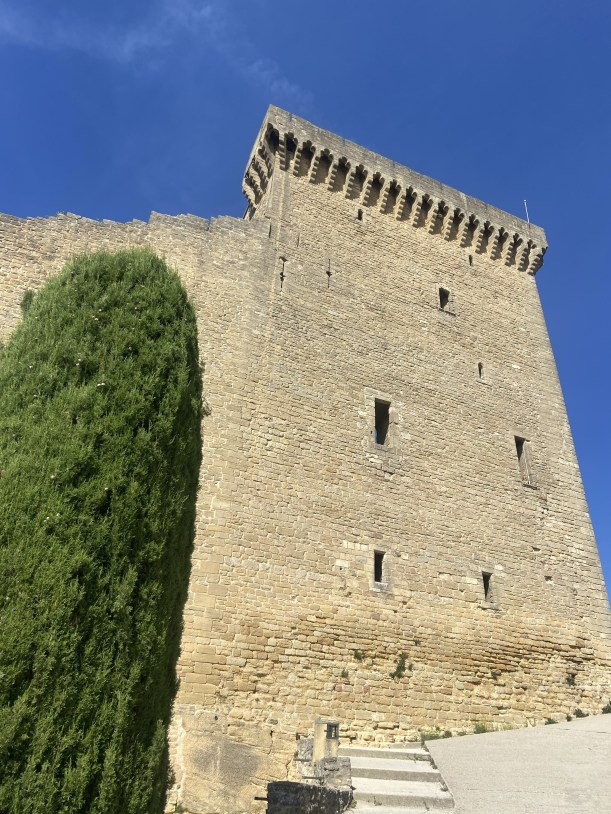
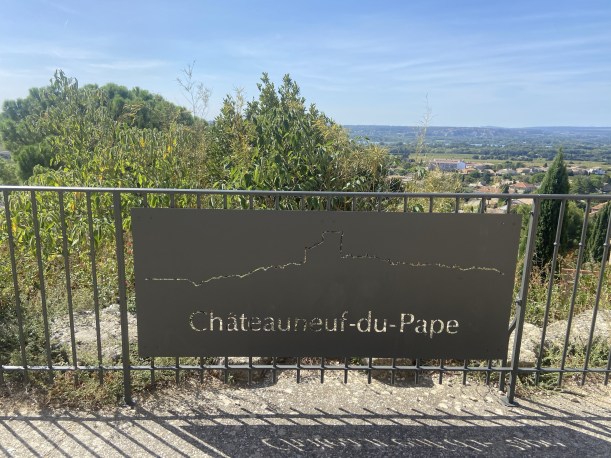
Châteauneuf-du-Pape
Next up a flight to Marseille, en route to another region I’ve longed to visit, Châteauneuf-du-Pape.
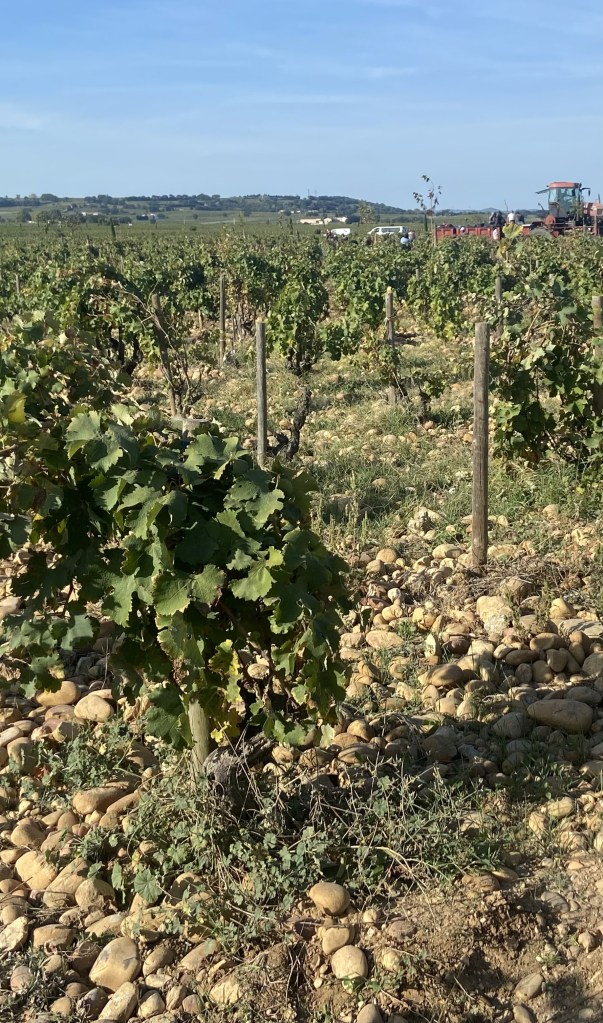
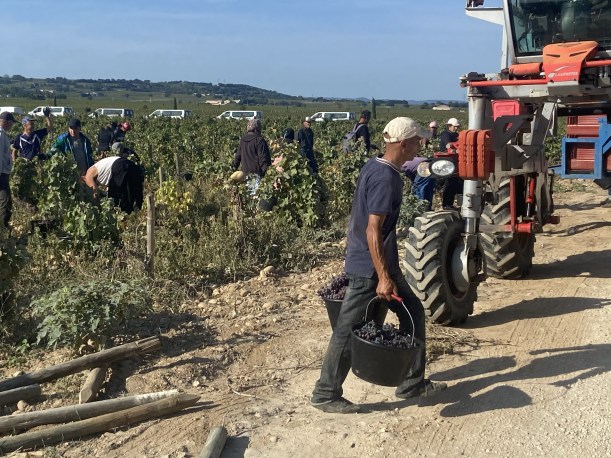
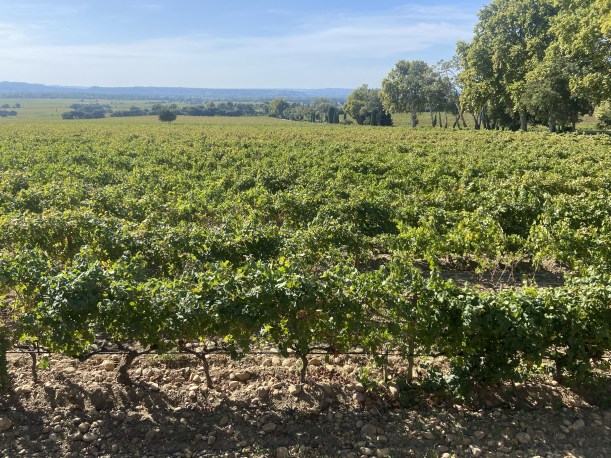
It’s one thing reading about the ‘Galets’ (larger pebbles/ smooth rocks) which are characteristic of the area. it’s another thing to see them. The entire vineyards are literally covered with layers of Galets with virtually no soil evident. These rocks have been washed down from the Alps over millions of years dating to when the area was the bed of the Rhone river.
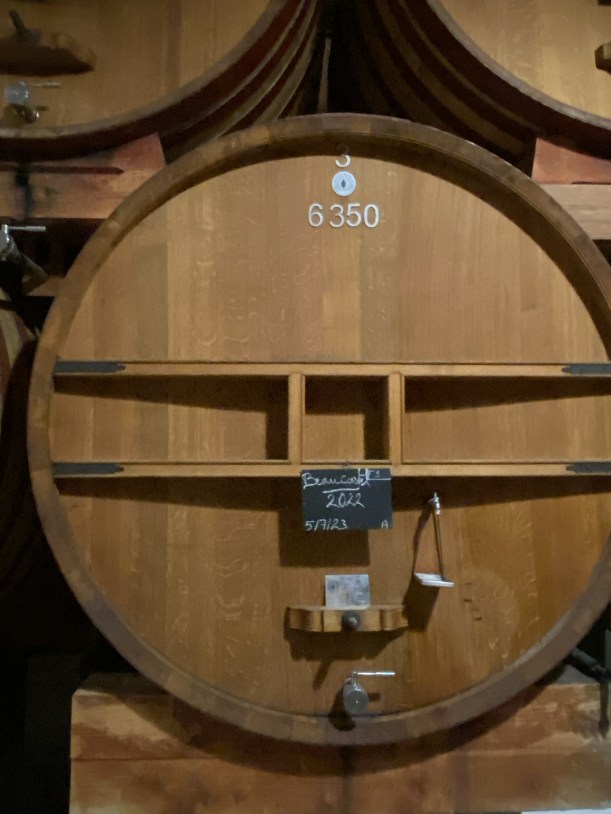
Beaucastel were in the midst of the most fascinating new build. They had a competition amongst world renowned architects who tendered for the job. It was finally won by and Indian based firm. In keeping with Beaucastel organic and biodynamic sustainability, the new structure is being built with products of excavation.
The excavated earth for the new cellar is gently crushed and then taken to a large vertical mold and compressed. This creates the large slabs to build the new winery. It already looks amazing and effortlessly blends in with the environment.
We tasted the 2008 and 2019 Beaucastel and also a 100% Roussane of which little is made. The wines as expected were spotlessly balanced and full of fine grained tannins.
I was impressed by the Chateau Mont Redon range, especially with their most moderately priced Lirac which is full of fruit but also has a lovely mouthfeel. I have been buying en primeur Mont Redon from the wine society for many years.
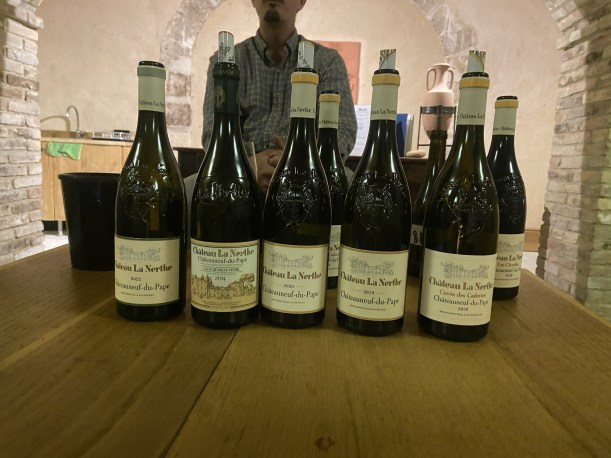
Final visit of the day was to a very welcoming and passionate Antoine at Chateau La Nerthe.
He gave us the historical background. There have been grapes here since Roman times. More recently they were one of the pioneers of the Appelation Controlle system
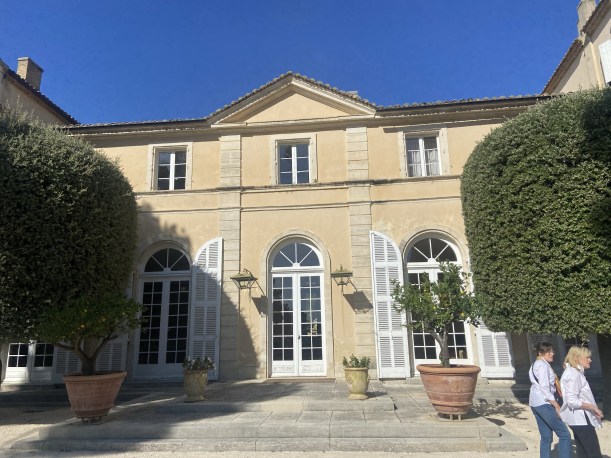
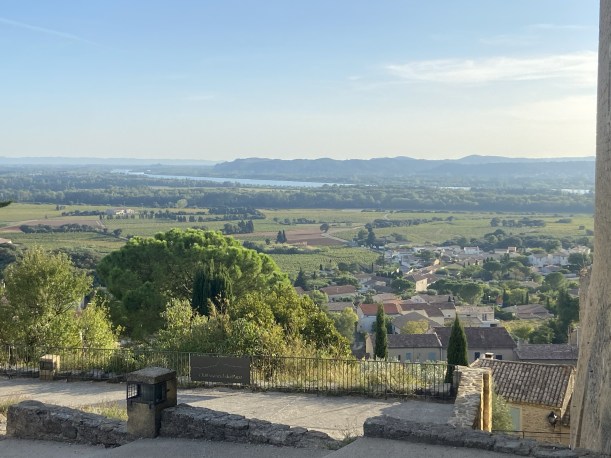
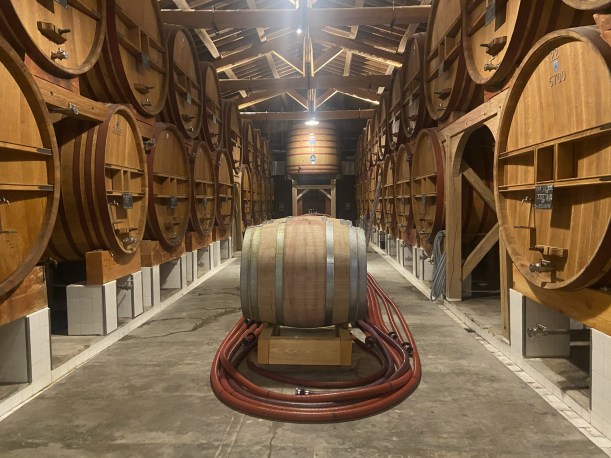
This a stunning chateau with views reaching far and wide. We toured the cellars and we were lucky enough to witness a live ‘remontage’ and sample 4 day old Mourvèdre from the tank. It was surprisingly delicious given its age.
Wine tasting here can be a little confusing as 13 grape varieties are permitted.
6 white grape varieties: Grenache blanc, Clairette, Roussanne, Bourboulenc, Picpoul and Picardan. Grenache blanc, a mutation of Grenache noir, is the most commonly used grape variety. Red grapes: Grenache, Syrah, Mourvèdre, Cinsault, Vaccarèse, Terret, Counoise, Muscardin.
We tasted a range of their wines including
Château la Nerthe 2014 Clos de Beauvenir – it had an oxidised nose, almond, nice freshness and texture Good food wine
Château la Nerthe Barrel sample, Syrah amazing for only 4 weeks old! Full of fruit Soft tannins Delicious!!!
2020 Château la Nerthe Châteauneuf du Pape 25% Mourvèdre, Balanced, good year, plenty of fresh fruit alcohol well integrated
2019 Château la Nerthe Châteauneuf du Pape . 35 %Mourvèdre Syrah 31 %Grenache 33 % about a third each A bit more serious than 2020 and probably need more ageing to develop complexity
2020 Château la Nerthe Châteauneuf du Pape Cuvee des Cadettes which is made from their best grapes 9.000 bottles only GSM blend
2019 Château la Nerthe Châteauneuf du Pape Cadettes 55 % Mourvèdre floral earthy savoury serious big wine.
Antoine then brought out a blind wine which I immediately described as Pinotesque. I was happy to be correct in my deduction that it was one of their very limited production 100% Grenache.
This tasting was one of the highlights of many years of different wine trips. Thanks to @bossofthewine, Bruce Baldinger and the New Yorkers. We had serendipitously met them on the tour of the old Synagogue in Carpentras the day before and tagged along to this visit.
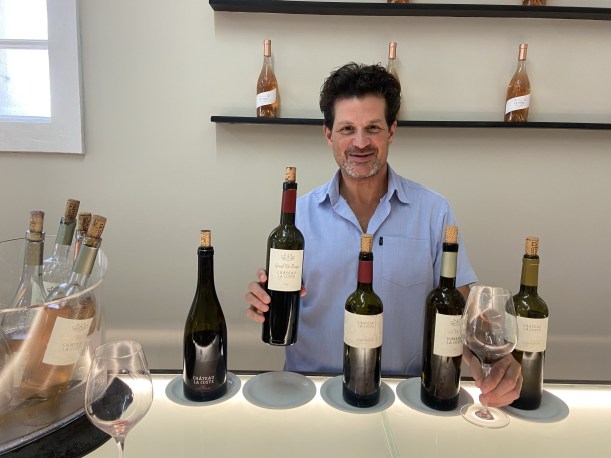
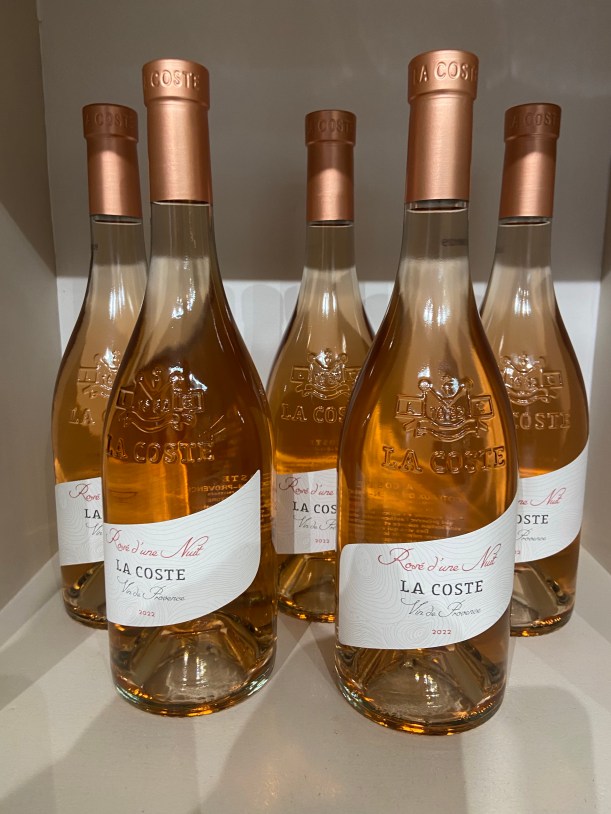
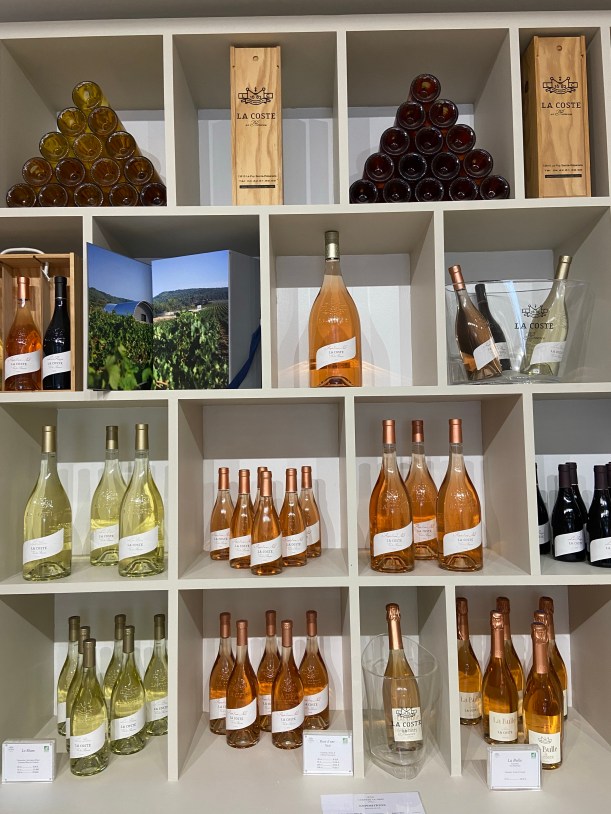
Finally I must not forget the opulent Chateau La Coste in Provence. It was a short drive south from our accommodation in Lourmarin through the beautiful countryside towards Aix en Provence near the village of Le Puy-Sainte – Reparade.
This is a real destination owned by Irish property magnate Paddy Mckillen. It has its own art and architecture walk, 600 acre sculpture park, a luxury hotel Villa La Coste multiple very high end restaurants and excellent wine.
Despite the breadth and depth and quality of wines across the world, there’s nothing quite like returning to La Belle France!
Umberto Cantele third generation of Cantele Wines of Puglia hosted this memorable evening at Fredericks a day before Burns night 2024.
Adam, his father and brother visited Umberto at Cantele winery in Salento a few years ago and have been long planning this dinner.
The whole family is involved in the business. They have 50 hectares of their own vineyards and manage a further 150 hectares. Their primary focus is on local native grapes of the region, including Primitivo, Negroamaro and Susumaniello for the red wines, and Verdeca and Malvasia Bianca for the whites. The winery also produces pure expressions of international varieties such as Chardonnay.
Aperitif
2022 Verdeca, Cantele, Puglia Stone fruit with ice texture and medium acidity
With Starter
2021 Teresa Manara IGT Salento Chardonnay
2021 Teres Manara Vendemmia Tardiva Chardonnay The star of the show tonight
rich textured beautiful oak integration caramel vanilla butter stone fruit
With maim
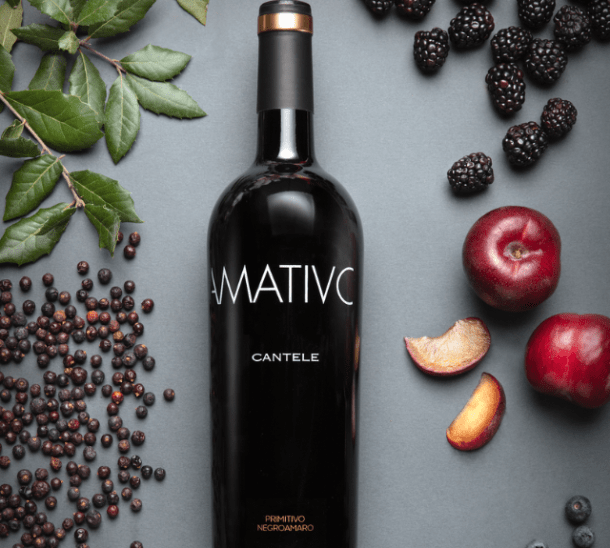
2021 Amativo, Cantele, Puglia lovely blend of NegroAmaro and Primitivo delicious rich black fruits hints of smoke and choclate
2022 Primitivo Puglia IGP, Cantele
Thanks to the crowd of 31 who braved dry January. Special thanks to Umberto who gave us great insight into his family winery and brought his Italian warmth to a London January.
En Primeur, the sale of wines as futures, was until a few years ago a method of sale for premium Bordeaux and Burgundy but now it is increasingly being used for fine wines from other regions.
In this tasting the wines are pre-release but not by much. Brunello di Montalcino must be matured for a minimum of 5 years, including at least two in barrel, before being released to the market. These wines are already in bottle, rather than barrel samples and due out in 2025. So this EP seems to be more about marketing and to generate some expert reviews and promotional activity amongst the merchants.
For the customer the days of buying a future wine to help the wine makers cash flow and enjoying a slight discount in exchange are largely long gone. Now EP seems to be more about securing an allocation of rare or prestigious wines.
Brunello di Montalcino is a DOCG south of Siena within Tuscany. It is warmer and drier than Chianti producing more powerful concentrated expressions of Sangiovese. Its not far from the coast so parts receive some cooling breezes and inland the beautiful rolling hills provide a little elevation. Both of these factors help slow ripening down, which helps develop flavour and maintain freshness in the wines.
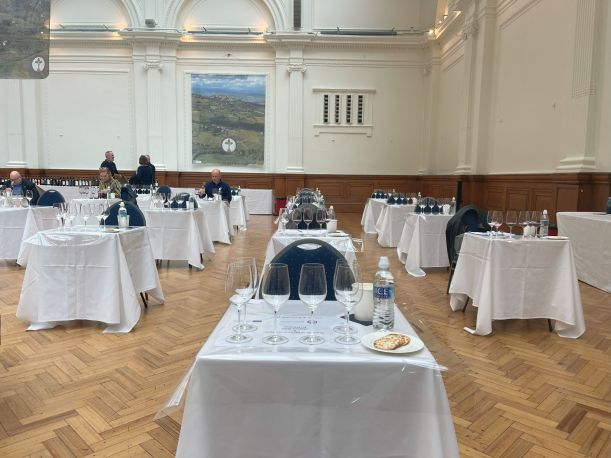
The seated format of the tasting was actually brilliant, no juggling of glass, catalogue (or e-catalogue on your phone) pen and pad, and no elbows required to push through the usual scrums that form around the popular tables – bliss!
It reminded me of how much I like Brunello and I was impressed by how approachable many of the wines were already on release. However with high acidity, fine sandy tannins and that concentrated red fruit they promise much more to come with bottle age. Many displayed classic sour cherry, dusty soft red fruits, bay leaf, dried herbs and a hint of black tea.
It was great to try and compare and contrast the impact of different soil types, those with more clay seeming to display riper fruit. Also to contrast the effect of using either Slavonian or French oak casks. Whilst the French oak did add a layer of spice and sometimes subtle toast, none of the wines I tried seemed overdone.
Of the many great wines on show a few stood out to me:
Argiano BdM – Lovely nose, balanced with a nice touch of spice.
Banfi Vigna Murrucheto BdM – Concentrated fruit and subtle toastiness.
Capanna BdM – Classic sour cherry, black tea and touch of wet stone.
Col d’ Orcia BdM – Intense riper red cherry and plum, dried herbs, bay leaf and a nice dusty finish.
Col d’ Orcia Poggio al Vento Riserva 2016 – Concentrated pot purri, raspberries, sour cherry, black tea, smoke and leather, super long.
Sesti BdM – Consistently fine, roses, sweet cherry, cranberry, dried oregano, black tea and freshly turned soil, amazing concentration.
Sesti Phenomina Reserva 2018 – Knock put too!
Uccelliera BdM – A big wine but still fresh with rich cherry tart, roasted herbs and a bit of toast.
Many thanks to Hunt and Speller and Consorzio del vino Brunello di Montalcino for organising this great tasting and providing so much interesting information about the wines in the catalogue.
By the way don’t forget the Rosso di Montalcino category of wines too. Supposedly entry level but many of the top estates produce what are effectively baby Brunello’s which represent great value for money and can be enjoyed sooner.
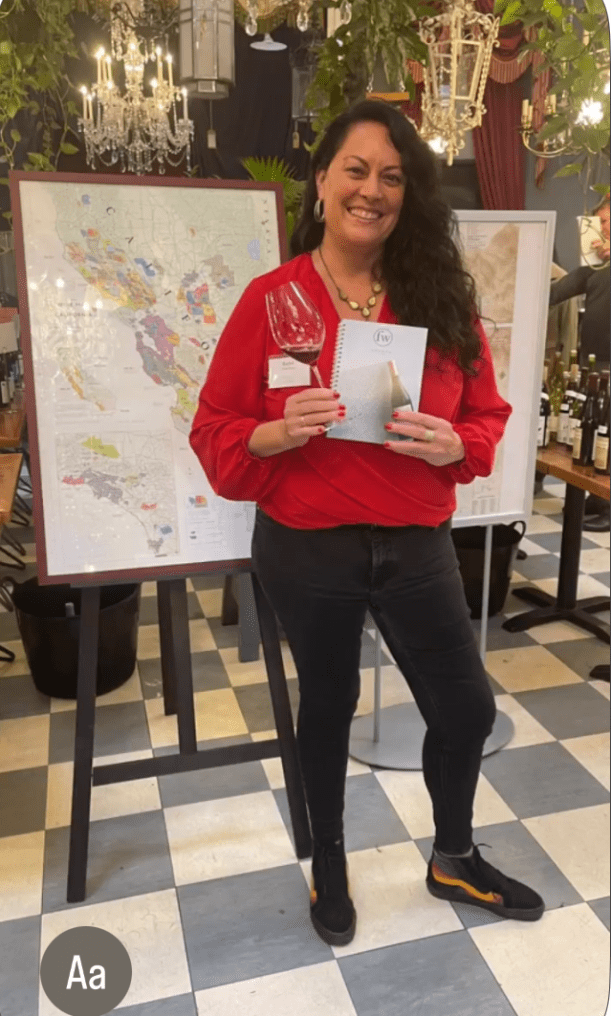
Flint Wines have a comprehensive portfolio of wines from the USA and to support a recent portfolio tasting they have put together an amazing American tasting booklet. It is packed full of maps, descriptions of each AVA’s character, climate, aspect, soils and detailed winery profiles.
Quality grapes in California are very much a product of one or more factors in the vineyard that moderate the otherwise warm climate. The cold Pacific sends cooling breezes and overnight fog far inland along the State’s various east west valleys that cut through the coast mountains and of course San Fransico Bay itself. Also vineyards planted at altitude on these mountain slopes also enjoy cooler nights.
Grapes as a result ripen more slowly, developing flavour and retaining more acid giving the wine maker lots of good material to work with. Growers of Pinot Noir, Chardonnay and even Syrah are particularly on the lookout for cool climate pockets. It was great to be able to visualise all this with aid of these maps.
The tasting was organised by region which allowed you to travel from one AVA to another comparing and contrasting and really see how wine makers are responding to the changing conditions.
Hats off to Rachel Dixon their USA Ambassador, who’s mission to educate about wines of American is certainly working!
For me standout wineries included:
Chanin Wines – Chardonnays & Pinots from Los Alamos, Santa Maria Valley
Christom Vineyards- Chardonnays & Pinots from Willamette Valley, Oregan
Tyler Winery – Chardonnays & Pinots from Santa Rita Hills, California.
Snowden Vineyards – Sauvignon Blanc & Cab Sauvignon from Napa Valley, California.
Perched on the edge of the old Saxon shoreline in Appledore, Kent, Gusbourne Estate makes a compelling argument for the quality and potential of English wine. With 60 hectares under vine here and another 30 in West Sussex, Gusbourne has focused on a clear ambition since planting its first vines in 2004: to produce vintage wines of the highest calibre using only estate-grown fruit.
The vineyards are planted with Burgundian clones of Chardonnay, Pinot Noir, and Pinot Meunier, varieties well suited to the region’s unique microclimates. Yields are deliberately kept low, resulting in grapes of concentration and character. These form the foundation of a range that includes both still and sparkling wines, all made using traditional methods with a low-intervention ethos that carries through from vine to bottle.
A visit to the estate offers more than a picturesque setting. The winery tour is well-structured and informative, culminating in a tasting that includes the rare opportunity to sample base wines before moving on to the finished sparklers. This provides a valuable insight into the effects of lees ageing, adding texture and biscuity complexity, and how dosage lifts the bright citrus notes that are a hallmark of the house style.
Among a strong portfolio, the Blanc de Blancs 2018 stands out for its precision and poise. It’s joined by a limited series of museum releases and small-batch cuvées, including vintage Blanc de Meunier, all reinforcing Gusbourne’s position at the premium end of the market. The still wines, notably the Guinevere Chardonnay, demonstrate real depth and finesse, and make a persuasive case that 51 degrees north is no longer a viticultural outlier.




























 WanderCurtis Wine