WanderCurtis Wine

Wine tastings, corporate events, reviews and recommendations


Leave a comment

Brane-Cantenac vertical tasting with Corinne Conroy

brane-cantenac-bottleesTasting 11 consecutive years of the Chateau’s grand vin, this event was a fantastic walk through the last decade of Bordeaux vintages, but the evening’s real revelation was the remarkable consistency of character and quality that the wines showed, through these varied times.

Kiran’s tasting notes:

2001: Heady mix of perfume, sandalwood and spice on the nose, lovely savoury and complex flavours in the mouth, fruit & cedar. Delicious, fresh and lively finish. Gorgeous.

2002: Quite closed at first on the nose, some floral hints, opening up after decanting to give delicate mature nose of earth and forest floor, on the palate medium body tasty and rounded.

2003: On the nose baked fruits and some earth and wood, in the mouth more fruit and spice but with enough acidity and lift.

2004: Slowly opening up with floral notes, sandal wood, beginnings of forest floor, lovely silky mouthful of black fruit tart, savoury, balanced, fresh and long. The gem of the evening. As with all of the wines tonight, a haunting perfume characteristic of the Chateaux lingers on in the empty glass. Wow!

2005: A little tight on the nose, sweet green pepper then opening up with blackcurrant, spice and cedar. In the mouth more fruit and a touch of spice. Quite concentrated with nice integrated tannins and great freshness. Still a tightly coiled spring.

2006: Needed decanting, sweet floral and fruity core then a whiff of hoisin sauce on the nose. Concentrated flavours of black fruit and bit of toast on the palate, again compact, packed with nice tannins.

2007: A floral nose with sweet fruit, lighter bodied than the previous wines but with nice red fruits and a few savoury notes, cool and clean.

2008: After decanting and some coaxing revealing some classic black fruit and cedar on the nose, but characteristically of these wines as if delivered from a perfume vaporiser  making it delicate and sensual. Medium body, with nice fruit and some savoury notes. Amazing how this wine has evolved into such an enjoyable experience from the awkward and unfriendly barrel sample I tasted EP 4 years ago.

2009: At first not as expressive as last time I tasted this wine (Corrine says it is beginning to close down for a period).  After decanting and some air, ripe fruit, flowers a touch of toast, lots of everything making a heady nose. On the palate lovely silky body, lots of fruit with enough savoury notes and a super crisp balance. Remains refined even though a bigger wine. Lovely!

2010: Wow! This wine has an intense yet somehow delicate perfumed nose, violets, red currants. Just a touch of cigar box, the vaporiser is working overtime on this one. Then in the mouth really concentrated, again silky but with strong backbone of tannin. The Chateau seems to really sing in this vintage, hitting equilibrium between refinement and substance. Outstanding!

2011: This wine really impressed. Side by side with the 2010, one could appreciate just how close in quality it is to that great vintage. Similar perfumed delicate nose, a nice sweetness and silky on the palate, with fresh red fruits and a hint of toast, good acidity.  Really fine.

brancan1Brane-Cantenac is a second growth from the original 1855 Bordeaux wine classification of 1855 in the Margaux appelation. In 1922 it was acquired by the Lurton family and in 1992 control passed to Lucien Lurton’s son, Henri Lurton. Brane-Cantenac’s vineyards lie on fine, gravelly soils, grapes include Cabernet Sauvignon (55%), Merlot (40%), Cabernet Franc (4.5%), and Carmenere (0.5%)

Brane Cantenac wines are available widely. The wonderful 2009 vintage is still vavailable from Nickolls and Perks at a good price http://www.nickollsandperks.co.uk/product.asp?product=NPCS19452

The superb 2004 and older vintages from Fine & Rare: http://www.frw.co.uk/searchWines.aspx?keywords=Brane+Cantenac+2009&sid=4&FRS=ws

The evening was in the private room at Bistro Aix, Crouch End, with a tantalizing selection of French classic cuisine.      http://www.bistroaix.co.uk/


1 Comment

Best Pinot Noir of New Zealand – Suze restaurant, Mayfair

35 people attended this seated tasting in Mayfair. A great evening showing the best pinots in New Zealand based on Matthew Dukes 5-star pinot rating table. Nicola Greening of Felton Road presented Calvert and Cornish Point, Mike Herrick was over from New Zealand presenting Pipeclay and the Estate from Mount Difficulty and Abbie Moulton of Liberty wines showed Ata Rangi.

Venue Suze restaurant in Mayfair is owned by passionate, wine-loving Kiwis. Matching canapés were served with the wines.

Welcome wines:

  • Kumeu River Estate, 2007, Chardonnay, Auckland New Zealand.

This is a firm favourite of the WanderCurtis duo since I hit upon the 2006 vintage. At about £15 a bottle it is not strictly every day drinking but so reliably delicious and morish that it is hard to resist reaching for it after a long day at the office. The 2007 is fresh with wood and citrus notes on the nose. It is quite tight to begin with and really benefits from decanting for an hour or two. It is even better the next day if there is any left. The oak softens and leaves a very nicely balanced and persistent wine which sustains the interest.  Available from The Wine Society £16, Farr Vintners and Swig. (The Wine Society Exhibition NZ Chardonnay is produced by Kumeu River and is almost as good at £12.50).

  • Kumeu River Coddington Vineyard, 2007, Chardonnay, Auckland New Zealand.

Kumeu produce a number of single vineyard chardonnays which, when tasted side by side, show an impressive variety of styles from the taught and steely Hunting Hill to the complex and creamy Mates vineyard. The Coddington is at the luscious, buttery and toasty end of the spectrum. Again although there is again smoky wood on the nose to begin with. This wears off and is replaced by citrus and biscuit, on the palette creamy and buttery but balanced with mineral tones. Complex and delicious. Available from The Wine Society for£18, Farr Vintners £20.

Round 1:  Felton Road, Central Otago. (introduced by Nicola)

  • Felton Road, Calvert  Pinot Noir 2010.

On the nose tight with cherries and red fruits to begin with, on the palette again very closed and delicate however ten minutes in the glass brings a revelation. On the nose a huge range of spice, chocolate, liquorice scents rolling one after another and on the palette it broadens out and gains weight and complexity. Obviously very young, but a tremendous wine. Available from http://www.uncorked.co.uk £36.95.

  • Felton Road, Cornish Point Pinot Noir 2010.

On the nose more open, spicy and voluptuous and immediately approachable than the Calvert. The Cornish Point also develops in the glass, a savoury and tasty wine. Also needs time. Available from http://www.uncorked.co.uk £36.95.

Round 2: Martinborough Ata Rangi wines (introduced by Abbie)

  • Ata Rangi, Martinborough Pinot Noir, 2009.

On the nose tight and a bit closed, cherries and a bit of smoke on the palette. Very young with plenty of acid and some tannin, a big wine but in its infancy.  In this primal state, a bit hard to judge and rather unfair in comparison to the forward Te Terra. Available from Bordeaux Index for £372 per case or £31 per bottle.

  • Martinborough Vineyard, Te Terra 2010.

On the nose, fruity and spicy, on the palette plums, savoury notes, tasty and quaffable and ready to drink already. Available from Majestic at £12.99 for 2+ bottles.

Round 3: Mount Difficulty, Central Otago
(introduced by Michael Herrick of Mount Difficulty and Helena Westcombe of Ellis of Richmond)

  • Mount Difficulty Estate, 2008.

On the nose delicate fruit, volatile floral scents, still quite compact, a nice mix of freshness, fruit and some savoury notes in the mouth. The Central Otago wines seem to be a bit crisper and more tightly wound than the two Martinborough wines tasted so far. The Estate blended from six different vineyards slowly evolves in the glass and sustains one’s interest seemingly confirming Mike’s recommendation to keep 6-7 years. Available from Waitrose for£23.74. and http://www.nzhouseofwine.co.uk for £19.95.

  • Mount Difficulty Pipe Clay Terrace, 2007.

A single vineyard wine only made good years, this is a darker, bigger wine, with a nice complex nose of earth, dark fruit and spicy tobacco notes, more fruit core and earthy flavours on the palette with some obvious tannin.  Also wine follow as it ages. Available from http://www.nzhouseofwine.co.uk for £40.45.

Round 4:

  • Ata Rangi, McCrone Vineyard Pinot Noir, Central Otago 2008.

Rather closed nose, red fruit, and floral scents, crisp acidity and tight structure in the mouth, overall bright fruit opening up a bit in time with some savoury flavours. Compact and long couldn’t be more of a contrast to the Henri Gouges Burgundy! Available from http://www.harrogatefinewinecompany.com for £44.99.

  • Henri Gouges, Nuits St Georges, Villages 2008, Burgundy.

The nose dominated by dirty, savoury scents, nappies, lamb chops, compost etc.  In the mouth these notes again, but underscored by ripe fruits. This wine elicited differing opinions and was a huge contrast with the NZ pinots. Available: Justerini & Brooks £330/case. 2009 vintage http://www.lhkfinewines.com en primueur £240/case In Bond.

Summary:

The New Zealand wines lived up to their reputation of offering clean crisp bright fruit and minerals. However it was great to see that a number promise to develop and offer that much sought after pinot noir experience of fragrant fruit contrasting with barnyard characteristics. Mike Herrick described this nicely as a walk through his grandmother’s rose garden with the scent of the flowers mingled with that of the compost and earth below.


Leave a comment

Barolos and wines of Piemonte, Italy at Giovanni Rana

Aged Barolo and Barbaresco live up to their international reputation but lesser known local varieties such as Arneis, Dolcetto and Barbera can be fantastic value in the hands of great wine makers.

Thirty-two guests attended this tasting, which was held at Giovanni Rana’s swish and airy new restaurant, in the Regents Place development on Euston Road. The tasting was designed to give an overview of the various wines of Piedmont. Most people have heard of Barolo (made from 100% Nebbiolo), arguably the region’s most famous wine and one that inspires wine buffs to launch into rapturous praise of its unique character, complexity and aging potential. But the region is also host to a  range of other grape varieties that produce great value delicious drinking wines and the evening set out to show some of these too.

Rebecca Nightingale of Montforte Wines and Roger Barlow of Gerard Seel kindly introduced the region and presented the wines on the evening. The restaurant provided a superb selection of antipasti and some memorable pasta dishes that complimented the wines perfectly, proving just what food friendly wines these are.

The first wine sampled was a white Arneis from Roero by the fabulously named Gigi Rosso. This wine was fresh with a persistent lingering and unique flavour. Aromas of flowers and unripe pear, really very well balanced with a long finish. Lovely and very popular amongst the guests.

Round 1: Dolcetto (introduced by Rebecca)

  • Dolcetto d’Alba ‘Duset’ 2010 by Le Vigne di Ca Nova. Fresh, with morello cherries and savoury notes. A wine to drink in his youth as a light and refreshing lunchtime drink.
  • Dolcetto d’Alba Rutuin 2007 by Caibot Berton. Slightly older, this wine was less fruity but slightly more complex on the palate with a note of golden Virginia tobacco. At five years old, it’s probably reaching its peak. A lovely, tasty, moreish drop. These wines  have fairly low tannin but are nevertheless fresh and good with food.

Round 2: Barbera (introduced by Rebecca, contrasting oaked and unoaked)

  • Barbera d’Alba 2010 by La Licenziana. Fresh with lots of acidity, a wine that really reacted well to the prosciutto and salami on the table. On the nose, fresh, light strawberry and red fruits. Again, a wine for drinking in its youth.
  • Barbera superiore ‘Bric de Maschi’ 2007 by Le Vigne di Ca Nova. Delivered a slightly smoky nose with vanilla, perhaps chocolate and still plenty of cherry fruit. Absolutely delicious on the palate with sticky crust of cherry tart and savoury notes. Fantastic value for money and a delicious drop of wine from 2007.

Round 3: Barolo (introduced by Roger)

  • Barolo Roggeri 2007 by Caibot Berton. In Piedmont, where Barolo has a reputation for huge tannins that need many years in the bottle to tame, 2007 is thought to be a very approachable and friendly year with lovely soft integrated tannins. The Roggeri proves the rule with absolutely delicious complex notes of fruit, classic tar and floral aromas on the nose. In the mouth, again gorgeous, still plenty of tannin but smooth and tasty. This wine has structure and hints of how it may develop in complexity with age. No wonder Decanter gave this five stars and rated it top for value for money in recent review of Barolo 2007.
  • Barolo Serralunga d’Alba 2007 by Fontanafredda. Also a 2007 and if it if anything even more approachable with notes of tobacco and mushrooms and a little liquorice on the nose. On the palate nice, fresh and fruity with a bit of spice and very soft integrated tannins. Perhaps a little brief but a really approachable and tasty Barolo. In fact a wine that many people found easier to enjoy than the slightly more structured Roggeri.

These lines were accompanied by a great range of pasta including pappardelle al ragù d’anatra (duck) and porcini ravioli, again proving how well these winds even in relative youth go with food.

Round 4: Style and Age – Barbaresco and Barolo

The final round of wines contrasted a Barbaresco with an older Barolo. Barbaresco wines are considered again to be more approachable more soft and feminine softer and less fiercely tannic. On the other hand Barolo is famed for the way it delivers a delicate cocktail of aromas and flavours once the tannin has reduced with age.

  • Barbaresco Bric Balin 2005 by Moccagatta. This single vineyard Nebbiolo has lovely savoury notes then toffee, condensed milk some floral scents perhaps a little bit of the famous tar, complex. In the mouth, long, savoury, sweet and delicious. Really an outstanding wine. Still young, but with beautifully integrated tannins and that great long future ahead of it.
  • Barolo Carobric, 1997 by Paulo Scavino. A big name in Barolo and a blend of three of their best vineyards. Stealing the show and providing a brilliant lesson in just what the Barolo can deliver, but even at 15 years of age it still needed time to open up in the glass. Notes of tar, earthiness, a bit of mushroom and a whiff of violets on top complex notes. In the mouth, still quite tannic but slowly opening up and providing more of those savoury sweet notes with a core of ripe fruit bellow. Changing flavours, complex and persistent still, with many years ahead of it. Fantastic.

We finished the evening with a glass of Moscato d’Asti 2010, Santa Vittoria. Another white, lightly fizzy and sweet, but also fresh to cleanse the palate and end a hedonistic evening.

Kiran’s wines of the evening

  • Barolo Carobric, 1997 by Paulo Scavino (£86.00 – Fine & Rare)
  • Barbaresco Bric Balin 2005 by Moccagatta. (£32.75 – Gerrard Seel)

Kiran’s best value wines

  • Barbera superiore ‘Bric de Maschi’ 2007 by Le Vigne di Ca Nova (£12.25 Montforte Wines)
  • Dolcetto d’Alba Rutuin 2007 by Caibot Berton (£9.95 – Gerrard Seel)

Must have for Kiran’s cellar

  • Barolo Roggeri 2007 by Caibot Berton (£29.95– Gerrard Seel)

Contact

  • wine@gerrardseel,co,uk
  • rebbecca@montfortewines,com


Leave a comment

The wines of Austria spring tasting – Highgate, London

Welcome wine:

  • Domaine Wachau Terrace. Lovely, clean, crisp, minerally, excellent value. Our wine of the month in June 2011. Available from Waitrose.

Round 1:

  • Lagler smaragd Riesling/Weissburgunder/Gruner Veltliner

Subtle differences the pinot blanc, which was more acidic. The riesling slightly honeyed, ripe apricots. The gruner minerally crisp.

Round 2:

  • Emmerich Knoll – Federspiel  gruner veltliner2010 and gruner veltliner ried Loibenberg smaragd vinothefullung.

Federspiel crisp young mineral quality.The smaragd full luscious oily viscous honeyed superb.

Break for Tafelspitz.

Round 3:

  • Weingut Brundlymayer Ried Kaferberg smaragd Gruner veltliner 2002 V 2009

Both full bodied honeyed lush wines. The 2002 particularly smooth, rounded. Lacks the crispness of the young ones and not fresh but a great embodiment of the best terroir.

Round 4:

  • Lagler Eiswein Neuberger 2003 harvested christmas eve
  • Berenauslese Riesling 200 served with Birgit’s Apfel Strudel

Impressive array of wines and food 18 guests. Other great wines to mention ,which we plan to introduce to future tastings are the amazing Brundlymayer Rose Brut and the superb Brundlymayer Red Lamm 2009.


Leave a comment

Four decades of Bordeaux – Highgate, London

Tasting and comparing classed growths from each of the last four decades certainly delivered plenty of intellectual interest, but a little more drinking pleasure from the wines wouldn’t have gone amiss.

The theme of the tasting, which included wines from 7 through to 42 years old, was aging.(Quite appropriate as it came a few days after my birthday on which one of the nicest treats was realising that over the last few months I’d been labouring under the impression that I was a year closer to 50 than I really am!)

Round 1: Old v Young

  • Chateau Grand-Puy-Lacoste 5th Paulliac 1975

We opened the two remaining bottles of this, the first being oxidised. The second although not faulty was unfortunately really an example of a wine on its very last legs. Brick coloured and noticeably lighter in colour than the Batailley. The nose initially delivered some stewed fruit and forest floor notes, bark chips etc. but soon faded. Interestingly after a while it turned to a not unpleasant scent of turmeric. On the palate more cooked fruit, then unmistakably oxidised. This was one of seven bought at auction, three of which were fantastic, three completely oxidised. *

  • Chateau Batailley 5th Growth Paulliac 2005

Garnet colour, restrained and tight nose but as it opens up classic cassis, cedar wood and a touch of blackcurrant leaf, good balance and freshness (acidity to age well hopefully). The tannins are there in abundance, but not harsh or aggressive at all. With decanting this becomes more complex and shows its potential. A good contrast, as this wine is too young but still lovely **++

Round 2: Saint Julien Leoville seconds
(sort of but not really as each of these are chateaus in their own right)

  • Chateau Langoa Barton 1989

Both of these similar colour with brick rim. Some similar characteristics as one would expect from neighbouring vineyards, but as they opened up they showed their individuality. ’89 was the better year and the Langoa didn’t disappoint, gradually opening up in the glass with wave after wave of subtle sweet and savoury scent combinations: forest floor, baked fruit tart etc. Similar experience in the mouth, soft and delicate blends of flavour sustaining one’s interest. This is a great example of how the primary flavours have dropped away to reveal more subtle and complex ones beneath. Excellent ***

  • Chateau Clos de Marquis 1988

Quite a perfumed nose, someone suggested of fabric plasters and Savlon but in a good way? In the mouth still some life with fruit and vegetable flavours. This didn’t develop in the same way as the Langoa and in comparison was a little one dimensional but enjoyable if not particularly long. **

Round 3: Left and Right bank

  • Chateau Cantenac Brown growth Margaux 3rd 1996

On the nose this was at first a little restrained but opened up with classic cassis, graphite, and a bit of wood still predominant, but accompanied by more savoury flavours of caramelised fruit and a bit of peat. Good balance still tight, refined as a Margaux should be. Could have done with decanting and has plenty of years left. **++

  • Le Jardin de Petit Village 1996. Pommerol

This has plenty of fruit on the nose, plumbs and a hint of cocoa powder which is the predominant merlot in this right bank second wine. On the palate rounded and mellow less structure than the Cantenac Brown but more mature and very tasty. My guess is that this is just right now in terms of aging.**

Round 4: Second Growths

  • Chateau Brane-Cantenac 2nd Growth Margaux 1970

The oldest wine of the evening, light brick colour, initially slightly funky nose as one taster put it, for me it was a whiff of Brussels sprouts with other vegetal notes, still some sweetness, changing to earthy loam then stewed fruit. On the palate nice sweetness, and engaging complexity, autumnal red fruits, baked tarts, spice, savoury notes. Again developing with a progression of fleeting flavour combinations to keep one interested. Lovely ***

  • Chateau Pichon Longueville 2nd Growth Paulliac 2002

A rather ungiving nose, some cassis and wood but a bit light and not forthcoming. Same on the palate, a bit too delicate, some fruit and mineral, but after a decade one would have hoped for more, perhaps a bit hollow? Will this improve is it just still shut tight or is there not much there? ’02 not a great year and disappointing for the price.*

The evening finished with a couple of sweet Bordeaux and Gerald’s excellent apple tart.

On reflection it was certainly an education in how Bordeaux age. Most people enjoyed the 1980s and 1996 wines, which were I think more accessible. The 1970 Brane-Cantenac was for me the wine of the evening just because it was so interesting whereas the Langoa 89 probably gave the most pleasure. The Cantenac Brown and Batailley didn’t show their full potential as they have on recent pre-tastings when they had time to fully open up over an evening, but should be delicious with a few more years.


Leave a comment

Wine quiz and tasting – New Hall, Channing, Highgate

The evening started with a few glasses of Heidsieck Gold Top Vintage 2004, classy steely fizz with a hint of biscuit that will no doubt develop.  A round of questions on champagne was followed by three whites.

Wine 1: Grüner Veltliner, Terraces, Domaine Wachau 2008, Austria. Lovely nose of apple and cinnamon, fresh limey notes in the mouth. Lovely balance.  £7.50 from Waitrose. Great value every day drinking.

Wine 2: Gewurztraminer Réserve, Trimbach Alsace, 2005, France. Exotic nose, good balance lychee and honey. £15.50 from the Wine Society. People either love it or hate it.

Wine 3: Chardonnay, Kumeu River Estate, 2006, New Zealand. Citrus, minerally, complex and delicious with nice woody notes.  This wine evolves in the glass and sustains ones attention. Mistaken for a premier cru Mersault or Puligny in many blind tastings. £15.50 from the Wine Society. Tremendous value.

After a break for the buffet four red wines followed:

Wine 4: The Wine Society Exhibition Cairanne, 2007, Grenache/Syrah, Cote du Rhone, France. Did not show well this evening.  Rather dumb on the nose and struggled to come across as more than pleasantly fruity. Normally this opens up after an hour’s decanting.  £8.95 from The Wine Society.  The Society’s Exhibition Vacqueyras, 2007 at a pound more is a clear step up and superb, also needs a good half hours decanting.

Wine 5: Emilio Moro, 2006, Tempranillo, Ribera del Duero, Spain. This wine also didn’t shine on the evening as it has on previous occasions.  Again it would have benefited from decanting to bring out the black fruit, chocolate and smokey characteristics that normally make this wine so moreish, great value at the price.  £12.95 reduced from £17.95 from Majestic.

Wine 6: Wither Hills ‘Winery Matured’ Pinot Noir, 2005 Marlborough, New Zealand. Smokey and boiled sweets on the nose, toasty notes over fruit on the palette. A rare chance to buy a matured new world pinot. £16.99 from Majestic

Wine 7: Langoa Barton, 1997, Cab Sav/Merlot, St. Julien, Bordeaux. Lovely nose of cedar, fruit and earth, still enough fruit on the palette underneath, vegetal and further earthy notes, complex, evolves in the glass.  At its peak now. Very good value for a mature claret.  £25.50 from Farr Vintners (minimum order of £500).

The evening was rounded off with chocolate brownies and Waitrose Sauternes Château Suduiraut 2005 Bordeaux. Lovely honey and beeswax nose, complex flavours sustained by just enough acidity to keep it fresh and very quaffable. £13.50per half bottle from Waitrose.

Lots of great feedback from 90 guests who seemed to really enjoy the quiz format and rolled home happily still arguing about the number of calories in a glass of white wine.


Leave a comment

Auction gamble on mature Bordeaux

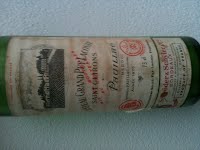
GPL1975I recently bought a mixed case of 21 bottles of mature Bordeaux mostly from the 1970’s with a couple from ’66 and ’64, both birthday years of wine loving  family members, which is what initially drew my attention to the lot.

For some time I’ve been trying to pick up some mature wines at auction. But taking the view that one should expect a discount of around 30%, given that the provenance of Duty Paid auction wines cannot be a hundred percent guaranteed, I  have been consistently disappointed. Admittedly I had been targeting full cases but was still quite surprised to receive an invoice for both mixed lots that I had placed absentee bids on. I had thought they were cheeky bids.

Clearly by pursuing mixed lots one eliminates the investment market and probably most merchants, BUT one is taking a gamble. So far, I have opened five bottles – three bottles of Grand Puy Lacoste 1975 (classed growth), and two Chateau Houissant 1975 (St Estephe cru – never heard of it either).  Three of these have been excellent (2x Houissant & 1 GPL) and two undrinkable.

The lot description of the GPL did highlight that two had ‘cut capsules’ one with ‘mid shoulder’ and the other with ‘high shoulder’ level (the level of the wine in the bottle is a critical indication of how well it has been stored and its likely quality). However when opened, the bottles only had about 1.5 cm of cork left. The corks must have pushed out (perhaps over heated?) as sometimes happens and burst the capsule. Someone then just trimmed them off but the remaining cork was not enough to stop the wine from completely oxidising.

The good bottle of GPL clearly from the same case had a level of ‘very top shoulder’ (apparently anything down to high shoulder should be fine for such an old wine) and still had a core of fruit with a bit of steel to start with and lovely savoury notes developing as the wine opened up over the evening, incredible. The two bottles of Houissant have also been delicious, less fruit but more of the classic, leather, tobacco, earthiness, which is impressive for a humble wine.

So far then I think I’m ahead, though sadly the levels of the ’64s are not so good, we shall see. Happy gambling!


Leave a comment

Kumeu River Coddington 07 v Olivier Leflaive Puligny-Montrachet Les Enseignères 05 er cru

Can’t compete with Adam’s recent jolly, but on a Kiwi note we tasted the above blind on 29th December. One light, the other a darker golden colour. On the nose the lighter was more closed with a touch of furniture polish; the other more woody. On the palette, the lighter with nicely balanced acid, fresh and minerally, taut but a little short; the other richer, fruitier, with more wood and more length, though at first a little harsh.

By now I had recognised the darker, richer wine to be the Kumeu River Coddington. Having read about how often the Kumeu chardonnays are mistaken for top flight Burgundies such as Puligny or Mersault (see Farr vintner blog for a similar blind tasting) I was a little disappointed at how easily we had distinguished the New Zealand wine and how different it was in character: much more extravagant and effusive. However the way the two wines developed in the glass was perhaps most interesting.

The Puligny improved in the glass showing more intensity, filled out a bit and developed more length, all refinement and restraint. The Coddington remained for a while dominated by the oak on nose and on the palette, pleasurable but a bit harsh. However as the evening wore on, I found myself wanting more fruit intensity and some nuttiness from the Puligny.  The Coddington by contrast gained complexity and eventually completely dropped the oakiness in flavour of intense rich fruit, perhaps without as much balancing acidity as the Puligny, but nevertheless with just enough to keep it engaging. It continued to have good length and to be overall delicious.

The Coddignton was polished off that night and the Puligny the next day when it had really come together in a refined but more intense way.

Tasting the full line up of different single vineyard Kumeu’s at the Farr Vintner Xmas tasting the range of styles was apparent, from intense and steely like the Hunting Hill to luscious and perhaps a little flabby in the Mates vineyard. Perhaps one of the more steely vineyards would have matched the Puligny better, but for me the Coddington provided a good balance and delivered in terms of pure drinking pleasure all the way to the bottom of the bottle. It leaves me thinking that comparisons with aristocracy of burgundy are beside the point.


Leave a comment

Bordeaux 2009 barrel tasting at The Sampler

Last month, The Sampler on Upper Street in Islington had the brilliant idea of bringing over some Bordeaux 2009 barrel samples for customers to try. The only other way of trying Bordeaux en primeur wines that I am aware of is at the Bibendum tasting usually held in early April, which unfortunately clashed with footie this year. If you don’t know the Sampler wine shop then it is definitely worth popping down there early evening to have a go on their fancy sampling machines which allow you to taste, for a small charge, a selection of wines on sale, including some fine and rare bottles.

I tasted the following wines (prices are the Samplers estimates):

Malartic Lagraviere Blanc, Pessac (£300)
Lovely sweet floral nose, quince, hay and vanilla, gorgeous. Palette light with touch of spice good acidity, quite long with a touch of heat at the end. *** (But at this price I would go for the ’08 which was also great, or an earlier vintage.)

Brown Rouge, Pessac (£170)
Leafy berry laden nose with a hint of green peppers, light fruitiness on the palette, balanced, ripe, a little tannin but not aggressive – cool, but not very long. **

Malartic Lagraviere Rouge, Pessac (£300) (now available at £285)
Dark colour, more closed nose, light berry fruit, very sweet with a hint of something flinty underneath. Cool on the palette, balanced and complete, mouth coating tannin but not aggressive. Nose develops still sweet with a touch of classic Pessac bell pepper (the one that you find in a donner kebab!). Interesting, complex and engaging, again round and tasty on the palette, quite long. Delicious. ***+

Domaine de Chevalier Rouge, Pessac (£350)
More bell pepper on the nose, spicier, edgy, rougher and bigger. More body and breadth, soft fruity and spicy with more aggressive tannin, mouth coating and lip smacking. Warmer tasty and long. This is a spicier bruiser of a wine. ***+

Smith Haut Lafitte Rouge, Pessac (£500)
Nose more closed and tough to get going, on palette cool, refined but concentrated and big. The refinement of Malartic and power of Chevalier, best of both worlds. Nose developing sweet fruit, touch of bell pepper, vegetal notes underneath a solid core of mouth filling fruit, spicy and complex with a lingering tasty finish. **** (Sadly this has since received high Parker scores so will be expensive).

Langoa Barton, St Julien (£480)
Slight scents of chutney/relish on the nose, then stoney with notes of plaster dust, developing with deeper and persistent fruit and limestone mix. Cool, compact, quite smooth on the palette, restrained and closed, ends with mouth puckering tannin, quite long.  Langoa’s do take time to open up, so one would have to trust on past performance on this one. All the right things in place except is there enough fruit?  **++  (Pricey for EP better to go back and buy previous vintages ’01 and ’04 are great)

Pedesclaux, Pauillac (£200)
Fruity, compact nose, light cassis in the mouth, balanced, tasty. **

Le Boscq
Sweet and sour notes on the nose, fruit with those salted yellow pickles you get with Sushi, fuller palette, fruit, cool balanced and tasty, not very long but a good drinker. **+

Citran
Sweet nose, slightly floral, balanced palette, cool and sweet, tasty. **+(good value?)

Sociando Mallet, Haut Medoc (£280)
Closed nose, bit imbalanced in the mouth and rather short with chunky tannin. Just hasn’t come together yet. Disappointing, as this is usually an excellent wine. *+?

La Tour Figeac, St. Emilion (£300)
Wider softer merlot nose, tasty but light bodied and rather tannic. The 2008 barrel sample last year was much more exciting, complex and approachable, and I’ve had lovely older vintages of this wine so again disappointing.  **?

Batailley, Pauillac (£350)
This wine was officially out, but I was kindly allowed to sample the dregs of the half bottle which were clear but slightly dusty. Lots of fruit, compact, pure and solid Pauillac. This should be great.

For what it’s worth
My personal view is that 2009 is a chance to pick up some fantastic wines for the cellar in the £200 – £400 price range (look for wines that other critics liked, Jancis, Decanter etc. but which weren’t singled out by Parker such as the Malartic Lagraviere & Batailley above or Haut Batailley). Then I think there will be a jump in prices up to £600 – £800 without much in between. For instance Duhart Milon was released at £270 last year and has sold out already at £600 this year! Also, while the left bank is universally agreed to be unique in terms of quality, the right bank is apparently more patchy and much better value will be had by going back to ’08 and older vintages. For example, a normally great value Pomerol Rouget was released at £220 last year and is £340 this year, but almost certainly not 50% better.


Leave a comment

Wine tasting trip to the Ribera Del Duero, 20-23 May

A stupendous long weekend in Ribera Del Duero arranged by R-C tours.

Day one
Commenced with a private tour of Dominio de Pingus, which was very hard to find just off a back street in the village.

Winemaker Patricia Benitez took us first around the super modern science labs including PCR machine! The scientists among us were already drooling even prior to the barrel samples of Pingus and flor de pingus 2009. A fascinating insight into one of the worlds most expensive ‘garage wines’.

We were whisked off to the ultra modern Bodegas Alion (Vega-Sicilia). Purification answered every last question, valiantly, from the density of the grain of French versus American oak to the concentration of TCAs on corked samples. Then to the exotic Japanese Gardens of Pablo Alvarez’s Vega Sicilia, and finally the private tasting from immaculately pristine top range Riedel-Alion 2005, Valbuena, Unico 2000 and the most mindblowing luscious marmalady Tokay 2002. This was going to take some beating!

Off to Bodegas Protos – a very much larger more modern, and somewhat colder operation.
Impressed by winemaker Maria but the wines were disappointing. In fairness they did have a very hard act to follow.

Day two
Viejo Coso by Jesus Ramos who descended from his castle in Curiel de Duero to show us his maturing barrels in a converted church with 2m thick stone walls. Then off up to the spectacular castle-hotel, hundreds of feet high on a limestone escarpment. Amazing setting, interesting toilets and good quality wines. He kindly invited us back for lechazo (baby lamb stewed for four hours) and Champions League final.

30km by bike later and to the highlight of the trip -Juan Carlos Vizcarra, Bodegas Vizcarra.

Tasting Notes

Coso Viejo
Vinification takes place in Peniefel, followed by aging in barrel and bottle in a restored church with 1.5m thick walls. Our tasting took place in the hotel Coso Viejo also run by Jesus, a restored castle on the hill with fantastic views over the valley and back towards Peniefel. Hotel Coso Viejo, Encarnacion 9, 29200 Antequera, Spain

Jesus ages his wines for longer than the minimum stipulations for Roble, Crianza, Reserva and sells 70% of his wine in Madrid and the rest to central Europe.

Roble 2005, released 2008.
Slightly brick coloured rim. Fruity nose, simple and tasty on the palette. Develops in the glass, soft ripe tannin, black cherries and becoming even more enjoyable. Shows the extra effort and aging ** Sells for 7 EU.14%

Crianza 2003 released 2008.
Again a bricky rim, blackberry fruit, compost and vegetal notes on the nose, smooth with plenty of tannin on the palette, needs food as many of these wines do. Opens up on returning to the glass later with caramel and more complexity. Very tasty. For 9 EU a bottle fantastic value. **

Reserva 2001 released in 2006.
A sweet nose, vegetal with hints of spice and caramel, nice and interesting. Soft and smooth on the palette, quite long, a lot of tannin has dropped away. Some still present, but the fruit is disappearing. A little rioja like. We returned that evening for chuletas, baby slow cooked lamb at the castle, which was accompanied perfectly with another couple of bottles of the Reserva which really came into its own. Again at 12 EU a bottle certainly the best value wine we had delivering loads of please.**

Bodegas Vizcarra
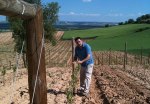
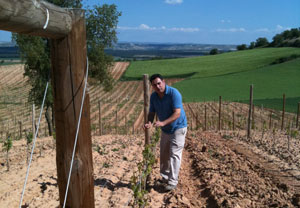
As we cycled back from Roa del Duero through Mambrilla wondering how we were going to find our last appointment of the day, we noticed some guy in a tractor in a field shouting and waving at us. It turned out to be Juan Carlos, owner, oenologist, winemaker, PR department, labourer and everything else at Bodegas Vizcarra. An inspiring and passionate man who has since our meeting pipped Cantona as Adam’s all-time hero.

JuanCarlos-Vizzcarra

Having visited four fascinating wineries and learnt all about winemaking in Ribera, and after a rather large lunch in Roa we thought we knew what to expect. But from the moment Juan Carlos stepped off his tractor to when we left three hours later it was clear that Bodegas Vizzcarra was something very special.

We visited the vineyards themselves and heard about the low yielding old bush vines and the younger row planted vines, also the different soils and positions in the valley. In the new winery, JC explained his use of larger new oak barrels to encourage a more gentle expression in the wines. We tasted 2009 from the barrel and were privileged to visit JC’s family cellar in the town and taste a mature bottle of one of his premier wines.

Senda del Oro 2009 from barrel
Fruity nose then packed with fruit, chewy yet fresh, tasty and balanced, nicely under oaked. **+

Vizcarra 2009
From 20-30 year old vines, a crianza. Roasted coffee beans on the nose also fruit. Lovely sweet blackberry and coffee beans, soft tannin, long viscous and tasty.  **++

Torralvo 2009
From 55 year old vines. This is the wine where JC is aiming for the perfect Ribera Reserve, made in bigger barrels to temper the effect of the oak. Full fruity, concentrated with a mineral undercurrent, powerful, viscous with a long lingering fruit aftertaste.  ***+

Celia 2009
Some Garnacha in the blend here again in big barrels with attractive pink metal bands (Celia’s favourite colour?) This wine is more feminine and refined in every respect, even delicate following the Torralvo. Compact and a little closed but beautifully balanced dense complex core and soft lingering tannin at the end. This has amazing potential. ****+

Innes 2009
This blend has a10% merlot in it and again a long maturation in large barrels. Wonderfully cool and fine textured, sweet and compact, with plenty of tanning, a great mouth feel.  ***++

Celia 2003
Delicate nose, sweet with hints of the savoury/sweet plum sauce one gets with crispy duck, complex and powerful in the mouth, soft tanning, very long and persistent on the palette.  Evolves in the glass, passing through waves of sweet fruit flavours and savoury soy notes.  One of the best of the trip, absolutely delicious!  ****

Torralvo 2006
Bit closed to begin with but opens up with fruit, limestone and persistent nose, then in the mouth, wow! Big, intense, powerful seemingly endless, good balance, and so very, very tasty.  ****

By the time we got to these last two we all gave up spitting – the wines were just too good. When we finally got back on our bikes, and JC got back into his tractor, there was not a drop left.