Full disclosure, I have a very soft spot for Austrian wine. It is undoubtably through my partner, who is Austrian, that I have grown to love the many and varied delights that the country and its people have to offer. It’s fair to say that family Curtis pulls its weight when it comes to consumption of Schnitzels, quaffing of Greuner Veltliner and bashing of mogul pistes. Oh, and it goes without question that Semmel are the best bread rolls ever and nobody makes better ryebread.
Anyway, we’ve written at length about Austria’s fabulous white wines: Greuners and Rieslings from the Wachau, Kamptal and increasingly from Traisental along with the characterful Sauvignon Blancs from SudSteirmark, but not enough about the country’s excellent red wines. My suspicion is that a lot of Austrian red wine just doesn’t make it out of the country because demand at home is so healthy. So, I was delighted be invited to a lunch spotlighting Zweigelt and the grape’s many faces organised Neusiedlersee DAC.
Zweigelt is the most planted red grape variety in Austria, second only to Gruener Veltliner in terms of vineyard area. It is a cross between Austria’s other two main red grapes, Blaufraenkisch and St. Laurent, the former, late ripening with high acidity and firm tannins and the later early ripening with delicate fruit and moderate tannins. The result, it is argued, is a wine that displays the best of both and is fruit forward, with gentle acidity and soft tannin. It can be made in a forward fruity style at a great price point or through selection and sometimes aging in barrique as a more structured reserve wine capable of many years bottle age.
Neusiedlersee DAC (designated area of origin) is located to the east of the Neusiedlersee a large lake on the boarder between Austria and Hungary. The designation is only for the production of Zweigelt and sweet wines although most of the winemakers in the area also produce a variety of other wines too.
Some nice Burgenlaendlisch drinking slang!
To demonstrate this the aperitif served before lunch was a Welschriesling Voll Freude 2021 by Georg Preisinger. Fresh with citrus and apple served gespritzt. The perfect refresher: half wine and half sparkling mineral water.
Next a young 2021 Zweiglet by Preiner Wein, served with an autumnal mushroom risotto.
Very fruit forward with accessible berries and a whiff of spice on the nose. A nice midweight body, soft tannins and good freshness. Well balanced and a collaborative partner to the delicate risotto flavours. Tasty!
The main course of grilled sweetbread was served with single vineyard Zweigelt by Gebrueder Nittnaus, Zweigelt Golser Ried Luckenwald 2004.
The wine demonstrated how well the variety can develop in the bottle in the right hands.
On the nose cut strawberries, damp forest floor, a touch of vanilla from the Barriques. It retained a lovely juiciness on the palate with complex tertiary notes of mulch and mushroom. Great length. Excellent and it held its own against the richness of the sweetbread.
Finally with a desert of baked apple and vanilla cream a TBA Welschriesling Siddartha 2018 by Johannes Muenzenrieder. Wow a delicious nose of peach, roasted nut and honey, more of the same in the mouth, lovely balance and length. Sweet wines from near the Neusiedlersee benefit from the morning mist and afternoon sun and somehow retain great freshness.
The line up of Zweigelts on the free pour table displayed a spectrum of wines most of which were juicy and tasty from the off with some cellared samples that had developed lovely complexity. There were nice examples by Artisan Wines, Weingut Kummer, Keringer, Preiner Wein, Hannes Reeh, Salzl Seewinkelhof and Allacher.
Hopefully we’ll start seeing some of these lovely Zweigelts appearing in shelves in the UK soon!
Founded in 1776, Boekenhoutskloof can be found way down the scenic Franschhoek valley. The farm’s name means “ravine of the Boekenhout” (pronounced Book-n-Howed). Boekenhout is an indigenous Cape Beech tree greatly prized for furniture making. Hence the 7 wooden chairs that the wine labels feature.
As with many wineries there was a change of ownership and reboot in the early 1990s and new vineyards were planted including Syrah, Cabernet Sauvignon, Cabernet Franc, Grenache, Semillon and Viognier.
The winery also produces a number of brands: Porcupine Ridge, The Chocolate Blick, The Wolftrap. Producing 7 million bottles a year it is one of the biggest wineries.
One needs to book about 6 months in advance to visit and taste at the estate but it quite a special experience hosted by Godfried Mocke the wine maker in Franschhoek.
Godfried explained that they now have vineyards in Swartland home of the famous Porseleinsberg Syrah, for Rhone varietals. The grow Cabernet Sauvignon in Franschhoek and Stellenbosch and Semillion in Franschhoek. They’ve set up a fairly new venture to grow and make Burguindian varieties in Hemel en Aarde called Cap Maritime.
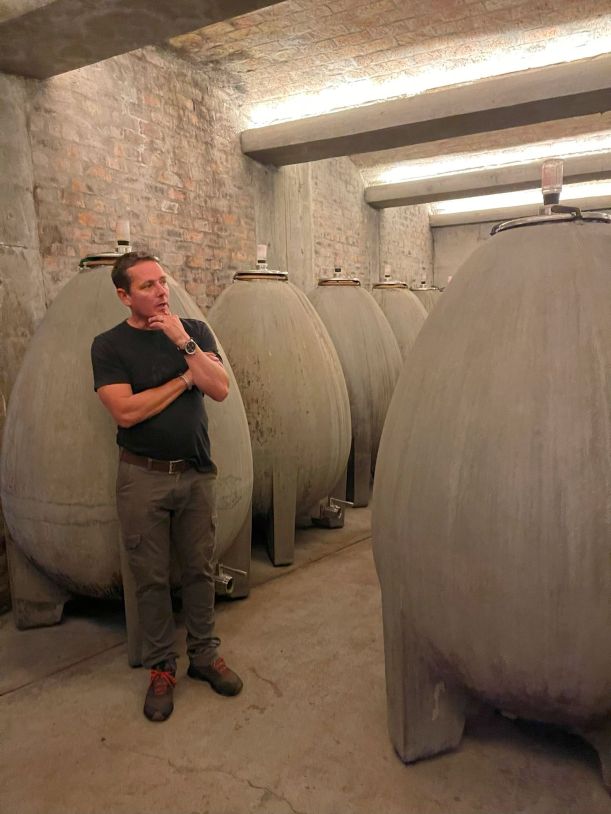
A tour through the winery revealed further details of their approach to wine making. They generally let wild yeast take care of fermentation. For red wine the concrete vessels used have rough surface that encourages a flora of yeast and so the cellar itself imparts a particular character in the same way that a cheesemakers cellar does. A part of the terrior.
Concrete eggs are used to ferment the whites, the egg shape makes vortex which moves wine around, stirring the lees and it is also gently oxidative too.
However they often ferment some in barrique and blend to achieve the final wines.
Boekenhautskloof are also using amphora made of clay fired at high temperature so this format doesn’t breath they use it for muscat.
Reds are matured in barrels. Large Foudre for Syrah to slow oxidation. Barrique for the Cabernets.
Interestingly Boekenhautskloof do not acidify their wines which is actually widely practiced to achieve balance in the wines of South Africa.
Tasting notes:
Cap Maritime 2020, Chardonnay Hemel en Aarde
Creamy, toasty, smoky with citrus zest. Great balance, full but firm body, nice structure, long.
Semillon 2019
Made from old vines the youngest planted in 1942 which are more resilient to the droughts recently experienced. Bit of polish, wax, bit of smoke, pleasant petrol aroma. Nice elastic mouth feel, baked lemon, slightly salty tang, some smoke. Capable of bottle aging and developing great complexity. Think Hunter Valley.
Cap Maritime Pinot Noir 2020
Difficult year not much energy to ripen so needed whole bunch to give a lift. Cherry, green herbs. Sweet red fruit, good lift medium body.
The Chocolate Block 2021 (1 M bottles!)
Made from 5 varieties the lend percentages always shift and change. Blind tasted to pick best but will always reflect the vintage characteristics.
Mix if red crunchy berries, dark black current then brambles, a touch of vanilla. Good balance, structured, high acid, medium body, clayey tannins present. Fruity with a tough of menthol. Med length.
Syrah 2019
Grown on blue schist in Swartland. Nose of crushed raspberries, blueberries, light spice. Fruit forward creamy texture, clove ripe fruit finish. Long.
Cabernet Sauvignon 2017
Stellenbosch fruit. Dark fruit, iodine and black current. Ripe fruit, lots of nice powdery tannin. High acid, dry savoury finish.
These are amazing age worthy, high quality wines representing superb value!
Nestled on the slopes of Simonsberg Mountain, Kanonkop Wine Estate is a proud custodian of South African winemaking heritage. Now in the hands of fourth-generation brothers Paul and Johann Krige, the estate produces around three million bottles annually, with sales evenly split between domestic and international markets. Known exclusively for its red wines, Kanonkop champions two hero grapes: Cabernet Sauvignon and Pinotage. The estate’s flagship wines are meticulously matured in French oak barrels, incorporating a portion of new wood to enhance complexity and elegance.
The Kadette range, meanwhile, showcases fruit sourced from 30 local farmers, with Kanonkop’s own viticulturalist overseeing the growing process to ensure quality and consistency,. The estate traces its name to a nearby hill (or kop) where, in the 17th and 18th centuries, a cannon (kanon) thundered to signal the arrival of ships in Table Bay. This booming call once rallied local farmers to race their wagons to the harbor, laden with fresh produce.
Since bottling its first wine in 1973, Kanonkop has become a benchmark for South African reds, carrying forward the legacy of the visionary Paul Sauer.
Tasting notes:
Kadette Range – A Young soldier ready for action!
Kadette dry Pinotage rose 2022
Short skin contact, blush colour and burst of floral notes.
50% Pinotage plus Cabernet Sauvignon and Cabernet Franc, 14% ABV.
Nice brambly nose with a bit of smoke, an inky note and touch of vanilla.
Lovely juicy fruit, fullish body but good lift and spicy finish, good length.
Pinotage 2020 14%
100% Pinotage 14% ABV. Really sweet red and black berries, touch of vanilla.
More fruit on palate, soft chewy tannins, medium acidity, good length. Slight herbal finish. Very tasty
Cabernet Sauvignon 2020 14%
Classic blackberry and black currant leaf on the nose.
Nice dry fruit, herbal, savoury, nice grainy tannin, medium length. Lovely and great value.
Estate wine Pinotage 2020
Old vineyards with 60 year old bush vines. Pinotage is dry farmed
Matured in 80% new oak. Classy barrel room notes of toast and spice.
Lovely balance, and structure, brambly fruit, coffee notes, lots of length.
Estate Cab Sauvignon 2020
Classic blackcurrant leaf and whiff of smoke.
Blackberry is ripe but not over ripe ,mineral notes, very fine ripe tannin, lingering length. Long savoury finish!
Estate Paul Sauer 2020
70% Cabernet Sauvignon, 15% Merlot and 15% Cab Franc. Matured in 100% new oak for 2 years.
More of everything. Black plum, coco powder and spice.
More talcum powdery ripe and super soft tannins. Lovely rounded fruit breadth. Very long.
In recent years Kanonkop have experienced very consistent vintages harvesting at same time of year but it is always a race against time to harvest everything as it ripens all at once. They have not apparently noticed much effect in terms of global warming.
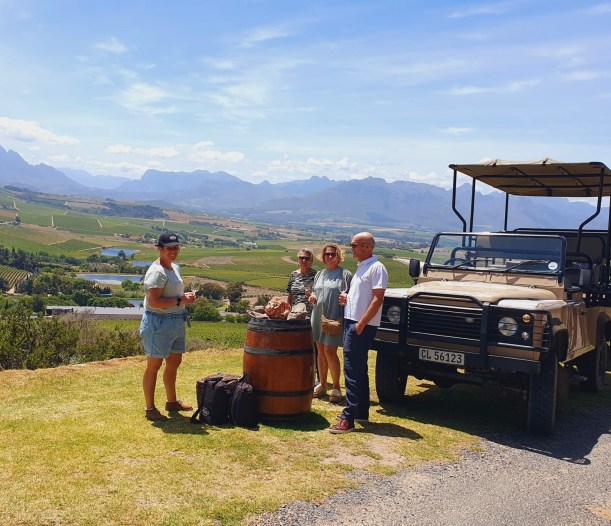
We loved the innovative safari, bumping along the dirt tracks through the vineyards at Jordan Winery in Stellenbosch. We travelled in a safari-style open topped Land Rover up to the top of the hillside to take in amazing views in one direction out to Table Top Mountain and Table Bay and the other towards False Bay. One the way we stopped for what has to be the most scenic venue for a wine tasting ever, looking out across Stellenbosch towards Simonsberg.
Along the way, we encountered the rich flora and fauna of the Cape Winelands, while gaining insight into Jordan’s unique terroir. The estate’s vineyards span altitudes from 160 to 410 meters above sea level, with slopes facing all four compass directions. Benefiting from cool coastal breezes and maritime fog, the vines thrive in soils ranging from ancient Cape Granite clay-loam to gravelly, sandy duplex. The trip finished off in the cellar with a tour and with more wine samples enjoyed in the on the sunlit restaurant terrace overlooking the lake, a great place for lunch. —a true celebration of Jordan’s exceptional terroir.
Try the Blanc de Blanc special cuve 2017 11%
Matured on lees for 54 months. Greenish gold in colour. Lovely chalky citrus notes, fresh cut granary loaf and a touch of ground almonds. Fresh, tight body, grapefruit pith and a long steely finish.
The magnificent vista from the sauvignon plots on the high ground at Veritas
I was very keen to visit Veritas. Andrew Hodson, the owner like myself is also an English Doctor. There is a long historical connection with physicians and wine. Amongst many examples is the founder of Penfolds in Australia by Dr Christopher Penfolds who was a member of the society of Apothecaries in London. For more information about this I strongly recommend reading ‘Wine & Medicine: An Enduring Historical Association‘
Andrew and Patricia bought the land at Veritas 23 years ago and have transformed it into one of the go to destinations in Virginia wine country. Alongside producing supreme quality wines they have onsite luxury accommodation, a lovely restaurant and manage events and weddings. It’s a magnificent property.
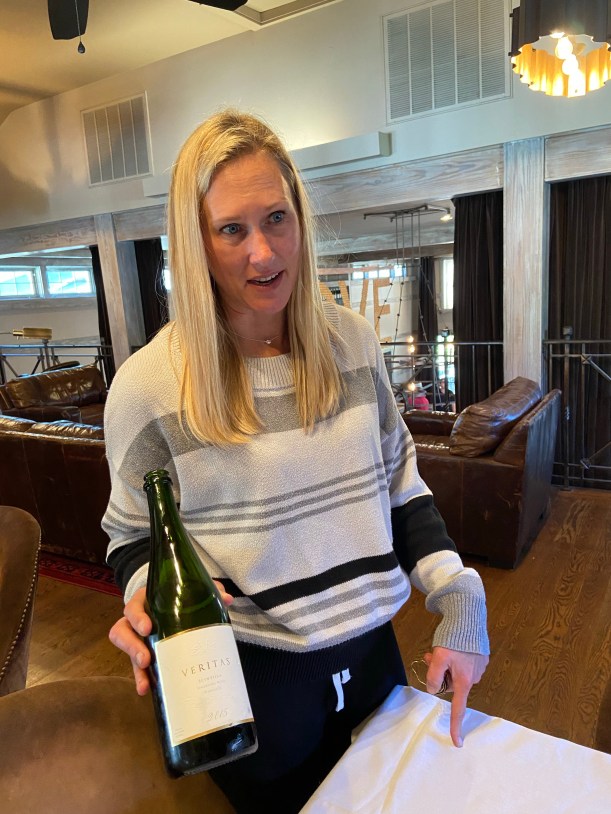
Emily Hodson, Winemaker, Veritas Winery
I was lucky enough to be hosted by Emily Hodson, winemaker and daughter of Andrew. It is very much a family run business. Emily’s brother George the general manager also popped in to say hello. We sat over lunch and tried a series of Veritas wines.
After the tasting, Emily took us to explore the land in her 4WD. This led us to the peak of the property at over 1000 feet and to panoramic views over to the blue mountains of the Appalachian range. The Appalachians stretch thousands of miles parallel to the East coast of the United States.
She showed us the Afton mountain gap. This is one of the few gaps in the mountain range which allows for a flow of wind. This helps decide the orientation of the vines on the hilltop. The air flow provides not only a cooling effect from the heat of the Virginian Summer, but also helps to suppress disease which would be prominent in the humid conditions. The Sauvignon Blanc vines were thriving in this environment.
Wines tasted- whites
Veritas Scintilla 2015 sparkling wine
Traditional Method
100% Chardonnay Blanc de Blanc, dosage 7 g
Aged On lees 7 years. This was the First vintage
Brioche toasted almonds marzipan fresh apple and lemon crisp and refreshing.
Grown at higher altitude and benefits from air flow through the Afton mountain gap
Veritas the momentarius collection 2019
Monticello white blend, no rules on what grapes to use or the vilification process
Petit manseng, chardonnay, viognier and sauvignon blanc.
Aromatic Sauvignon Blanc feels the most predominant. Nice balance.
Veritas the momentarius collection 2021
More restrained than 2021 and the petit manseng characteristics come through
Could not make a 2020 vintage as frost destroyed much of the crop in this part of Virginia
Wines tasted -reds
Veritas Cabernet Franc 2009
Bordeaux nose of cedar, tobacco and some aged character coming through, also effects of barrel hints of smoke and chocolate
Soft tannins nicely integrated, fruit dropped out
Initially slight Smokey and sulphurous but this blew off and complexity developed.
Veritas. Cabernet Franc Reserve 2017
As Benoit at Pollak had found the 2017 was a Great vintage. Emily’s description made me laugh out load!
‘As happy as it can be’
Delicious ripe cherry a fruit Bomb.
Pot pourri, floral, dry petals, and some dried herbs such as thyme really seductive nose, fabulous.
Veritas Cabernet 2021 franc
Plenty of fruit raspberries, nice balance of oak
More simple candied fruit but delicious easy drinking a bit more Pinot like
Veritas 3 2009
3 winemakers 3 vineyards 3 grapes a collaboration with Veritas, Pollak and King Family
A blend of 3 grapes Merlot, Petit Verdot, Cabernet franc
Fruity fresh, lively, balanced with a Savoury salty mineral element. Chocolate pudding on the finish
Veritas Reserve 2019
Their Flagship wine
Can’t use ,vintners reserve, name due to name protection rights. I suggested Emily’s Reserve which went down well.
Violet chews, floral elements came through.
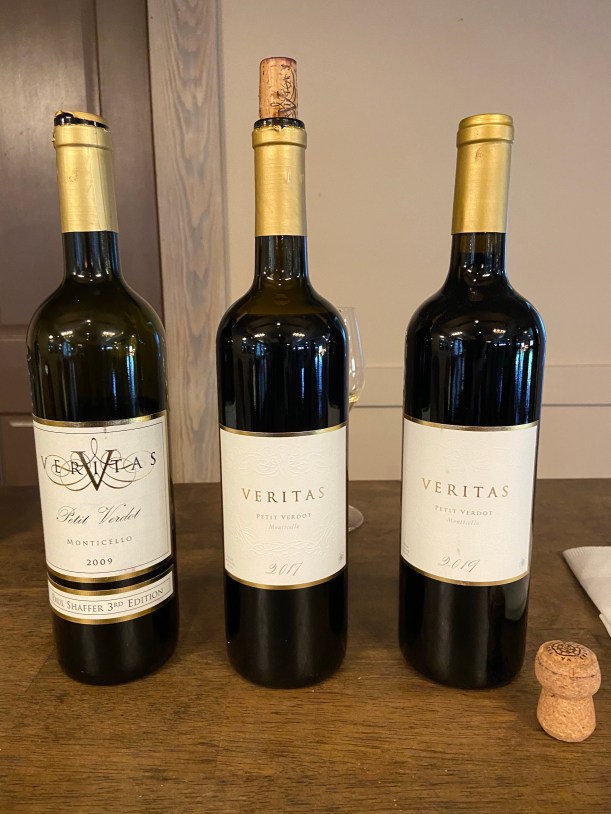
Veritas Petit Verdot 2019
Aromas of blueberry , Intense colour, deep ruby
Chunky dark thick skinned berries
A bit tight closed needs a decant nice rounded tannins, food wine, some violet notes
Lilies floral improved. Tried over the next few days whist in Washington DC and became more complex.
Veritas Petit Verdot 2017
Blueberry jam lots of delicious fruit a great top vintage clearly evident
Veritas Petit Manseng 2014
Dessert wine Great retention of acidity
Nuttiness slight oxidation 85g/l per litre sugar
Lovely complex most of candied pineapple and hazelnuts very ripe apples beeswax
Really well made, Jurancon like dessert wine
This tasting highlighted the potential in Virginia to establish some novel grape varieties such as Petit Manseng.
This grape in many ways is highly suited here. It ripens late leading to high sugar but retains its acidity
The thick skin helps with disease resistance and the high skin to pulp ratio intensifies flavours.
The 100% petit Verdot rarely found in the Old world seems to work here with the warmer climate.
It was interesting to try along with traditional varieties some more unusual wines such as dry Petit Manseng and 100% petit Verdot.
I managed to pick out some of Emily’s personal characteristics in the wines, such as the violet aromas from the Cabernet Franc and the blueberry in the 2009 Petit Verdot which has parcels of grapes grown on heavier clay soils.
It was also lovely to see the collaboration and friendliness between the winemakers exemplified here by the Veritas 3.
Matthieu Finot, Winemaker, King Family Vineyards
French winemaker Matthieu very kindly networked me in with local winemakers which facilitated my arrangements in Virginia.
I really like the way the winemakers join forces in the wine industry. This is something I have found throughout the world and is a joy to see. In so many walks of life people work against each other, more interested in bettering their own aims. Not so in the wine industry. It’s about sharing ideas, sharing innovations and helping the industry as a whole.
Matthieu was a shining example of this. He is from Northern Rhone and has a vineyard with his brother. He has worked in Bandol, Rhone and also Burgundy.
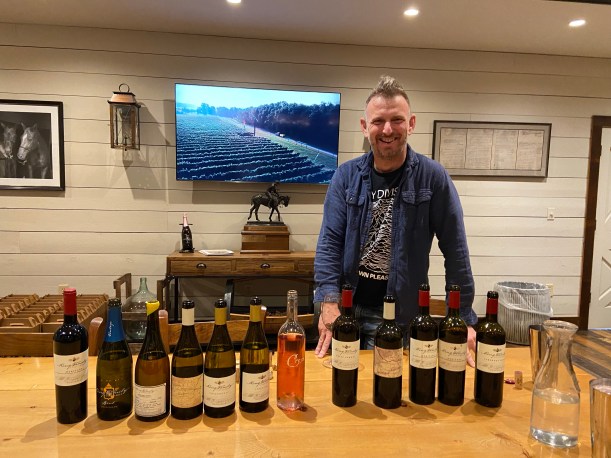
Matthieu proudly showing off his magnificent range of King Family wines
The wine industry is still relatively new here despite the planting of vines dating back hundreds of years by Thomas Jefferson at his Monticello estate. Matt is carrying on with developments and is planting Nebbiolo here. His favourite wines are Pinot and Syrah, but it’s too warm and wet here and the Clay soils don’t lend to those varieties Cabernet franc red does best being more resilient. The Soil is not right for Cabernet Sauvignon You can also do a lot with Cabernet Franc, such as Rose dessert wine, light style red and more full bodied red. It doesn’t have the acidity of the Loire and doesn’t show the methoxypyrazines shown in the old world. Matthieu wanted to produce a dry rose when he first came here. There was Some scepticism doing a dry rose now it’s the biggest seller.
Wines tasted, reds
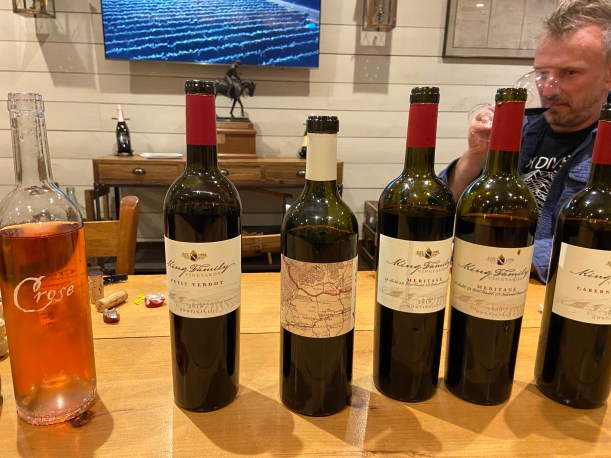
King family Crose
100% merlot medium colour 1 day skin contact
Their biggest seller, Sold in cans too
Nice red fruits and balance
King family Petit manseng
I tried a dry petit manseng at Veritas too
High acidity, some honey and nutty notes and candied pineapple nicely crafted
Kings family vineyard Brut Blanc de Blanc 2015 100%Chardonnay
7 years ageing on Lees
Chalky Lemon apple crisp fresh
Kings family vineyard Viognier 2021
Watermelon apricot bitter finish
Not same oily texture as others. Harvested a little early so a fresher style
Kings family vineyard Chardonnay 2021
Barrel fermented with malolactic 25% new oak light citrus fruits fresh smokiness oak
Kings family vineyard mountain plains 2021
A blend of Chardonnay petit manseng and viognier, third each
Petit manseng does well in the Basque Country humid and clay in Jurançon
Works well here too maintain acidity and high brix. Very high acid good
18 months barrel, pineapple nuts some oxidation
Kings family vineyard ViognierOrange wine
Skin contact Viognier orange wine
Fermented like a red wine with punch down and malolactic
Very interesting complex nose Spicy nutmeg saffron orange, clove
Tannins but soft, served at room temperature fine but bitter tannins
Big wine interesting
Kings family vineyard Cab franc
Light style
Harvest early 12.3% wants fresh light style
Tuesday evening pizza night wine simple fresh light fruity
Bit savoury slightly vegetal
Kings family vineyard Meritage 2019
Flagship red which sells the most
18 Months in barrel
Merlot, petit Verdot, cab franc and Malbec blend
Needs time to develop slight bitter
Kings family vineyard Meritage 2008
Matthieu pulled something a bit older out of the cellar, Unfiltered wine
Showing some Bret horsiness with some fruit and good structure
Kings family vineyard Petit verdot 2019
Blue fruit, deep colour lots tannins full bodied
This tasting highlighted how well some varieties are doing here, such as viognier and petit verdot
I like the style of Cabernet Franc less pyrazined and more fruit forward which can be very green and herbaceous in places such as Chile and also Bordeaux but here seems to be a nice balance between new and old world. In the hands of gifted winemakers such as Matthieu it was also interesting to see the range of wines made and the embracing of new styles such as the viognier Orange wine.
The restaurant name means spice that that is exactly what you get but in the most amazingly nuanced and innovative way.
I hate to say it was a ‘journey’, as that word is so overused, but the tasting menu with wine pairing really was quite an experience. The theatrics of table side prep, and wafts of dry ice all helped but the food was just incredibly complex and delicious.
For me the stand out dish was the normally humble bread course. First a large brass plate is sprinkled with spices: caraway, cumin, coriander, turmeric, black pepper and more, then warm wagyu dripping is poured over it. I had to soak up every drop with the bread it was so good. Actually the pairing with this was a wheat beer which worked very well.
Every member of the team was warm and friendly and super attentive. Book ahead to make sure to get a table, you do not want to miss out.
Monticello AVA, view from Pollak Winery with the Blue Mountains of the Appalachian range in the background
Blind Mondays in London was the fabulous concept of Guillaume Raffy. A team of wine lovers would meet on Monday evenings in a pre selected London restaurant and bring along hidden wines, following a theme.
I’ll never forget the Nebbiolo evening.
One wine stood out. More full bodied and fruit forward than Nebbiolos I’d had before, but with that lovely seductive perfume and classic structure.
The wine was revealed – Barboursville vineyards, Virginia, Nebbiolo, part of the Zonin family.
That was about ten years ago and I’ve been planning to visit Virginia since.
To further whet my appetite the book ‘Billionaires Vinegar’ helped set the scene.
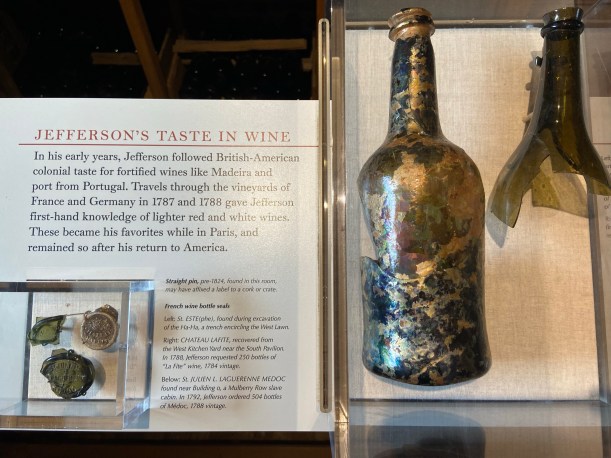
A bottle of Lafite, with the initials of Thomas Jefferson, dated 1787, was offered to Christie’s by Hardy Rodenstock, a German wine collector . He refused to say exactly where it had come from. Allegedly a hidden cellar in an unidentified 18th century house in Paris, possibly part of a Nazi hoard.
Jefferson spent time in France and was an avid wine lover. He regularly sent wine back to Monticello, his home in Virginia. He set up some of the first Vineyards in Virginia in the 1800’s.
Bottle of Chateau Lafite from Jefferson’s house in Monticello
There are now 1200 hectares of planting and 220 wineries. The AVAs are Eastern Shore, Monticello, Northern Neck, North Fork of Roanoke, Rocky Knob, Shenandoah Valley.
I will focus on Monticello AVA and have chosen five wineries to visit based on reviews in Decanter Magazine and from personal contacts in the wine trade.
The supremely talented Benoit with degrees in Oenology and Viticulture from Bordeaux Blaqufort
Winemaker Benoit Pineau took me on a mini safari around the 100 acre property, planted with 34 acres of vines.
It’s a beautiful property with a large decked tasting room overlooking a lake with the blue ridge mountains providing the backdrop.
Benoit discussed the disease pressures here in Virginia. They have high humidity and high rainfall in summer. Up to 900mm to 1000mm annually make it a relatively high rainfall region for viticulture.
Note the mounding at the base of the vines to protect the graft site for the winter
They can’t grow organically as pesticides are required. Furthermore there is a frost risk. In 2020 most of the vine growth was wiped out. Then there’s the small matter of hurricanes, which can wipe out a harvest. Not to mention Deer and Bears necessitating the perimeter fencing . Oh, and netting to prevent the birds stripping the grapes.
It’s a wonder they can make wine here at all!
The soils are mainly clay with silt so Merlot and Cabernet Franc do well here but there’s less Cabernet Sauvignon which ‘doesn’t like it’s feet wet’. They are planting their first Nebbiolo vines which explained the mounds of soil surrounding each vine base to protect the graft sites throughout the winter as in the photo above.
Wines tasted – white wines
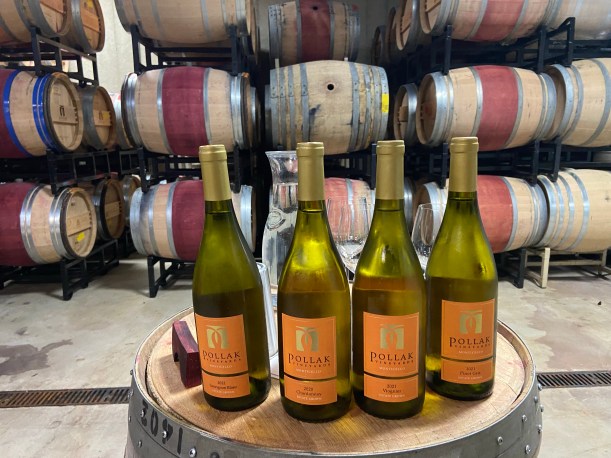
Pollak Sauvignon Blanc 2021
French style Sauvignon, French clones, restrained
Neutral oak Crisp fresh
Served a bit cold and then opened up.
Lovely balance
Pollak Chardonnay 2020
Hints of peach, banana apples pear
Beautiful balance again
Pollak Viognier 2021
Floral and apricots.
Lovely texture, Viognier typically has lower acid
Difficult to press as skins thicker often giving a Rich oily texture
Very smooth with good length. Lovely
Pollak Pinot gris 2021
Delicious, ripe pear on the nose
Mouthfeel Is rich and slightly oily, balanced, alive, Skin thicker, Lees 4 months, Little battonage
Award winning wine. Beautifully crafted
(Vin pair voted in top 50 wines of the world)
Wines tasted – red wines
Red wines. Benoit generously served one of their best vintages 2017 which he described as perfect.
The ‘perfect’ 207 vintage selection
Pollak Cabernet Franc 2017
Fantastic with a nose of blueberries, raspberries
Tons of fruit, No greeness No herbaceousness
Delicious ripe soft tannins. Really enjoyed a Cabernet Franc without all that Capsicum greeness.
Pollak Meeitage 2017
CF 60% merlot 24% petite Verdot 16%
Beautiful balance, 18 months 40% French oak
Bordeaux blend
I didn’t realise they have to Pay a dollar case to use the name Meritage!
Ripe delicious tannins, smooth and well balanced.
Pollak smuggler 2017
Merlot 56% cf 24% CS 20%
Slightly more pyrazine and black currant
Beautiful balanced too
More structure more tannic than Meritage
Pollak Mille fleur
100% petit manseng
Petit Manseng is Popular in Virginia following Horton winery winning a competition in California.
It is however difficult to grow, has high acidity but can lose acid fast in the heat.
This was fortified and stored in barrels for 5 years
Really complex, Brazil nuts, Prunes.Delicious
A wine transfusion? Benoit’s creativity demonstrated here with bag of red wine connected by tubing to maintain full barrels
This was a great start to my exploration of Virginian wines. Benoit is passionate and focused and brings experience from working in France, California Australia and even a spell making rum in Guadaloupe! The wines tasted were top quality. It’s a shame I can’t get them at home in the UK!
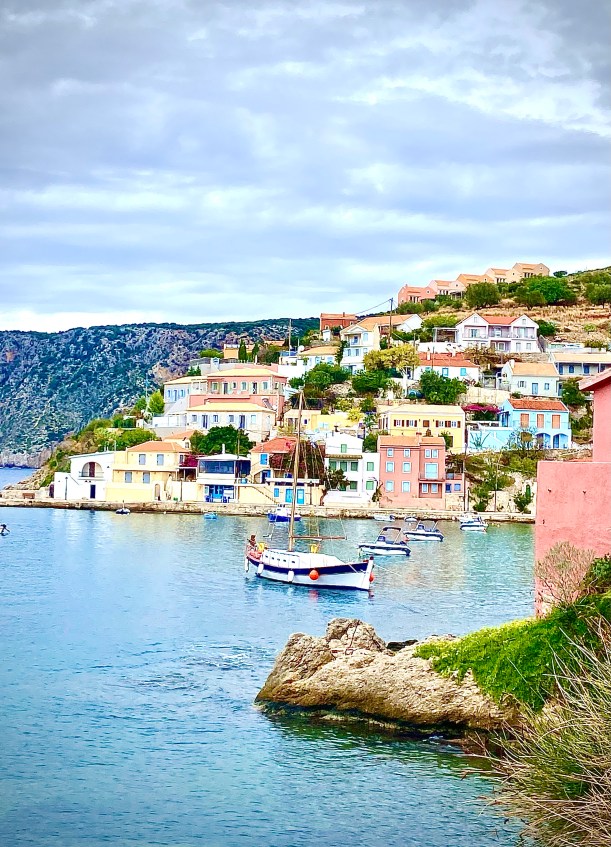
The late afternoon breeze begins to dissipate the heat of the day, the sun gently sinks over the sea, islands in the distance emerge in silhouette as the sky shades pink and purple. Evening time on the Greek islands. Hard to improve on that I hear you murmur?
Well actually there is a way to dial up the experience: make sure you are enjoying a glass of chilled Robola on the island of Cephalonia!
In Captain Corelli’s Mandolin the bottles of Robola that the drunken priest downs while hiding from his flock would bear, I imagine, little relation to the excellent wines the island currently produces. However, the storey does serve to illustrate the very long tradition of wine making on the island which stretches back over centuries of Venetian influence.
Wine is produced on several of the Ionian islands but Cephalonia is known as the home of one of the best Greek white wines Robola. Perhaps not as famous as Santorini’s Assyrtiko but definitely worth searching out particularly if you enjoy fresh, crisp and minerally wines with elegance and structure. The best are grown in poor limestone soils high up on mount Ainos.
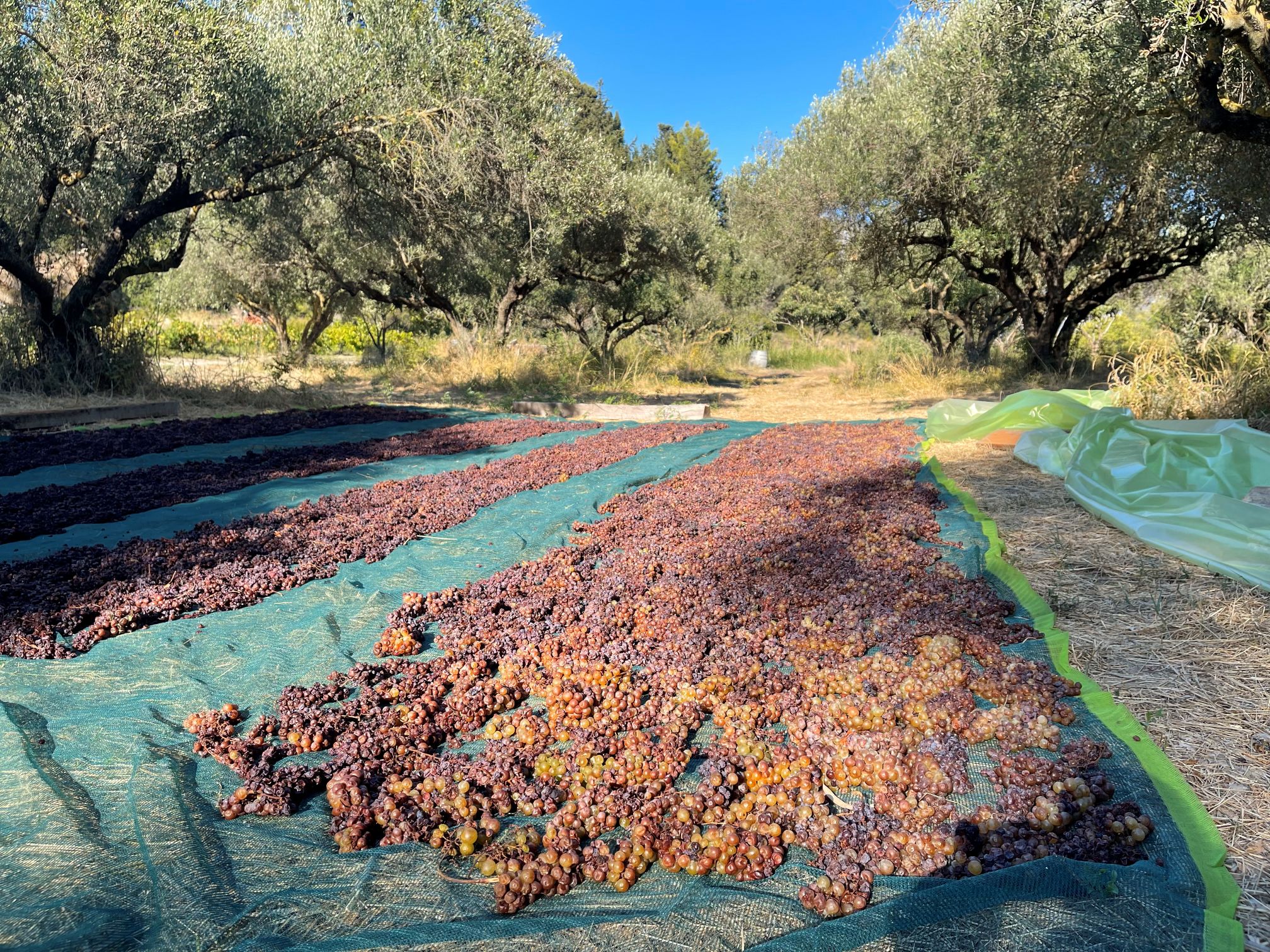
Grapes drying at Sclavos Wines
Robola is not the only show in town though indeed there is a bewildering array of grape varieties grown on the island. The other main grape varieties are Mavrodaphne and Muscat Blanc. Mavrodaphne is a red grape traditionally used to produce a sweet red wine, thanks to the Venetians love of the Passito method of sun drying their grapes, but now also made into a delicious dry reds too.
Local wines are widely available in all the tavernas, many stocking the excellent entry level Robola produced by the Cephalonia Cooperative which arrives in a cloth sack. Also, sometimes some more premium higher altitude and even single vineyard Robolas by the Cooperative and wineries such as Gentilini. Do try the various alarmingly coloured rose wines (think Aperol Spritz) that are made on the island too!
Sadly, I only managed to visit Sclavos Wines and Domaine Foivos whilst on the island and as Adam has recently reviewed Sclavos Winery here I will focus on Domaine Foivos.
Domaine Foivos
Domaine Foivos was formed when Theodore Orkopoulos bought the Matzavino family winery which is one of the oldest wineries in Greece. In fact, Theodore believes that Homer mentions the wines in the Iliad!
The estates vineyards are located in different parts of the island and contain a large range of very old indigenous grape varieties many of which are pre-phylloxera. Since the phylloxera louse killed off most native European vines by attacking their roots nearly all modern vines have been grafted onto American vine roots which are resistant so it is unusual to find old ungrafted vines that have survived.
It became evident during our three hour long tasting that Theodore possesses just the sort of boundless enthusiasm and a relentlessly enquiring mind needed to fully grasp the wine making opportunities that this precious library of vines presents.
Theodore Orkopoulos winemaker at Domaine Foivos
We started with a master class on Robola show casing different wine making techniques applied to grapes from the vineyards on mount Ainos.
Black Label Cephalonian Robola, 2021.
The vines are fully pressed and allowed a bit of skin contact.
The nose is a little floral with a touch of pink grapefruit. On the palate nice fruit, good balance and freshness and a pleasant prickle from the skin contact. A very nice wine that has tension and character.
Blue Label Cephalonian Robola, 2021.
This wine is also made with a full press but without any skin contact.
A refined nose of peach and wet stone. In the mouth a slimmer body and softer acidity with good length. This wine is available in the UK. It would work well as an aperitif to go with the sunset followed by the black label with dinner at the local Taverna.
Barcarola Cephalonian Robola, 2021.
This version of Robola is made with only the first free run juice of a selection of the grapes.
It has quite a different nose, much more perfumed, floral with delicate citrus notes. Theodore describes it as more pure expression of the grape. Again, a lighter body, very nicely balanced with a long lingering finish. This is a more premium wine.
Orange Robola 2021
This wine is made with 5 days skin contact which is relatively restrained by natural wine making standards so it is not very ‘orange’ in appearance. Possibly why I liked it so much! Ripe fruit on the nose, white peach, rounder on the palate with more ripe fruits and a nice prickly sensation. Very tasty.
Amphora Robola, 2021
This wine is made in small clay amphora.
On the nose more herbal notes over the top of peach, wet stony notes and something floral like lilac. Also complex in the mouth with a very nice texture and length.
East – West Robola + Assyrtiko, 2020
This wine is a 50:50 mix of Robola from Domaine Foivos and Assyrtiko from Zanthi.
It has a rich nose of peach and other tropical fruits and on the palate a lovely a mix of peach fruit and salty citric notes from the Assyrtiko.
Asteris Robola Rose, 2020
A bit of mavrodaphne is added to give a splash of juicy fruit to layer on top of the peach and citrus profile of the Robola. This is not one of the alarming coloured roses mentioned in the introduction, looks very respectable.
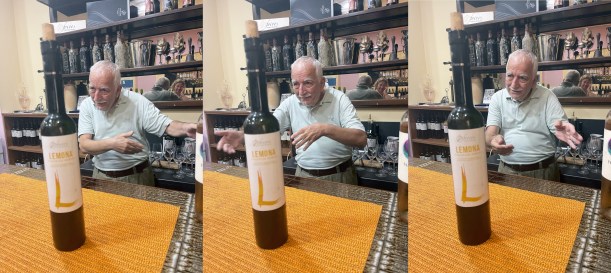
Lemona Sun dried Robola, 2012
Grapes are dried in the sun for up to 20 days. Then pressed to make this amazing sweet wine. Around 10kg of grapes are needed for each half bottle!
On the nose sweet fruit, caramel. In the mouth complex flavours of lemon, nuts and honey. Very long, great balance with real lift and length.
Appropriately named after Lemona goddess of the environment.
Foivos is one of the few wineries offering so many versions of Robola and it’s a result of Theodoros’ continuing search to discover all aspects of the grape.
The masterclass of Robola over, Theodore explained what had prompted him to start to experiment with using amphora. It’s understood that the ancient Greeks heavily watered their wine down and Theodore wanted to find out why. He set about making wine using clay amphora in the way that the ancients did, which included adding wooden staves and found that the results were good. However, Theodore realised that storage of the wine in clay amphorae over weeks and months would cause the wine to oxidise badly. So, the theory is that by the time the important religious festivals came around in the new year the wine from the last harvest would have needed to be heavily diluted to make it drinkable.
Theodore also believes that the ancient Greeks stored wines under water possibly to try and prevent it spoiling through oxidation and this has also led Foivos to carry out some very interesting experiments in aging wine under the sea.
Nautilus White, 2021
Made from blend of Tsaousi, Vostilidi, Muscatel and Muscat grapes this wine is bottle aged for 6 months in the winery aquarium which creates and environment of total darkness, constant temperature and lack of oxygen. On the nose lemon pith, lemon peel, fresh green herbs and a floral note. In the mouth round, medium acidity, more pith and citrus notes with a pleasant slight bitter bite at the end. Very vibrant and long. Available in the UK.
Nautilus Rose, 2021.
Mavrodaphne, Muscatel, Muscat, Tsaousi and Vostilidi grapes. Also bottle aged in the winery tank. Very aromatic, wild flowers and wet stones. On the palate soft red fruits, super dry with a fresh lift and a dry salty finish. Very nice in deed. Exported to British Columbia amoungst other places.
47 and 47 Undersea
47, 2017
The wine is a remarkable blend of 47 varieties: 41 whites and 6 reds to make a rose. This is where the field ‘library’ of indigenous grape varieties comes in.
Mineral, stony notes on the nose with fresh cut soft red fruit. On the palate strawberries, raspberries then baked lemon, very fresh. Complex with waves of flavours, long.
47 Undersea, 2017
As if 47 wasn’t extraordinary enough the same 47 varieties have also been bottle aged for 18 months under sea. The wine is stored in cages at depth of 22 m. As with the Nautilus wines this ensures, darkness, constant temperature and lack of oxygen but in addition higher than atmospheric pressure and a saline environment.
This wine has a different nose to the straight 47, with less obvious fruit, the fruit more integrated with the mineral notes. In the mouth tangy fruit salad flavours, complex with a stony and salty edge. Amazing to see the difference to the non-sea aged version
Red varieties.
Myesis, 2017 (initiation)
Made of 3 grapes mostly Mavrodaphne but with Cephalonian varieties: Theiako and Araklino.
A nice whiff of marzipan oh the nose with a bit of spice. A good medium body with soft rounded fruit and subtle barrel notes.
Daphne Daphne, 2016
This is a dry wine made from 100% Mavrodaphne. On the nose, plums, farmyard, smoke. In the mouth medium body, a bit of lift, dark fruits and savoury notes, medium soft tannins. Very tasty.
Amphora Red, 2021.
Another dry red mostly Mavrodaphne with 15% Vostilidi. The clay amphora gives the wine an overdose if oxygen for about 2 weeks while it ferments. Also, the amphora mean that the fermentation temperature is uncontrolled.
Nice balance, medium acidity, soft but mouth coating tannins. Lovely.
42, 2016
Another remarkable blend this time of 42 red varieties from heritage vineyards. Theodore says the grapes compete in the glass to come out on top, a continuing battle with new winners presenting themselves at each stage of the wine’s development. A rich nose of dark and red fruit and smoke. Medium body, a kaleidoscope of fruits, toasty notes, complex. Delicious!
Methyse, 2004.
Named after a follower of Dionysus the god of winemaking.
This is the traditional sweet wine of Mavrodaphne.
Super dark in colour, nose of chocolate, Kirsch, dried oranges and Christmas spices. Sweet but with enough freshness to lift it, complex and very long. A real treat!
Tasting the Foivos range of wines with Theodore at his cellar was a fascinating experience! It is wonderful that way he takes inspiration from the past, cherishes local heritage and yet continues to explore and experiment with new ways of expressing the wines. Do seek out the wines and try them.
After recent visits to Santorini and Crete, I was keen to continue exploring and increasing my knowledge of Greek wines. I could not miss the famous Robola of Cephalonia, the largest of the Ionian Islands. Other important grape varieties found on the Island are Muscat of Kefalonia, Vostilidi, Zakynthino, Tsaoussi and Moschatella, and the red grape Mavrodaphne.
I chose to visit Sclavos wines on the Paniki peninsula, following recommendations from the excellent ‘Wines of Greece’ recently published by Yannis Karaksis MW.
I am grateful to Yiannis Papadimitrakopoulos from the winemaking team who gave us a fantastic introduction to Cephalonia and Sclavos wines.Yiannis has a degree in Oenology from the University of Athens and a Masters degree in vine, wine and terroir from the university of Burgundy in France. He has gained great experience in wineries across the world.
The history of Sclavos commences generations ago. Sclavos’s great grandfather made wines in Odessa.
Evriviadis Sclavos runs the business and is a professional viticulturist and adopted the system of biodynamic agriculture. In 2014 they had to seek investment following extensive damage to the winery following an earthquake.
Biodynamic farming
The concept of Biodynamics started in the 1920’s with an Austrian philosopher, Rudolph Steiner.
Biodynamic winemaking involves a set of farming practices that views the vineyard as one organism. Everything in the universe is considered connected including the moon and planets and stars.
It is important to follow the calendar and lunar cycles. There are particular fruit days for harvesting grapes, root days for pruning , flower days to leave the vineyard to rest and leaf days for watering. It is a holistic and homeopathic approach to viticulture.
Natural materials, soils, and composts are used in the vineyard. Chemical fertilizers and pesticides are forbidden. Animals such as horses, chickens and sheep roam around helping create a more natural fertile environment. Biodynamic farming seeks sustainability aiming to leave the land in as good or better shape as it was found it for future generations.
Whilst touring the winery we witnessed one of the many natural products used. A crate of dried horsetail. This is made into a form of tea which is diluted many times to create a homeopathic spray to use in the vineyard against disease.
Other more bizarre practices involve burying cow horns filled with manure over the winter preferably from a lactating cow. It is then diluted and sprayed on the soil.
Many of these practices may appear wacky and bizarre. They certainly require a deep passion to follow them.
I have to admit to buying into biodynamism.
Some of the best wines I’ve ever had are biodynamic such as Felton Road, Zind Humbrecht ,Chateau Pontet Canet and Chapoutier.
Views from Sclavos, Kostilidi old vines in foreground Mount Ainos in the distance
Sclavos also practice minimum intervention wine making and produce natural wines with no sulphur added and Orange wines often with long aging on lees which protects wine from oxidation
They have 14 hectares of their own vineyards all over the Island including Robola on Mount Ainos
Some grapes are purchased which may not be biodynamic.
Total production is 160000 bottles
They are fortunate enough to have some 100 year old ungrafted phylloxera resistant vines.
Sales are widespread including France and Europe and USA
We were lucky to catch the Last day of the harvest. A team of workers were bringing in the Roditis grapes when we arrived. Interestingly there were red and green grapes. Ioannis explained that they were from the same vines but Roditis can have both colours on the same vine.
I couldn’t resist pinching a few from the sorting table. The pink were decidedly sweeter.
We were led through the process of wine production. First the crates were emptied onto a vibrating conveyer belt with perforations in it so debris falls through.
Then a multitude of workers meticulously picked out debris and any damaged or diseases grapes. At the latter end of the conveyer belt a couple of people snipped the larger bunches into more manageable sizes. They were then fed onto a steeply sloped shelved ramp and fed into the destemming machine.
It was mesmerising watching the destemmer in action. Whole perfectly formed bunches became individual slightly macerated berries and the stripped stems were neatly piled aside ready for composting or feeding to the local goats.
The berries were then pumped via a large bore tube into the hydraulic pressing machine. This is a cleverly designed bit of apparatus.
Once in the metal cylinder a bag inflates inside gently pressing the berries and free flowing juice is pumped off into tanks.
No yeast is added at Sclavos. fermentation begins with naturally occurring yeast.
This method is more risky but leads to more complex wines and is a more natural process.
We followed Ioannis into the winery
I spotted a 1500 litre vat of red grapes. They were releasing a heady aroma of alcohol. They were nearing the end of their 30 day natural fermentation and maceration and needed a daily Pigeage (pumping down)
I was fortunate enough to be allowed to do the manual punch down. I did this with great enjoyment but perhaps not great effectiveness as I didn’t correctly wet the cap on the final motion of punch down.
My first attempt at Pigeage!
More expertise in the winery is needed until I can ever produce my chosen cuvee.
Wines tasted outside surrounded by the wineries cats and dogs.
Alchimiste 2021
Natural yeast, low sulphite,Good sales in Canada.From the Peloponnese high altitude
Mixture of 4 varieties tsaousi, vostilidi, moscatella, rhoditis(50%)
Citric orange, Bitterness on finish,fresh.
Robolla in a Cephalonia
Robola is indigenous to Kefalonia and is restricted to a specific zone, the Robola zone. Robola of Kefalonia VQPRD. The zone extends from the Omala Valley up to the Paliki peninsula and the surrounding of Mount Ainos Natural Park. Robola nose is often described as citrus blossom , peach and green apple.
Recommended to keep for at least 1 year to develop complexity and mineral notes. Ideal 5-7 years. Mostly grown in a bush traditional system. Bush protects grape from wind and sun via shade.
Robolla vino do Sasso Wine of stone
800 meter altitude high vineyard
Nice floral minerally nose, medium body, fresh acidity citrus and riper stone fruit. Stoney finish. Lovely long.
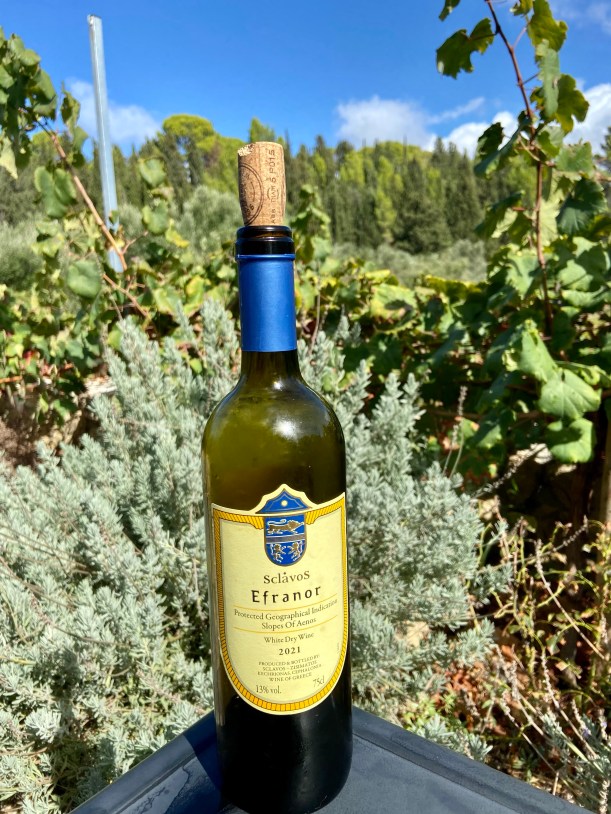
Efranor 2021 Meaning – fills the heart with joy
Muscat of alexandra 70% 30% Vostilidi, 100 year old. Before phyloxera so ungrafted.
Muscat nose, elder flower, grape, nice mouth feel, fresh herbal green twist to the finish.
Alchymiste rose
Mavrodaphne 80%moscatella 20
Medium pink colour, slight orange hue from oxidation but doesn’t affect taste
Characterful rose, some complexity and texture with fruit.
Metagitnion
Biodynamic natural wine, from kostolidi 15 hl per hectare low yield ungraded old vines
Nutty honey complex can age 8 years Urea, clementine very full bodied
Floral develops spice with time good length
Very interesting wine
Muscat orange
Made in same way as a red wine whole grapes destemmed in tank. Natural Orange wine
Concrete eggs nil added unfiltered no sulphites no additives, 30 day maceration
Crushed raspberries, chalk with a smokey slightly gamey nose. Medium all through soft powdery tannins
Monambeles
Organic grapes Mavrodaphne 100%
70 year old vines 250 meters, soil is calcareous (marly limestone – Maltese slate) fermentation with native yeasts, aging in five hundred litre French oak Allier barrels and also in a three ton oak vinifier for at least twelve months.
Black fruits soft long tannins some spice
Quite long concentrated some savouriness
Thiniatiko
From Thinia 2 grapes from grandfather of the new investor. Naturally made with log maceration natural yeast biodynamic
Good black fruits round tannins spice savoury
Needs some time to develop
Vin doux du soliel 2019
Made with passito method dried in vineyard Mavrodaphne grapes
Intense concentrated fruit, good acidity, very long delicious
Sclavos winery takes a minimum intervention approach to wine making and is transitioning to biodynamic practices in the vineyards.
Their goal is to craft natural organic wines that showcase the unique characteristics of local grape varieties, influenced by their microclimate. After harvest, grapes undergo careful hand-sorting to remove any unsuitable fruit. Vinification employs modern techniques, including stainless steel tanks, pneumatic presses with nitrogen environments, and oak fermenters.
Mavrodaphne is traditionally made as a sweet wine on Kefalonia and in order to protect the PDO classification dry versions are actually not allowed to be labelled as Mavrodaphne! Sclavos along with others, has long advocated for the recognition of red dry wines from this variety. The winery is introducing new expressions of Mavrodaphne Kefallinia, continuing its pioneering efforts in dry vinification and aging, a practice initiated 25 years ago.
The Mavrodaphne variety undergoes three weeks of fermentation, followed by over a year of aging in French oak barrels of varying sizes (225L, 500L, and large oak tanks).
The winery has 14 hectares of their own vineyards, but buys some grapes in to produce 160, 000 bottles annually.
The wines:
Alchymiste 2020 Mavrodaphne and Moschatela grapes picked relatively early. This wine is made in stainless steel tanks producing a rose colour wine. On the nose crushed raspberries and chalk dust. A nice fruit mix with a smoky slightly animal note – goaty! also malt loaf. It is fresh and medium bodied with soft powdery tannins.
Orgion 2020 Mavrodaphne aged partly in French oak barrels. There is a floral jasmine note also smoke and again malt loaf. The oak is very subtle and fills it all out the wine making it a bit rounder. Very nice.
Xinodos Biodaynamic 2020 From old vine Mavrodaphne + 17% Vostilidi, co-vinified. Matured for one year in big barrels. The wine is dark and concentrate. It is dry with red and blue fruits and has the tannin and acidity to age well.
Vin Doux Du Soleil 2020 Made from sun dried Moschato grapes. Intense concentrated fruit, good acidity, very long.























 WanderCurtis Wine