WanderCurtis Wine

Wine tastings, corporate events, reviews and recommendations


Leave a comment

Mayacamas

At Roberson Wine’s recent Californian tasting Cathy Cohn of Mayacamas led a tasting of the estates wines.

Mayacamas is one of the oldest continuously producing wine estates in Napa. It was founded in 1889 by John Henry Fisher a Scotsman who of all things was a sword engraver. He made his money through producing pickles and then bought land and established the vineyards at the far end of the Mayacamas mountain.

Unfortunately, when San Francisco burnt to the ground in the earthquake of 1906 all his businesses floundered and he had to sell the winery at auction. A Catholic family bought it and grew wines for the sacristy and for that reason the winery managed to survive prohibition and the vineyards were kept intact.

The wine making style here has always been traditional and this style fell out a favour as Robert Parker rose to pre-eminence in the 1990s. The Schottenstein Family bought the winery in 2013 because they love this style and have continued the wine making philosophy ever since. The winery is that an elevation of 550 m and is still accessed by a dirt track.

The Chardonnays are from Wente clones, everything is dry farmed and in order to retain freshness they keep the barrels cold to prevent malolactic fermentation. The wines are aged in stainless steel and then used oak barrels. There is some Lee’s contact but minimal battonnage.

Mayacamas Chardonnay 2022. Pale lemon colour bright and shiny.. There are thick slow legs. On the nose ripe lemon, grapefruit, yellow ripe apples and pears and peach. A touch of smoke and green nuts. In the mouth it is dry with medium acid but a distinct freshness the fruits are still ripe but mostly citrus and it is full bodied with a plush mouth feel only the merest hint of toast and smoke and it’s very long.

Mayacamas Chardonnay 2001.This Wine is medium golden colour showing his age but it’s still bright. The legs are thick and slow on the glass. There is ripe lemon, peach and then dried apricots and raisins on the nose. It’s dry with medium acid full body high alcohol but well integrated and a silky plush mouth feel. The finish is quite nutty and a touch salty. A lovely fully developed wine.

The red wines are all made in a similar way. Fermentation takes place in enamelled concrete vats and is relatively quick. They are unconcerned about achieving high levels of extraction and more interested in maintaining freshness. Flavour develops through long aging in a variety of used barrels, 3 years for the Cabernets and 2 for the Merlot. Then the Cab’s get another year in bottle before release.

Mayacamas Merlot 2021. Deep ruby colour nearly all the way to the rim, bright. There are thick slow slightly stained legs. On the nose red fruit, plums both red and black, cherries again red or black and a nice prickly capsicum note. There’s a touch of spice and a touch of stewed plump, cloves and all spice. In the mouth very fruit forward. Fresh ripe red and black plums again. Medium minus acid medium soft tannins on the gums and cheeks and there is a slight tingle of alcohol on the nose. Oak is there but very subtle. A long tasty finish.

Mayacamas Cabernet Sauvignon 2019. Deep ruby with slight brick at the rim and reflective. There are medium legs. On the nose violet, blackcurrant .blackberries, bay leaf (which apparently grows on the mountain) leather and toast. This would be difficult to place in California blind as there is such a savoury component. On the palate, dry with full body, ripe tannins ends fresh and long. Wow, this is an amazing wine. The wine is 100% Cabernet Sauvignon and has a classic slightly grainy tannin structure felt around the gums with the ‘direction’ that Nick Jackson talks about. The only clue here might be that there’s a slight hole in the mid pallet leading to 100% Cabernet Sauvignon which would be unusual in Bordeaux.

Mayacamas Cabernet Sauvignon 2014. Deep garnet.  The nose is perfumed with violets, black fruit sweet black currant, bay leaf, earth, leather and toast. This is super complex and absolutely enchanting. In the mouth the wine has great balance, it’s dry with full body, ripe fine grained tannin.  The fruit coats the mouth. This wine has a touch of Merlot in the blend but still very firmly structured. It’s super long in the finish. An amazing wine that is really singing. Cathy says that the 2019 vintage was very similar to 2104 so worth finding some and tucking it away.

Mayacamas Cabernet Sauvignon 2003. This is deep and fully garnet but still bright. More spice and tertiary notes on the nose there is still blackcurrant and blackberry some capsicum a little cedar and some mint. In the mouth it is full bodied the tannins are ripe soft and very fine grained. There is a touch of cooked fruit on the mouth and then there is a long fruit driven finish.

Mayacamas Cabernet Sauvignon 1998.  A treat brought over from Cathy’s wine fridge in New York. Deep garnet in colour, lightning to the rim but still bright. Medium thick slow legs. There is black fruit, mint and capsicum.  Then earth, mushroom, cedar and leather. A  very complex and fully developed wine. On the pallet really well balanced and very refined and elegant and very, very long.

Tasting the wines gives one an insight into what ‘traditional’ wine making means at Mayacamas: the wines are elegant, structured and clearly unfurl beautifully with age.

Leave a comment

Österreichischen Traditionsweingüter (ÖTW)

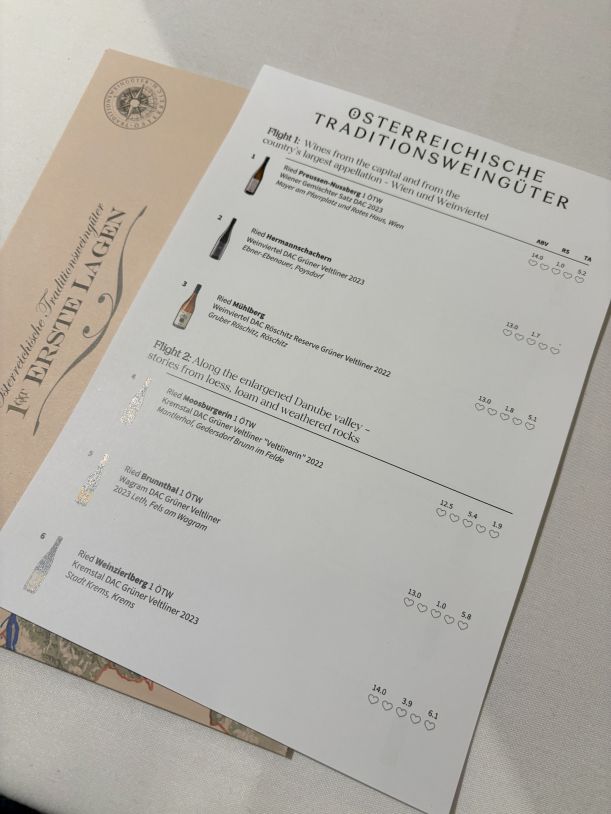
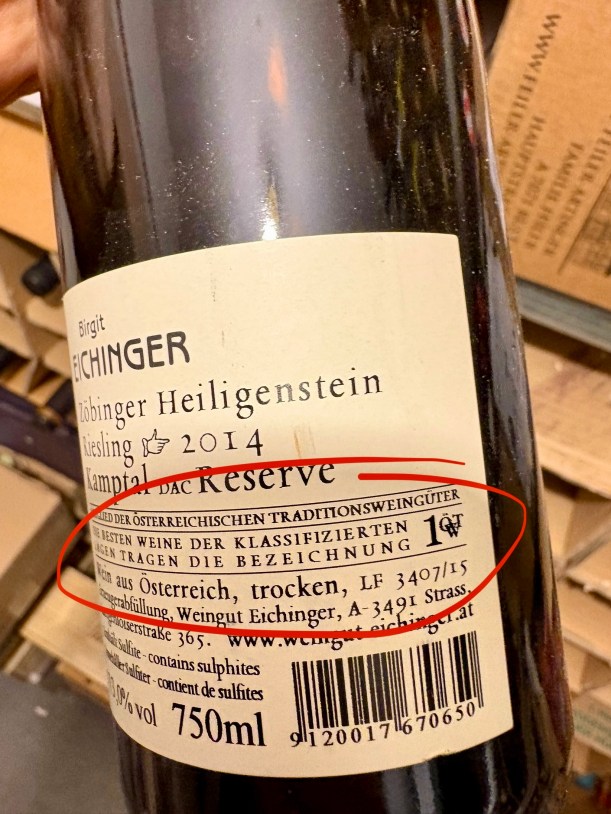
Have you ever wondered what the term ‘Erste Lage’ or 1 ÖTW on a bottle of wine from Austria means? I attended a seminar at the bi-annual Trade Austrian Wine tasting last week that explained the story behind the ÖTW and forthcoming changes coming into place.

First a quick overview of the current legal framework that applies to Austrian wine. Like other European wine producing countries a tiered classification system exists with specific labelling:

  • ‘Österreichischer Wein’ means that the wine is made from grapes grown anywhere in the country. The wine can be from a single grape variety but not certain protected varieties such as Blaufränkisch. There are also some not very challenging minimum and maximum limits on must weight and yield.
  • ‘Landwein’ means the wine is made from grapes from an area with Protected Geographical Indication (PGI). There are three: Weinland, Steirerland and Bergland. Each area has an approved list of grape varieties but the list is long and the areas are large.
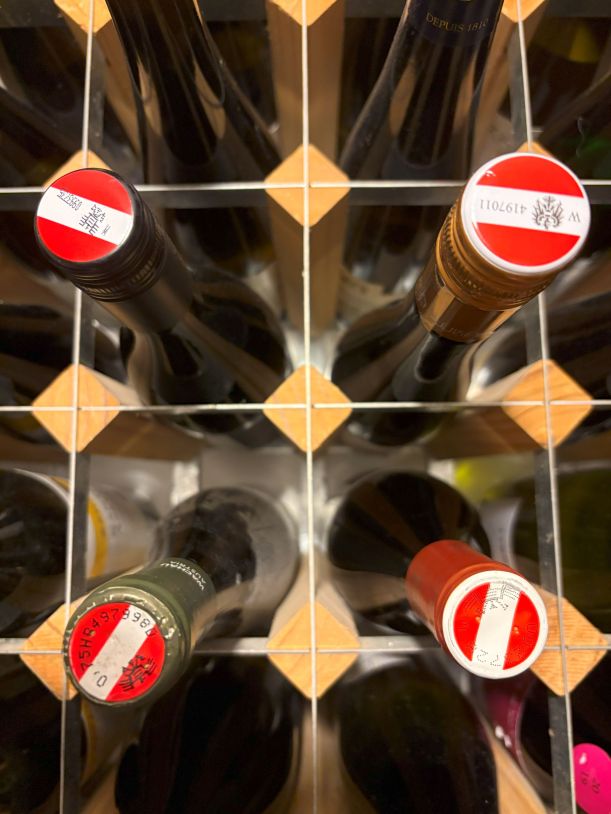
  • ‘Qualitätswein’ is indicated by the red top with a white stripe through it. These wines are from grapes coming from an area with protected status (PDO). The wines are tasted and tested to ensure they display typical characteristics of the region and meet more stringent minimum standards including must weight and maximum yields.

‘Qualitätswein’ can be labelled ‘Kabinett’ if it is not enhanced within the winery in any way and is less than 13% ABV. If labelled ‘Reserve’ the wine will be 13% ABV or over.

‘Qualitätswein’ may also be labelled Districtus Austriae Controllatus (DAC).  This means that it comes from one of 18 regionally typical controlled areas for example Weinviertel, Wachau or Leithaberg. Each DAC has quite a limited list of permitted grape varieties and the wines are tasted by a panel to approve typicity. Anything falling outside the scope or from a non-permitted variety can only be labelled Landwein.

Now within the DAC geographical area there are further spatial refinements: Gebietswein means it just corresponds the DAC area, Ortswein is from a particular village area and Riedenwein is from a single vineyard.

This is where the ÖTW comes in.

Founded in 1991 the ÖTW (oo – tay – vay) is a trade Association. It was set up to create a vineyard classification system designed to help consumers get an even better understanding of what to expect from the wine inside the bottle.  Anything that can help in this respect is of course a good thing. 

Started by a group of wineries in Kamptal and Kremstal the ÖTW splits the Riedenwein category down into three ascending subcategories: Ried Lage , Erste Lage and Grosse Lage. So far vineyards have only been classified as Erste Lage / 1 ÖTW but in time the intention is to elevate some of these to Grosse Lage.

The model is evidently similar to the classification of vineyards in Burgundy where distinct from village and lieu dit wines there are classified premier and grand cru vineyards. However as with the Bordeaux classification Chateaux in 1855 the vineyards in Burgundy were categorised back in the 19th Century according to the market value achieved of the wines, as a measure of quality and status.

So interestingly the ÖTW claims that vineyards in their system are not classified on the subjective bases of quality and price. Instead the ‘significance’ of the plot is measured using multiple parameters. These include: historical and cultural, physical characteristics, the number of wineries producing from the vineyard also average price and variance over time.  The wines produced are also evaluated via blind tastings by growers and international experts and the consistency of their performance over time.

Anecdotally we tasted three wines from Ried Heiligenstein 1 ÖTW which were all Riesling but from three different producers: Birgit Eichinger 2022, Allram 2019 and Bründlmayer 2015. The wines were all of the highest quality with thrilling concentration and persistence. They were layered and complex and showed how age worthy they can be.

This was obviously too small a sample to be able to divine clear vineyard characteristics but the tasting certainly backed up my experience that 1 ÖTW on the label means that the winery has set out with serious intent to make a high quality wine that speaks of its origin.

The ÖTW system has expanded and is now used by members in Kamptal, Kremstal, Traisental, Wagram, Vienna, Carnuntum, Thermenregion and the Weinviertel.

A notable exception to this list is the Wachau and its not clear why the producers there don’t feel the need to participate.  Speculating, the region is perhaps more domestically and internationally well-known and they have their own quality hierarchy: Stienfeder, Federspiel and Smaragd so demand and recognition is probably already strong enough. Also many single vineyard wines are produced and I wonder if the number of monopole vineyards are sufficient to make vineyard classification less important than producer name? Research for another day.

The ÖTW is however on the up and has in principle be approved for adoption by the ministry of agriculture into law.  As with any change in wine law there are those that are not convinced and currently an appealed against adoption is being determined in the courts. Watch this space.


Leave a comment

Vin Jaune: A labour of love from Jura

At a recent Alliance Wine/H2Vin tasting I was delighted to find the wines of Jura represented by Domaine Berthet-Bondet.  Jura, tucked between Burgundy and the Swiss border, is home to one of France’s most fascinating wines: Vin Jaune. Produced exclusively from the Savagnin grape, this golden-hued wine is the result of an extraordinary winemaking process and a true reflection of the region’s terroir.

Jura’s climate isn’t for the faint of heart. Winemakers here battle heavy rainfall and the constant threat of spring frosts, making each vintage a labour of love. The region’s distinctive local varieties—Savagnin, Poulsard, and Trousseau—thrive in the marl and limestone soils, giving rise to wines with remarkable complexity. But it’s Savagnin that truly shines in Vin Jaune production.

An ancient variety, Savagnin is a genetic powerhouse. It’s the parent of some of the world’s most renowned grapes, including Pinot Noir, Chenin Blanc, Grüner Veltliner, Sauvignon Blanc, Silvaner, Trousseau, and Petit Manseng. Despite its heritage, Savagnin remains a relative rarity, thriving in Jura’s cool climate where it retains its bright acidity and rich aromatics.

What makes Vin Jaune so distinctive is its biological aging. After fermentation, the wine is transferred to old oak barrels and left untouched for a minimum of six years. During this time, a delicate layer of yeast known as voile (meaning “veil”) forms on the surface. This yeast blanket protects the wine from oxidation while contributing complex nutty, spicy, and saline flavours. The result is a wine with striking aromas of walnuts, almonds, curry spice, and dried fruit, all balanced by piercing freshness.

Due to the extended aging process, evaporation takes its toll, all that is left from one litre of wine is 62 cl which is why Vin Jaune is bottled in the distinctive clavelin, a squat 62 cl bottle.  This is also the reason why it is relatively expensive. Although quite often wine makers will bottle wines matured sous voile earlier which offer much of the character and are a little more accessible.

On the table, Vin Jaune is a great match with the local Comté cheese and works well with rich spicy food. And while it’s fascinating young, Vin Jaune is built to age, developing even more complexity over decades.

The Domaine Berthet-Bondet, Chateau Chalon 2016 was floral, chamomile, with bruised apples, bread dough notes, orange peel and nutty notes. Really complex. There is something in common with a Fino sherry but Vin Jaune is quite distinctive with more fruit at its core and of course the wines are lighter. It was dry with quite high acidity and full body, finishing with a very long nutty saline note. Amazing.


Leave a comment

Choosing the next NYN Wine Co Vinho Verde Blend

Alex and Manuel cofounders of The Not Yet Named Wine Co hosted an event recently which asl always put subscriber participation at the heart of their next bonus Vinho Verde wine release.

The very first wine that NYNW made was an Alvarinho from Vinho Verde made at Quinta de Soalheiro. Now they are making a bonus Vinho Verde with VineVinu which is Manuel’s family winery.

A bit of background on the region before revealing how the evening went.

Situated in the northwest of Portugal, the Vinho Verde region is renowned for its fresh, aromatic wines. Its location between the Atlantic Ocean to the west and mountain ranges to the east creates a moderate maritime climate, ideal for grape growing. The Atlantic’s cooling influence brings humidity and gentle breezes, while the mountains provide shelter from harsher inland weather. The region is further shaped by its river valleys, including the Minho, Lima, and Dour, which connect the coast to the interior, creating diverse microclimates and promoting balanced grape ripening.

Vinho Verde is best known for its white wine blends, crafted from native grape varieties that thrive in the region’s cool, damp conditions. The main grapes include:

  • Loureiro – Floral and fragrant, with aromas of citrus blossom and green apple.
  • Alvarinho ( same as Alborino grown in Rias Biaxas just to the north) – Known for its structure and elegance, offering notes of peach, citrus, and minerality.
  • Pederna (also called Arinto) – Crisp and zesty, contributing bright acidity and citrus flavors.
  • Avesso – Richer and fuller-bodied, with stone fruit notes and a creamy texture.
  • Trajadura – Delicate and fresh, adding subtle orchard fruit flavors and softness to blends.
  • Maria Gomes (known as Fernão Pires elsewhere) – Aromatic and fruity, with notes of citrus, tropical fruit, and subtle spice.

While most Vinho Verde wines are blends, the Monção and Melgaço sub-region produces 100% Alvarinho wines.

On the evening we were presented with three blends. Each was based on Alvarinho and Loureiro with varying additions of Arinto and Maria Gomes.

We were not told what the blends were but served the wines blind to taste.  Everyone then voted for their favourite and runner up blend.

The winning blend was then announced based strictly on receiving the most votes and will go on sale in the summer!

A fun and interesting experience and I would definitely recommend subscribing to NYNW as its both fun and educational. 

Was it the best wine? Well lets just say it was obviously the crowd pleaser!


Leave a comment

Not Yet Named Wine Co:  ‘I helped make that wine’

Last year I signed up to the Not Yet Named Wine Co. at the suggestion of one of our regular wine dinner guests (thanks Carrie)

The attraction was that Alex Brogan who runs the venture offers an ingenious way of involving wine lovers of all levels to become part of the winemaking process. Founded by Alex and Manuel two Plumpton College Viticulture and Oenology students seeking a way to fund their own wines, the project has evolved into a vibrant community of wine enthusiasts, united by a shared passion for creating something truly unique.

At its core, the concept is beautifully simple: members pay a monthly subscription to participate in crafting two wines per year, one from the northern hemisphere and one from the southern. In return, they receive six bottles twice annually. What makes it special, however, is the democratic decision-making process. At every key stage, whether selecting fermentation methods, maturation vessel or blending styles, members vote on how the wine should be made, guided by detailed, jargon-free educational emails outlining the pros and cons of each option. Normally these emails come with an added dash of humour or at the very least a pun or two.

For those seeking deeper engagement a WhatsApp group offers a space to debate decisions with fellow members. The company also organizes annual vineyard visits (northern hemisphere), where subscribers can taste their wine in barrel and participate in blending or acidity trials transforming the experience from theoretical to hands-on.

The current vintage is being produced in Slovenia and Alex and Ales Rodica from the winery hosting the vintage, brought over some barrel samples of the Malvazija that we’re making for us to taste. And that’s the great thing about this, you do feel as if you are a part of the wine making team even if Alex is doing all the work.


Leave a comment

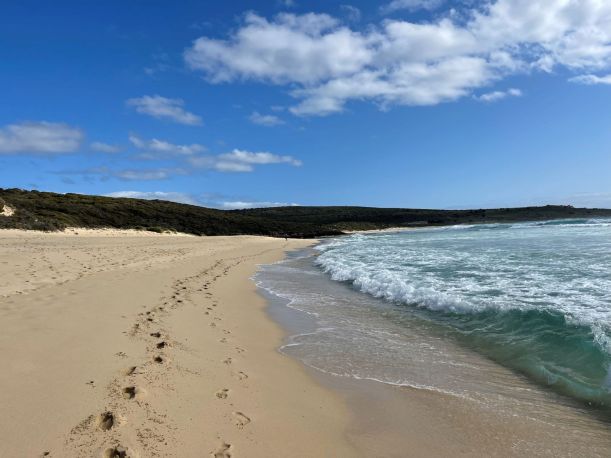
Margaret River – well worth a visit.

Margaret River only produces 3% of Australia’s wine but produces a large proportion of its premium offerings.

Though a young wine region, Margaret River is recognised globally for its premium wines, particularly its elegant Cabernet Sauvignon, refined Chardonnay, and crisp white Bordeaux-style blends. Located in Western Australia, this remote yet picturesque region benefits from a unique climate and ancient soils, creating exceptional conditions for grape growing.

Margaret River’s wine story began in 1967, when Dr. Tom Cullity planted the first commercial vineyard at Vasse Felix, inspired by Harold Olmo, a University of California viticulture professor who identified the region’s potential for fine wine production. Soon after another medic Dr. Kevin Cullen and his wife founded Cullen Wines, further establishing the region’s credibility. By the 1970s, the area attracted the attention of Robert Mondavi, the legendary Napa Valley winemaker. His technical expertise and influence were pivotal in guiding Leeuwin Estate towards planting Chardonnay, which was still rare in Australia at the time. Under his mentorship, Leeuwin’s Art Series Chardonnay became one of the nation’s most celebrated wines, proving Margaret River’s potential on the world stage.

Situated at 34 degrees latitude, Margaret River’s climate should be warm to hot. However, it enjoys a cooler maritime influence due to the Cape Current, which hugs the Indian Ocean coastline surrounding the peninsula. This cooling current moderates the summer temperatures, preventing the vines from overheating and allowing for a long, gentle ripening season essential for producing wines with complexity and balance.

The region’s rainfall pattern is also significant. With high winter rainfall and dry, warm summers, Margaret River experiences a low disease pressure growing season, reducing the need for chemical intervention. The region’s red gravelly loam soils, formed over ancient granite and gneiss bedrock, are low in nutrients, naturally restricting vine vigour and promoting concentrated, high-quality fruit.

The absence of phylloxera allows Margaret River’s vineyards to have been propagated from selected heritage cuttings, preserving and enhancing the region’s clones.

Margaret River’s Cabernet Sauvignon thrives in the region’s free-draining, gravelly soils. The extended ripening period ensures full tannin maturity, resulting in wines with dark fruit flavours, fine structure, and great aging potential.

Chardonnay, often made from the region’s signature Gingin clone, performs exceptionally well in the cool maritime climate. This clone produces small, loose bunches with berries of varying sizes, resulting in wines with concentrated citrus, stone fruit, and tropical flavours, complemented by vibrant acidity.

The region’s Sauvignon Blanc and Semillon blends, inspired by white Bordeaux, flourish in the cool conditions, offering zesty citrus, passionfruit, and herbaceous notes with crisp acidity and freshness.

There is also a vibrant wine and gastronomic culture driven by visitors from nearby affluent Perth and international tourists are also drawn by the amazing coastal landscape and ancient gum tree forests.


Leave a comment

Kumeu River: Producing champion chardonnays

The story of Kumeu River (pronounced: Koo-MEE-oo River) Wines is intertwined with the origins of New Zealand’s wine industry itself. From its early pioneering days as Croation immigrants who established a vineyard to its current reputation for producing world-class Chardonnay, the Brajkovich family has been at the forefront, earning international acclaim for their exceptional wines.

In 2015 Stephen Browett of Farr Vintners, organised a series of blind tastings against some of the finest Premier Cru and Village white Burgundies. The events brought together top critics, sommeliers, and wine writers to assess the wines side by side. In an upset to the established order Kumeu’s Maté’s, Coddington, Hunting Hill, and Estate Chardonnays triumphed in every flight except one, where they placed joint first with a leading Burgundy. This achievement cemented Kumeu River’s reputation for incredible quality and value wines.

The winery’s 30 hectares of vineyards, located on clay-rich soils with a sandstone base, play a vital role in their success. These soils retain enough moisture at depth to keep the vines hydrated through the dry summer months, eliminating the need for irrigation. This ensures the vines produce grapes of great concentration and balance.

With Auckland’s urban sprawl encroaching on vineyard land, Kumeu expanded in 2017, acquiring the Rays Road vineyard in Hawke’s Bay. Here, they have planted Chardonnay, alongside Sauvignon Blanc and Pinot Noir, on limestone slopes, adding further diversity to their portfolio.

In the winery, grapes are meticulously hand-harvested and sorted before whole-bunch pressing. Fermentation takes place in French oak barrels, the mix of new and old is tailored to the vintage and vineyard plots.  Wild yeast is always used to enhance the wines’ complexity.

A recent tasting of the 2023 vintage confirmed once again that these refined, elegant Chardonnays rival the best in the world.


Leave a comment

Meerlust Rubicon 2017

From vineyards close to False Bay in Stellenbosch, South Africa. There is a noticeable cooling effect from breezes, in this part of the region, that push inland from the cold waters of the Bay really slowing the ripening season down and allowing concentrated and flavourful grapes to grow.

Founded in 1756 Meerlust Estate does call into question the use of the term ‘New World’ when comes to the wines of South Africa (see our review of Constancia which tells the story of how wine growing started in the country). On the other hand it is fair to say that the birth, or probably rebirth, of quality wine production only properly got under way after the fall of apartheid in 1994.

The idea of ‘crossing the Rubicon’, at which point there was no turning back for Julius Ceasar, inspired the name of the wine. Nico Myburgh, part of the founding family, created the wine from Cabernet Sauvignon, Merlot and Cabernet Franc, inspired by the use of blending in Bordeaux crossing the line and helping to establish the style in South Africa.

Indeed this wine is easy to mistake for a classic right back Bordeaux when tasted blind, there is something about the way that the growing conditions in Stellenbosch allow restrained and elegant wines to be made that whilst ripe retain notes of capsicum and black currant leaf characteristic of classic Claret.

This wine already shows some bricking on the garnet rim. The nose is expressive with ripe black currant, capsicum, black pepper, baked blackcurrant tart, smoke, toast and coffee grounds, signifying use of French Oak. It also has nice notes of earth and leather from the years in bottle.

In the mouth it is fresh, with ripe but firm tannin, the body is full but the alcohol well integrated. Elegant and well balanced with a very long tasty finish. This wine is widely available and great value for a wine showing enough maturity to drink now but with capacity to develop further.


Leave a comment

Do low yields really make for better wines?

There’s a romantic allure to the idea that if vines put all their energy into fewer grapes, flavours concentrate, skins thicken and wines of depth and character will follow. It’s a story winemakers often tell, and it’s one that underpins much of European wine law. But does lower yield really mean higher quality in the glass? Or is it more complicated than that?

In the AOC system (Appellation d’Origine Contrôlée), maximum yields are tightly regulated. As you move up the hierarchy, the permitted output drops. For example, in IGP Pays d’Oc, where mass-market Merlots and Syrahs are made, yields can reach 100 hL/ha. But in Bandol, home to intense Mourvèdre reds, the limit is just 40 hL/ha.

Many wineries proudly talk about their yield-reducing techniques: bud rubbing, green harvesting, shoot thinning, all in pursuit of better fruit. But how real is the link between fewer grapes and better wine?

Grape quality.

It’s true that lower yields often result in higher-quality grapes, smaller berries with more concentrated flavours and better balance between sugars and acids. In red grapes, that also means a higher skin-to-juice ratio, which is crucial for extracting colour, tannin, and aroma. This can lead to wines that are more structured, more complex, and more age-worthy.

Conversely, when a vine carries too much fruit, the result can be diluted, insipid wine. The vine simply can’t ripen everything well. Sugar may build, but flavour lags behind, and acid levels drop, leaving wines flat or unbalanced. This is particularly noticeable with more delicate varieties that struggle to retain their identity under high cropping.

But this isn’t a one-size-fits-all rule. Some varieties are more sensitive than others. Pinot Noir, with its thin skin and delicate nature, thrives on low yields. Push it too hard, and it quickly loses character. Grenache, on the other hand, can crop more generously and still produce juicy, expressive wines, particularly in warm, dry climates where ripening is less of a challenge.

Correlation isn’t the same as causation

In Burgundy, Grand Cru vineyards like Echezeaux are restricted to 35 hL/ha, and the wines are often sublime. But low yields alone don’t guarantee greatness. In Bordeaux, some legendary vintages; 1982, 2005, 2010 delivered both high quality and high volume. And in tough years like 2013 or 2017, yields were low, but this certainly didn’t make them great vintages.

The issue is this: yields can be low for many reasons, frost, hail, drought, disease. These stresses can reduce volume, but they don’t necessarily improve grape quality. In fact, they often have the opposite effect, leaving berries under-ripe or damaged. Low yield, in these cases, is more of a symptom of vineyard struggle than a sign of excellence.

It’s about balance

What really matters is how much fruit a vine can properly ripen. This sweet spot depends on grape variety, vine age, and, critically, location. A vine in the cool Mosel will struggle to ripen Cabernet Sauvignon no matter the yield. In contrast, in warm, dry areas like Châteauneuf-du-Pape, Grenache can yield generously and still reach full flavour.

This is why a balanced vine is everything. A healthy canopy, well-matched to the fruit load, allows grapes to ripen slowly and evenly. Sunlight must reach the bunches without overexposure. Dr. Richard Smart’s research highlights the importance of the leaf-to-fruit ratio. If the canopy is managed well, through pruning, training, and shoot thinning, the vine can support both ripeness and complexity, even at higher yields.

Beyond yield: The bigger picture

Yield is just one piece of the quality puzzle. Soil structure, drainage, and mineral content shape a vine’s health and its capacity to ripen its fruit. Climate, both macro and micro, dictates ripening windows, acidity levels, and the development of flavour compounds.

Then comes vineyard management: irrigation, pest control, canopy structure. And let’s not forget the winemaking itself. Gentle handling, fermentation temperature, ageing choices all can make or break a wine, regardless of what happened in the vineyard.

So yes, lower yields can help, particularly with sensitive varieties and in cooler climates. But  plenty of mediocre wines come from low-yielding vintages, just as some brilliant bottles emerge from vines that carried more fruit.

Practical limits

Growers do have tools to influence yield like green harvesting and bud removal, but they’re not without risk. Pruning too early invites frost damage. Cutting bunches mid-season may encourage larger grapes, lowering that all-important skin-to-juice ratio.

In practice, especially in regulated regions, if harvest looks too big, grapes are often simply left on the vine or dropped before picking to meet AOC rules. That might tick the legal box, but it doesn’t always improve quality, especially in mechanically harvested vineyards, where sorting isn’t as selective.

Dr. Smart argues that growers have more control over ripeness than yield. By managing the canopy to avoid shading and encourage even ripening, growers can often improve both the quality and the quantity of grapes. When a vine is in balance for the site in question, the result is often better than any number dictated by regulation.

The verdict.

So, does low yield mean better wine? Well sometimes……..

Great wine comes from thoughtful choices: matching grape to place, nurturing healthy vines, managing the canopy, harvesting at the right moment. Yield matters, yes, but quality is about balance, timing, and a touch of artistry.


Leave a comment

Weingut Ebner-Ebenauer – an exciting discovery from the Weinviertel, Austria

At this year’s bi-annual Austrian wine tasting in London Adam & I came across the charismatic Marion Ebner-Ebenauer of Weingut Ebner-Ebenauer and their wonderful range of wines. The  Weinviertel is Austria’s most northern region, an expansive, windswept area that borders the Czech Republic.  There is a lot of variation in soils and climate across the region and historically it has a reputation for easy drinking characteristically peppery Grüner Veltliner, falling rather in the shadow of the Danube regions like the Wachau.  However it looks like Ebner-Ebenauer are well on the way to demonstrating just what serious age and worthy wines the region is capable of producing.

At the helm of this historic family estate are Marion and Manfred Ebner-Ebenauer, their winery, based in the town of Poysdorf, has been producing wine for over 400 years.

The backbone of their philosophy lies in single-vineyard bottlings that aim to reflect the unique voice of each plot. Their 20 hectares are scattered like puzzle pieces across a patchwork of soils, originally a safeguard against hail, now a key asset with some of these vineyards boast old vines over 70 years of age.

In the vineyard, everything is farmed organically, with grapes picked entirely by hand at optimal ripeness. Careful handling, minimal oxidation, and small harvest bins preserve the clarity and integrity of the fruit.

Down in their 400 year old cellar, a low-intervention approach prevails with wines fermenting spontaneously. Alongside the single vineyard wines they make a range of cuvées called the Black Edition which includes a Grüner Veltliner, using extended skin contact and fermentation in barrique to coax out texture and complexity.

Their méthode traditionelle Sekt, aged on lees for years and disgorged only when truly ready, has been turning heads abroad, winning international awards for its finesse and depth.

A quick search of the web and social media and Ebner-Ebenauer crop up repeatedly, this an image savvy couple who make great wine in a great way, what’s not to love?